



- Your cart is empty Browse Shop
Erythritol as a Sugar Substitute in Food Manufacturing: Applications and Formulation Considerations
Introduction
Reducing sugar in manufactured foods is not simply a matter of replacing one ingredient with another. Sugar contributes sweetness, bulk, texture, moisture control, browning and flavor balance, so changing it can affect both processing performance and the finished product.
When manufacturers evaluate erythritol as a sugar substitute, they therefore need to consider more than its relative sweetness. Erythritol provides a clean sweet taste and a crystalline structure that can be useful in reduced-sugar formulations, but it does not behave exactly like sucrose. Its cooling effect, solubility and crystallization characteristics may influence flavor, mouthfeel, texture and product stability.
The performance of erythritol in food manufacturing also varies by application. A confectionery product, beverage, bakery formulation or dry sweetener blend may require a different combination of ingredients and processing conditions. In many cases, erythritol is used together with stevia, monk fruit or another sweetener to achieve the desired sweetness profile.
This guide explains the main functions and applications of erythritol, the formulation factors manufacturers should evaluate, and the quality information buyers should review before commercial production.
What Is Erythritol?
Erythritol is a polyol, commonly known as a sugar alcohol, used in a variety of reduced-sugar foods and beverages. In commercial food production, it is generally supplied as a white crystalline powder or granule. Its appearance resembles sugar, but its functional behavior and level of sweetness are different.
Erythritol provides approximately 60–70% of the sweetness of sucrose. This relatively moderate sweetness profile allows manufacturers to use it alone in some formulations or combine it with high-intensity sweeteners when greater sweetness is required. Stevia and monk fruit are common blending options, although the appropriate combination depends on the application, target flavor and desired mouthfeel.
In addition to sweetness, the crystalline form of erythritol can provide bulk in products where a liquid or highly concentrated sweetener would not be suitable. Particle size, dissolution behavior and mixing uniformity may therefore be important when selecting food grade erythritol for a particular production process.
However, erythritol is not a direct functional equivalent to sugar. Differences in solubility, cooling sensation, crystallization, browning and moisture retention can influence the finished product. For this reason, manufacturers should evaluate it within the complete formulation rather than judging it only by sweetness. Laboratory and pilot-scale trials help determine whether the ingredient performs as expected under actual processing and storage conditions.
Why Use Erythritol as a Sugar Substitute?
Manufacturers use erythritol as a sugar substitute when developing products with a lower sugar content while retaining a familiar sweet taste. Unlike high-intensity sweeteners, which are effective at very low usage levels, erythritol can also contribute some of the bulk needed in confectionery, powdered mixes, tabletop sweeteners and other solid formulations.
Another reason for its use is its relatively clean sweetness profile. Erythritol is often combined with stevia, monk fruit or other sweeteners to build the required sweetness intensity and improve overall flavor balance. In these blended systems, erythritol may provide volume and moderate sweetness, while the high-intensity sweetener supplies the additional sweetness needed to reach the formulation target.
Its crystalline form also makes it suitable for applications in which ingredient handling, dry blending and product structure are important. Manufacturers can evaluate different particle sizes and formats according to their mixing equipment, dissolution requirements and packaging process. This flexibility allows an erythritol sugar substitute to be considered across several product categories rather than for one specific application alone.
However, replacing sugar involves more than matching sweetness. Sucrose affects browning, moisture retention, texture, volume and structural development in many foods. Erythritol does not reproduce all of these functions in the same way and may introduce a noticeable cooling sensation or crystallization challenges at certain usage levels.
For this reason, the ingredient is often most effective as one part of a broader sugar-reduction strategy. Other bulking agents, sweeteners or texture-supporting ingredients may be required to achieve the intended product performance. Manufacturers should assess sweetness, mouthfeel, processing behavior and storage stability together before moving from an initial formulation to commercial production.
Key Functional Properties in Food Formulation
The performance of erythritol in food manufacturing depends on how its physical and sensory properties interact with the other ingredients in a formulation. Understanding these properties helps manufacturers anticipate potential processing challenges before beginning larger production trials.
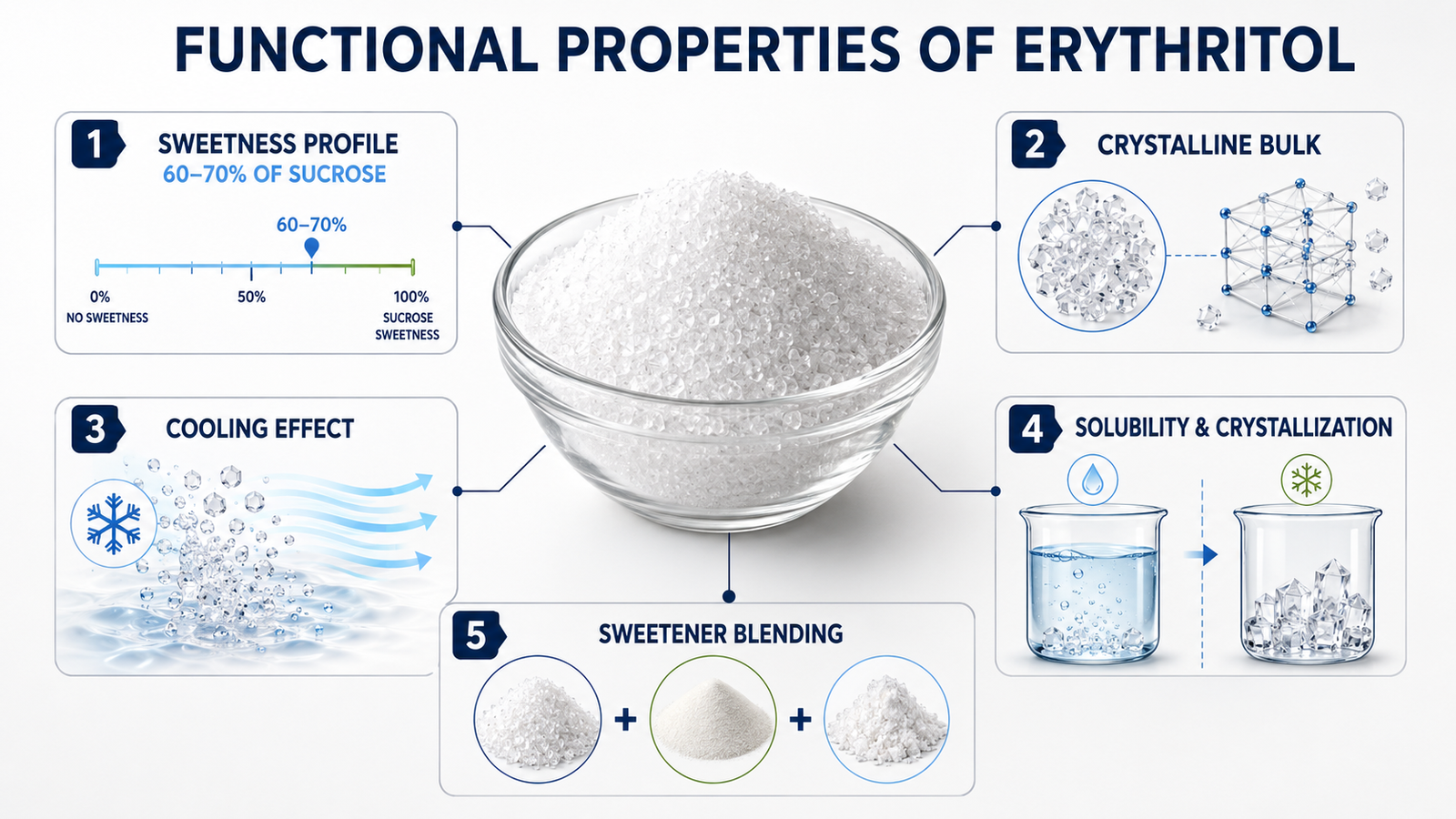
Sweetness Profile
Erythritol provides approximately 60–70% of the sweetness of sucrose, although perceived sweetness can vary with concentration, temperature, acidity and flavor system. It may provide sufficient sweetness in some products, but other formulations require an additional sweetener. Sensory testing is important because matching a calculated sweetness level does not always produce the intended flavor experience.
Bulk and Crystalline Structure
Unlike high-intensity sweeteners used in very small quantities, erythritol can contribute physical bulk to a formulation. Its crystalline structure may be useful in tabletop sweeteners, confectionery and dry mixes. However, particle size can affect flowability, blending uniformity, dissolution and mouthfeel. Manufacturers should select a suitable particle specification based on their equipment and finished-product requirements.
Cooling Effect
Erythritol absorbs heat as it dissolves, which can create a cooling sensation in the mouth. This effect may complement products such as mints and chewing gum, but it can be less desirable in bakery products, chocolate-style formulations or beverages with a warm flavor profile. Its intensity depends on usage level, dissolution and the other ingredients present.
Solubility and Crystallization
Solubility should be evaluated carefully in liquid, concentrated and moisture-sensitive products. If erythritol is not fully dissolved or if processing and storage conditions change, crystallization may affect clarity, texture or surface appearance. Water content, temperature, concentration and cooling rate can all influence performance, so results from one application should not be assumed to apply to another.
Sweetener Blending
Erythritol is frequently used with stevia, monk fruit or other sweeteners. This approach allows formulators to increase sweetness without relying entirely on a single ingredient. The blend may also help balance sweetness onset, lingering taste and overall flavor perception. Nevertheless, an effective sweetener system must be evaluated within the complete product, as acids, flavors, fats, proteins and processing temperatures may change the final sensory result.
Together, these properties explain why erythritol requires application-specific testing. A formulation that performs well in a powdered drink may need substantial adjustment before it can be used in confectionery or bakery production.
Erythritol Applications in Food Manufacturing
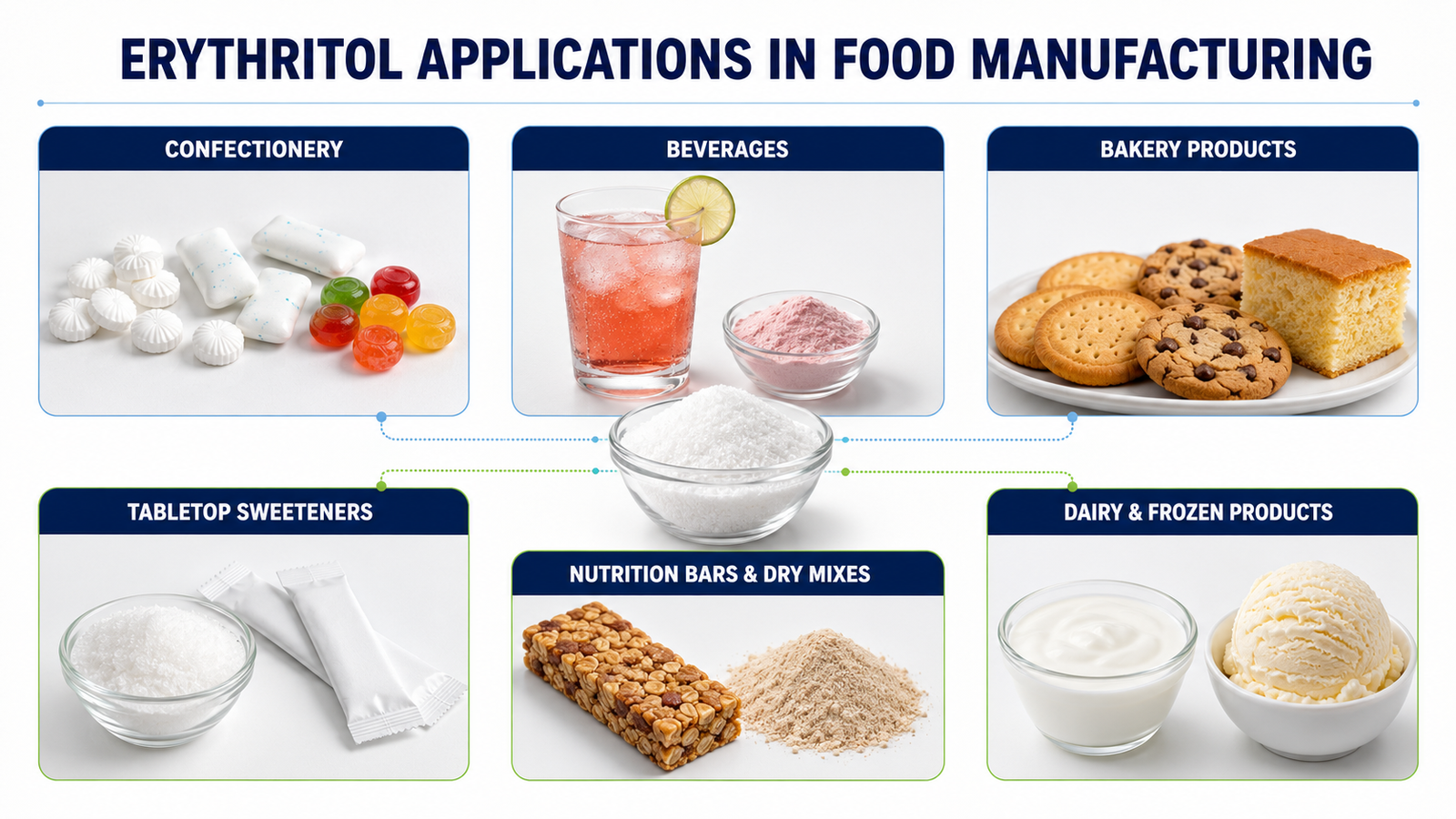
Erythritol applications cover several food and beverage categories, but the ingredient does not perform identically in every formulation. Product format, processing temperature, water content, target texture and the complete sweetener system all influence the final result. Manufacturers should therefore evaluate erythritol according to the requirements of each application.
Erythritol in Confectionery
Erythritol in confectionery may be considered for candies, chewing gum, mints and chocolate-style products. Its crystalline structure provides bulk, while its cooling sensation can complement mint-flavored products. In applications where cooling is not desired, the usage level and sweetener combination may need to be adjusted.
Crystallization behavior is another important consideration. It can influence surface appearance, hardness and mouthfeel, particularly in products containing limited moisture. For chocolate-style formulations, manufacturers should also assess particle size, fat compatibility and texture. A technically workable formula must still meet the intended sensory standard.
Erythritol in Beverages
Erythritol in beverages can be evaluated for flavored water, powdered drink mixes, reduced-sugar drinks and other beverage formulations. Its clean sweetness profile can support products where formulators want to reduce sugar without introducing an overly strong sweetener taste.
Solubility is especially important in liquid applications. Concentration, water temperature, acidity and the order in which ingredients are added may affect dissolution. The beverage should also be tested after cooling and during storage to identify possible crystallization, sediment or changes in flavor balance. In many cases, erythritol is blended with another sweetener to reach the desired sweetness level.
Erythritol in Bakery Products
Erythritol in bakery products may be used in cookies, cakes, biscuits, fillings and similar reduced-sugar formulations. However, replacing sucrose can change more than sweetness. Sugar contributes to browning, moisture retention, spread, volume and structural development during baking.
Because erythritol behaves differently, a direct one-to-one replacement may produce a drier texture, lighter color or different product shape. The recipe may require changes to fat, water, flour, fiber or other structural ingredients. Baking temperature and time should also be reviewed during trials rather than carried over automatically from the original sugar-based formula.
Tabletop and Blended Sweeteners
Tabletop sweeteners often combine erythritol with stevia, monk fruit or another high-intensity sweetener. Erythritol provides bulk and moderate sweetness, while the second sweetener raises the overall sweetness intensity.
Particle size and blend uniformity are critical because uneven distribution can cause inconsistent sweetness between portions. Flowability, dust formation, packaging format and resistance to moisture should also be evaluated. Manufacturers producing sachets, jars or compressed formats may require different particle specifications and processing controls.
Nutrition Bars and Dry Mixes
Erythritol uses in food also include nutrition bars, protein products and powdered mixes. In dry systems, manufacturers should evaluate particle size, segregation risk and compatibility with flavors, proteins, fibers and other powdered ingredients.
For bars and similar products, crystallization and moisture migration may affect hardness or texture during storage. Accelerated and real-time stability testing can help identify changes that are not immediately visible after production. Packaging should provide suitable protection from moisture under the intended distribution conditions.
Dairy and Frozen Applications
Erythritol may also be evaluated in selected dairy and frozen formulations. In these products, sweetness, freezing behavior, crystal development and texture must be considered together. Replacing sugar can change the solids balance and sensory properties of the finished product.
Trial formulations should be monitored throughout processing and storage, not only at the point of production. The appropriate sweetener system will depend on the product type, target texture, serving temperature and expected shelf life.
Important Formulation Considerations
Using erythritol successfully requires more than selecting a replacement percentage for sugar. A change in sweetener can affect flavor, processing behavior and product stability at the same time. Manufacturers should evaluate these factors as a connected system rather than solving each one separately.
Sweetness Level and Flavor Balance
Because erythritol is less sweet than sucrose, replacing sugar at the same weight may not produce the same perceived sweetness. Simply increasing the erythritol level may create other formulation challenges, including a stronger cooling effect or increased crystallization risk. A blended sweetener system can help reach the target sweetness while keeping the total erythritol concentration within a workable range.
Cooling Sensation
The cooling effect of erythritol varies according to usage level, product temperature and the way the ingredient dissolves during consumption. It may be desirable in mints or chewing gum but distracting in baked goods and certain flavor systems. Formulators can evaluate lower usage levels, sweetener combinations and flavor adjustments when the cooling sensation does not match the intended product profile.
Moisture and Texture
Sugar contributes to moisture retention and texture in many foods. When it is reduced or removed, the finished product may become drier, firmer or more prone to textural change during storage. Erythritol does not reproduce every moisture-management function of sucrose, so manufacturers may need to review water content, fats, fibers, hydrocolloids or other texture-supporting ingredients.
Browning and Color Development
Replacing sugar can also alter browning and surface color, particularly in bakery applications. A product may reach its required internal structure before developing the expected external appearance. Increasing baking time or temperature is not always an appropriate solution because it may cause excessive moisture loss. Color and flavor development should therefore be assessed alongside texture and process efficiency.
Solubility and Crystallization Control
Temperature, water availability, ingredient concentration and cooling rate can influence whether erythritol remains dissolved or forms crystals. Uncontrolled crystallization may lead to graininess, sediment, cloudiness or surface changes. Manufacturers should observe the product after processing and throughout its expected shelf life, especially when the formulation contains limited moisture or experiences temperature fluctuations during distribution.
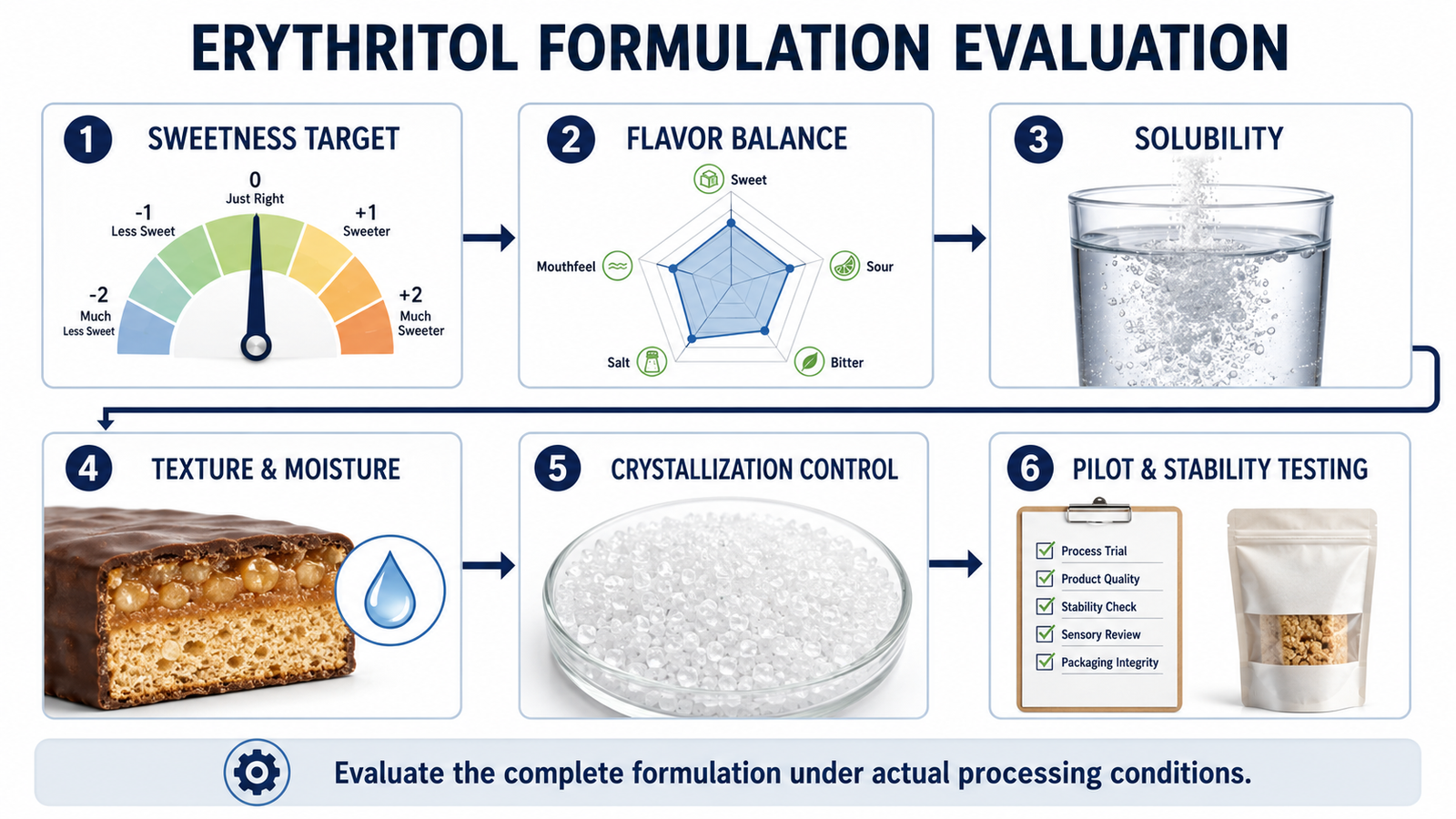
Laboratory and Pilot-Scale Testing
Initial laboratory trials are useful for comparing sweetness, flavor and texture, but they may not fully predict commercial performance. Mixing efficiency, heating and cooling rates, holding times and packaging conditions can change when production is scaled up.
Pilot-scale testing should reproduce the intended process as closely as possible. Manufacturers should record ingredient levels, processing temperatures, mixing order, product yield and storage observations. Sensory evaluation and stability testing can then be used to determine whether further adjustment is required before commercial production. This structured approach reduces the risk of treating erythritol as a simple one-to-one sugar replacement.
Using Erythritol with Other Sweeteners
Erythritol is often combined with stevia, monk fruit or another high-intensity sweetener rather than used as the only source of sweetness. Each ingredient performs a different role: erythritol contributes moderate sweetness and physical bulk, while the high-intensity sweetener helps the formulation reach its target sweetness without requiring a large increase in total solids.
A blended sweetener system can also improve overall flavor balance. Sweeteners differ in how quickly their sweetness is perceived, how long it remains and whether it introduces a noticeable aftertaste. Combining them may create a more balanced sweetness profile, but the result depends on the complete formulation. Acidity, flavors, proteins, fats and serving temperature can all change how a blend is perceived.
There is no universal ratio for erythritol and stevia or for erythritol and monk fruit. A combination that works well in a powdered drink may be unsuitable for a cookie, confectionery product or tabletop sweetener. Formulators should begin with a defined sweetness target, prepare several trial blends and compare sweetness intensity, aftertaste, cooling sensation and mouthfeel.
Processing performance must also be considered. The ingredients should remain evenly distributed during mixing, filling and storage. In dry products, differences in particle size or density may cause segregation and inconsistent sweetness. In liquid products, dissolution and stability require careful evaluation.
For these reasons, sweetener blending should be treated as a formulation process rather than a fixed substitution formula. Sensory evaluation, processing trials and stability testing are necessary before selecting the final combination for commercial production.
How to Select Food Grade Erythritol for Production
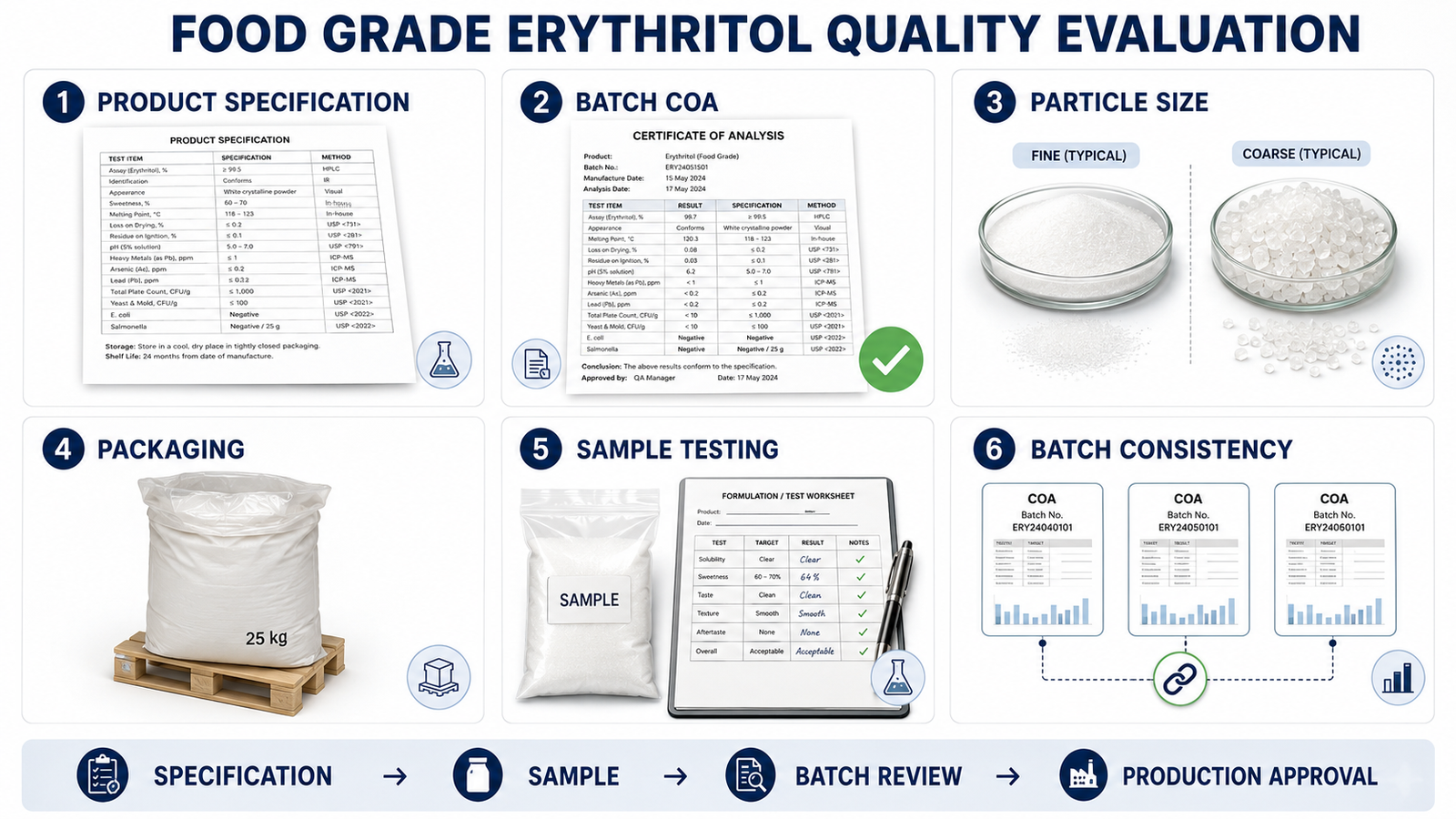
Once a formulation has shown acceptable results, manufacturers must confirm that the selected food grade erythritol can be supplied with suitable quality characteristics and consistent documentation. Purchasing decisions should be based on more than assay alone, as differences in physical properties may affect handling and finished-product performance.
The product specification should be reviewed first. Important items may include assay, appearance, loss on drying, pH, ash, heavy metals and other requirements relevant to the destination market or intended application. Buyers should compare the specification with their internal quality standards rather than assuming that every food grade product follows an identical set of limits.
Particle size also deserves attention. It can influence flowability, dust formation, mixing uniformity, dissolution and mouthfeel. A fine powder may be suitable for one process, while a larger crystalline grade may perform better in another. Manufacturers should therefore communicate their application and handling requirements before approving a material.
A representative Certificate of Analysis can help buyers understand the supplier’s typical reporting format. For commercial orders, the batch COA should be checked against the agreed specification and purchasing requirements. Where consistency is important, results from multiple batches may provide more useful information than a single sample document.
Packaging and storage conditions should also match the production environment. Buyers may need to confirm bag size, liner material, labeling, pallet requirements and protection from moisture during transportation. Sample testing should ideally use material that is representative of the intended commercial supply.
Manufacturers evaluating food grade erythritol specifications should review technical documents alongside formulation results, production requirements and expected order volume. Before approval, it is useful to confirm the current specification, batch documentation, packaging options, lead time and change-control procedures.
A structured supplier evaluation helps ensure that a successful laboratory formulation can be supported by consistent material during pilot trials, scale-up and repeat production.
Storage and Handling Considerations
Food grade erythritol should be stored in its original sealed packaging in a cool, dry and well-ventilated area. Exposure to moisture, excessive heat, direct sunlight or materials with strong odors should be avoided. Storage conditions should follow the current product specification and the supplier’s handling recommendations.
Moisture control is particularly important because changes in the physical condition of a crystalline ingredient may affect flowability, weighing and mixing performance. Opened bags should be resealed securely when the remaining material is not used immediately. Manufacturers should also follow appropriate hygiene and contamination-control procedures when transferring the product into production equipment or intermediate containers.
Bulk packaging should be selected according to order volume, warehouse conditions and material-handling capabilities. Bag size, liner construction, pallet configuration and label information should be confirmed before shipment, especially when the material will pass through multiple storage or distribution locations.
Inventory should be managed using an appropriate batch-traceability and stock-rotation system. Before use, operators should check the packaging condition, batch identification and any relevant quality-release status. If the material shows unexpected clumping, contamination or packaging damage, it should be assessed according to the manufacturer’s internal quality procedures before entering production.
Frequently Asked Questions
How Sweet Is Erythritol Compared with Sugar?
Erythritol generally provides approximately 60–70% of the sweetness of sucrose, although perceived sweetness may change with concentration, temperature, acidity and the other ingredients in a product. An erythritol sugar substitute may therefore require support from stevia, monk fruit or another sweetener when the formulation must reach a higher sweetness level. Manufacturers should use sensory trials rather than relying only on a calculated replacement ratio, as sweetness onset, duration, cooling sensation and overall flavor balance can differ from those of sugar.
Can Erythritol Completely Replace Sugar in Food Formulations?
Erythritol can replace some or all of the sugar in selected formulations, but it does not reproduce every function of sucrose. Sugar can influence sweetness, browning, moisture retention, texture, volume and structure. The extent of replacement therefore depends on the product and its processing conditions. Bakery, confectionery and beverage formulations may each respond differently. Other sweeteners, bulking agents or texture-supporting ingredients may be needed, and laboratory testing should be completed before the revised formulation moves into commercial production.
Why Does Erythritol Produce a Cooling Effect?
Erythritol absorbs heat as it dissolves, creating a cooling sensation in the mouth. The strength of this effect depends on the usage level, product temperature, available moisture and speed of dissolution. Cooling may be desirable in mints or chewing gum, but it can conflict with the intended sensory profile of baked goods, chocolate-style products or certain beverages. If the sensation is too noticeable, formulators can evaluate a lower concentration, a blended sweetener system or adjustments to the flavor profile.
What Should Manufacturers Test Before Commercial Production?
Manufacturers should evaluate sweetness, aftertaste, cooling sensation, solubility, crystallization, texture, moisture behavior and storage stability. Processing variables such as mixing order, heating and cooling rates, holding time and packaging conditions should also be recorded. Testing should progress from laboratory samples to pilot-scale production using equipment and conditions that reflect the intended commercial process. The approved formulation should then be supported by suitable product specifications, batch COA documentation, packaging controls and procedures for monitoring consistency across repeat orders.
Conclusion
Using erythritol as a sugar substitute can help manufacturers develop reduced-sugar foods and beverages while maintaining a clean sweetness profile and useful ingredient bulk. However, its performance depends on the application, usage level, processing conditions and the other ingredients in the formulation.
Erythritol does not reproduce every function of sucrose. Sweetness intensity, cooling sensation, solubility, crystallization, browning, moisture retention and product texture should therefore be evaluated together. Laboratory and pilot-scale trials provide a more reliable basis for formulation decisions than a fixed one-to-one replacement ratio.
Before moving into commercial production, manufacturers should also confirm that the selected material meets their technical and quality requirements. Current product specifications, batch COA documentation, particle size, packaging, storage conditions and supply consistency should all form part of the approval process.
By combining structured formulation testing with appropriate raw-material evaluation, food manufacturers can determine where erythritol fits their product goals and establish a more reliable path from initial development to repeat production.Buyers can contact us to request current product specifications, available batch documentation, packaging information and quotation details.