



- Your cart is empty Browse Shop
Maltodextrin Manufacturing Process: From Starch Hydrolysis to Spray Drying
Maltodextrin starts as starch, but producing a consistent food-grade powder takes more than breaking down starch and removing water. The maltodextrin manufacturing process involves controlled hydrolysis, purification, evaporation and spray drying, followed by powder handling and packaging.
Each stage serves a different purpose. Hydrolysis brings the material to its target dextrose equivalent (DE), while concentration prepares the liquid for drying. Spray drying then turns that concentrated feed into powder, with operating conditions influencing moisture content and particle characteristics.
For food manufacturers, these details help explain why two maltodextrin powders with similar specifications may handle differently during mixing or storage. The following sections trace a typical enzyme-based production route and explain the controls that help keep the finished ingredient consistent from batch to batch.
How Is Maltodextrin Made? A Process Overview
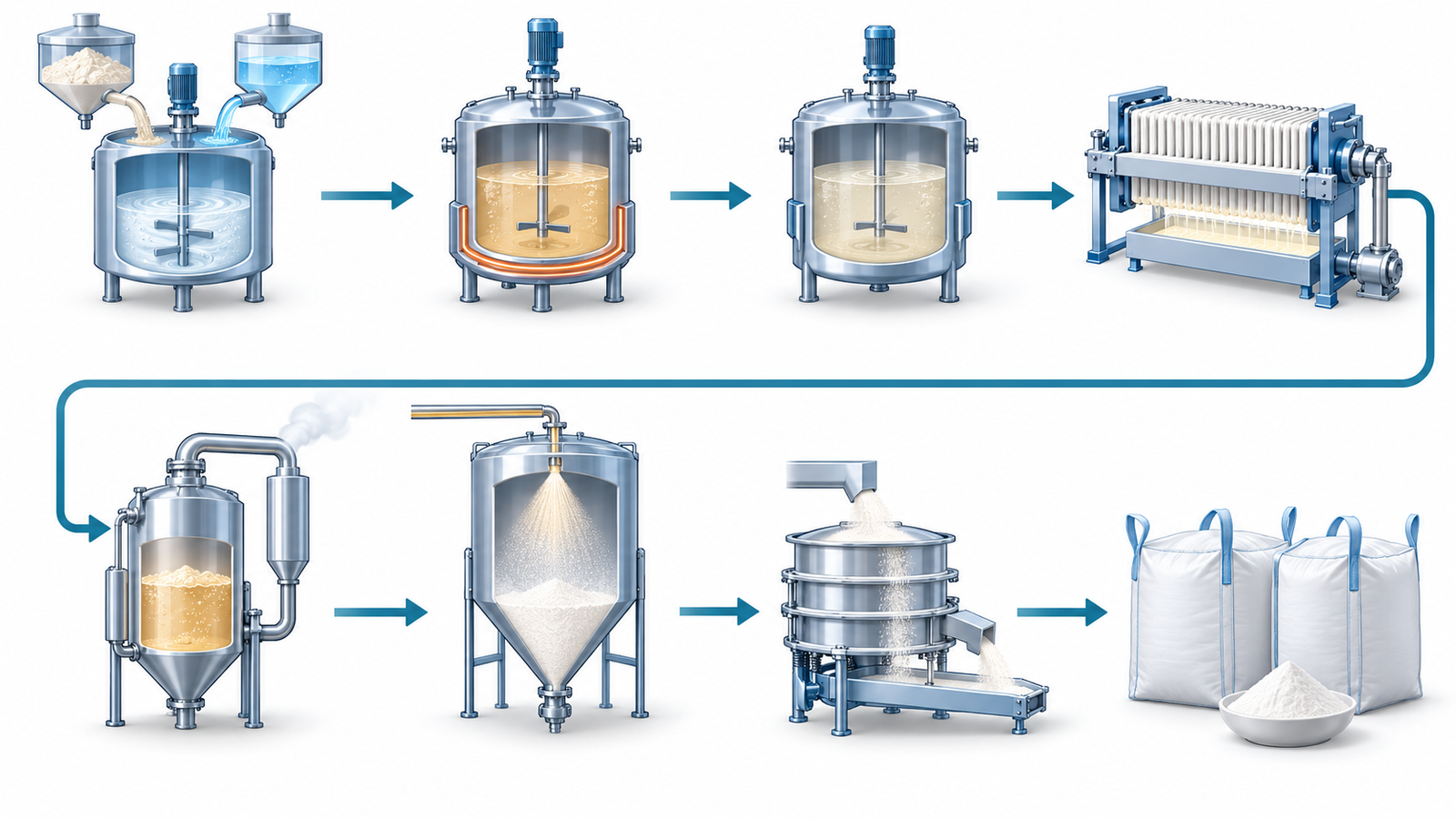
Maltodextrin is made by partially hydrolyzing starch, then processing the resulting liquid into a dry powder. In a typical enzyme-based production process, the main stages are:
- Starch preparation: Select the starch source and check its quality before processing.
- Slurry preparation and gelatinization: Mix starch with water and apply heat to make it more accessible to enzyme action.
- Controlled hydrolysis: Break down the starch chains to reach the target degree of conversion.
- Enzyme inactivation and purification: Stop the reaction and remove unwanted material.
- Evaporation: Remove part of the water to concentrate the liquid before drying.
- Spray drying: Atomize the concentrated feed into heated air to produce powder.
- Cooling, sieving and packaging: Prepare the powder for storage and transport while limiting moisture exposure.
The exact equipment and sequence can vary between production lines. The key is to coordinate each stage: the liquid leaving hydrolysis must be suitable for purification and concentration, and the concentrated feed must be suitable for stable drying.
Raw Materials and Starch Slurry Preparation
Starch Sources Used in Production
Maltodextrin can be produced from several starch sources, including corn, tapioca and potato. The choice depends on raw material availability, production capabilities and customer requirements.
For buyers, confirming the starch source is useful for ingredient documentation and sourcing requirements. However, the source alone does not fully describe the finished maltodextrin. Hydrolysis conditions and subsequent processing also influence its properties, so products should be evaluated against their specifications rather than judged solely by their botanical origin.
Preparing a Consistent Starch Slurry
Production begins by mixing starch with water to form a uniform slurry. Thorough mixing helps prevent lumps and uneven solids distribution, giving the next processing stages a more consistent feed.
The solids content needs to suit the equipment and process. A slurry that is too concentrated can be difficult to mix, pump and heat evenly, while excessive dilution adds water that must later be removed. Operators therefore balance solids content with viscosity and handling requirements.
Once prepared, the slurry moves into gelatinization and hydrolysis, where heat and enzymes begin converting the starch into shorter carbohydrate chains.
Gelatinization and Controlled Enzymatic Hydrolysis
Why Starch Is Gelatinized
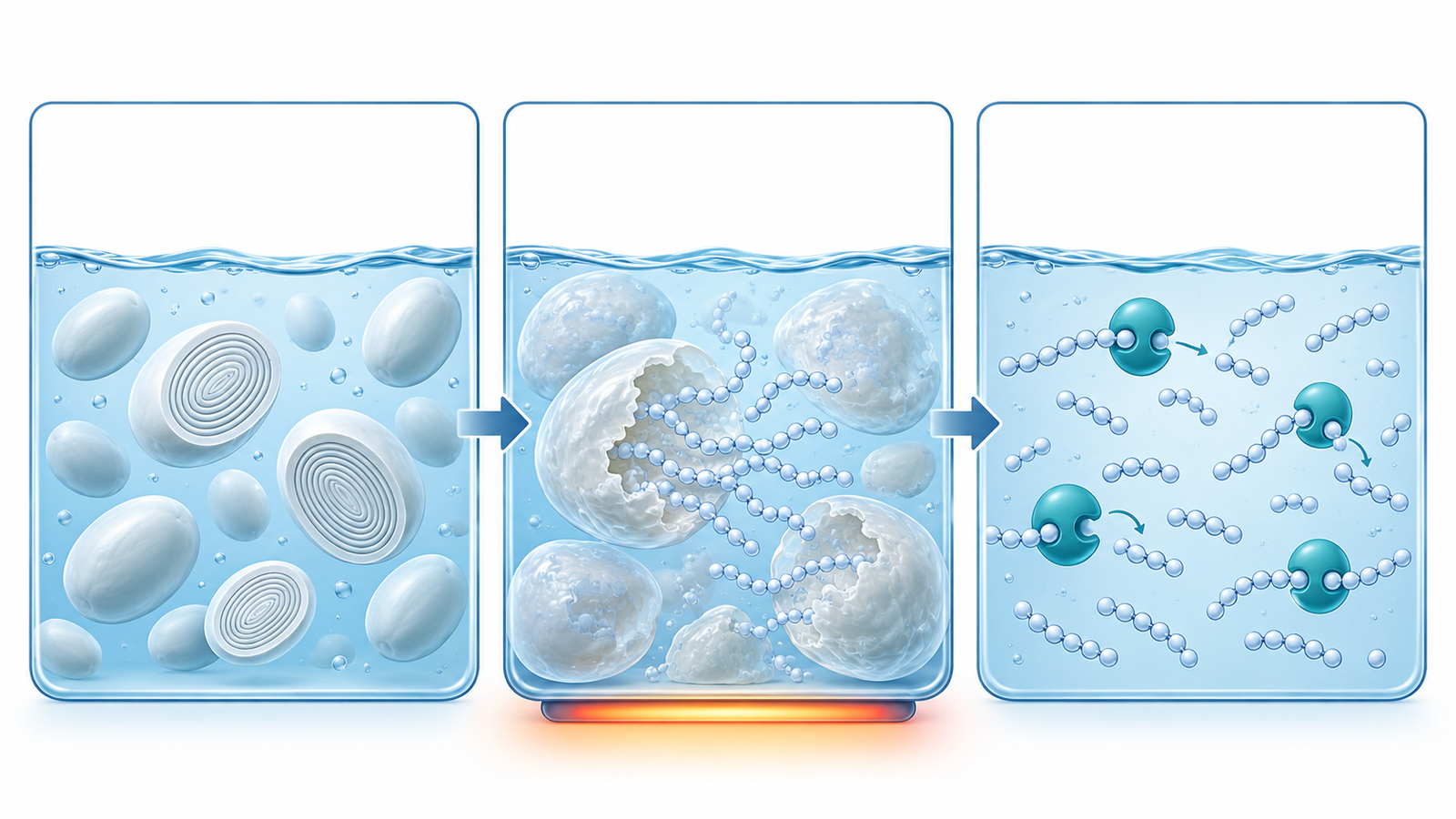
In a starch slurry, much of the carbohydrate remains organized within starch granules. Heating the slurry under suitable conditions causes these granules to swell and lose their ordered structure, making the starch more accessible to enzymes.
This stage needs to provide a consistent feed for hydrolysis. Uneven mixing or heating can leave portions of the starch insufficiently processed, making the reaction harder to control. Depending on the production system, gelatinization and enzyme-assisted liquefaction may overlap rather than take place as completely separate steps.
How Hydrolysis Is Controlled
During enzymatic hydrolysis, enzymes cleave starch chains into shorter carbohydrates. The aim is to reach a defined degree of conversion while maintaining a processable liquid.
Several conditions work together to determine how the reaction progresses:
- Enzyme type and dosage: These influence the pattern and rate of starch breakdown.
- Temperature and pH: Both affect enzyme activity and must suit the enzyme system being used.
- Reaction time: The duration influences how far hydrolysis proceeds.
- Slurry conditions: Solids content and mixing affect enzyme distribution and heat transfer.
Because these factors interact, controlling reaction time alone is insufficient. Operators monitor the process and test samples to determine whether the material is approaching the required endpoint.
Reaching the Target DE and Stopping the Reaction
Dextrose equivalent, or DE, is a measure of reducing power expressed relative to dextrose on a dry basis. It helps indicate the extent of starch hydrolysis, although it does not describe the complete carbohydrate composition.
Once the target endpoint is reached, enzyme activity must be stopped or sufficiently reduced using a method suited to the process. This helps prevent further conversion during subsequent handling.
For a closer look at what DE means and how grades differ, see our guide to dextrose equivalent in maltodextrin.
Filtration and Purification Before Concentration
After hydrolysis, the liquid may still contain insoluble material and other unwanted components carried over from the raw starch or introduced during processing. Filtration and clarification help remove these materials before the liquid enters the concentration stage.
The purification steps depend on the starch source, the condition of the hydrolysate and the intended product specification. Some production lines may include activated carbon treatment to reduce color or ion exchange to reduce dissolved ionic impurities. These treatments serve different purposes and are selected according to the needs of the process.
Effective purification helps control the appearance and composition of the liquid entering the evaporator. However, a clear-looking solution does not by itself demonstrate that the product meets all quality or food safety requirements. Those checks must be addressed through appropriate process controls and testing.
Once the hydrolysate meets the requirements for the next stage, it moves to evaporation, where part of its water is removed.
Maltodextrin Evaporation and Concentration
Why the Hydrolysate Is Concentrated Before Drying
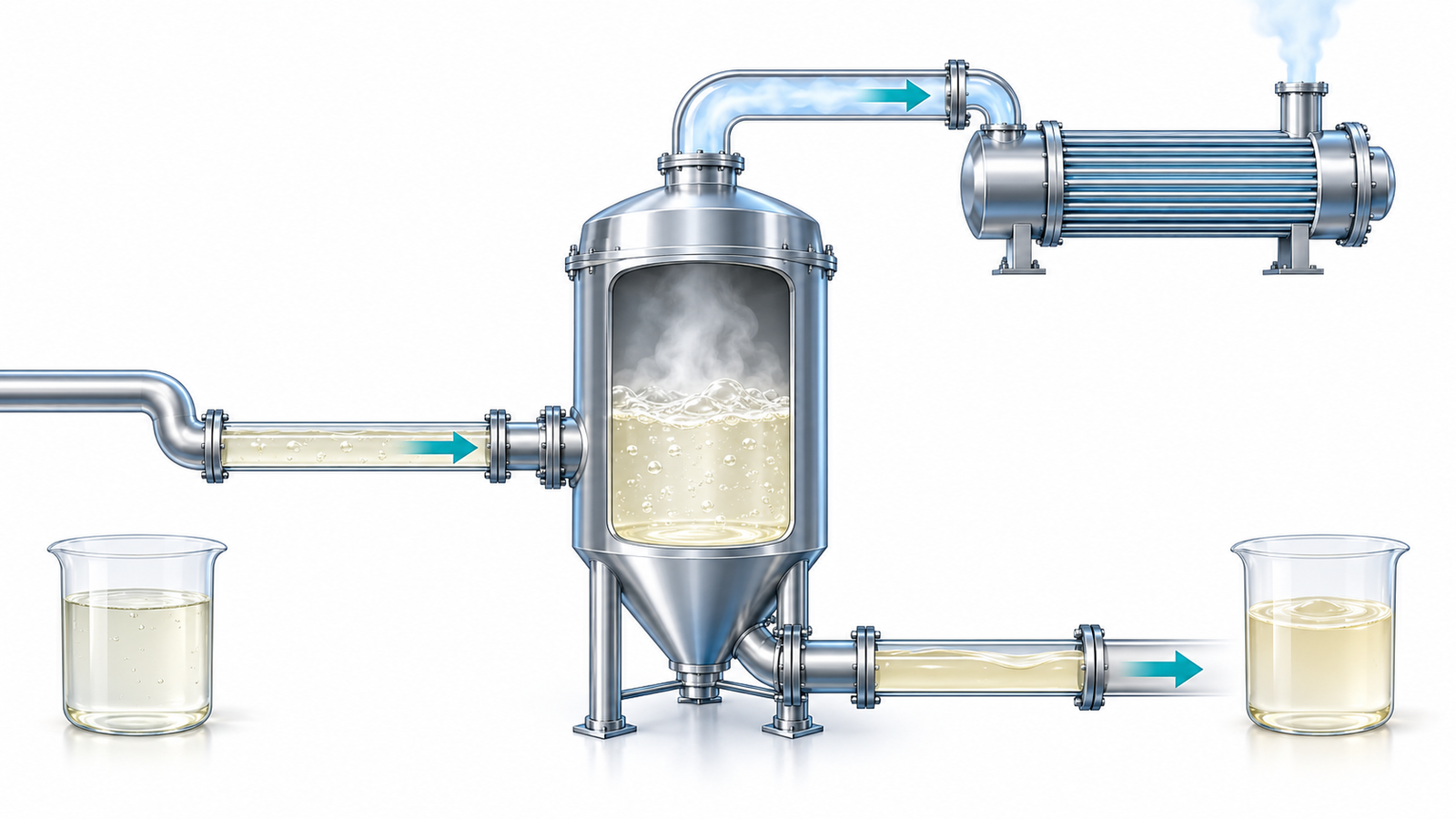
After purification, the maltodextrin solution still contains water that must be removed to produce powder. Although spray drying removes water, sending a dilute solution directly to the dryer would increase its evaporation load. Concentrating the liquid first reduces the amount of water that the dryer needs to handle.
During maltodextrin evaporation, water is removed while the dissolved carbohydrates remain in the liquid. The result is a more concentrated feed for the next stage. Industrial systems may operate under vacuum, allowing water to evaporate at a lower temperature than it would at atmospheric pressure.
Evaporation and spray drying therefore perform different jobs: evaporation increases the solids content of the solution, while spray drying converts the concentrated feed into powder.
For an equipment-focused reference, GEA outlines filtration, evaporation and spray drying technologies used in sweetener and maltodextrin processing.
Balancing Solids Content, Viscosity and Heat Exposure
The aim of maltodextrin concentration is to prepare a feed that the drying system can process consistently. Removing more water is useful only while the liquid remains suitable for pumping and atomization.
As solids content rises, viscosity generally increases. The extent of that change depends on the maltodextrin grade and the temperature of the solution. A feed that becomes too viscous can be harder to distribute into droplets, affecting the stability of the drying process.
Heat exposure also needs attention. Operators balance temperature and residence time to limit unwanted color development and other quality changes. The appropriate concentration endpoint therefore depends on the feed properties, evaporator design and dryer requirements; there is no single solids level that suits every production line.
Maltodextrin Spray Drying: From Liquid Feed to Powder
Atomizing the Concentrated Feed
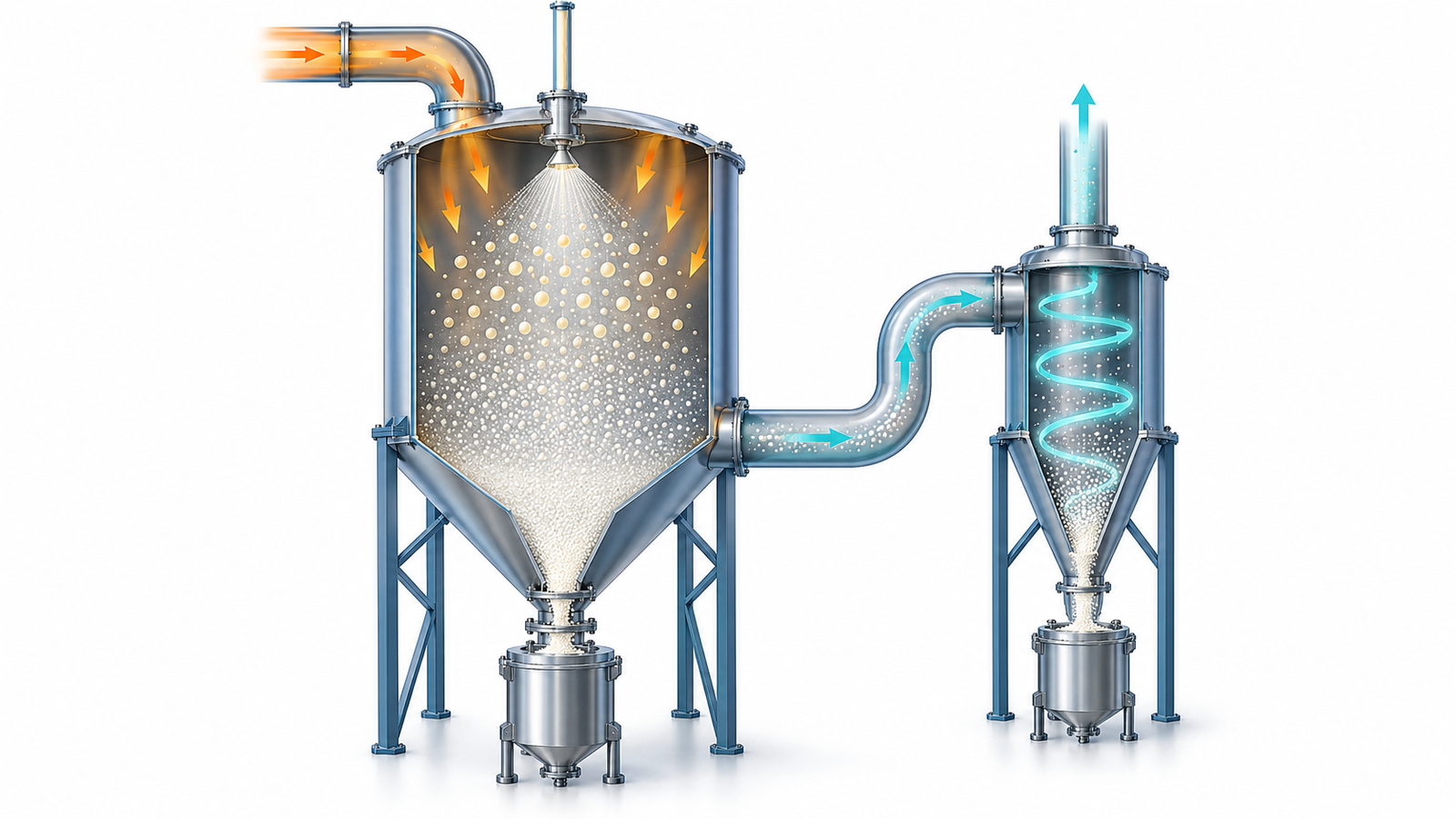
After evaporation, the concentrated maltodextrin solution is fed into a spray dryer. An atomizer breaks the liquid into fine droplets, creating a large surface area for moisture removal. As the droplets contact heated air, water evaporates and solid particles form.
Consistent atomization helps maintain stable drying. Changes in feed viscosity, solids content or atomizer operation can alter droplet size, which in turn affects how the material dries and the characteristics of the resulting powder.
Controlling Drying Conditions
The maltodextrin spray drying process requires a balance between the liquid feed and the drying air. Operators adjust conditions together to achieve the required moisture content and powder properties.
| Control factor | Why it matters |
|---|---|
| Feed solids content and viscosity | Influence pumping, atomization and the amount of water to be removed |
| Atomizer settings | Affect droplet formation and the resulting particle size distribution |
| Feed rate | Determines the liquid and moisture load entering the dryer |
| Drying air temperature and airflow | Influence heat transfer and moisture removal |
| Outlet air temperature | Provides an operating indicator that helps assess drying conditions alongside other measurements |
Inlet and outlet temperatures describe the air at specific points in the system; they should not be treated as the actual temperature of every particle. Product temperature changes during drying, particularly while moisture is evaporating.
Suitable operating conditions depend on the feed, equipment and target specification. A temperature setting that works for one maltodextrin grade or dryer may be unsuitable for another.
Powder Recovery and Optional Agglomeration
The dried powder must then be separated from the exhaust air using suitable collection equipment, such as cyclones or filters. Depending on the production line, recovered fines may be returned to the process.
Some systems also include agglomeration, which joins smaller particles into larger structures to adjust powder handling and reconstitution characteristics. This is an optional treatment rather than a standard feature of every maltodextrin grade. The collected powder then moves to cooling and final handling before packaging.
Cooling, Sieving and Packaging the Finished Powder
Drying is followed by powder handling steps that help preserve the product’s condition through storage and transport. Where needed, the maltodextrin is cooled before packing to bring it to a suitable handling temperature. Exposure to humid air must also be controlled, as moisture uptake can encourage caking and reduce flowability.
The powder is then sieved to remove oversized agglomerates and meet the required particle size specification. Additional foreign-material controls may be included according to the production line’s food safety procedures.
Packaging provides a barrier against moisture and contamination. Its suitability depends on the packaging material, seal integrity and expected storage conditions. Even a correctly dried powder can deteriorate if its packaging is damaged or left open in a humid environment.
Each package should carry a batch identification linked to production and quality records. This traceability allows finished goods, test results and shipment details to be checked together when a quality question arises.
Quality Control in Maltodextrin Manufacturing
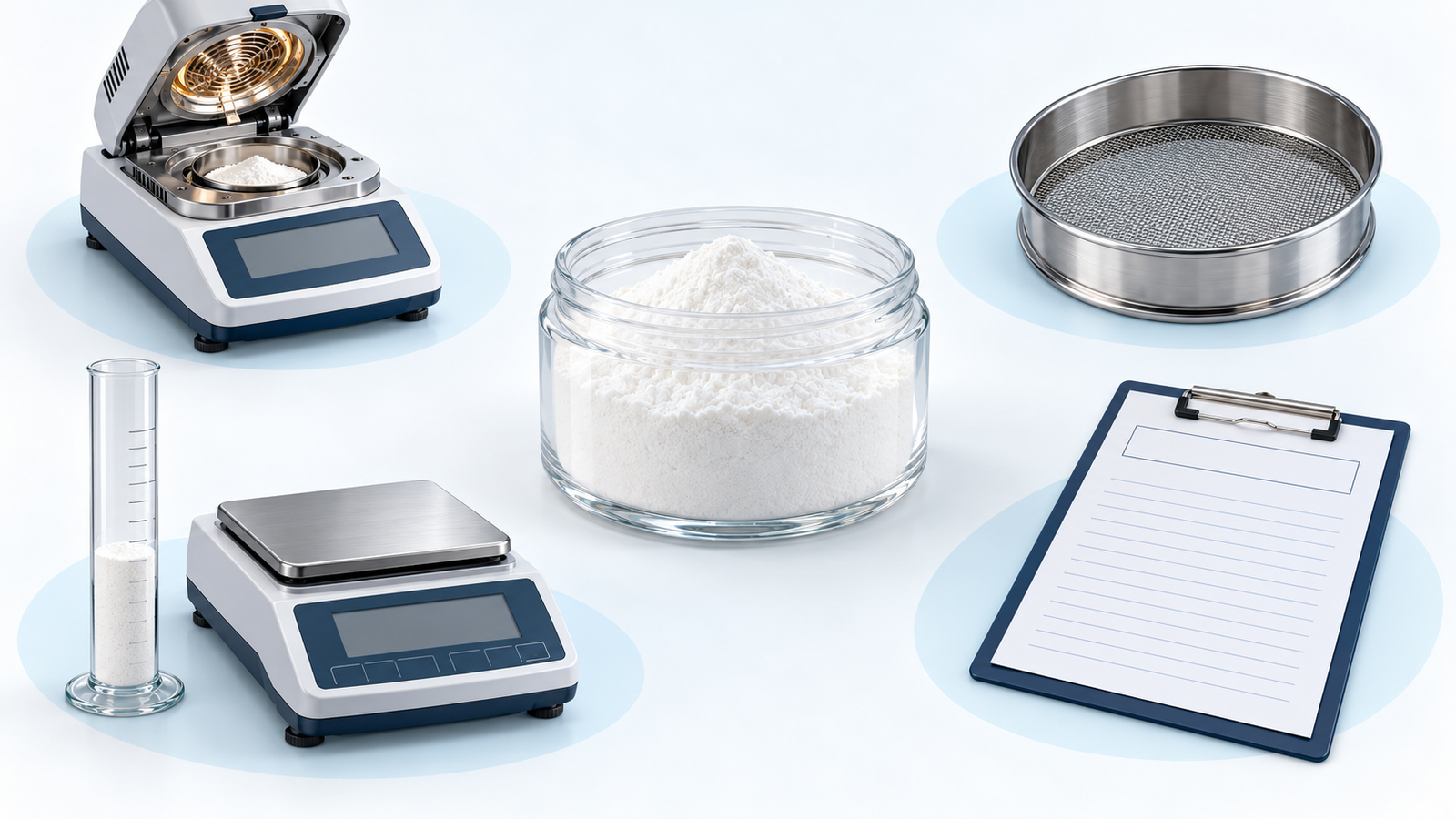
Maltodextrin quality control connects production conditions with the requirements of the finished ingredient. Process monitoring helps operators identify changes during manufacture, while finished-product testing checks whether the powder meets its agreed specification.
A useful assessment considers several properties together. Two batches may have similar DE values, for example, yet differ in moisture content, particle size or bulk density.
| Quality check | What it helps verify |
|---|---|
| DE value | Whether the degree of conversion falls within the specified range |
| Moisture content | Whether the powder meets its moisture specification, which supports storage and handling requirements |
| Appearance and color | Whether the product has the expected appearance and is free from visible abnormalities |
| Dissolution behavior | How the powder dissolves under defined water temperature, concentration and mixing conditions |
| Particle size and bulk density | Whether the powder meets requirements relevant to conveying, blending and packing |
| pH | Whether a solution prepared using the specified method falls within the agreed range |
| Microbiological criteria | Whether results meet the applicable microbiological requirements |
| Relevant contaminants | Whether the product meets limits established by applicable requirements and customer specifications |
Test methods matter as much as the reported numbers. Results should be interpreted using the stated preparation conditions, units and acceptance criteria rather than compared without context.
What to Check on a Batch COA
A certificate of analysis should identify the product, grade and batch clearly. Buyers should check that the reported results correspond to the supplied material and compare them with the agreed specification.
The COA may not contain every piece of supporting information. Starch-source declarations, allergen statements, detailed test methods and other documents may need to be requested separately. Any requirement essential to purchasing approval should therefore be confirmed before shipment.
Common Processing Problems and Possible Causes
When maltodextrin powder falls outside expectations, the cause may lie in production, storage or the way the ingredient is handled during use. A single symptom rarely identifies the source. Caking, for example, can reflect residual moisture, moisture absorbed after drying or unsuitable storage conditions.
The following checks provide a starting point for investigation.
| Observed problem | Possible causes and checks |
|---|---|
| Caking or poor flowability | Review finished-product moisture, exposure to humid air, powder temperature at packing and packaging integrity. |
| Slow wetting or lumps during mixing | Check particle characteristics alongside water temperature, addition rate and agitation. Surface clumping does not necessarily mean the material is insoluble. |
| Unexpected color | Examine raw material variation, purification performance and heat exposure during processing. |
| Moisture outside specification | Check feed consistency, dryer operating conditions and possible moisture uptake during cooling or packing. |
| Variable particle size or bulk density | Review atomization, feed viscosity, fines return and any agglomeration or sieving steps. |
| DE outside the target range | Investigate hydrolysis conditions, reaction termination, sampling and the analytical method used. |
An investigation should first confirm the result using a representative sample and the agreed test method. Batch records can then help establish where the change occurred. Comparing retained samples with material taken after transport or storage may also help distinguish a production issue from changes introduced later.
This approach gives a stronger basis for corrective action than adjusting a process setting in response to one isolated result.
How Processing Affects Performance in Food Formulations
Manufacturing conditions help explain why maltodextrin powders with similar DE values can behave differently in a formulation. Particle size and structure influence how readily a powder wets and disperses, while bulk density affects the volume occupied by a given weight during weighing and filling.
Moisture control and packaging also matter. A powder that absorbs moisture during storage may become harder to discharge or distribute evenly in a dry blend.
These characteristics should be assessed under the conditions in which the ingredient will actually be used. Water temperature, mixing equipment, addition order and other ingredients can all influence the result. Checking specifications alongside a formulation trial gives a more useful comparison than relying on DE alone.
For a broader explanation of ingredient functions and uses, see our guide to maltodextrin in food processing.
Frequently Asked Questions
Is maltodextrin always made from corn?
No. Maltodextrin can also be produced from other starch sources, including tapioca and potato. If the botanical source is important to your purchasing requirements, ask the supplier to confirm it through the relevant product documentation.
Is maltodextrin made by fermentation?
In a typical enzyme-based process, maltodextrin is produced by controlled starch hydrolysis rather than fermentation. The enzymes used may themselves be manufactured through fermentation, but that is separate from converting starch into maltodextrin.
What is the difference between evaporation and spray drying?
Evaporation removes part of the water from the purified liquid, increasing its solids content. Spray drying then breaks the concentrated feed into droplets and removes sufficient moisture to form powder. Concentration prepares the feed for drying, so the two stages need to work together.
Does spray drying determine the DE value?
The target DE is established primarily during starch hydrolysis. Spray drying is used to convert the concentrated liquid into powder, rather than to select its DE grade. Controlling the hydrolysis endpoint and subsequent enzyme activity helps maintain the intended degree of conversion.
Do all maltodextrin grades use the same drying conditions?
No. Suitable conditions depend on feed properties, dryer design and the required powder characteristics. Solids content, viscosity, feed rate and atomization must be considered together. Operating settings should therefore be established for the specific product and equipment.
Choosing Maltodextrin with Consistent Quality
The maltodextrin manufacturing process brings together controlled hydrolysis, purification, concentration and drying. For buyers, the practical question is whether those controls deliver powder that consistently meets the required specification and performs well in their formulation.
Looking for food-grade maltodextrin? Contact us to discuss your grade requirements, review product specifications and request available batch documentation.