



- Your cart is empty Browse Shop
Where to Buy Erythritol in Bulk: Supplier, Specifications and Purchasing Guide
Introduction
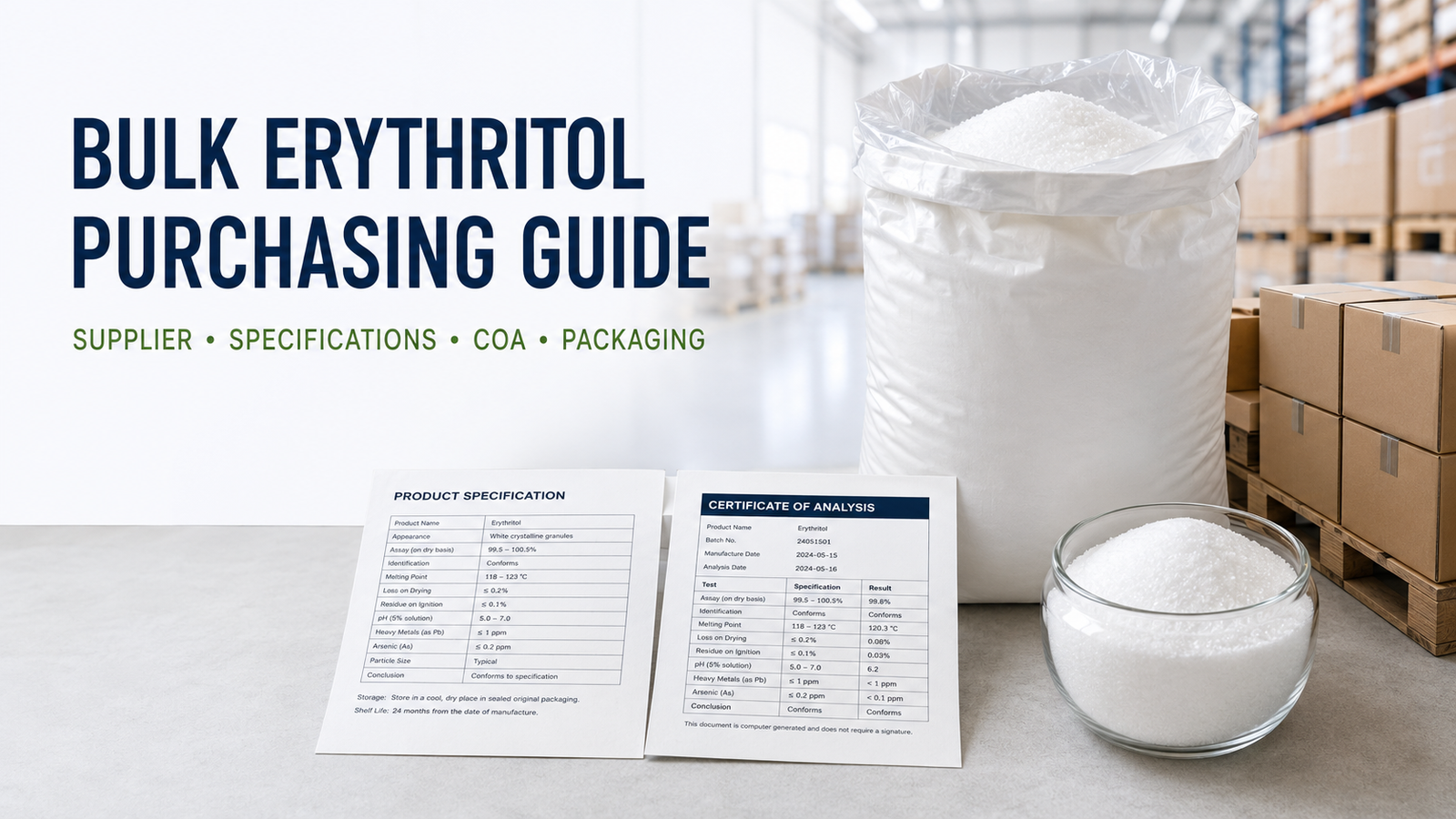
Sourcing bulk erythritol involves more than identifying a supplier with an acceptable price. For food manufacturers, ingredient distributors and importers, the material must also meet the required technical specification, perform consistently in the intended application and arrive with suitable batch documentation.
Differences in particle size, packaging, moisture protection and quality-control practices can affect handling, dissolution, blending and storage performance. Commercial factors are equally important. Minimum order quantity, sample availability, lead time, export documentation and communication procedures should all be reviewed before an order is approved.
The appropriate purchasing channel may also vary. Some buyers work directly with an erythritol supplier for larger or recurring orders, while others rely on a distributor for local inventory or smaller quantities. This guide explains where to buy erythritol in bulk, what to check in product specifications and Certificates of Analysis, and how to compare suppliers based on both technical suitability and supply reliability.Buyers who are still evaluating formulation suitability can also review how erythritol works as a sugar substitute in food manufacturing.
Where Can Food Manufacturers Buy Erythritol in Bulk?
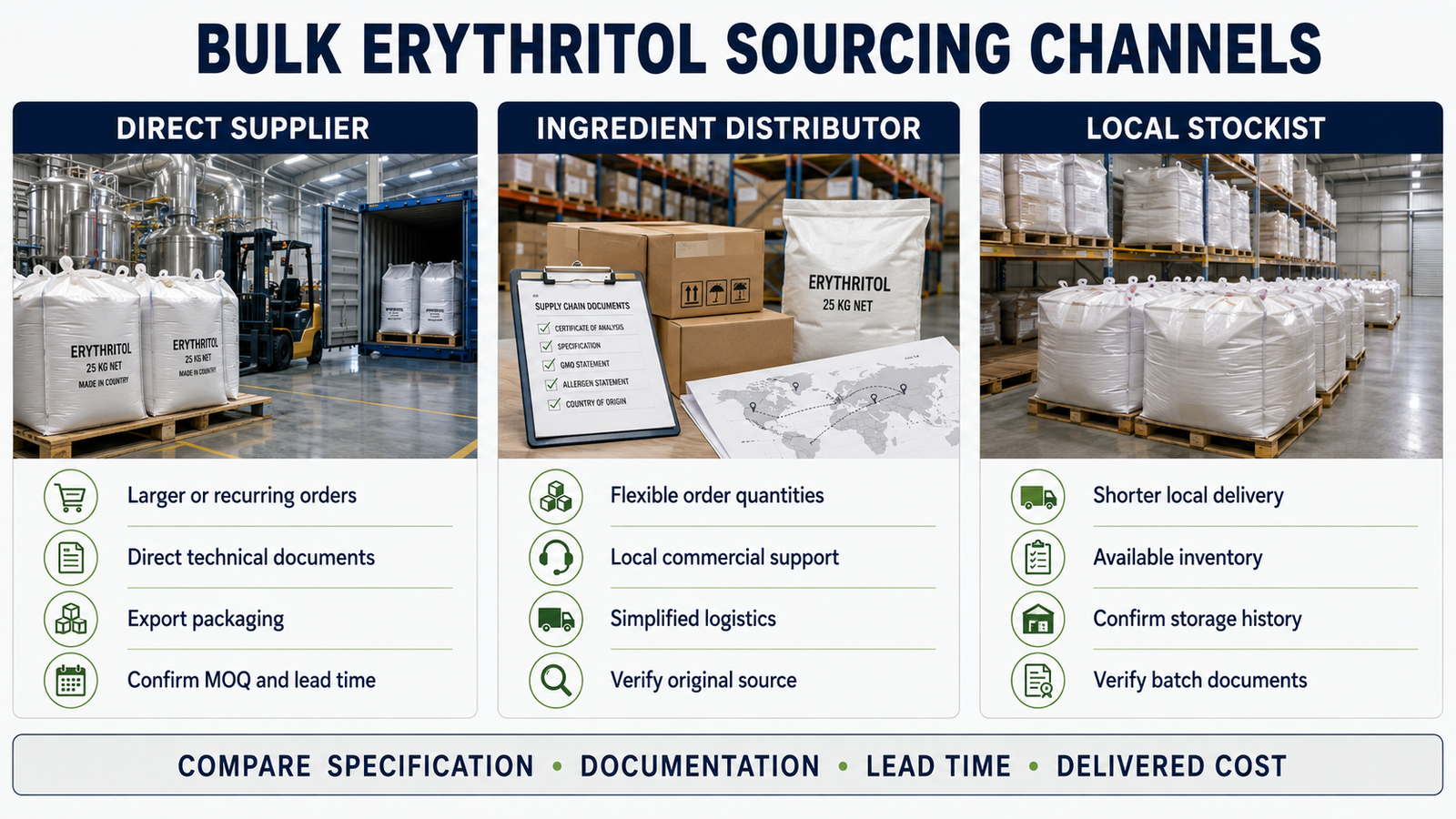
Food manufacturers looking for where to buy erythritol in bulk generally have several sourcing options, including direct suppliers, international exporters, ingredient distributors and local stockists. The appropriate channel depends on order volume, delivery requirements, destination market and the level of technical support required.
Direct erythritol suppliers may be suitable for regular or larger-volume purchases, particularly when buyers need export packaging, batch documentation or consistent specifications across repeat orders. However, buyers should confirm whether the company is the manufacturer, an export partner or a trading supplier, as this may affect production visibility, communication and lead times.
Ingredient distributors and local stockists can be practical when shorter delivery times or smaller quantities are required. Local availability may simplify logistics, but product origin, remaining shelf life, storage history and access to batch-specific documents should still be verified.
Online marketplaces may help buyers identify potential erythritol suppliers, but a listing alone is not sufficient for approval. Company information, technical specifications, sample quality, documentation and commercial terms should be checked independently.
Before purchasing bulk erythritol, buyers should define their application, required grade, estimated quantity and destination. A clear purchasing requirement makes it easier to compare suitable supply channels rather than evaluating offers based on price alone.
Erythritol Supplier vs Distributor: Which Option Fits Your Purchase?
A direct erythritol supplier and an ingredient distributor can both support commercial purchasing, but they may serve different operational needs. The right choice depends on order volume, delivery schedule, documentation requirements and the buyer’s preferred level of supply-chain visibility.
Direct suppliers are often considered for larger or recurring orders. They may provide more direct access to product specifications, batch COA documents, packaging options and production-related information. This route can also be useful when buyers need consistent material over multiple shipments or want to discuss specific particle-size and labeling requirements. Lead times and minimum order quantities, however, should be confirmed before approval.
An erythritol distributor may be more suitable when local inventory, smaller quantities or shorter delivery times are priorities. Distributors can also simplify domestic transport and import-related arrangements. Buyers should still verify the original product source, storage conditions, batch traceability and availability of current technical documents.
Neither option is automatically better. Buyers should compare the complete offer, including specification suitability, documentation, sample availability, total delivered cost, lead time and consistency of supply.
What Buyers Should Confirm Before Requesting a Quote
A useful quotation depends on the quality of the purchasing information provided. Before asking to buy erythritol in bulk, buyers should define their technical and commercial requirements clearly. This helps suppliers recommend a suitable product and reduces the risk of comparing offers that are based on different specifications, packaging formats or delivery terms.
The intended application should be stated first. Erythritol used in beverages, confectionery, bakery products or dry sweetener blends may require different particle sizes and handling properties. Buyers should also confirm the required grade, target specification and any testing or documentation requirements connected with the destination market.
Estimated order quantity is equally important because it can affect pricing, packaging and transport arrangements. Rather than requesting a general price, buyers should indicate whether the inquiry concerns a sample, a trial order or recurring commercial volumes. Preferred bag size, pallet requirements and private-label needs, if applicable, should also be discussed.
The delivery destination and requested trade terms should be included so that freight and export costs can be evaluated correctly. Buyers should specify the country, port or delivery location and indicate the expected purchasing schedule.
A complete bulk erythritol inquiry should therefore cover the application, specification, particle size, quantity, packaging, destination, documentation and desired delivery time. These details allow quotations to be compared on a consistent basis rather than on unit price alone.
Food Grade Erythritol Specifications Buyers Should Review
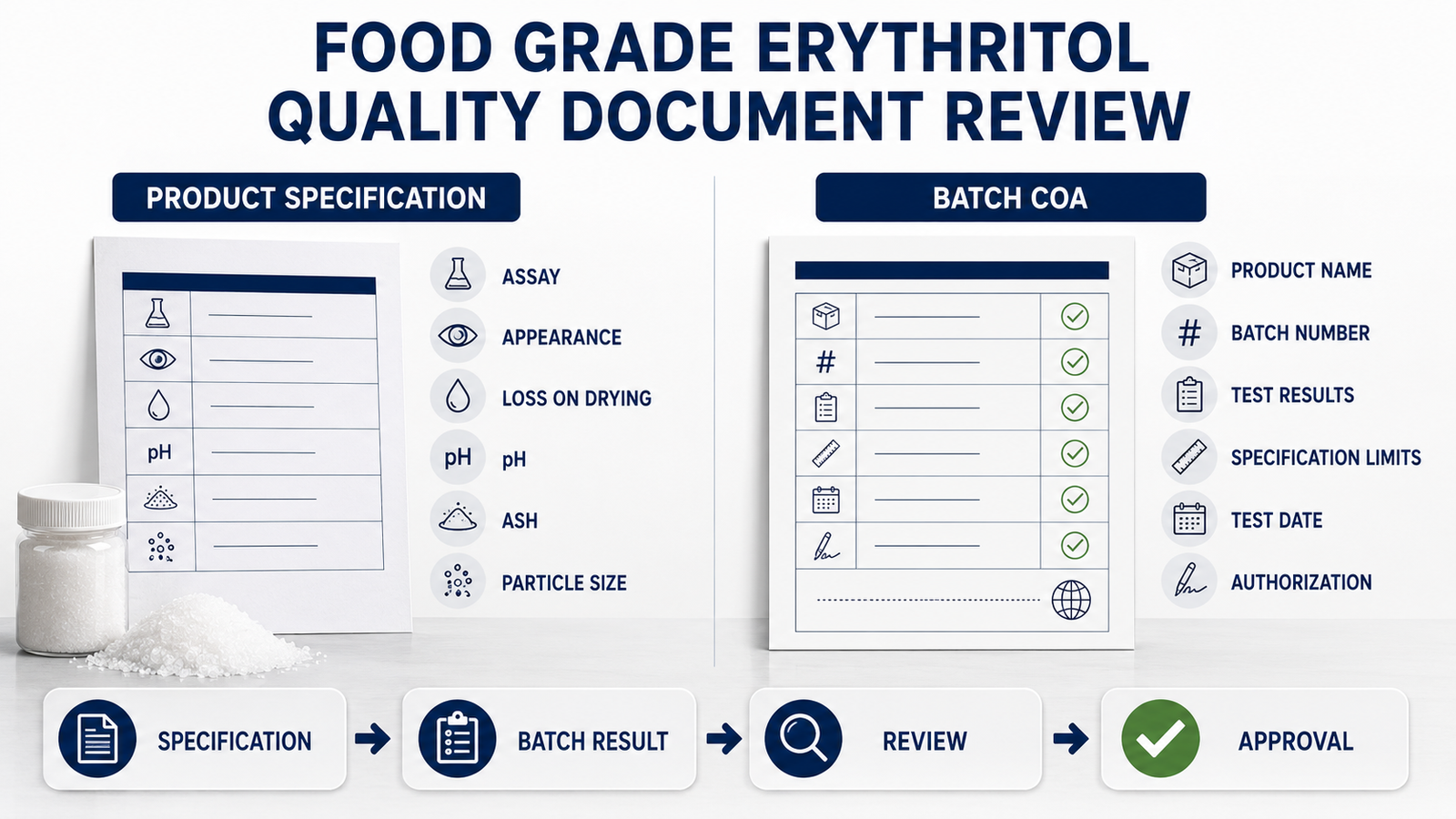
Food grade erythritol specifications define the technical requirements a product is expected to meet. Buyers should review the supplier’s current specification against their own formulation, processing and regulatory requirements before approving a sample or commercial order. The parameters included and the applicable limits may vary according to the supplier, testing method, intended application and destination market.
Item | What Buyers Should Review |
|---|---|
| Appearance | Color, crystalline form and absence of visible foreign material |
| Assay | Stated purity basis, testing method and acceptance range |
| Identification | Method used to confirm product identity |
| Loss on Drying | Reported limit and its relevance to moisture control |
| pH | Test conditions and specified acceptance range |
| Ash | Maximum limit and testing basis |
| Particle Size | Available grade and suitability for the intended process |
| Contaminants | Requirements applicable to the product and destination market |
| Microbiological Items | Limits required for the intended food application |
Assay is an important indicator of erythritol purity, but it should not be evaluated in isolation. Two materials with similar assay results may still differ in particle size, flowability, dissolution behavior or handling performance. Appearance and identification results also help confirm that the supplied material matches the agreed product description.
Loss on drying provides information related to moisture content under the stated test conditions. Excess moisture or exposure to humid conditions may affect the physical condition of a crystalline ingredient, although the acceptable limit should be determined by the agreed specification rather than a general assumption.
Erythritol particle size deserves particular attention because it can influence dust formation, mixing uniformity, dissolution and mouthfeel. Buyers should communicate whether a powder or more granular form is required and verify the available particle-size range before ordering.
Requirements for contaminants and microbiological parameters should be reviewed according to the intended application and applicable market rules. A general reference table is useful for initial evaluation, but final approval should always be based on the current supplier specification, agreed testing methods and batch-specific quality documentation.
How to Read an Erythritol COA
An erythritol Certificate of Analysis provides test results for a specific batch of material. It should be reviewed together with the agreed product specification, as the specification defines the acceptance requirements while the batch COA records the reported results for the supplied lot.
Buyers should first confirm that the product name, grade and batch number on the document match the material being evaluated. The production date, testing date, reporting date and shelf-life information should also be checked where applicable. These details support traceability and help prevent a general sample document from being mistaken for the COA of a commercial shipment.
Each reported result should then be compared with the corresponding specification limit. A statement such as “complies” may be acceptable for certain qualitative tests, but quantitative parameters should provide enough information for the buyer to determine whether the batch meets the agreed requirements. Testing methods or referenced standards should also be reviewed when they are relevant to purchasing approval.
A representative COA can help buyers understand a supplier’s reporting format before placing an order, but it does not replace the batch-specific COA issued for the material shipped. For repeat purchases, reviewing documents from several batches may provide useful evidence of consistency over time.
Document quality should be considered alongside sample testing, packaging condition and supplier communication. A complete batch COA supports quality review, but it does not by itself confirm that the material will perform as required in a particular formulation or production process.
Powder vs Granular Erythritol
Powdered and granular erythritol are different physical forms of the same ingredient. Neither form is inherently higher in quality; suitability depends on the formulation, processing equipment and handling requirements.
Erythritol powder has a smaller particle size and greater surface area. It may disperse or dissolve more quickly under suitable processing conditions, which can be useful in powdered beverages, fine dry blends and applications requiring a smoother texture. However, very fine material may generate more dust, require additional handling controls and show different flow characteristics during conveying or filling.
Granular erythritol generally contains larger crystals. It may offer easier handling and lower dust generation in some production environments, making it suitable for tabletop sweeteners, dry blending and selected confectionery applications. Larger particles may dissolve more slowly, however, and differences in particle size or density between ingredients can contribute to segregation during mixing and transportation.
Buyers should not select erythritol powder or granular erythritol based on appearance alone. Dissolution rate, blend uniformity, flowability, dust formation and finished-product mouthfeel should be assessed under actual processing conditions. The required erythritol particle size should be communicated to the supplier and confirmed in the product specification or other agreed technical documentation.
MOQ, Samples and Bulk Packaging
Minimum order quantity can vary according to the supplier, product form, packaging configuration and shipping arrangement. Buyers should therefore confirm the applicable MOQ for the specific erythritol grade they require rather than relying on a general figure. Requirements for trial orders may also differ from those for regular commercial shipments.
A representative sample can help manufacturers evaluate appearance, particle size, dissolution, handling and formulation performance before placing a bulk erythritol order. Where possible, the sample should reflect the material expected in subsequent commercial supply. Sample approval does not replace batch inspection, so the specification and COA for each purchased lot should still be reviewed.
Bulk packaging must protect the product throughout transportation and storage. Food grade erythritol is commonly supplied in sealed bags with a protective inner liner, although available bag sizes and packaging materials should be confirmed with the supplier. Buyers may also need to specify pallet configuration, labeling, batch identification and any destination-specific packaging requirements.
Freight planning should consider order volume, delivery location, trade terms and the handling capabilities available at the receiving warehouse. Packaging that is appropriate for a full-container shipment may not be the most practical choice for a smaller trial order.
Before confirming an order, buyers should agree on the MOQ, sample basis, net weight per package, liner construction, pallet requirements and shipping terms. These details help ensure that the quotation reflects the full purchasing requirement and reduce avoidable changes after production or dispatch has been arranged.
Storage, Moisture Control and Caking Prevention
Bulk erythritol should be stored in its original sealed packaging in a cool, dry and well-ventilated area. Exposure to moisture, excessive heat, direct sunlight and materials with strong odors should be avoided. Buyers should follow the storage conditions and shelf-life information stated in the current product specification.
Moisture control is important because changes in the physical condition of a crystalline ingredient may affect flowability, weighing and mixing performance. Packaging should be inspected when goods arrive, particularly around seals, liners and areas that may have been damaged during transportation.
Once a bag has been opened, any unused material should be resealed promptly or transferred to a suitable closed container under controlled handling conditions. Warehouse teams should also maintain batch identification and appropriate stock rotation.
Caking does not automatically indicate that the chemical identity or assay has changed, but unexpected clumping can affect processing performance and may indicate moisture exposure or unsuitable storage. Material showing damaged packaging, contamination or abnormal physical changes should therefore be assessed under the buyer’s internal quality procedures before being released for production.
How to Evaluate Bulk Erythritol Suppliers
Evaluating bulk erythritol suppliers requires more than comparing quoted prices. A lower unit cost may not represent better purchasing value if the material does not meet the required specification, documentation is incomplete or delivery performance is inconsistent.
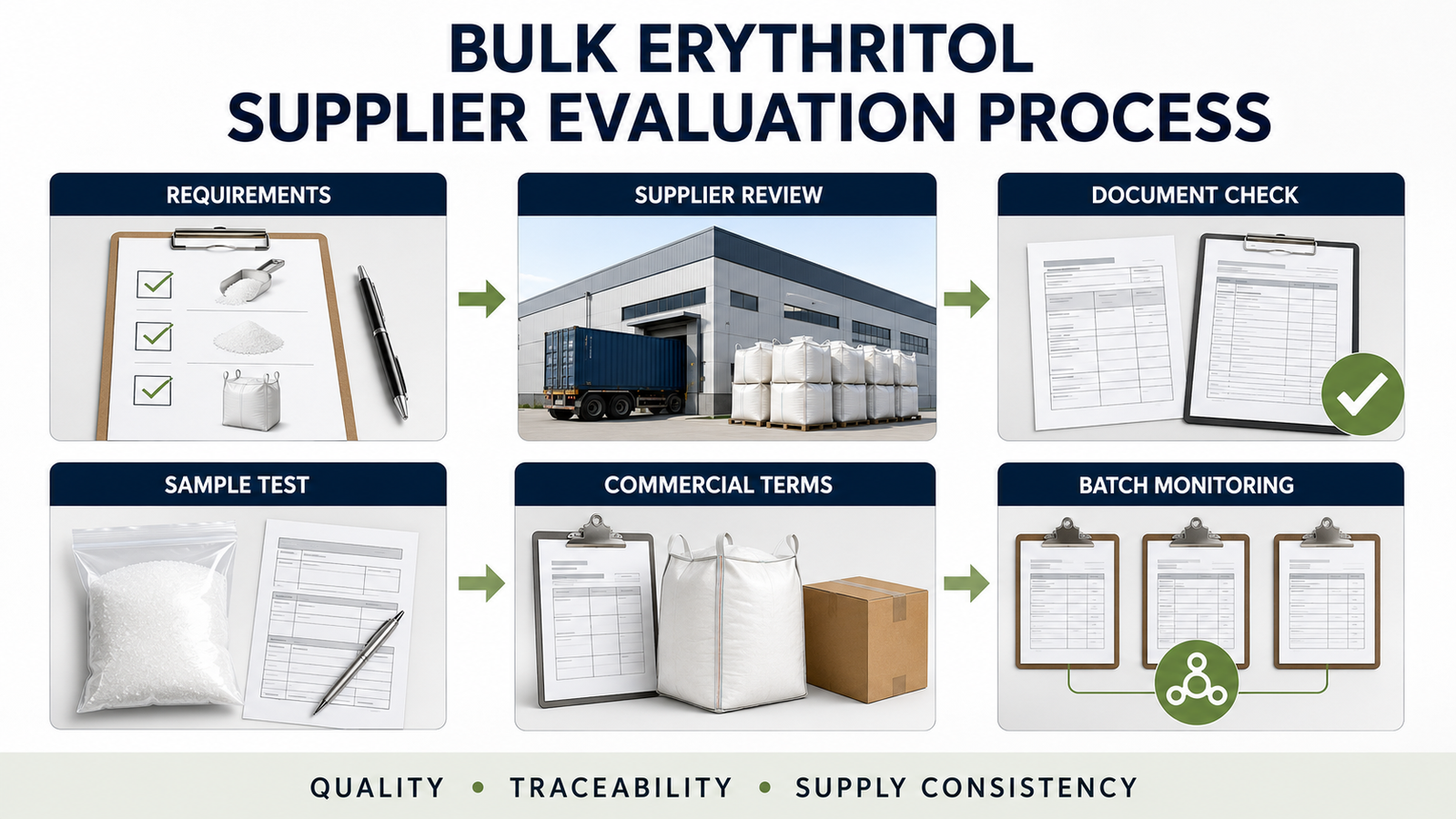
Buyers should begin by requesting the current product specification and a representative COA. These documents help establish which parameters are routinely controlled and how batch results are reported. For a commercial shipment, the buyer should also expect access to the relevant batch-specific COA and sufficient traceability information to connect the document with the supplied material.
Sample availability is another useful consideration. A representative sample allows the buyer to assess physical form, particle size, handling and formulation performance before a larger order is approved. Where repeat purchasing is planned, results from more than one batch may provide a clearer indication of consistency than a single sample.
The supplier’s operational capabilities should also be reviewed. Important points include available packaging, lead time, export documentation, communication during order processing and procedures for notifying customers of significant specification or production changes. Buyers requiring a particular particle-size range or labeling format should confirm whether those requirements can be maintained across repeat orders.
A reliable food grade erythritol supplier should be able to provide clear, current and internally consistent information. Final approval should consider technical suitability, documentation, sample performance, total delivered cost and supply continuity together. This creates a more dependable basis for purchasing than selecting a supplier on price or marketing claims alone.
Common Purchasing Mistakes
One common mistake is comparing bulk erythritol offers only by unit price. Quotations may be based on different specifications, packaging formats, trade terms or delivery destinations, so the lowest listed price may not produce the lowest total delivered cost.
Another mistake is evaluating quality by assay alone. Purity is important, but particle size, physical form, moisture-related properties and handling performance may also affect production. Buyers should assess the complete specification against their intended application.
A representative COA can show how a supplier reports test results, but it should not be treated as the document for every future shipment. Commercial buyers should check the batch number and confirm that the COA corresponds to the material received.
Finally, packaging and logistics are sometimes reviewed too late. Bag size, liner construction, pallet configuration, labeling, lead time and import documentation can all affect warehouse handling and delivery planning. Confirming these details before order approval helps avoid unexpected costs, delays and changes after the goods have been prepared.
Frequently Asked Questions
Where Can I Buy Erythritol in Bulk?
Food manufacturers can buy bulk erythritol from direct suppliers, exporters, ingredient distributors or local stockists. The most suitable source depends on the required quantity, particle size, delivery location and documentation needs. Before purchasing, buyers should verify the product specification, sample basis, packaging, batch COA availability and total delivered cost.
What Should I Check Before Choosing an Erythritol Supplier?
Buyers should review the current specification, representative COA, batch traceability, available particle sizes, packaging options and sample availability. Lead time, export experience, communication and consistency across repeat orders should also be considered. Supplier approval should be based on technical suitability and supply capability rather than price alone.
What Is the Typical Packaging for Bulk Erythritol?
Bulk erythritol is commonly supplied in sealed food-grade bags with protective inner liners. The available net weight, liner material, pallet configuration and labeling format vary by supplier and shipment. Buyers should confirm these details before ordering and ensure that the selected packaging suits their warehouse, handling equipment and storage conditions.
Should Buyers Request an Erythritol COA Before Ordering?
Yes. A representative COA can help buyers understand how results are reported during supplier evaluation, while the batch-specific COA should be checked for the actual commercial shipment. The product name, batch number, test results and applicable specification limits should be reviewed together to confirm that the supplied lot meets the agreed requirements.
What Is the Difference Between an Erythritol Supplier and Distributor?
A direct erythritol supplier may support larger or recurring orders with closer access to technical documents and production-related information. A distributor may offer local stock, smaller quantities or shorter delivery times. Buyers should compare product origin, traceability, documentation, total delivered cost and supply continuity when choosing between the two channels.
Conclusion
Purchasing bulk erythritol requires a balanced review of technical suitability, documentation and commercial terms. Price is important, but it should be considered together with the agreed specification, particle size, sample performance, batch COA, packaging and total delivered cost.
Before approving an erythritol supplier, buyers should confirm that the proposed material fits their formulation and processing requirements. They should also verify how the supplier manages batch traceability, documentation, lead times and consistency across repeat orders.
A structured evaluation process helps food manufacturers compare offers on a consistent basis and reduces avoidable problems during production, storage and delivery. Buyers seeking food grade erythritol should request current technical documents and confirm all product, packaging and shipping requirements before placing a commercial order. For specifications, sample availability and a quotation based on your purchasing requirements, please contact us.