



- Your cart is empty Browse Shop
Sodium Alginate in Food: Functions, Applications and Processing Considerations
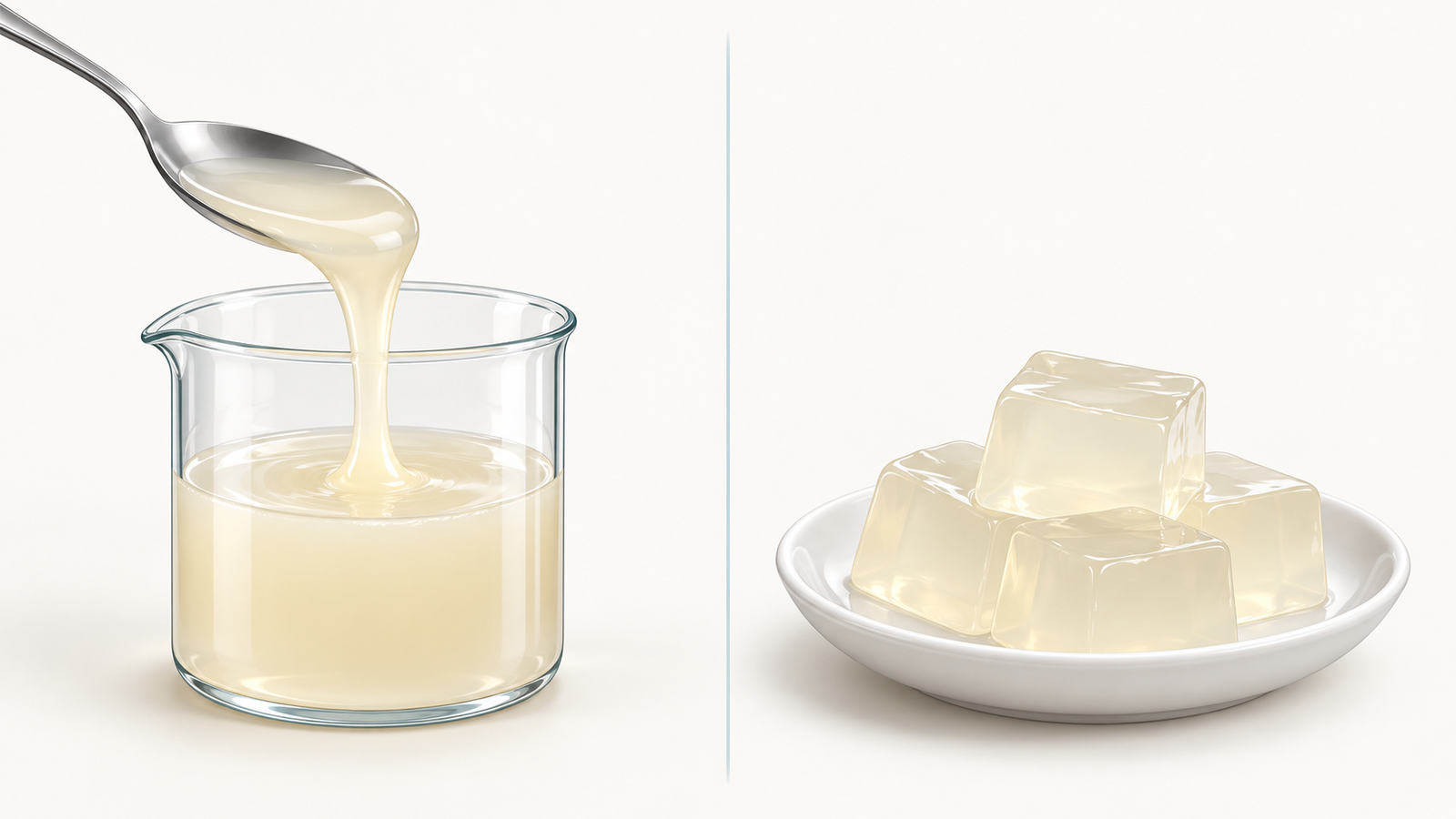
Sodium alginate in food serves several purposes: it can increase viscosity, support physical stability, or form gels when calcium ions are available. These functions are related, but they lead to different results. A sauce that needs a smoother pour requires a different approach from a filling that needs to hold its shape.
The practical question is therefore not simply whether sodium alginate can thicken or gel, but which behavior a particular formulation needs. Its performance depends on the grade selected, how thoroughly it hydrates, and the surrounding conditions—including pH, available calcium, and the order of ingredient addition.
For food manufacturers and ingredient buyers, understanding these relationships helps turn a general ingredient specification into a useful selection decision. This guide explains the main functions, food applications, and processing factors to evaluate before choosing a grade and testing it in production.

What Is Sodium Alginate?
Sodium alginate is the sodium salt of alginic acid, a polysaccharide obtained from brown seaweed. In food formulation, it belongs to the hydrocolloid family: ingredients that interact with water to influence viscosity, texture, and physical structure.For further background on its origin and properties, see FAO’s overview of alginate production and uses.
When properly dispersed and hydrated in suitable water conditions, sodium alginate forms a viscous solution. If sufficient calcium ions are available, they can link parts of the alginate chains together to form a gel network. This explains why the same ingredient can serve different purposes—and why its behavior in water alone may differ from its behavior in a finished formulation.
Food-grade sodium alginate is produced to meet applicable food-use specifications, but that designation does not mean every grade performs identically. Differences in molecular characteristics can affect solution viscosity and gel properties. A grade selected for thickening therefore may not be the most suitable option for a firm gel.
For manufacturers, the useful starting point is to define the required function, then evaluate a grade under conditions that reflect the actual product.
Main Functions of Sodium Alginate in Food
The main functions of sodium alginate in food are closely related, but each addresses a different formulation need. Understanding these differences helps manufacturers decide whether to focus on flow behavior, gel structure, or physical stability when evaluating a grade.
Thickening and Viscosity Control
Once hydrated, sodium alginate increases the viscosity of the water phase, changing how a product flows during mixing, filling, pouring, and consumption. In a sauce, for example, the aim may be to develop enough body to coat food while retaining a smooth, manageable pour.
Using sodium alginate for thickening therefore involves more than achieving a higher viscosity reading. Excessive thickening can make a product difficult to pump or dispense, while insufficient viscosity may leave it thinner than intended. Grade, concentration, hydration, and measurement conditions all influence the result. Evaluation should consider both processing requirements and the texture experienced by the consumer.
Calcium-Induced Gelling
The gelling properties of sodium alginate depend on calcium ions linking alginate chains into a network. This creates a structure that can hold its shape rather than simply flow more slowly. Gel formation does not inherently require heating, although temperature may influence other aspects of the formulation and process.
The amount and availability of calcium, its rate of release, and the characteristics of the alginate affect how the gel develops. Rapid calcium contact may be useful when forming a gel layer around a food bead, whereas a structured filling may require more controlled gel development throughout the mixture. The objective is therefore to achieve suitable firmness and uniformity within the available processing time.
Stabilization and Water Management
Sodium alginate can also support physical stability by increasing the viscosity of the continuous phase or forming a network that holds water within a structured product. Higher viscosity may slow particle movement, while a suitable gel network can help manage moisture distribution.
These effects have limits. A thicker product may still separate, and a gel may release water if its structure is unsuitable for the formulation or storage conditions. Stabilization should therefore be assessed through observations such as settling, separation, and water release over time, alongside texture measurements.
| Aspect | Thickening | Calcium-Induced Gelling |
|---|---|---|
| Main objective | Adjust viscosity and flow | Develop a cohesive structure |
| Typical behavior | Remains flowable | Can hold shape |
| Role of calcium | Not required for thickening; may alter behavior | Enables network formation |
| Key evaluation points | Pourability, pumping, mouthfeel | Setting time, firmness, uniformity, water release |
Sodium Alginate Food Applications
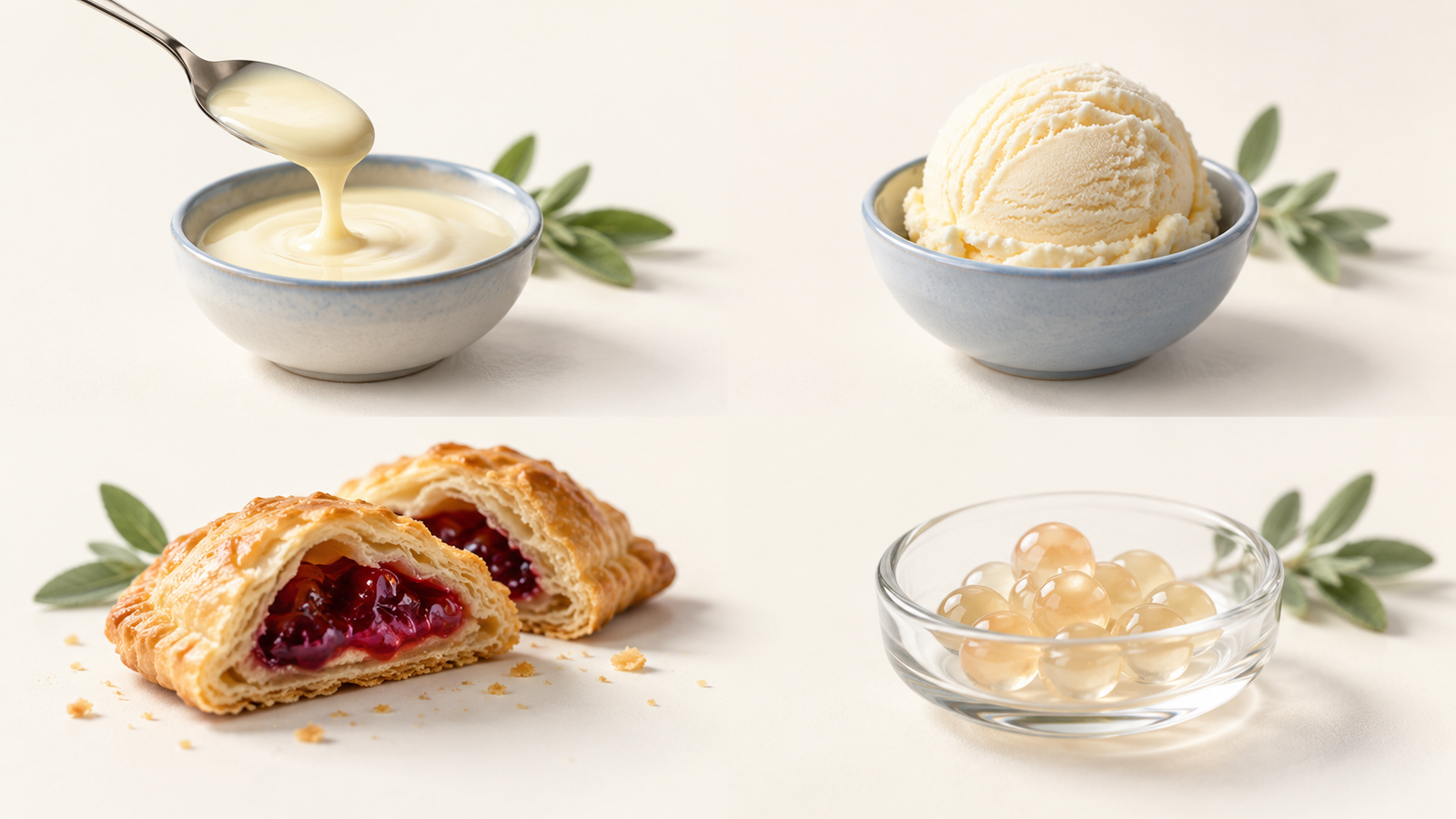
Sodium alginate is used across several food categories, but the product category alone does not determine whether it is suitable. The more useful question is what the formulation needs to achieve—and whether its composition and processing conditions allow alginate to perform that function.
Sauces, Dressings and Selected Liquid Foods
In suitable sauces and dressings, sodium alginate can help develop body and adjust flow. The formulation goal may be a sauce that coats food evenly, pours smoothly, and maintains a consistent texture during storage.
Increasing viscosity, however, does not automatically resolve every stability problem. An emulsion may still require an appropriate emulsifier, while suspended particles may need additional control beyond thickening. Acidic recipes and calcium-containing ingredients also require attention because they can affect hydration and alter the intended texture.
Trials should therefore assess pourability, coating behavior, and separation under the actual processing and storage conditions. A viscosity measurement provides useful information, but it should be considered alongside how the finished product behaves.
Frozen Desserts and Selected Dairy Systems
In some frozen dessert formulations, sodium alginate contributes to texture and water management, sometimes as part of a stabilizer blend. Evaluation needs to extend beyond the liquid mix: a formulation that appears satisfactory before freezing may behave differently during frozen storage or melting.
Dairy systems introduce another consideration because milk contains calcium. Its availability depends on the composition and conditions of the product, so alginate behavior cannot be predicted simply from total calcium content. Uncontrolled interaction may cause unwanted thickening or uneven gel formation.
For these applications, manufacturers should examine mix consistency, processing compatibility, frozen texture, and melt behavior where relevant. Acidified dairy products need separate assessment rather than being treated as equivalent to a neutral dairy mix.
Gelled Fillings and Restructured Foods
Where shape retention is the priority, calcium-induced alginate gels can provide structure in selected fillings and restructured foods. The target may be a cohesive filling or a formed product that remains intact during handling.
Here, gel strength is only one part of the requirement. A mixture that sets too early may become difficult to distribute or form, while slow setting may leave the product unable to retain its intended shape. Calcium delivery must therefore be coordinated with mixing and forming.
Evaluation should include setting time, firmness, uniformity, and water release. If the product will undergo heating, freezing, or prolonged storage, the complete formulation should also be tested under those conditions.
Spherification and Food Beads
Spherification uses contact between alginate and calcium to form a gel layer. In direct spherification, an alginate-containing liquid is introduced into a calcium bath. In reverse spherification, a calcium-containing liquid is introduced into an alginate bath.
The choice depends partly on the liquid’s composition and the required result. Acidity, calcium content, viscosity, and contact time can influence formation and texture. Direct-spherification beads may continue to gel inward, making holding time particularly relevant when a liquid center is desired.
Useful trial observations include bead size, shape consistency, membrane thickness, handling strength, and changes before serving or packaging.
| Application | Main Formulation Goal | Important Trial Checks |
|---|---|---|
| Sauces and dressings | Controlled flow and body | Pourability, coating, separation |
| Frozen desserts and selected dairy systems | Texture and water management | Mix consistency, frozen texture, melt behavior |
| Fillings and restructured foods | Cohesion and shape retention | Setting time, firmness, water release |
| Spherification and food beads | Controlled gel-layer formation | Shape, membrane thickness, holding behavior |
Key Considerations for Sodium Alginate in Food Processing
Using sodium alginate in food processing requires attention to how the ingredient enters and develops within the formulation. A suitable grade can still produce inconsistent results if dispersion, hydration, or calcium interaction is poorly controlled. Before changing the dosage, it is worth checking whether the process allows the ingredient to perform as intended.
Powder Dispersion and Hydration
Dispersion and hydration are separate steps. Dispersion distributes powder particles through the liquid; hydration allows the polymer to interact with water and develop viscosity. When powder is added too quickly, the outer surface of an agglomerate may hydrate first, enclosing dry material inside. Continued mixing may then leave persistent lumps rather than a uniform solution.
Depending on the formulation, dry blending with a compatible ingredient such as sugar can help separate particles before they enter the water. Controlled powder addition and suitable mixing can also improve distribution. These approaches should be assessed against the available equipment and recipe.
A mixture that looks uniform is not necessarily fully hydrated. Check whether viscosity has stabilized under consistent measurement conditions before judging the grade or adjusting its concentration.
Water Quality and Available Calcium
Water is part of the formulation, not simply a processing medium. Calcium introduced through process water or other ingredients can change alginate behavior, potentially causing localized thickening or gel formation before these effects are wanted.
For a thickened product, this interaction may interfere with smooth hydration. For a gelled product, calcium is intentional, but its availability and release still need control. Total calcium content alone does not describe how readily it will interact with alginate.
If results differ between laboratory and production batches, compare water quality and ingredient sources alongside the mixing process. Where appropriate, formulation specialists may evaluate a permitted sequestrant to manage calcium availability, while checking its wider effects on the recipe.
pH and Ingredient Compatibility
Acidic conditions can reduce alginate solubility and make hydration more difficult. Consequently, adding powder directly into an acidic mixture may produce a different result from hydrating it in a suitable water phase before acidification.
The second approach may improve initial hydration, but it does not guarantee stability at the final pH. The finished formulation still needs evaluation. Minerals, dissolved solids, proteins, and other hydrocolloids can also influence water availability and texture.
Compatibility trials should reproduce the complete recipe rather than relying solely on an alginate solution in water. This helps distinguish an unsuitable grade from a problem caused by the surrounding formulation.
Order of Addition and Mixing Conditions
Ingredient order should support the intended function. Many processes benefit from adequately hydrating alginate before exposing it to conditions that promote gel formation or hinder dissolution. In a controlled gel system, calcium addition or release must also fit the mixing, transfer, and forming stages.
Mixing needs to distribute ingredients effectively without introducing excessive air or disrupting a developing structure. Laboratory and production equipment may differ substantially in mixing intensity and powder incorporation, so copying mixing time alone is insufficient.
Record the addition sequence, equipment, mixing conditions, and holding periods during trials. These details make successful results easier to reproduce.
Processing and Storage Validation
Assess performance after the actual heat treatment, cooling, freezing, or storage steps relevant to the product. Initial viscosity or firmness cannot establish how the finished food will behave throughout its intended life.
Use consistent sampling and measurement conditions, and monitor the properties that matter to the application. These may include flow, gel uniformity, separation, and water release.
| Observed Problem | Priority Checks |
|---|---|
| Persistent lumps | Powder distribution, addition rate, hydration conditions |
| Unexpected gel particles | Calcium sources, local ingredient contact, addition sequence |
| Variable viscosity | Hydration, grade, concentration, temperature and test method |
| Uneven gels or water release | Calcium delivery, mixing, formulation and storage conditions |
How to Choose Food-Grade Sodium Alginate
Choosing food-grade sodium alginate starts with the application, rather than a single specification value. Two grades may both meet relevant food-use specifications yet behave differently in the same recipe. The aim is to identify a grade that delivers the required texture under realistic production conditions.

Define the Target Function
First, describe what the finished product needs to do. For a sauce, this might mean coating food while remaining easy to pour. For a gelled filling, it may mean holding shape without becoming excessively firm or releasing water.
These requirements help determine which performance data matter. A thickening application calls for attention to viscosity and flow, whereas a gelled product also requires information about setting behavior and gel properties. Choosing the highest-viscosity grade does not necessarily improve either application; it may create processing difficulties without delivering the desired texture.
Give the supplier enough context to recommend suitable candidates, including the food category, target consistency, relevant formulation conditions, and major processing steps.
Compare Grades Under the Same Test Conditions
Viscosity values are meaningful only when their test conditions are understood. Solution concentration, temperature, instrument, and measurement procedure can all affect the reported result. A higher number on one technical sheet therefore does not establish that the grade will produce a thicker finished food than another.
Request comparable test information before drawing conclusions. For gelling applications, also ask how any reported gel strength was measured, including the alginate concentration, calcium system, and setting conditions.
Where application data are limited, comparing samples in the same formulation provides a more useful basis for selection than ranking specification numbers alone.
Check Documentation and Run Application Trials
Review the technical data sheet, applicable food-grade specifications, and a batch-specific certificate of analysis. These documents serve different purposes: the technical sheet describes the grade, while the COA reports results for the supplied batch. Neither independently confirms suitability for every food category or destination market.
Application trials should then establish whether the candidate meets the product’s requirements. Compare samples under consistent conditions, record texture and processing observations, and check performance after relevant storage steps. For shortlisted grades, production-scale evaluation and checks across more than one batch can help assess reproducibility before routine purchasing.
Frequently Asked Questions
What Is Sodium Alginate Used for in Food?
Sodium alginate is used to adjust viscosity, support physical stability, and form calcium-induced gels. Applications include selected sauces, frozen desserts, structured fillings, and food beads. Its suitability depends on the desired texture and the formulation: an ingredient that performs well in a neutral sauce may behave differently in an acidic or calcium-rich system.
Does Sodium Alginate Need Heat to Form a Gel?
No. Sodium alginate can form a gel through interaction with available calcium ions without heating. However, temperature can influence hydration, calcium release, and other ingredients in the recipe. A process that does not require heat for gel formation still needs evaluation under the product’s actual manufacturing and storage conditions.
Why Does Sodium Alginate Form Lumps During Mixing?
Lumps can develop when powder particles cluster and hydrate on the outside before water reaches the dry material inside. Calcium contact can also create gel particles that resemble hydration problems. Before changing the dosage, check powder addition, dispersion, hydration conditions, and calcium sources to identify which process is causing the uneven mixture.
How Much Sodium Alginate Should Be Used in a Food Formulation?
There is no single dosage suitable for every application. The amount depends on the grade, target texture, formulation, and processing conditions. Use application guidance from the supplier to establish a trial range, then assess performance in the complete recipe. Any selected level must also meet applicable requirements for the food category and destination market.
Can Sodium Alginate Replace Xanthan Gum?
Sometimes, but it should not be treated as a direct, equal-weight replacement. Both ingredients can increase viscosity, while sodium alginate also responds to calcium by forming gels. Their flow behavior and formulation compatibility differ. A sodium alginate vs xanthan gum comparison can help narrow the choice, but substitution still requires testing in the intended product.
Conclusion
Using sodium alginate in food effectively starts with a clear texture objective. Thickening a pourable sauce and building a structured gel require different selection criteria, even when both use the same ingredient. Grade characteristics, hydration, calcium availability, and pH need to be considered together.
Specifications help narrow the options, but trials in the complete formulation show whether a grade meets the product’s processing and storage requirements. For manufacturers evaluating suitable grades, sharing the food category, target texture, processing conditions, and required specifications gives the supplier a practical basis for recommending samples and supporting a more focused comparison.To discuss grade options for your application, contact our team with your product type, target texture, and processing requirements.