



- Your cart is empty Browse Shop
Maltodextrin in Food Processing: Functions, DE Value, Applications and Selection Guide
Introduction
Maltodextrin is a versatile carbohydrate ingredient used in beverage powders, seasonings, bakery products, spray-dried flavors and many other formulated foods. Depending on the application, it may add solids, carry flavors, support drying, adjust mouthfeel or improve the handling of a powdered mixture. These functions make maltodextrin valuable in food processing, but they do not mean that every grade will perform in the same way.
Differences in dextrose equivalent, starch source, moisture, particle characteristics and manufacturing conditions can influence sweetness, solubility, viscosity, hygroscopicity and processing behavior. A product suitable for a dry beverage mix may therefore respond differently in a spray-drying system or a heat-processed formulation. For food manufacturers, effective selection requires more than identifying maltodextrin powder on an ingredient list. This guide explains how maltodextrin is produced, what DE value indicates, how it functions in food manufacturing and which factors should be evaluated before a grade is approved.
What Is Maltodextrin?
Maltodextrin is a carbohydrate ingredient produced through the controlled partial hydrolysis of starch. Instead of consisting of one type of molecule, it contains a mixture of glucose polymers and smaller saccharides with different chain lengths. The extent to which the original starch has been broken down is commonly expressed through its dextrose equivalent, or DE value.
Commercial maltodextrin can be made from corn, tapioca, potato, wheat or other suitable starch sources. The source may vary by region, manufacturer and customer requirement, although the functional performance of the finished ingredient also depends on the hydrolysis process and resulting carbohydrate profile. Food manufacturers evaluating food-grade maltodextrin should therefore review both the declared source and the product specification when these factors are relevant to formulation, labeling or market requirements.
Food-grade maltodextrin is generally supplied as a white or off-white powder with a relatively mild flavor. It is often selected because it can add solids or carry other ingredients without contributing the level of sweetness associated with sugars such as dextrose or sucrose. However, its solubility, sweetness, viscosity, moisture sensitivity and powder-handling properties can differ between grades. These differences are important when choosing maltodextrin powder for a specific food-processing system.
How Is Maltodextrin Produced?
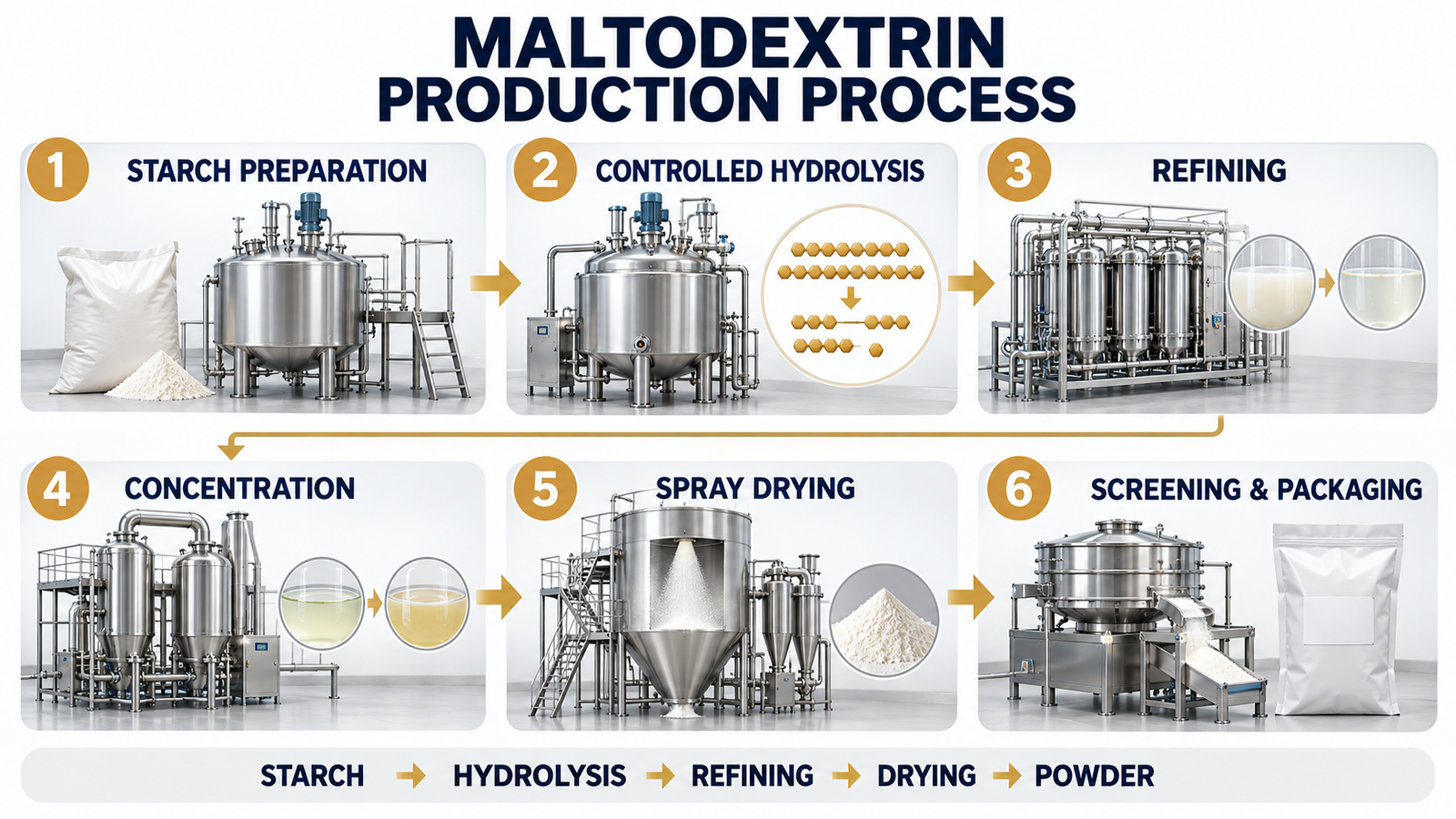
Maltodextrin production begins with a purified starch slurry prepared from corn, tapioca, potato, wheat or another suitable source. The starch is heated in water and partially hydrolyzed using enzymes, acid or a controlled combination of processing methods. This breaks some of the long starch chains into shorter glucose polymers and saccharides.
The manufacturer controls the extent of hydrolysis to obtain the required carbohydrate profile and dextrose equivalent. Once the target is reached, the liquid is typically clarified and refined to remove unwanted residues. It is then concentrated before being converted into powder, most commonly through spray drying.
During spray drying, the concentrated maltodextrin solution is atomized into small droplets and exposed to heated air. Water evaporates rapidly, leaving dry particles that can be collected, screened and packed. Drying conditions and subsequent handling can influence moisture, particle characteristics, bulk density and powder flow.
The finished product is tested against its specification before release. Because raw-material characteristics and processing conditions may differ between manufacturers, buyers should not assume that two maltodextrin powders with a similar DE value will have identical handling or formulation performance.
What Is Dextrose Equivalent in Maltodextrin?
Dextrose equivalent, usually abbreviated as DE, expresses the amount of reducing sugars in a starch hydrolysate relative to dextrose, calculated on a dry-solids basis. It is commonly used to indicate how extensively the original starch has been hydrolyzed.
[
DE = \frac{\text{Reducing sugars expressed as dextrose}}{\text{Total dry solids}} \times 100
]
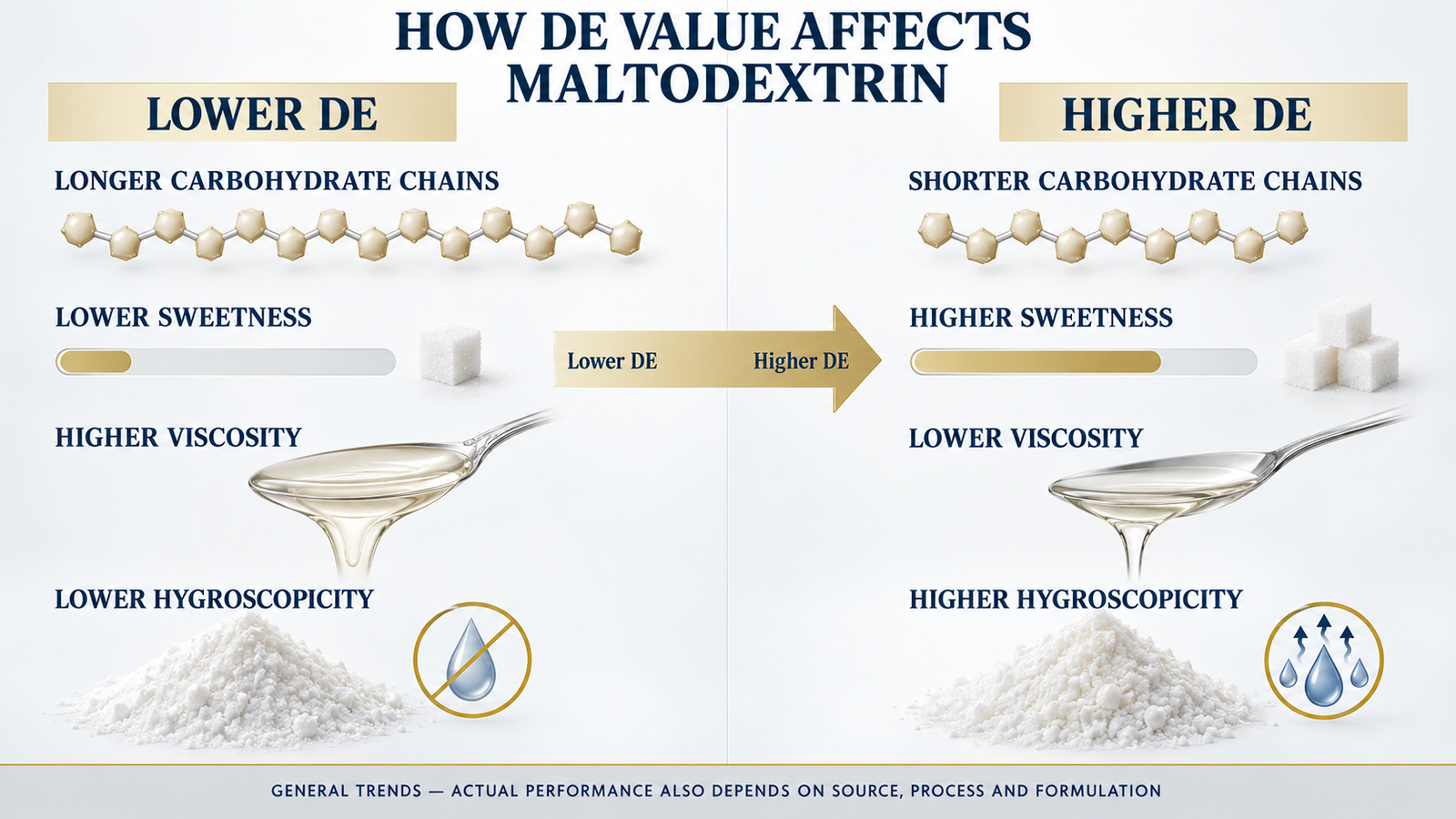
Dextrose is assigned a DE of 100, while intact starch has a value close to zero. As hydrolysis breaks starch molecules into shorter carbohydrate chains, the number of reducing ends increases and the DE value rises. A higher maltodextrin DE value therefore generally indicates more extensive hydrolysis and a greater proportion of shorter saccharides. A lower value usually indicates less extensive hydrolysis and a higher proportion of longer glucose polymers.
Maltodextrin is commonly associated with starch hydrolysates having a DE below 20, although product classification and declaration should always be checked against the applicable regulations and supplier documentation. Within this range, manufacturers may offer different grades for different processing and formulation requirements.
DE is useful for comparing the general carbohydrate profile of maltodextrin products, but it is not a complete description of performance. Products with a similar DE can still differ in molecular-weight distribution, starch source, moisture, particle size, bulk density and processing behavior. Most importantly, a higher DE does not mean higher quality. It represents a different degree of hydrolysis that may be more suitable for one application and less suitable for another. Food manufacturers should therefore interpret dextrose equivalent together with the full product specification and results from formulation testing.
How DE Value Affects Maltodextrin Properties
The DE value provides a useful starting point for predicting maltodextrin behavior, but it should not be used in isolation. Starch source, molecular-weight distribution, particle size, moisture and production conditions can also influence how a grade performs in a food system.
Sweetness
As DE increases, the proportion of shorter saccharides generally rises. Higher-DE maltodextrin therefore tends to taste sweeter than lower-DE material, although it remains less sweet than dextrose. The practical effect depends on usage level and the other sweeteners or flavor components in the formulation.Manufacturers comparing these ingredients can review the key differences between maltodextrin and dextrose before selecting the appropriate carbohydrate for a formulation.
Solubility and Dispersibility
Higher-DE grades are generally more soluble because they contain a greater proportion of shorter carbohydrate chains. However, rapid solubility does not always guarantee easy dispersion. Water temperature, agitation, addition rate and powder characteristics can influence lump formation and hydration.
Viscosity and Body
At the same solids concentration, lower-DE maltodextrin typically contributes more viscosity and body than a higher-DE grade. This can be useful where a formulation requires solids and mouthfeel with limited sweetness. Actual viscosity must still be confirmed in the complete product because temperature, shear and other ingredients can change the result.
Hygroscopicity
Higher-DE maltodextrin is generally more hygroscopic and may absorb moisture more readily during handling and storage. This can increase the risk of stickiness or caking in dry mixes, making packaging, humidity control and storage conditions important.
Browning and Flavor Interaction
A higher DE also indicates a greater level of reducing sugars, which may increase the potential for Maillard browning when suitable amino compounds, moisture and heat are present. The extent of browning depends on the complete formulation and processing conditions.
These relationships describe general trends rather than fixed rules. Food manufacturers should compare supplier data and verify sweetness, solubility, viscosity, moisture sensitivity and color development through application testing.
Main Functions of Maltodextrin in Food Processing
Maltodextrin performs several technical roles in food processing, and a single formulation may use it for more than one purpose. Its effectiveness depends on the selected grade, usage level and interactions with other ingredients, so the required function should be defined before product selection.
Bulking and Solids Addition
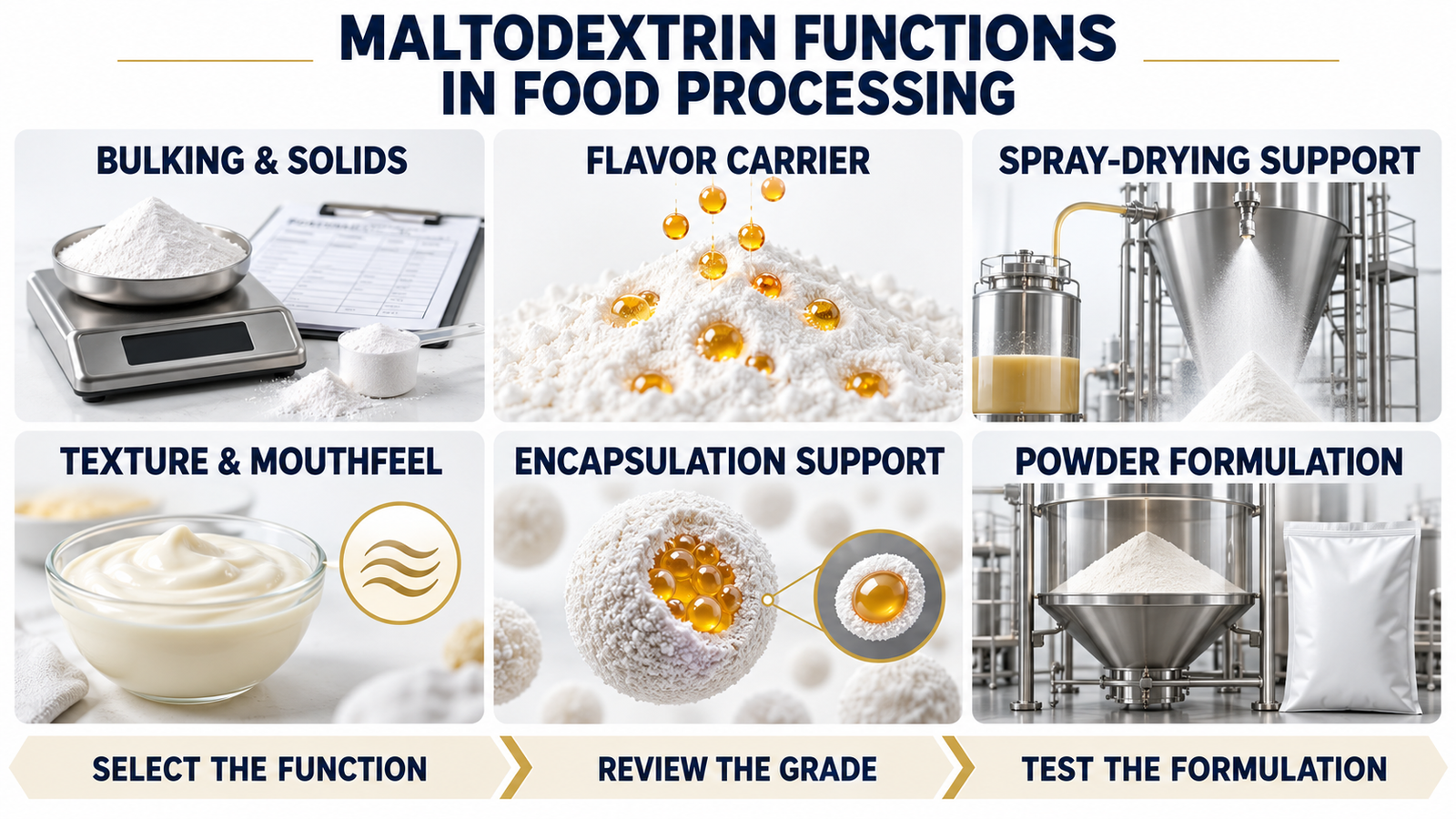
Maltodextrin can increase the solids content and volume of a formulation without adding the same level of sweetness as sucrose or dextrose. This makes it useful when manufacturers need additional material for body, yield or formulation balance while maintaining a relatively mild flavor profile.
Carrier for Flavors and Ingredients
As a carrier material, maltodextrin can help distribute flavors, colors, sweeteners and other concentrated ingredients through a food system. It may also convert small quantities of liquid or highly concentrated components into forms that are easier to measure and blend. Performance depends on the carrier ratio and the properties of the active ingredient.
Spray-Drying Aid
In some spray-drying processes, maltodextrin is added to increase feed solids or reduce the handling difficulties associated with sticky materials. It may support powder recovery when drying fruit concentrates, flavors or other ingredients. The appropriate grade and addition level must be determined according to feed composition, dryer conditions and required powder properties.
Texture and Mouthfeel Adjustment
Maltodextrin can contribute body and modify mouthfeel without providing intense sweetness. Lower-DE grades may offer greater viscosity at the same solids level, while higher-DE grades generally contribute less body. The final effect should be assessed in the complete formulation rather than predicted from DE alone.
Encapsulation Support
Maltodextrin is frequently used as part of a carrier system for spray-dried flavors, oils and other sensitive ingredients. It can help form a dry matrix around the incorporated material. However, encapsulation efficiency and storage stability depend on the complete wall system, processing conditions and characteristics of the material being encapsulated.
Powder Handling and Formulation Support
In dry blends, maltodextrin may add bulk, dilute highly concentrated ingredients and support more uniform distribution. Its effect on powder flow, dispersibility and caking depends on particle size, moisture, DE value and storage humidity. Application testing is therefore necessary before its processing benefits can be confirmed.
Maltodextrin Applications in Food Manufacturing
Maltodextrin applications extend across liquid, semi-solid and powdered food systems. The purpose of using it varies by product: one manufacturer may require a carrier for spray drying, while another may need additional solids, controlled sweetness or improved powder handling. Selection should therefore reflect the processing requirements of each application.
Beverage Powders and Instant Drinks
In powdered beverages, maltodextrin may add solids, carry flavors and help distribute concentrated ingredients throughout the blend. Its mild flavor allows the intended beverage profile to remain dominant. Manufacturers should evaluate dissolution time, dispersibility, sedimentation and sensitivity to humidity under the intended preparation and storage conditions.
Flavors and Spray-Dried Ingredients
Maltodextrin is commonly incorporated into carrier systems for spray-dried flavors, oils, extracts and other concentrated materials. It can increase feed solids and help form a dry powder matrix. Performance depends on the carrier ratio, feed viscosity, inlet and outlet temperatures, atomization conditions and the properties of the ingredient being dried.
Seasonings, Soups and Dry Mixes
In seasonings, soup powders and other dry blends, maltodextrin may provide bulk and support the uniform distribution of flavors, colors or high-intensity ingredients. Particle-size compatibility is important because major differences between blend components can contribute to segregation. Moisture control and suitable packaging are also necessary to manage caking during storage.
Bakery and Confectionery Products
Maltodextrin may be used in bakery and confectionery formulations to adjust solids, texture or formulation balance. Its effect varies with DE value, usage level, water availability and heating conditions. Because reducing sugars can participate in browning reactions, manufacturers should evaluate color and flavor development during processing.
Dairy and Frozen Products
In dairy and frozen formulations, maltodextrin may contribute solids and influence body or mouthfeel. It can also serve as a carrier for flavors or other powdered components. Its contribution to viscosity, freezing behavior and sensory quality should be tested in the complete product rather than assumed from the ingredient specification alone.
Nutrition Products and Powdered Formulations
Maltodextrin can function as a carbohydrate source, bulking material or carrier in nutrition powders and other formulated products. The selected grade should align with the intended nutrition profile, labeling requirements, dissolution conditions and sensory targets. Regulatory suitability must be confirmed for the product category and destination market.
Across all these applications, formulation testing is essential because maltodextrin performance depends on both the selected grade and the surrounding food system.
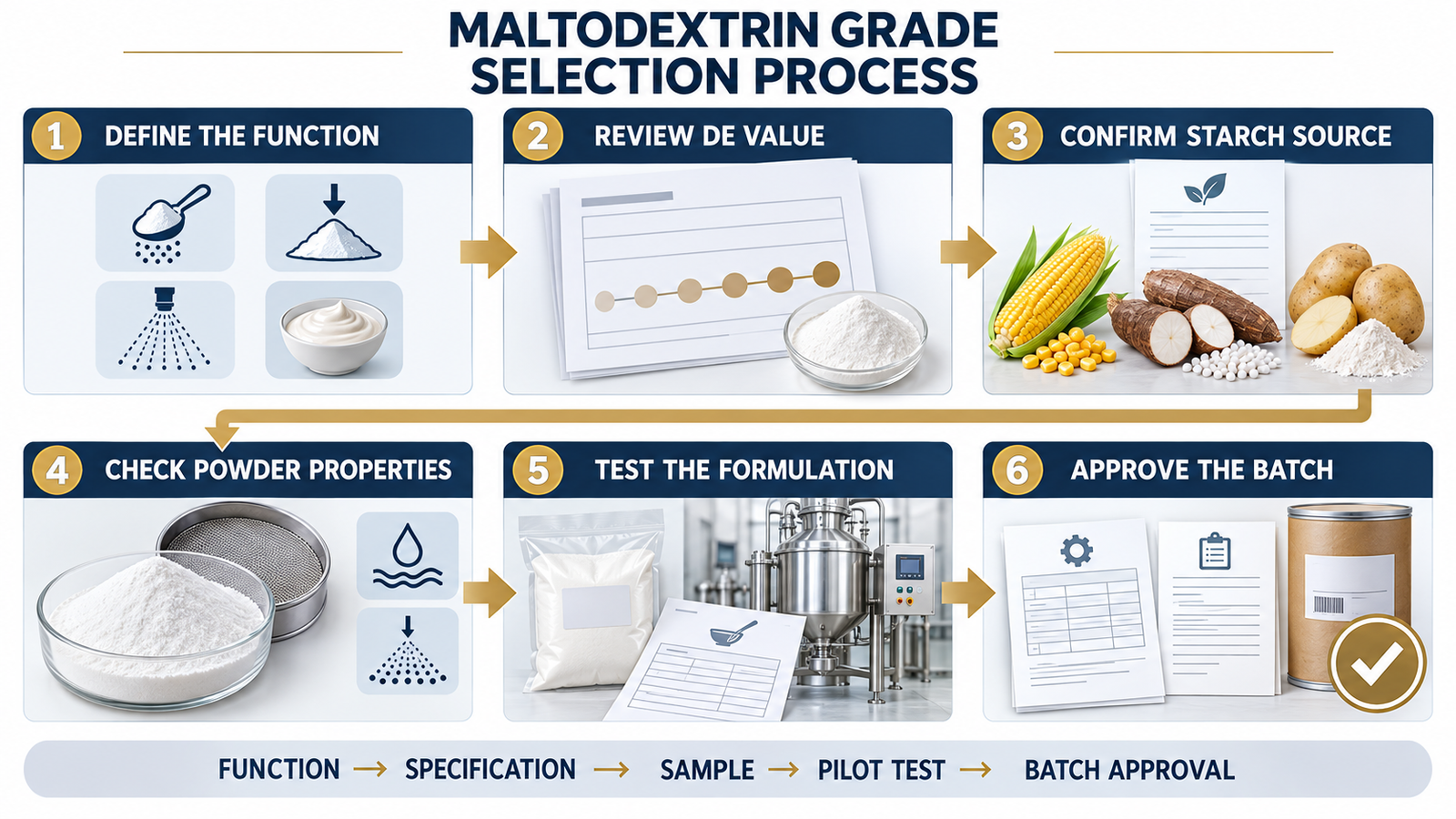
How to Select a Maltodextrin Grade
Choosing a maltodextrin grade requires matching its properties to the formulation and production process. DE value is important, but it should be considered together with source, powder characteristics and actual application performance.
1. Define the Required Function
First identify why maltodextrin is needed. The objective may be to add solids, carry flavors, support spray drying, adjust mouthfeel or improve the distribution of concentrated ingredients. A clear functional target prevents selection based only on a familiar grade name.
2. Review the DE Value
Consider how sweetness, viscosity, hygroscopicity and solubility should be balanced. Lower- and higher-DE grades may behave differently, but the preferred range must be verified in the complete formulation.
3. Confirm the Starch Source
Check whether the maltodextrin is produced from corn, tapioca, potato, wheat or another starch. Source information may be relevant to customer requirements, labeling, allergen management or the regulations of the destination market.
4. Evaluate Powder Properties
Review moisture, particle size, bulk density, flow and dispersibility. These characteristics can affect weighing, blending, transfer, dissolution and storage, even when two products have a similar DE value.
5. Consider Processing Conditions
Assess the temperature, shear, pH, solids concentration, humidity and storage conditions that the ingredient will encounter. For spray drying, the feed composition and dryer operating conditions also require evaluation.
6. Conduct Formulation and Pilot Testing
Test a representative sample at laboratory scale, then confirm performance in a pilot trial. Record the relevant results, such as solubility, viscosity, powder recovery, texture, flavor and stability, before approving the grade for commercial use.
This process gives food manufacturers a more reliable basis for maltodextrin selection than DE value or price alone.
Quality and Purchasing Considerations
When purchasing food-grade maltodextrin, buyers should confirm that the product specification reflects both regulatory requirements and the needs of the intended application. Relevant parameters may include DE value, appearance, moisture, solubility, pH, particle size and microbiological limits. Depending on the product and destination market, information about starch source, allergens and other compliance requirements may also be necessary.
The specification defines the agreed requirements for the product, while the batch certificate of analysis reports test results for a particular lot. Buyers should check that the product name, batch number, test items, specification limits and reported results are consistent across the documents. A COA should not be treated as a replacement for technical review or application testing.
Packaging also matters because maltodextrin powder can be affected by moisture during transportation and storage. Buyers should review the outer packaging, protective inner liner, sealing method and recommended storage conditions. Damaged or poorly sealed packaging may contribute to caking and handling problems.
For repeat orders, manufacturers should monitor batch consistency rather than relying only on an initial approved sample. Supplier documentation, batch results and performance in the actual formulation should be reviewed together. This approach provides a stronger basis for approval than selecting maltodextrin solely by DE value, price or a general food-grade description.
Frequently Asked Questions
What is maltodextrin used for in food processing?
Maltodextrin may be used to add solids, carry flavors, support spray drying, adjust mouthfeel or distribute concentrated ingredients in a dry blend. Its function depends on the selected grade and formulation. Manufacturers should test its effect on processing behavior and finished-product quality rather than assuming that every grade performs identically.
What does DE value mean in maltodextrin?
Dextrose equivalent indicates the level of reducing sugars in a starch hydrolysate relative to dextrose on a dry-solids basis. It provides a general indication of the degree of starch hydrolysis. Higher-DE maltodextrin usually contains a greater proportion of shorter carbohydrate chains, while lower-DE material generally contains longer chains.
Does a higher DE value mean better maltodextrin?
No. A higher DE value indicates a different carbohydrate profile, not a higher level of quality. It is generally associated with greater sweetness, solubility and hygroscopicity, while lower-DE grades may provide more viscosity or body. The most suitable grade depends on the required function and processing conditions.
How should food manufacturers select maltodextrin powder?
Selection should consider the required function, DE value, starch source, moisture, particle properties, solubility and storage conditions. Buyers should review the product specification and batch COA, then test a representative sample in the complete formulation. Pilot-scale evaluation is recommended before the grade is approved for commercial production.
Conclusion
Maltodextrin in food processing can serve as a bulking material, carrier, spray-drying aid or formulation support ingredient, but its performance varies by grade and application. DE value helps explain general differences in sweetness, solubility, viscosity and moisture sensitivity, yet it does not provide a complete measure of functionality or quality.
Food manufacturers should select maltodextrin by matching the required function with the product specification, processing conditions and intended finished-product characteristics. Reviewing the batch COA confirms lot-specific results, while sample and pilot-scale testing show how the material performs in the actual formulation. Together, these steps provide a practical basis for consistent ingredient approval and commercial production.