



- Your cart is empty Browse Shop
Dextrose Equivalent in Maltodextrin: DE Values, Properties and Selection Guide
Introduction
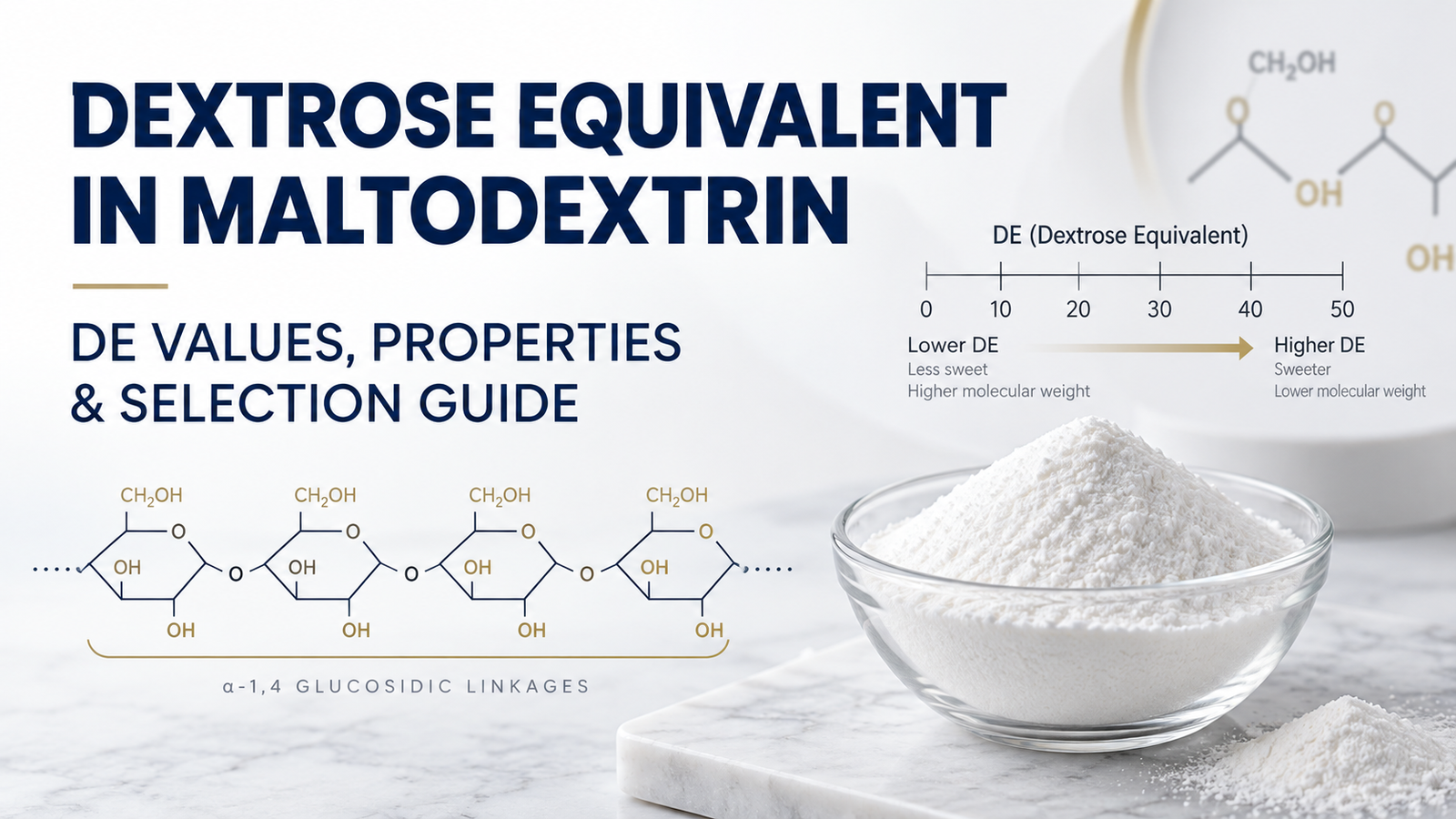
Dextrose equivalent is one of the key technical parameters used to describe maltodextrin, but it is often misunderstood during ingredient selection. Usually shown as a DE value in product specifications, it reflects the extent to which starch has been hydrolyzed into shorter carbohydrate chains. This measurement can help food manufacturers anticipate how a maltodextrin grade may behave in a formulation.
The maltodextrin DE value can influence sweetness, viscosity, solubility, hygroscopicity and browning tendency. However, a higher number does not automatically indicate better quality, nor does it represent the actual percentage of dextrose in the product. Instead, different DE ranges provide different functional characteristics.
A lower-DE grade may be preferred when greater body and limited sweetness are required, while a higher-DE grade may offer better solubility and a somewhat sweeter profile. This guide explains what dextrose equivalent means, how common DE ranges compare, how DE affects maltodextrin properties, and what manufacturers should review in specifications and certificates of analysis before selecting a grade.
What Is Dextrose Equivalent?
Dextrose equivalent, commonly abbreviated as DE, is a numerical measurement used to describe the amount of reducing sugars present in a starch-derived ingredient, expressed as dextrose on a dry-weight basis. In practical terms, it indicates the degree of starch hydrolysis that has taken place during production.
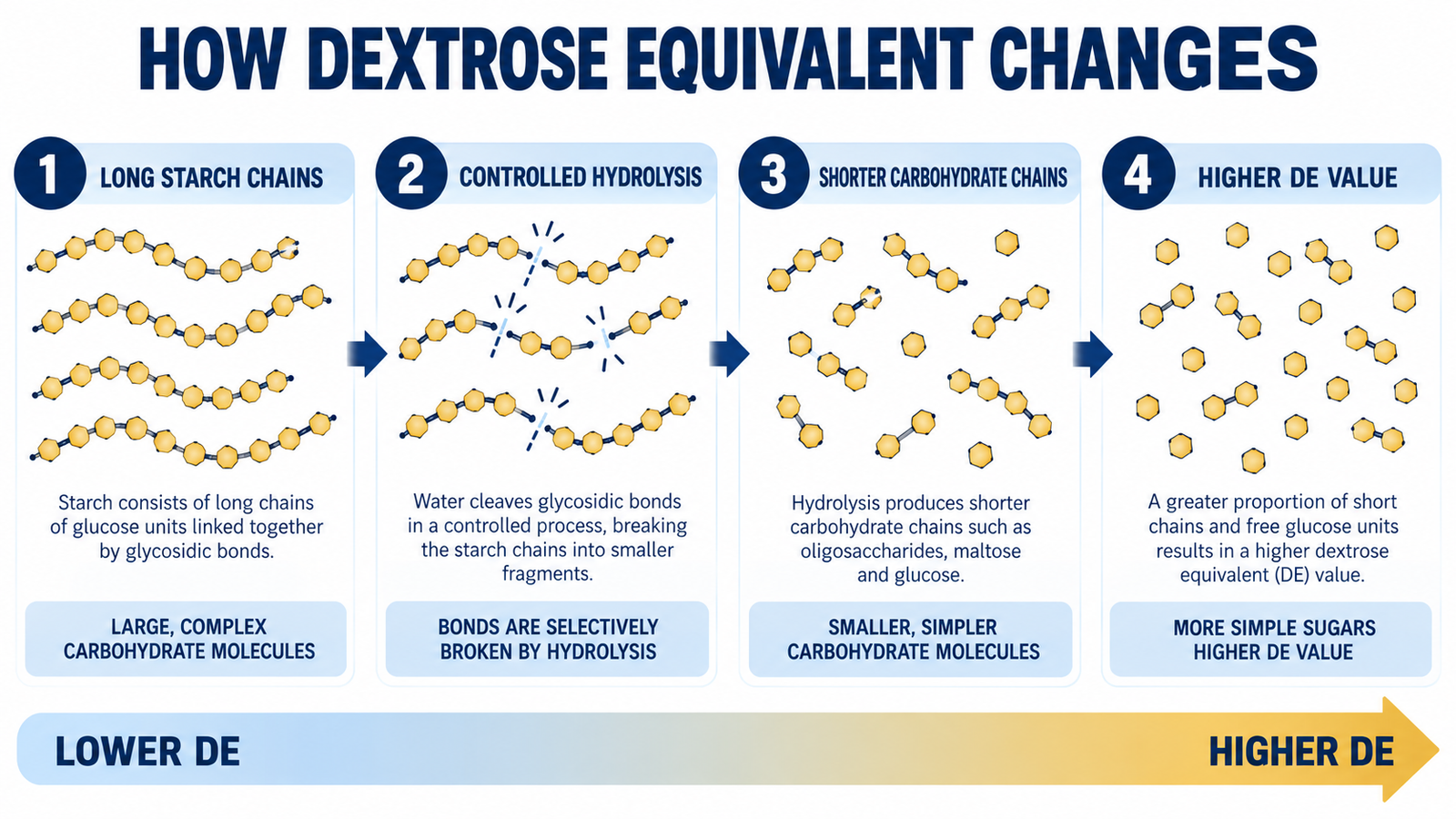
Native starch consists mainly of long carbohydrate chains and has a DE value close to zero. As hydrolysis breaks these chains into smaller molecules, the reducing activity of the material increases, resulting in a higher DE value.Pure dextrose is used as the reference point and has a DE of 100, although its composition and functional properties differ significantly from maltodextrin. Maltodextrin falls between these two ends of the scale, although its specific range depends on the product grade and the standard being applied.
Understanding the dextrose equivalent meaning is important because the number reflects the overall reducing power of the carbohydrate mixture—not the exact percentage of free dextrose it contains. For example, a material with a DE of 15 does not necessarily contain 15% dextrose. Its measured value may result from a mixture of carbohydrate chains with different lengths and molecular sizes.
DE should therefore be treated as a useful classification and formulation parameter rather than a complete description of the ingredient. Two maltodextrin products with similar DE values may still differ in moisture, particle size, bulk density, dispersibility and processing performance. Manufacturers should consider DE together with the complete product specification and actual application requirements.
Dextrose Equivalent in Maltodextrin
Maltodextrin is produced through the controlled hydrolysis of starch obtained from sources such as corn, wheat, potato or tapioca. During this process, longer starch molecules are broken into shorter carbohydrate chains. The extent of this breakdown determines the maltodextrin dextrose equivalent and helps manufacturers classify the resulting product into an appropriate grade.
Commercial products may be identified by a target value or a specified maltodextrin DE range. Common examples include grades with DE values around 10–12, 15–18 or 18–20, although the exact ranges vary among manufacturers. For the U.S. market, the FDA definition describes maltodextrin as having a dextrose equivalent of less than 20, although manufacturers should still confirm the requirements applicable to each target market.However, buyers should always confirm the applicable regulatory definition, regional requirements and individual supplier specification rather than relying on a general industry range.
The DE value of maltodextrin provides a useful indication of its expected functional behavior. Lower-DE products contain a greater proportion of longer carbohydrate chains, while higher-DE products generally contain more short-chain carbohydrates. This difference helps explain variations in sweetness, viscosity, solubility and moisture sensitivity among maltodextrin grades.
Nevertheless, the maltodextrin DE value does not describe every relevant product characteristic. Two grades with similar DE values may be produced from different starch sources or may differ in particle size, bulk density, moisture content and agglomeration. These factors can affect dispersion, powder handling and performance in the final formulation.
For this reason, DE is best used as an initial grade-selection parameter. Food manufacturers should compare the complete technical specification, review representative batch data and conduct application testing before approving a maltodextrin product.
Dextrose Equivalent Chart for Maltodextrin
The following dextrose equivalent chart provides a general comparison of commonly encountered maltodextrin DE ranges. It can be used as an initial reference when comparing grades, but the boundaries and measured properties may vary by supplier.
Approximate DE range | Hydrolysis level | Relative sweetness | Relative viscosity | Solubility tendency | General functional direction |
|---|---|---|---|---|---|
| Below 10 | Lower | Very low | Higher | Moderate | Body, bulk and texture support |
| 10–15 | Low to moderate | Low | Moderately high | Moderate to good | Bulking, carrier and mouthfeel functions |
| 15–18 | Moderate | Slightly higher | Moderate to lower | Good | Balanced solubility and solids contribution |
| 18–20 | Relatively higher | Higher within the maltodextrin range | Lower | Generally higher | Faster dissolution and lower-viscosity applications |
In general, low-DE maltodextrin contains a greater proportion of longer carbohydrate chains. It tends to provide more body and viscosity while contributing limited sweetness. As the DE value increases, the average chain length decreases. Higher-DE maltodextrin therefore tends to be more soluble, somewhat sweeter and less viscous under comparable formulation conditions.
These relationships should be interpreted as trends rather than fixed performance guarantees. Maltodextrins with the same stated DE may behave differently because of their starch source, solids concentration, particle size, production process or degree of agglomeration. Temperature, pH and interactions with proteins, minerals and other carbohydrates can also affect final performance.
The classification limit should also be checked carefully. Under many commonly used definitions, products with a DE below 20 may be classified as maltodextrin, while more extensively hydrolyzed products may fall into another starch-hydrolysate category. Buyers should therefore confirm the supplier’s stated maltodextrin DE range, the applicable regional standard and the complete specification before selecting a grade.
How DE Value Affects Maltodextrin Properties
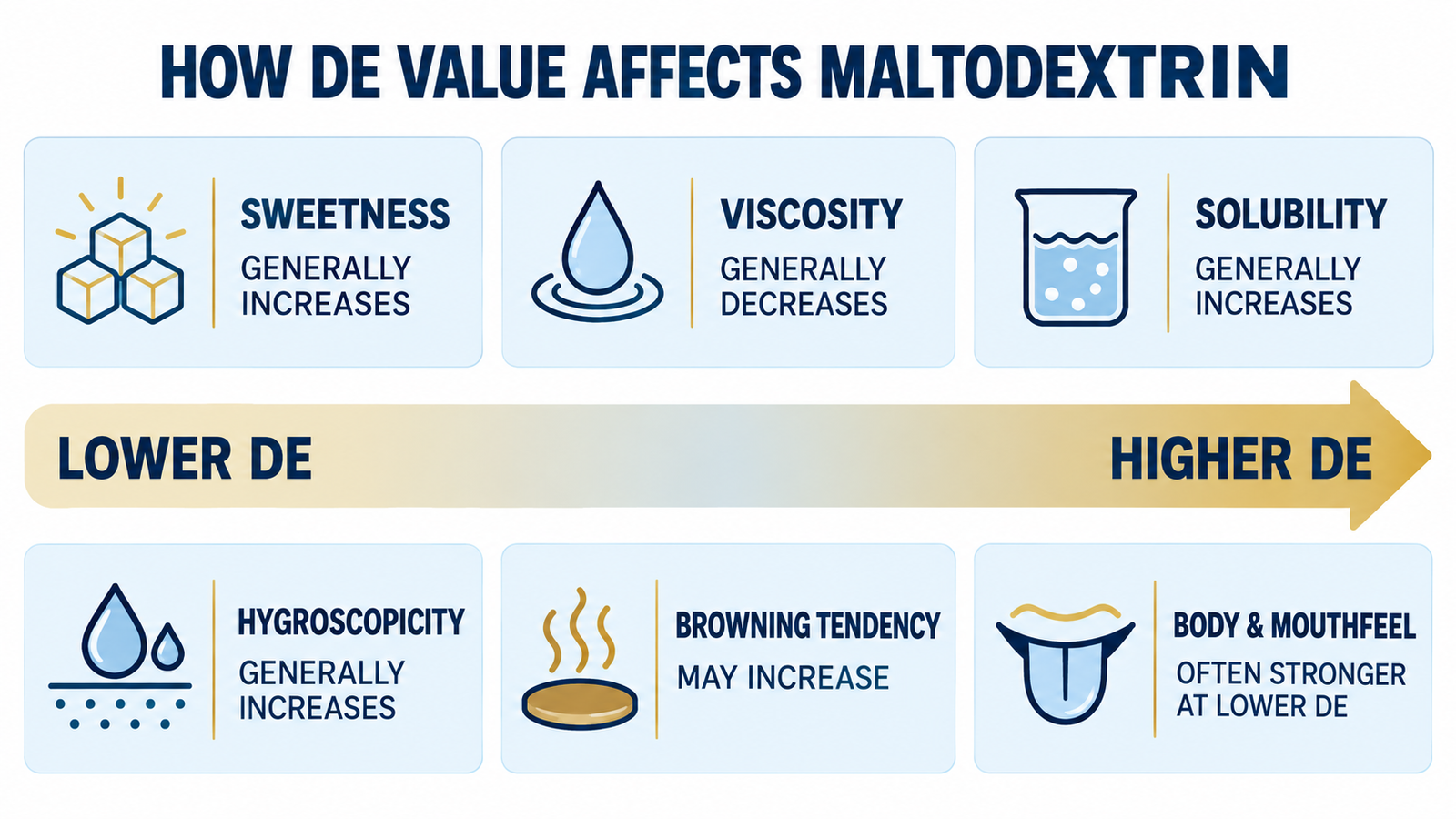
Understanding how DE value affects maltodextrin begins with carbohydrate chain length. As starch hydrolysis progresses, long molecular chains are divided into smaller units and the maltodextrin DE value rises. This structural change influences several properties that food manufacturers evaluate during grade selection.
Sweetness
Maltodextrin is generally much less sweet than dextrose or sucrose. However, sweetness tends to increase as DE rises because higher-DE grades contain a greater proportion of shorter carbohydrate chains. The difference may be useful when balancing solids and sweetness, but the actual sensory result also depends on the other sweeteners and flavor ingredients in the formulation.
Viscosity
Under comparable solids concentration and processing conditions, low-DE maltodextrin generally produces greater viscosity than a higher-DE grade. Its longer carbohydrate chains provide more body and structural contribution. However, concentration, temperature, shear and interactions with other ingredients must also be considered when predicting final viscosity.
Solubility and Dispersion
Solubility usually improves as DE increases and average chain length decreases. A higher-DE maltodextrin may therefore be suitable for systems requiring easier dissolution or relatively low viscosity. Dispersion is not determined by DE alone, however. Particle size, agglomeration, powder addition rate and mixing conditions can substantially affect lump formation and hydration speed.
Hygroscopicity
Higher-DE grades tend to attract moisture more readily because they contain more short-chain carbohydrates. This may increase the risk of caking or reduced powder flow during storage. Packaging barrier performance, humidity control and resealing practices should therefore be evaluated alongside DE.
Browning Tendency
More extensive hydrolysis generally increases reducing activity. As a result, higher-DE material may contribute more readily to Maillard browning when combined with proteins or amino compounds under heat. Final color development still depends on temperature, moisture, pH, processing time and the complete formulation.
Bulking and Mouthfeel
Low-DE maltodextrin is often selected when a manufacturer needs solids, body or mouthfeel without adding substantial sweetness. Higher-DE grades may provide less viscosity but improved dissolution. The preferred balance depends on whether the formulation prioritizes texture, processability, sweetness control or powder stability.
These relationships make DE a useful screening parameter, but maltodextrin properties should ultimately be confirmed through complete specification review and application testing.
Choosing a Maltodextrin DE Value by Application
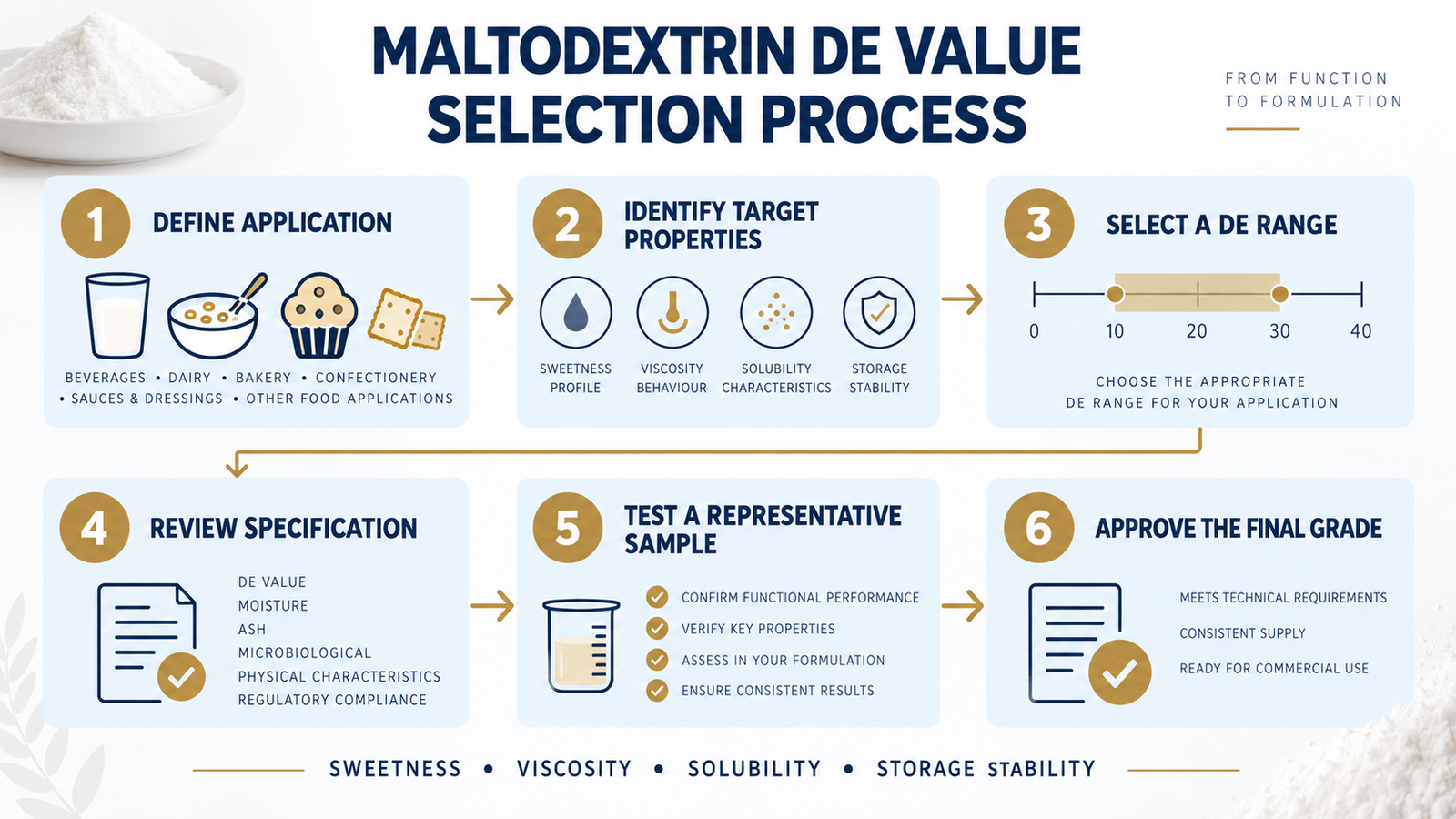
Choosing a maltodextrin DE value requires more than matching a number to a product category. The appropriate maltodextrin DE value by application depends on the desired balance of sweetness, viscosity, solubility, moisture sensitivity and processing performance.
Beverages and Instant Dry Mixes
When selecting maltodextrin for beverages, manufacturers should consider dissolution speed, viscosity, flavor impact and the required solids level. A relatively higher-DE grade may offer easier dissolution and lower viscosity, which can be useful in concentrated or instant systems. However, increased hygroscopicity may require closer attention to packaging and powder storage. Beverage clarity and compatibility with acids, minerals and sweeteners should also be tested.
Bakery and Confectionery
Bakery and confectionery formulations may use maltodextrin to contribute bulk, manage sweetness or adjust texture. A lower-DE grade can provide body with limited sweetness, while a higher-DE grade may dissolve more easily but contribute more reducing activity. Manufacturers should evaluate browning, moisture retention, dough or batter behavior and the texture of the finished product rather than selecting a grade based on DE alone.
Dairy and Frozen Products
In dairy and frozen systems, the required grade depends on the target mouthfeel, solids content and processing conditions. A lower-DE product may support body, while a higher-DE product may provide easier incorporation. Protein interactions, freezing behavior, stabilizer systems and storage conditions can change the final result, so application trials remain necessary.
Flavor Carriers and Spray Drying
When selecting maltodextrin for spray drying, manufacturers typically examine feed viscosity, solubility, encapsulation performance, powder recovery and storage stability. Lower-DE grades may provide useful film-forming and carrier properties, but excessive viscosity can limit the workable solids level. Higher-DE grades may improve solubility while increasing moisture sensitivity.
Nutrition Powders and Instant Products
Nutrition powders require a balance between dispersibility, mouthfeel, sweetness and powder stability. The preferred grade may also depend on interactions with proteins, minerals, vitamins and flavors. Agglomeration and particle size can be as important as DE when evaluating instant performance.
DE should therefore be used to narrow the initial grade options—not to make the final decision. Pilot testing under actual processing and storage conditions is essential before commercial approval.
Reviewing DE Value in Specifications and COA
Reviewing the DE value in specifications and COA documents helps manufacturers confirm that a selected grade meets both formulation and quality requirements. The product specification and certificate of analysis serve different purposes and should be evaluated together.
A maltodextrin specification normally states the acceptable DE range that the supplier commits to maintaining. For example, a grade may be defined by a range rather than one fixed value. Buyers should confirm that this range is suitable for the intended application and determine whether it is broad enough to cause noticeable differences in processing or finished-product performance.
A maltodextrin COA reports the test result for a specific production batch. The DE value in a maltodextrin COA should fall within the approved specification. When consistency is especially important, manufacturers may also compare results from several representative batches rather than relying on a single document.
The document review should cover:
- The specified DE range and actual batch result
- The analytical method or referenced standard
- Moisture content and solubility
- Particle size or bulk density, when relevant
- Microbiological limits
- Packaging and storage requirements
- Batch-to-batch consistency
DE should not be reviewed in isolation. A food-grade maltodextrin may meet its DE requirement while differing in moisture, powder flow, dispersibility or microbial quality. These characteristics can influence handling and formulation performance even when the DE results are similar.
Before approving a supplier or grade, manufacturers should follow a structured specification and COA evaluation process, test a representative sample and, where appropriate, conduct a pilot-scale production trial. This process confirms that the material performs consistently under the actual formulation, processing and storage conditions.
Frequently Asked Questions
What does dextrose equivalent mean?
Dextrose equivalent indicates the reducing power of a starch-derived carbohydrate ingredient, expressed as dextrose on a dry-weight basis. It is commonly used to describe the degree of starch hydrolysis. A higher DE generally means that more long starch chains have been broken into shorter carbohydrate molecules.
What is the typical DE value of maltodextrin?
Under many commonly used definitions, maltodextrin has a DE value below 20. Commercial grades may be supplied in ranges such as 10–12, 15–18 or 18–20. Exact classifications and available ranges vary, so manufacturers should check the applicable standard and individual supplier specification.
Does a higher DE value mean greater sweetness?
Generally, yes. Sweetness tends to increase with DE because a higher-DE product contains a greater proportion of shorter carbohydrate chains. However, the difference may not be equally noticeable in every formulation. Overall sweetness also depends on the grade, concentration and other sweetening ingredients used in the product.
Is DE value the same as dextrose content?
No. DE value and the actual dextrose content of a food ingredient are not interchangeable measurements.DE represents the total reducing activity of the carbohydrate mixture relative to dextrose. A maltodextrin with a DE of 15 does not necessarily contain 15% free dextrose because multiple chain lengths contribute to the measured result.
How should manufacturers select a maltodextrin DE value?
Manufacturers should begin with the required sweetness, viscosity, solubility, mouthfeel and moisture stability. They should then compare suitable grades through specifications, COA results and representative samples. Final approval should be based on testing under actual formulation, processing, packaging and storage conditions rather than DE alone.
Conclusion
Dextrose equivalent is an important parameter for understanding how extensively starch has been hydrolyzed and how a maltodextrin grade may perform in food manufacturing. Changes in the maltodextrin DE value can influence sweetness, viscosity, solubility, moisture sensitivity, browning behavior and mouthfeel.
However, DE should not be treated as a complete measure of product quality or as the actual percentage of dextrose in the material. Starch source, particle characteristics, moisture and processing conditions may also affect performance.
Before approving a grade, food manufacturers should define their formulation priorities, compare the full specification, review batch-specific COA results and test representative samples. Combining technical documentation with application trials provides a more reliable basis for selecting a consistent and suitable maltodextrin product.