



- Your cart is empty Browse Shop
Dextrose Monohydrate: Properties & Food Ingredient Guide
Introduction
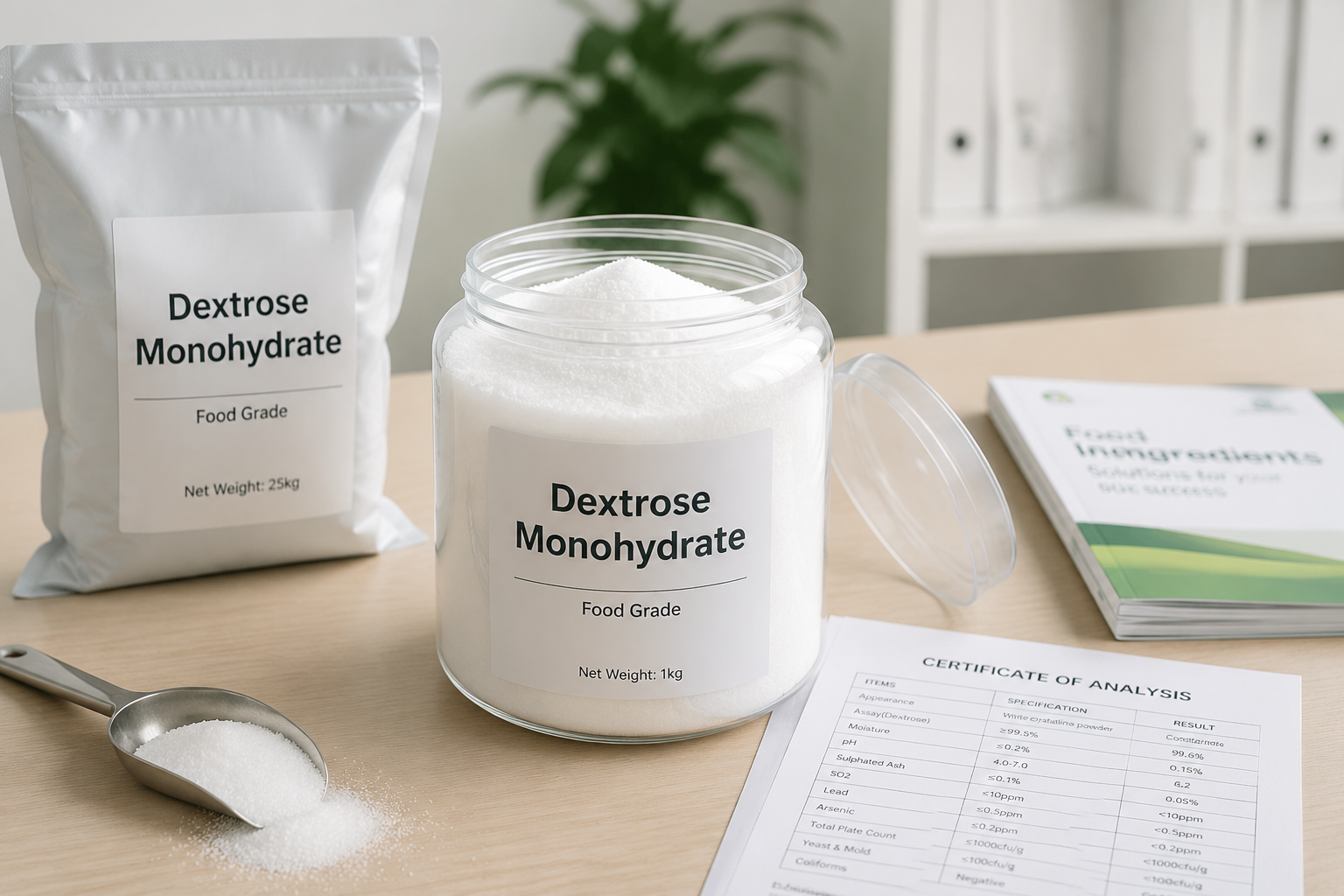
Dextrose monohydrate is a widely used carbohydrate ingredient in the food industry, valued for its mild sweetness, high solubility, and functional versatility. From bakery products and beverages to confectionery and processed foods, it is commonly used by manufacturers to improve formulation performance and maintain consistent product quality across different food ingredient applications.
For food producers, choosing the right glucose ingredient is not only about sweetness. Factors such as purity, processing characteristics, supply consistency, and documentation support also play an important role in ingredient selection.
This guide explains what dextrose monohydrate is, how it is produced, its main food applications, and the key considerations manufacturers should evaluate when sourcing this ingredient.
For a broader overview of specifications, food grade requirements, and sourcing considerations, see our dextrose monohydrate guide.
What Is Dextrose Monohydrate?
Dextrose monohydrate is a crystalline form of glucose that contains one molecule of water within its molecular structure. It is produced from starch-based raw materials through controlled hydrolysis and purification processes, followed by crystallization and drying.Dextrose is also available in an anhydrous form. Manufacturers can review the differences between dextrose monohydrate and dextrose anhydrous when selecting an ingredient for moisture-sensitive formulations.
Chemically, dextrose monohydrate is a form of D-glucose, a simple carbohydrate that provides sweetness and functional properties in various food formulations.
Compared with other sweeteners, dextrose monohydrate has several characteristics that make it suitable for industrial food applications:
Property | Description |
|---|---|
| Appearance | White crystalline powder |
| Taste | Mild sweet taste |
| Solubility | Highly soluble in water |
| Form | Glucose monohydrate crystal |
| Function | Sweetening, texture adjustment, fermentation support |
Because of its consistent quality and predictable performance, dextrose monohydrate is commonly selected by food manufacturers that require reliable ingredient performance across different production batches.
Dextrose Monohydrate Powder Characteristics
In commercial food production, dextrose monohydrate is typically supplied as a fine white powder. Its powder form allows easy handling, accurate dosing, and efficient mixing during manufacturing.
Key characteristics include:
- Good water solubility — allowing smooth incorporation into liquid and semi-liquid formulations.
- Controlled sweetness profile — providing sweetness while balancing other ingredients.
- Stable processing performance — supporting consistent results in large-scale production.
For manufacturers, these properties make dextrose monohydrate a practical ingredient choice for applications where formulation consistency and production efficiency are important.
How Is Dextrose Monohydrate Produced?
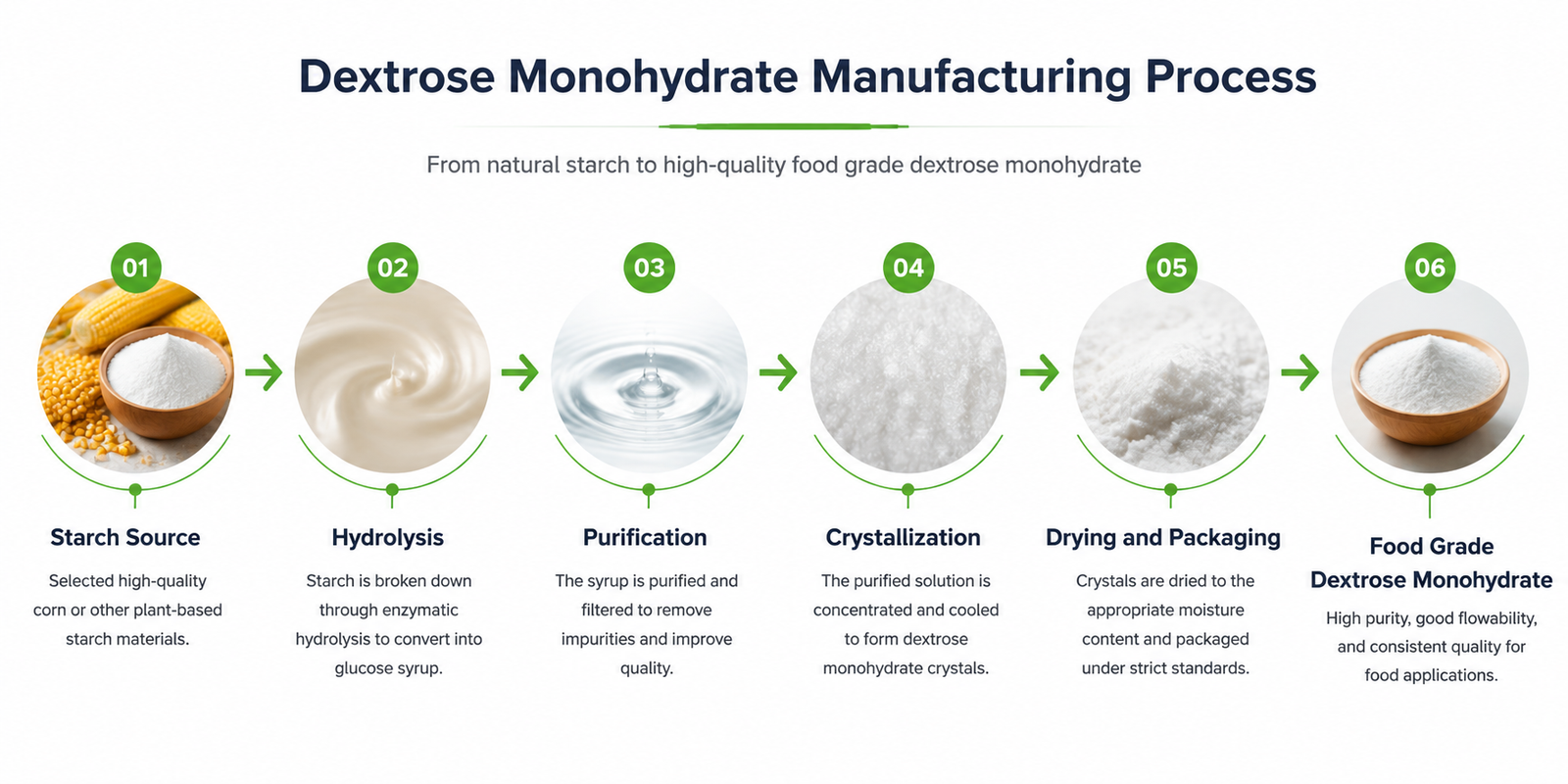
The production of dextrose monohydrate involves several controlled processing steps to convert starch-based raw materials into a purified glucose ingredient.
Although the manufacturing process varies slightly depending on production facilities and quality requirements, the general process includes starch conversion, purification, crystallization, and drying.
Understanding this process helps food manufacturers better evaluate ingredient quality and consistency when selecting a dextrose monohydrate supplier.
1. Starch Hydrolysis
Dextrose monohydrate is commonly produced from starch sources such as corn or other plant-based starch materials.
During the first stage, starch is broken down through enzymatic or acid hydrolysis. The long-chain starch molecules are converted into glucose syrup through controlled reactions.
The hydrolysis process directly influences the final glucose quality, including sweetness profile, purity, and processing performance.
2. Purification and Filtration
After hydrolysis, the glucose syrup undergoes purification steps to remove unwanted components and improve product quality.
Common purification processes include:
- Filtration
- Color removal
- Mineral removal
- Concentration adjustment
These steps help achieve a cleaner glucose solution suitable for food-grade applications.
For industrial food production, consistent purification is important because variations in raw materials or processing conditions can affect the final ingredient performance.
3. Crystallization Process
The purified glucose solution is concentrated and gradually cooled under controlled conditions to form dextrose crystals.
During crystallization, water molecules become part of the crystal structure, creating dextrose monohydrate.
This controlled crystallization stage determines important characteristics such as:
- Crystal size
- Moisture content
- Solubility
- Appearance
A stable crystallization process helps ensure that each batch meets expected quality specifications.
4. Drying and Packaging
After crystallization, the dextrose monohydrate crystals are separated, dried, and prepared for packaging.
The final product is typically a white crystalline powder with good flowability and handling properties, making it suitable for transportation and large-scale food manufacturing.
Professional suppliers usually provide supporting quality documents, such as product specifications and Certificates of Analysis (COA), to help manufacturers verify product consistency.
Dextrose Monohydrate Manufacturing Process Overview
The complete production flow can be summarized as:
Starch Source
↓
Hydrolysis
↓
Purification
↓
Crystallization
↓
Drying and Packaging
↓
Food Grade Dextrose Monohydrate
Key Food Applications of Dextrose Monohydrate
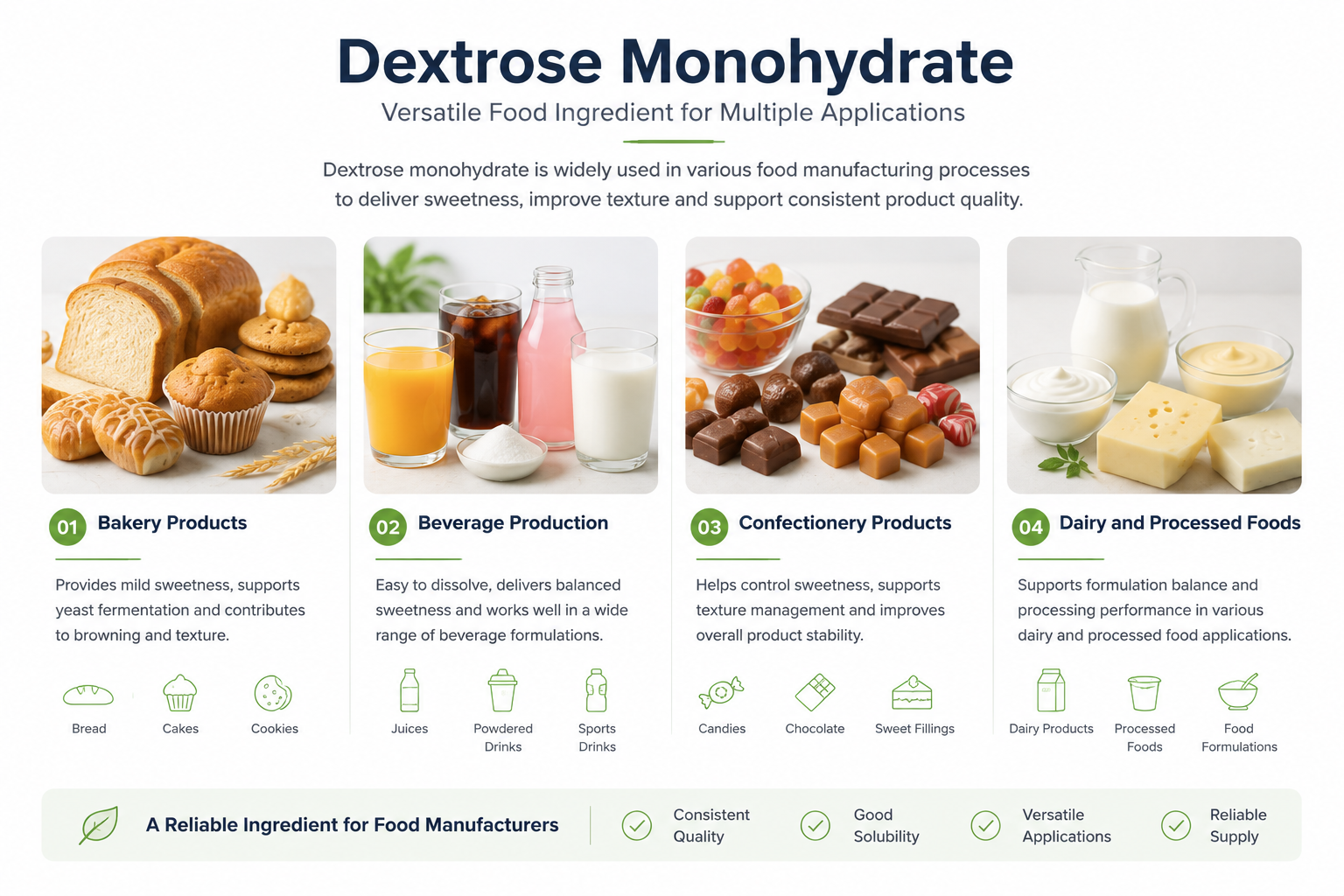
Dextrose monohydrate is widely used across the food industry because of its balanced sweetness, good solubility, and functional properties in different food manufacturing applications.
Unlike sweeteners that are mainly added for taste, dextrose monohydrate can also influence processing performance, texture, fermentation behavior, and product consistency.
For food manufacturers, understanding where and why dextrose monohydrate is used helps with better ingredient selection and formulation decisions.
1. Bakery Products
Bakery manufacturing is one of the common application areas for dextrose monohydrate.
In bread, cakes, cookies, and other baked goods, dextrose monohydrate can serve multiple functions:
- Providing mild sweetness
- Supporting yeast fermentation
- Contributing to browning reactions during baking
- Helping maintain consistent product characteristics
Compared with sucrose, dextrose has different functional properties during processing, which allows manufacturers to adjust sweetness levels and optimize product formulation.
For industrial bakery production, ingredient consistency is especially important because even small variations can affect dough performance, appearance, and final product quality.
2. Beverage Applications
Dextrose monohydrate is also used in various beverage formulations, including nutritional drinks, powdered beverage mixes, and other functional beverage products.
Its high solubility makes it easy to incorporate into liquid systems, while its mild sweetness allows manufacturers to balance flavor profiles without overpowering other ingredients.
Common benefits in beverage applications include:
- Easy dissolution
- Consistent sweetness distribution
- Support for carbohydrate-based formulations
For beverage manufacturers, selecting a reliable dextrose ingredient helps ensure stable production results across different batches.
3. Confectionery Products
In confectionery production, dextrose monohydrate can contribute to sweetness control and texture management.
It is commonly considered in products such as:
- Candies
- Chocolate-related products
- Sweet fillings
- Dessert ingredients
Because glucose-based ingredients can influence crystallization behavior, manufacturers may use dextrose monohydrate to achieve desired texture and product stability.
The appropriate selection and dosage depend on the specific formulation requirements and production process.
4. Dairy and Processed Food Applications
Dextrose monohydrate can also be used in selected dairy and processed food formulations.
Its functional characteristics make it suitable for products where manufacturers need:
- Controlled sweetness
- Improved formulation balance
- Consistent ingredient performance
Depending on the product category, dextrose monohydrate may be combined with other ingredients to achieve the desired taste, texture, and processing characteristics.For a more detailed explanation of sweetness, fermentation, browning, crystallization and texture, read our guide to Dextrose Monohydrate uses in food manufacturing.
Why Food Manufacturers Choose Dextrose Monohydrate
Across different food applications, manufacturers typically consider dextrose monohydrate because of several practical advantages:
Consistent Processing Performance
Food production requires ingredients that perform reliably from batch to batch. Stable quality helps manufacturers maintain predictable results during large-scale production.
Good Solubility
The powder form allows efficient mixing and easy integration into different formulations.
Versatile Application Range
From bakery products to beverages and confectionery, dextrose monohydrate can support various food manufacturing needs.
Dextrose Monohydrate Applications Overview
| Application | Main Functions |
|---|---|
| Bakery Products | Sweetness adjustment, fermentation support, browning |
| Beverages | Solubility, sweetness balance, carbohydrate source |
| Confectionery | Texture control, sweetness adjustment |
| Dairy & Processed Foods | Formulation balance and processing support |
Dextrose Monohydrate vs Dextrose Anhydrous: What Is the Difference?
When selecting a glucose-based ingredient, food manufacturers often compare dextrose monohydrate and dextrose anhydrous.
Although both ingredients are forms of glucose and share similar functional characteristics, they differ mainly in their water content, production form, and suitability for specific applications.
Understanding these differences helps manufacturers choose the right ingredient based on formulation requirements and processing conditions.
1. Molecular Structure and Water Content
The main difference between dextrose monohydrate and dextrose anhydrous is the presence of crystallized water.
Dextrose monohydrate contains one molecule of water within its crystal structure, while dextrose anhydrous has no bound water.
This difference affects certain physical properties, including moisture content, stability requirements, and handling characteristics.
2. Comparison of Dextrose Monohydrate and Dextrose Anhydrous
| Feature | Dextrose Monohydrate | Dextrose Anhydrous |
|---|---|---|
| Chemical form | Glucose with one water molecule | Glucose without crystal water |
| Moisture content | Contains bound water | Lower moisture content |
| Appearance | White crystalline powder | White crystalline powder |
| Sweetness profile | Similar glucose sweetness | Similar glucose sweetness |
| Common consideration | General food applications | Applications requiring lower moisture |
3. Application Considerations
For many food manufacturing applications, dextrose monohydrate is selected because it provides reliable performance, good solubility, and broad compatibility with different formulations.
It is commonly considered for:
- Bakery products
- Beverage formulations
- Confectionery products
- Processed foods
Dextrose anhydrous may be preferred in applications where moisture control is a more important factor.
The final choice depends on several factors, including:
- Product formulation
- Processing conditions
- Storage requirements
- Desired ingredient characteristics
4. How Manufacturers Choose Between Them
When evaluating dextrose ingredients, manufacturers typically consider more than just the ingredient name.
Important factors include:
Product Specifications
Parameters such as moisture content, purity, and physical characteristics should match the requirements of the final product.
Processing Requirements
Different production processes may have different requirements regarding solubility, handling, and moisture control.
Supply Consistency
Stable quality and reliable documentation help manufacturers maintain consistent production performance.
In summary, dextrose monohydrate and dextrose anhydrous are both important glucose ingredients used in food manufacturing. The right choice depends on the specific application, formulation goals, and production requirements.
How to Choose a Reliable Dextrose Monohydrate Supplier
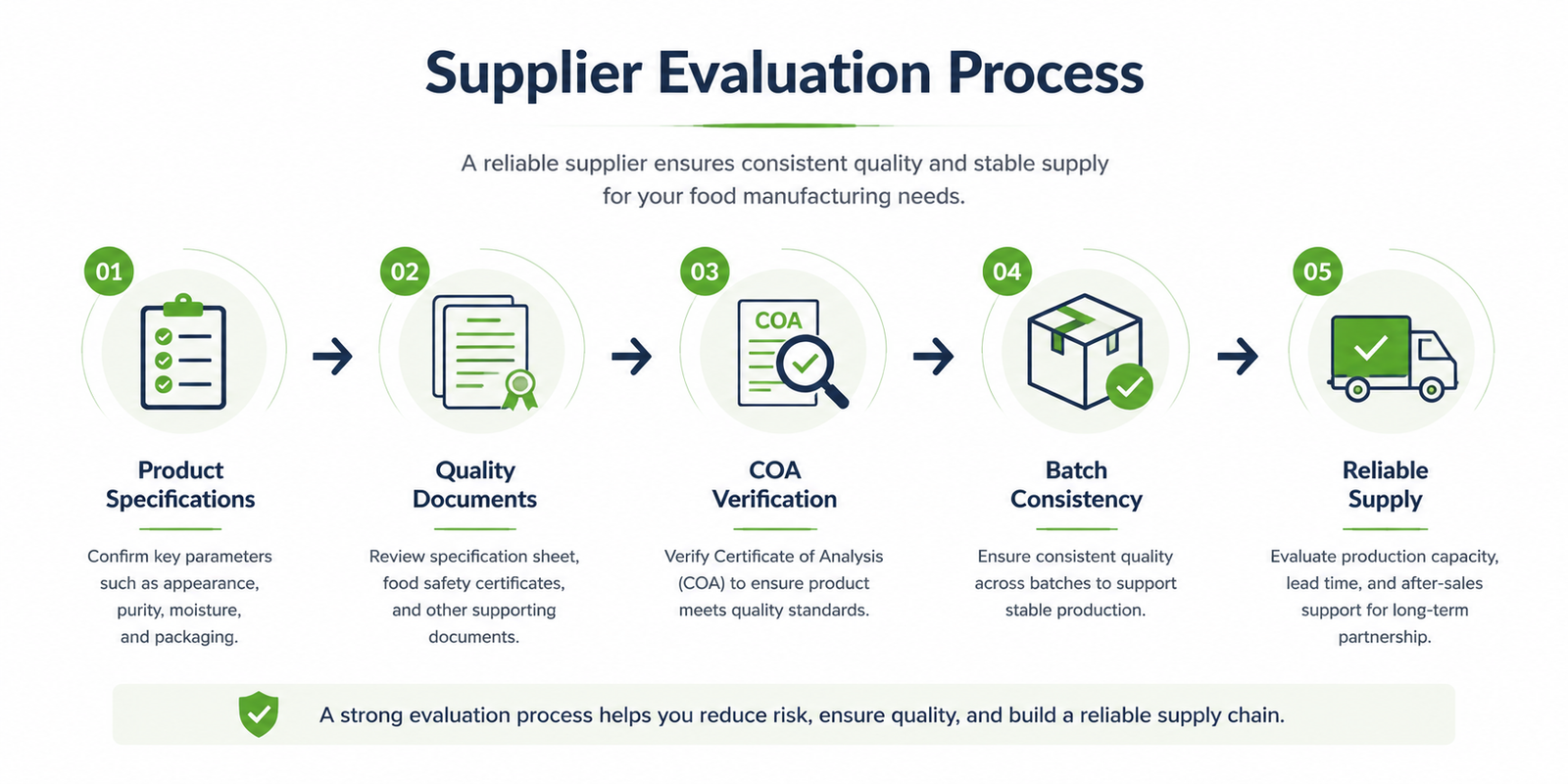
Selecting a dextrose monohydrate supplier involves more than comparing prices. For food manufacturers, ingredient quality, supply reliability, and technical support all contribute to long-term production stability.
A dependable supplier should be able to provide consistent products, transparent documentation, and responsive service throughout the purchasing process.
Below are several factors manufacturers commonly evaluate when sourcing food-grade dextrose monohydrate.
1. Verify Product Quality
Product quality should always be the starting point when evaluating a supplier.
A reliable supplier should provide clear specifications that describe important quality parameters, such as:
- Appearance
- Purity
- Moisture content
- Solubility
- Packaging specifications
Reviewing these details before placing an order helps ensure the ingredient matches your formulation and production requirements.
2. Request Quality Documentation
Professional ingredient suppliers should be able to provide documentation that supports product quality and traceability.
Common documents include:
- Certificate of Analysis (COA)
- Product Specification Sheet
- Food Safety Documentation
- Technical Data Sheet (when available)
These documents help purchasing teams verify product consistency and simplify internal quality approval procedures.
3. Evaluate Supply Stability
Reliable supply is just as important as product quality.
Manufacturers often consider questions such as:
- Can the supplier maintain consistent batch quality?
- Is production capacity sufficient for long-term cooperation?
- Are delivery schedules reliable?
- Can the supplier support repeat orders without significant variation?
A stable supply chain helps reduce production risks and improve inventory planning.
4. Consider Technical and Customer Support
Good suppliers do more than deliver products. They also provide timely communication and technical assistance when needed.
Whether discussing product specifications, packaging options, or export documentation, responsive support can make the purchasing process more efficient.
This is particularly valuable for international buyers who may have additional requirements related to shipping, compliance, or documentation.
Supplier Evaluation Checklist
When comparing potential suppliers, manufacturers may use a simple evaluation checklist:
| Evaluation Item | Why It Matters |
|---|---|
| Product Specifications | Confirms the ingredient meets formulation requirements |
| Quality Documents | Verifies consistency and traceability |
| Production Capacity | Supports long-term supply stability |
| Batch Consistency | Reduces variation in manufacturing |
| Technical Support | Improves communication and purchasing efficiency |
Choosing the right supplier is ultimately about reducing risk and building a reliable partnership. A supplier that consistently delivers quality products, complete documentation, and dependable service can help manufacturers maintain stable production and meet their own customer expectations.
Frequently Asked Questions About Dextrose Monohydrate
What is dextrose monohydrate used for?
Dextrose monohydrate is commonly used as a functional carbohydrate ingredient in food manufacturing.
It is widely applied in products such as bakery goods, beverages, confectionery, and processed foods. Depending on the formulation, it can provide sweetness, support fermentation, improve processing performance, and help maintain consistent product characteristics.
The specific application depends on the product category, manufacturing process, and desired formulation results.
Is dextrose monohydrate the same as glucose?
Yes. Dextrose is another name commonly used for D-glucose, which is a simple sugar naturally found in many plants.
Dextrose monohydrate refers specifically to a crystalline form of glucose that contains one molecule of water within its structure.
In food manufacturing, the terms glucose and dextrose may sometimes be used interchangeably, but the exact ingredient specification should always be confirmed according to the product requirements.
What is the difference between dextrose monohydrate and dextrose anhydrous?
The main difference is water content.
Dextrose monohydrate contains one molecule of crystallized water, while dextrose anhydrous does not contain bound water in its crystal structure.
Both ingredients provide similar glucose functionality, but manufacturers may select one over the other depending on factors such as moisture requirements, processing conditions, and final product specifications.
How should manufacturers evaluate a dextrose monohydrate supplier?
When choosing a supplier, manufacturers should consider several factors, including product specifications, quality documentation, production capability, and supply reliability.
Important documents such as Certificates of Analysis (COA) and product specification sheets can help buyers verify ingredient consistency and ensure the product meets their manufacturing requirements.
Conclusion
Dextrose monohydrate is a versatile food ingredient widely used across different areas of food manufacturing, including bakery products, beverages, confectionery, and processed foods.
Its consistent performance, good solubility, and flexible application range make it a practical choice for manufacturers looking for reliable glucose-based ingredients.
When sourcing dextrose monohydrate, buyers should evaluate not only product quality but also documentation support, supply stability, and supplier reliability.
Working with a professional ingredient supplier can help manufacturers maintain consistent production performance and build a stable long-term supply chain.