



- Your cart is empty Browse Shop
How to Choose a Dextrose Monohydrate Supplier: Bulk Purchasing and Quality Guide
Introduction
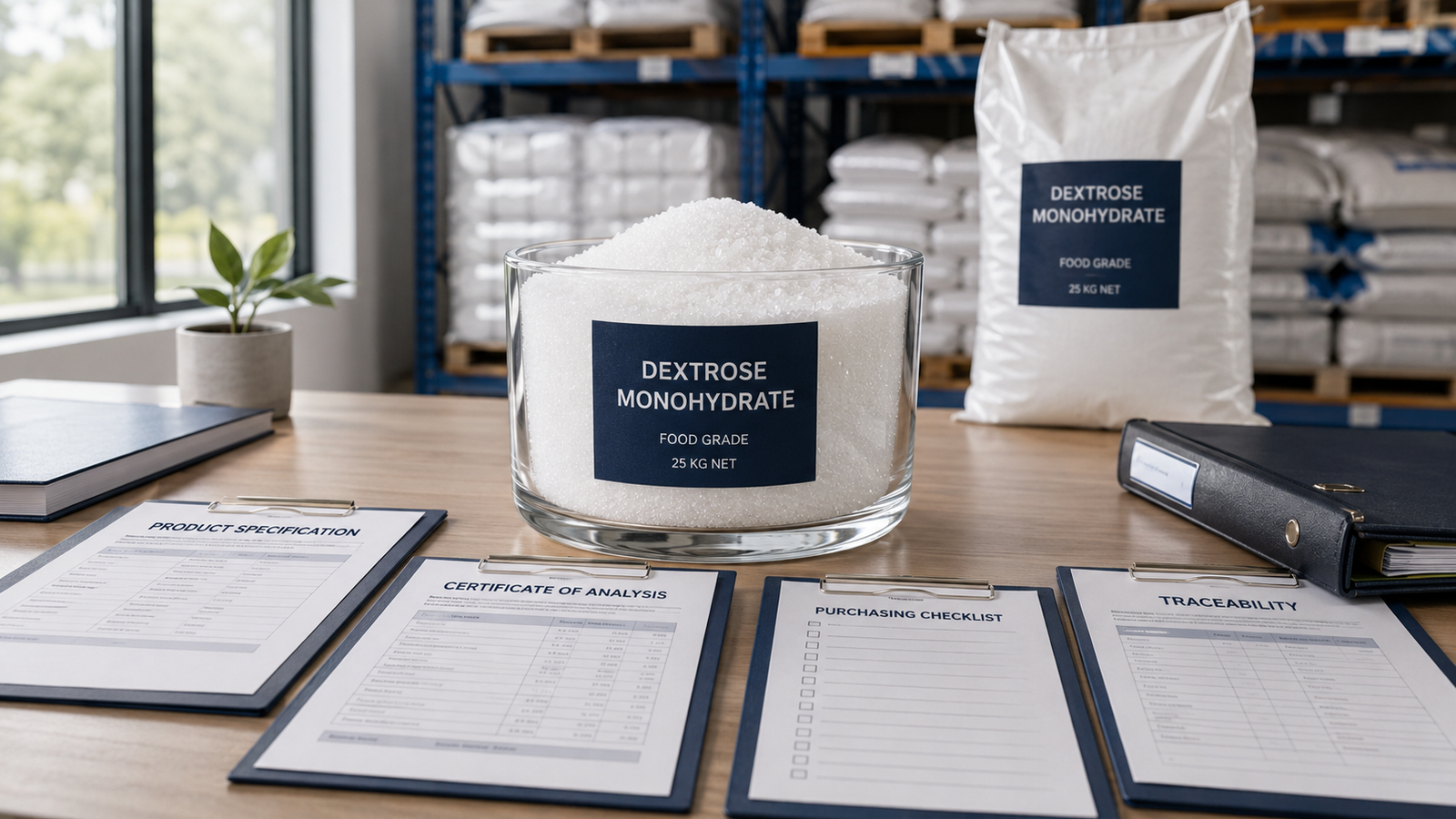
Choosing a reliable dextrose monohydrate supplier requires more than comparing quotations. For food manufacturers and ingredient buyers, product specifications, batch consistency, documentation, packaging and delivery reliability can have a greater long-term impact than the initial unit price.
Buyers sourcing bulk dextrose monohydrate should first define the required grade, application, order volume and packaging format. If OEM/ODM service or custom bulk packaging is needed, these requirements should also be confirmed before requesting quotations. This helps ensure that different suppliers are quoting comparable products and supply conditions.
Technical qualification should begin with the correct form and grade of food-grade dextrose monohydrate, followed by a review of the specification, batch-specific Certificate of Analysis, traceability information and representative samples. Commercial evaluation should then cover minimum order quantity, lead time, packaging suitability, shipping capability and long-term supply consistency.
This guide explains how to compare dextrose monohydrate suppliers for bulk purchasing, evaluate COA and specification documents, assess samples and packaging options, and identify a supply arrangement that remains technically suitable and commercially dependable.
Start by Defining Your Dextrose Monohydrate Requirements
Supplier evaluation should begin with a clear internal purchasing brief. Without one, buyers may receive quotations for different grades, specifications, packaging formats or delivery terms and then compare them as though they represented the same product.
Define the Intended Application
Start with the finished product and the function dextrose monohydrate is expected to perform. A beverage manufacturer may focus on solubility, sweetness and solids contribution, while a bakery producer may be more concerned with fermentation and browning. Frozen-food manufacturers may also need to evaluate effects on texture and freezing behavior. These differences help determine which product characteristics should receive the most attention during supplier qualification.
A more detailed review of dextrose monohydrate uses in food manufacturing can help buyers connect these functional requirements with the appropriate product and testing criteria.
Confirm the Required Form and Grade
The purchasing brief should state whether the formulation requires dextrose monohydrate rather than dextrose anhydrous, since the differences between dextrose anhydrous and dextrose monohydrate can affect moisture contribution, formulation calculations and ingredient selection.Buyers should also define the required food-grade standard, specification limits, particle-size expectations and packaging format. Any market-specific regulatory or customer requirements should be documented before quotations are requested.
Establish Commercial Supply Requirements
Finally, define the practical conditions of supply. These include the quantity needed for initial testing, expected commercial order volume, preferred packaging, delivery destination, purchasing frequency and required lead time. A supplier capable of providing a laboratory sample may not necessarily have the capacity or logistics experience to support recurring bulk orders.
A clear purchasing brief gives every potential source the same basis for quotation. It also allows technical suitability, documentation and commercial terms to be compared consistently rather than evaluated as separate or unrelated factors.
Supplier or Manufacturer: What Is the Difference?
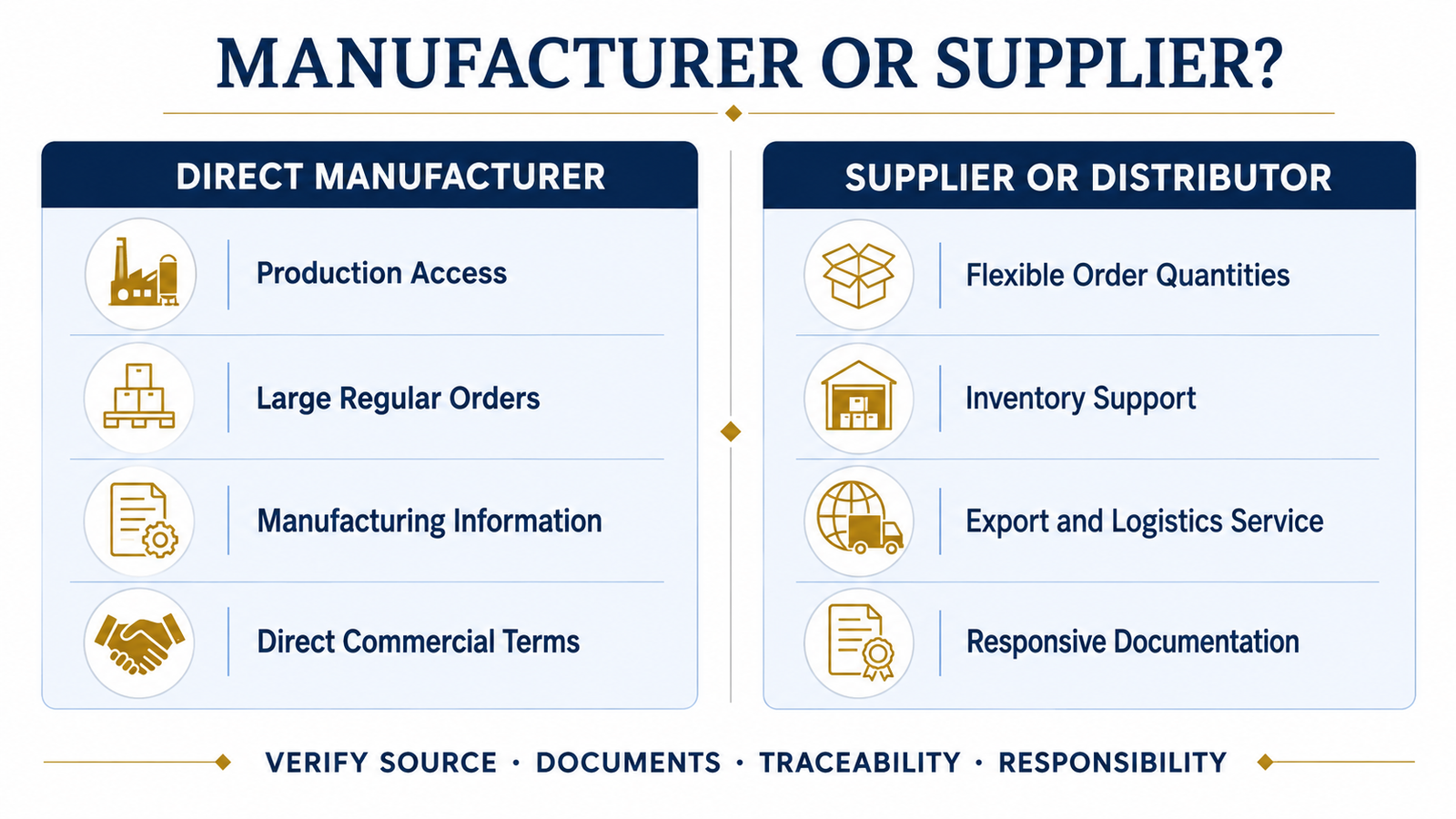
When sourcing dextrose monohydrate, buyers may work directly with a manufacturer or purchase through a supplier or distributor. A manufacturer produces the ingredient, while a supplier may source it from one or more approved production facilities and manage documentation, inventory, export procedures and delivery.
Buying directly from a dextrose monohydrate manufacturer can be practical for large, regular orders, particularly when the buyer requires closer access to production information or customized commercial arrangements. However, direct purchasing does not automatically guarantee shorter lead times, better service or greater flexibility. Minimum order quantities, export capabilities and destination coverage may still limit the arrangement.
A qualified distributor or food ingredient supplier may offer smaller order quantities, local inventory, mixed shipments or more responsive logistics support. The trade-off is that buyers need clear visibility into the original manufacturing source and the relationship between the supplier’s documents and the delivered batch.
For this reason, the decision should not be based on the title “manufacturer” or “supplier” alone. Buyers should confirm who produces the material, who issues the specification and COA, how each lot is traced and which party is responsible if a quality or delivery problem occurs. These checks provide a stronger basis for comparison than the supplier category itself.
Review Specifications, COA and Supporting Documents
Technical documents should be reviewed before suppliers are compared on price. Two quotations may both describe the material as food-grade dextrose monohydrate, yet refer to products with different specification limits, test methods or documentation standards.
Buyers who need a more detailed technical review can refer to this guide to evaluating dextrose monohydrate specifications and COA results before approving a commercial batch.
Review the Product Specification
The product specification defines the requirements that commercial batches are expected to meet. Buyers should first confirm the product name, monohydrate form, grade and applicable standard. The document should then be checked for relevant parameters such as appearance, assay, moisture-related limits, pH, ash, contaminants and microbiological criteria. Particle size may also matter when dissolution, dust control or dry blending is important to the application.
A specification should not be accepted simply because it contains a familiar list of tests. The stated limits must be compared with the buyer’s own requirements, and the units and test methods should be clear enough to support a meaningful evaluation.
Verify the Batch Certificate of Analysis
While the specification describes expected quality, the Certificate of Analysis shows the reported results for an individual lot. A useful dextrose monohydrate COA should identify the product and grade, provide a batch or lot number and report actual results alongside the corresponding specification limits.
Buyers should confirm that the COA belongs to the sample or shipment being evaluated. A generic or undated example may demonstrate the supplier’s document format, but it cannot verify the quality of a specific commercial batch.
Check Supporting Documents for Consistency
Depending on the application and destination market, supporting documents may include a Technical Data Sheet, Safety Data Sheet, allergen statement, GMO statement and relevant food-grade compliance declarations. Although buyers still commonly search for a dextrose monohydrate MSDS, the current document is generally referred to as an SDS.
The same product identity, grade and manufacturing source should remain consistent across the specification, COA and supporting documents. Missing details do not automatically indicate an unsuitable product, but they should be clarified before supplier approval. Reliable documentation is valuable because it connects the offered material, the tested batch and the product ultimately delivered.
Test a Representative Sample in the Actual Application
Document review establishes whether a product meets defined requirements on paper, but application testing shows whether it performs as expected in production. For this reason, buyers should request a representative dextrose monohydrate sample before approving a supplier for bulk purchasing.
The sample should come from normal commercial production rather than a specially prepared laboratory batch. Its lot number should be recorded and matched with a batch-specific COA. This creates a traceable connection between the material tested, its reported quality results and the supplier’s regular production.
Testing should reproduce the intended formulation and processing conditions as closely as practical. Depending on the application, the evaluation may include dissolution, dispersion, sweetness contribution, fermentation behavior, browning during heating or effects on texture and freezing performance. Compatibility with other ingredients should also be observed because an acceptable result in water alone may not predict performance in a complete food system.
Approval criteria should be defined before the trial. Instead of relying on a general impression that the sample “works,” the technical team should record measurable or observable requirements relevant to the finished product.
Sample approval is not the final step. When the first commercial shipment arrives, its identity, COA and application performance should be compared with the approved sample. This helps determine whether the supplier can reproduce the quality that originally supported the purchasing decision.
Evaluate Packaging, Storage and Traceability
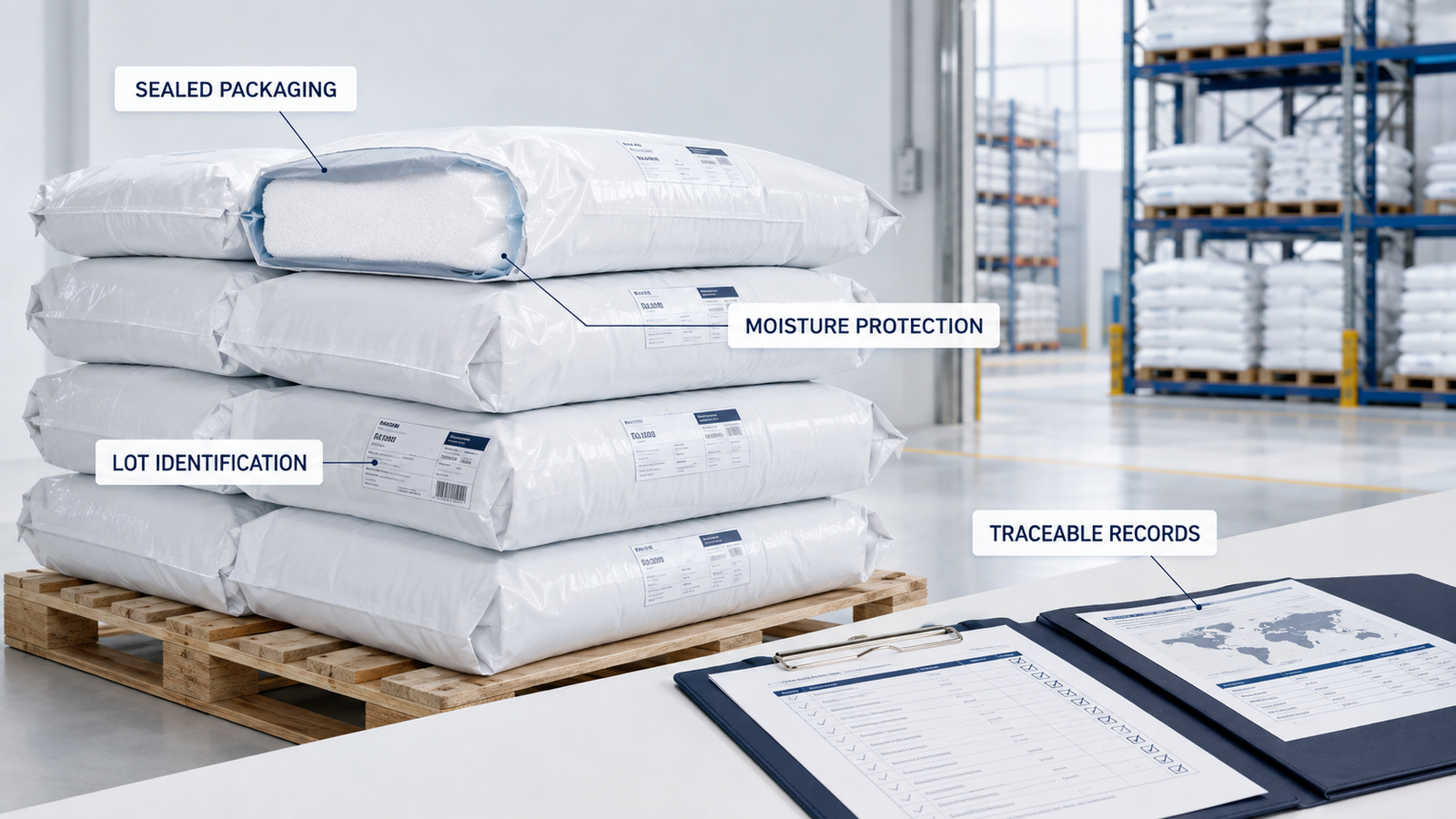
Packaging is not only a commercial detail; it is part of product protection. Bulk dextrose monohydrate should be supplied in packaging that remains properly sealed and helps limit exposure to moisture, contamination and physical damage during handling, transportation and storage.
Buyers should review the available packaging formats against their order size, warehouse conditions and production practices. Each unit should carry clear identification, including the product name, grade, batch or lot number and other information required by the applicable market or purchasing agreement. Labels should also correspond with the batch details shown on the COA and shipping documents.
Storage instructions and shelf-life information should be reviewed before purchase. The supplier should state the recommended conditions, particularly any requirements related to moisture, temperature, opened packaging and warehouse hygiene. A shelf-life statement is useful only when the product is stored under the conditions on which that period is based.
Traceability connects the packaged material to its manufacturing and quality records. A reliable supplier should be able to trace a delivered lot back to the relevant production and testing information. If a complaint or nonconformity occurs, this allows the affected material to be identified without unnecessarily involving unrelated shipments. Packaging, labeling and traceability therefore support both routine inventory control and effective quality investigation.
Understand Price and Total Purchasing Cost
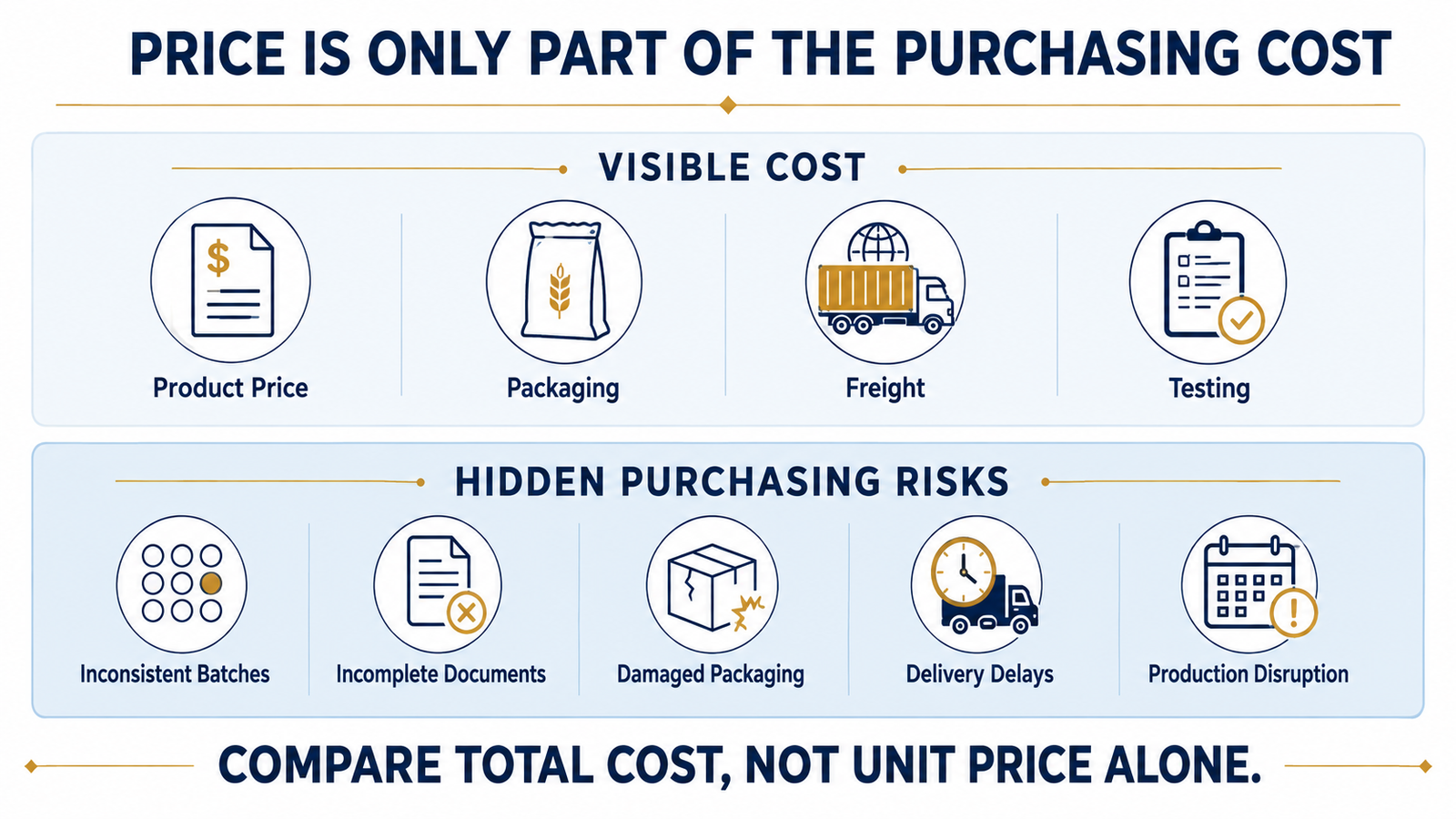
Dextrose monohydrate price should be compared only after the technical and supply requirements have been defined. A lower quotation may reflect a different grade, specification, packaging format, order quantity or delivery basis rather than a genuine cost advantage.
Several factors can influence the quoted price of bulk dextrose monohydrate. These include product grade, order volume, minimum order quantity, packaging, testing or documentation requirements, shipping destination, freight terms and requested lead time. Market conditions and quotation validity may also affect whether prices received at different times are directly comparable.
Buyers should therefore evaluate total purchasing cost rather than unit price alone. Potential costs may arise from damaged packaging, inconsistent product performance, incomplete documents, delayed deliveries, production interruptions or rejected batches. These risks may not appear in the original quotation, but they can be considerably more expensive than a modest difference in purchase price.
To support a fair comparison, each supplier should quote against the same purchasing brief. The quotation should identify the product and grade, quantity, packaging, price basis, applicable Incoterms, lead time, payment terms and validity period. Sample costs and any additional testing or documentation fees should also be clarified.
The objective is not to disregard price, but to understand what the quoted figure includes. A commercially sound offer balances an acceptable price with verified quality, suitable logistics and a realistic ability to meet the buyer’s ongoing requirements.
Assess Supply Capacity and Long-Term Reliability
A supplier that can provide an acceptable sample and complete one order may not necessarily support continuous production. Before establishing a long-term arrangement, buyers should evaluate whether the supplier’s capacity, inventory planning and logistics are aligned with expected demand.
The discussion should cover normal order volume, peak-season availability, standard lead time and the supplier’s approach to changes in purchasing forecasts. If the material is imported, buyers should also consider export-document experience, transportation routes and the time required to respond to shipping delays. A realistic delivery commitment is more useful than an unusually short lead time that cannot be maintained.
Long-term reliability also depends on batch consistency. Suppliers should explain how routine production is controlled and how buyers are notified if there is a meaningful change to the manufacturing source, process, specification, packaging or supporting documentation. These changes may not always affect product suitability, but they should be reviewed before the altered material enters production.
Communication becomes especially important when something goes wrong. Buyers should understand how complaints are recorded, investigated and resolved, as well as who is responsible for providing technical documents and corrective-action information.
A reliable dextrose monohydrate supplier is therefore not defined only by production capacity. Reliability is demonstrated through consistent material, realistic lead times, transparent change management and a practical response when quality or delivery issues occur.
Use a Practical Supplier Evaluation Checklist
A structured checklist helps purchasing, technical and quality teams evaluate potential suppliers on the same basis. It also reduces the risk of approving a source because one factor—such as price or sample performance—appears attractive while other requirements remain unverified.
| Evaluation Area | What the Buyer Should Confirm |
|---|---|
| Product fit | The correct monohydrate form, food grade and intended application |
| Specification | Relevant limits, units, test methods and applicable standards |
| Batch COA | Lot identification and actual results matched to specification limits |
| Supporting documents | Current specification, TDS, SDS and required compliance statements |
| Sample identity | A representative commercial sample with traceable batch information |
| Application performance | Acceptable results under the intended formulation and process conditions |
| Packaging | Suitable format, secure sealing, moisture protection and clear labeling |
| Traceability | Connection between the delivered lot, COA and production records |
| Commercial terms | Price basis, MOQ, packaging, payment terms and quotation validity |
| Logistics | Realistic lead time, shipping terms and destination support |
| Supply reliability | Capacity, batch consistency and contingency planning |
| Technical support | Clear communication, complaint handling and change notification |
Not every factor needs to carry the same weight. A manufacturer running continuous production may prioritize batch consistency and delivery reliability, while a distributor placing smaller orders may give more weight to MOQ and inventory flexibility.
The checklist should therefore be adapted to the buyer’s risk level and operating conditions. However, any unresolved issue involving product identity, food-grade suitability, traceability or batch documentation should be addressed before a bulk dextrose monohydrate supplier receives final approval.
Avoid Common Mistakes When Sourcing Dextrose Monohydrate
Many sourcing problems begin before the first order is placed. The following mistakes can make an apparently competitive offer more difficult or expensive to manage:
- Comparing prices before confirming the grade. Quotations for different product forms, standards or packaging formats should not be treated as equivalent.
- Assuming every specification represents the same quality. Similar test items may have different limits, units or methods, so the documents must be reviewed in detail.
- Accepting a generic COA as batch evidence. A sample document can show the supplier’s reporting format, but only a lot-specific COA verifies the reported results of the material being evaluated.
- Approving a supplier without application testing. Compliance with a written specification does not automatically confirm performance in the buyer’s actual formulation and process.
- Ignoring packaging and logistics. Moisture exposure, damaged bags, unclear labels or unrealistic delivery commitments can affect usable product quality and production planning.
- Evaluating only the first shipment. Supplier qualification should continue after approval by monitoring later COAs, application performance, delivery consistency and any notified changes.
Avoiding these mistakes does not require a complicated purchasing system. It requires each decision to be supported by comparable quotations, traceable documents and evidence from the intended application. This makes it easier to distinguish a low initial price from a genuinely reliable supply option.
Follow a Clear Final Supplier Selection Process
A practical supplier selection process can be summarized in six connected steps:
- Define the required product form, grade, application and order conditions.
- Shortlist suppliers or manufacturers capable of meeting those requirements.
- Review the specification, batch COA and supporting technical documents.
- Test a representative sample under the intended processing conditions.
- Confirm packaging, traceability, pricing, lead time and supply capacity.
- Approve the supplier and monitor performance across commercial shipments.
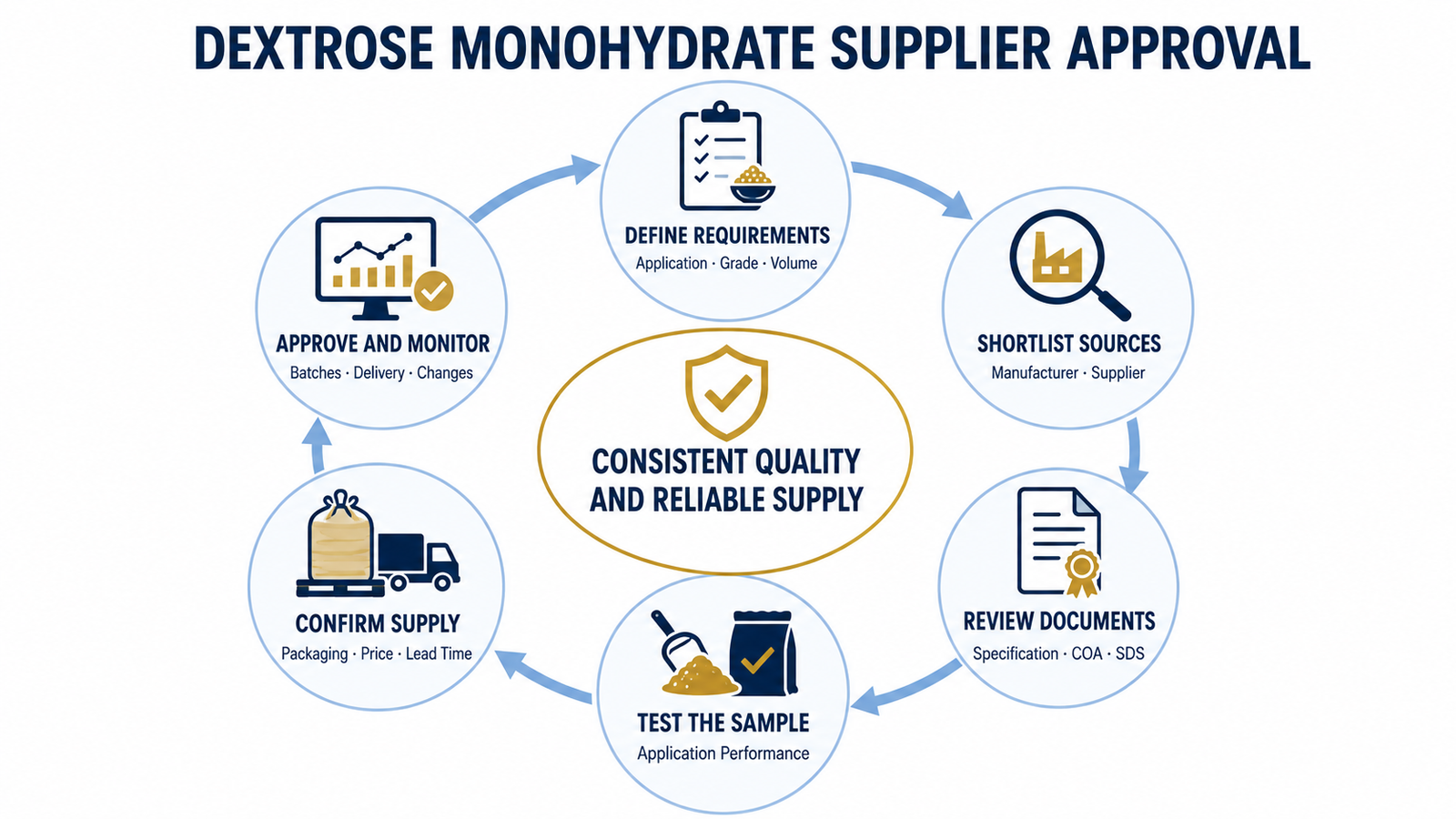
Final approval should be based on the combined evidence rather than one favorable result. A competitive quotation cannot compensate for unsuitable material, while an acceptable sample cannot compensate for incomplete traceability or unreliable delivery.
Supplier qualification also continues after the first order. Later batches should be checked against the approved specification, COA and expected application performance. Delivery consistency, communication and notified changes should also remain under review.
The best dextrose monohydrate supplier is therefore not simply the company offering the lowest price or the broadest specification. It is the supplier that can provide technically suitable material, verifiable batch quality and dependable commercial support on a repeatable basis.
Frequently Asked Questions
Where can food manufacturers buy dextrose monohydrate in bulk?
Food manufacturers can source bulk dextrose monohydrate from producers, exporters or specialized food ingredient distributors. The appropriate source depends on order volume, destination and required service. Buyers should verify the manufacturing source, food-grade documentation, packaging, traceability and delivery capability before placing a commercial order.
What documents should a dextrose monohydrate supplier provide?
Core documents generally include a product specification, batch-specific Certificate of Analysis, Technical Data Sheet and Safety Data Sheet. Depending on the application and destination market, buyers may also require allergen, GMO, origin or food-grade compliance statements. Document requirements should be defined before supplier approval.
How should buyers compare dextrose monohydrate prices?
Prices should be compared using the same grade, specification, quantity, packaging and delivery basis. Buyers should also confirm Incoterms, lead time, payment terms and quotation validity. Total purchasing cost should include potential risks associated with inconsistent batches, damaged packaging, incomplete documentation or delivery delays.
Is it better to buy from a manufacturer or a distributor?
Neither option is automatically better. Direct manufacturers may suit large, regular orders, while distributors may offer lower minimum quantities, local inventory or more flexible logistics. The stronger option is the one that provides transparent sourcing, traceable batches, suitable technical documents and reliable supply support.
Why is sample testing necessary before bulk purchasing?
A specification confirms defined quality limits, but it does not fully predict performance in a finished food system. Testing a representative commercial sample allows the buyer to evaluate dissolution, processing behavior and compatibility under actual formulation conditions. The first bulk shipment should then be compared with the approved sample.
Conclusion
Choosing a dextrose monohydrate supplier is not simply a matter of locating available material and accepting the lowest quotation. The purchasing decision should connect the requirements of the finished food product with documented batch quality, verified application performance and realistic supply conditions.
Specifications, COAs and supporting documents establish the technical basis for evaluation, while representative samples show how the ingredient performs in practice. Packaging, traceability, pricing, lead time and communication then determine whether the proposed arrangement can support routine commercial production.
For food manufacturers purchasing in bulk, the strongest supplier is one that can reproduce acceptable quality across shipments and provide clear information when conditions change. Approval should therefore be treated as the beginning of supplier monitoring rather than the end of the evaluation process.
A structured approach may require more work before the first order, but it reduces uncertainty and provides a more reliable foundation for consistent production and long-term supply.