



- Your cart is empty Browse Shop
Dextrose Anhydrous vs Dextrose Monohydrate: Key Differences and Selection Guide
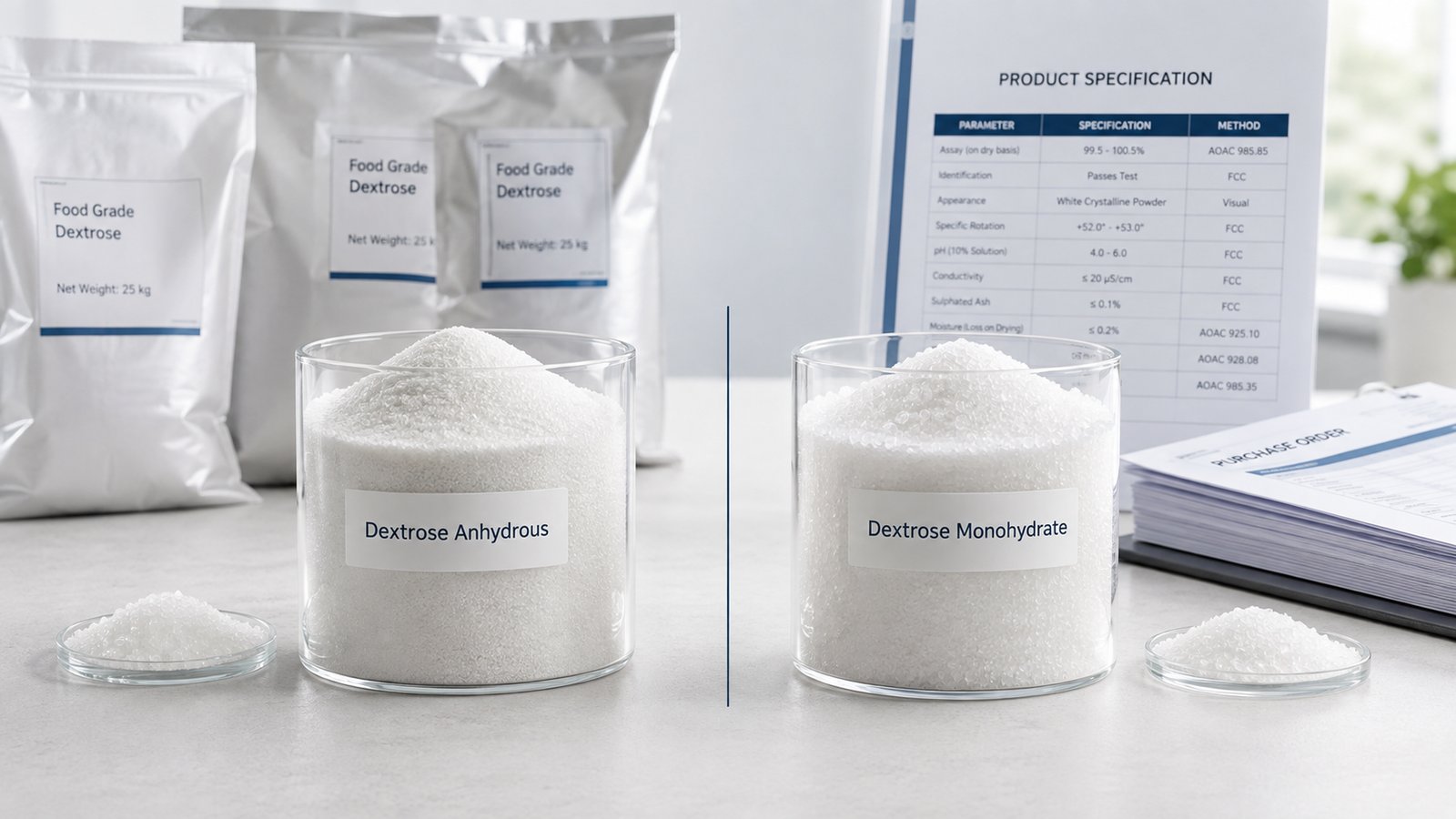
Dextrose is widely used in bakery products, beverages, confectionery, dairy products, dry mixes, and many other processed foods. When sourcing this ingredient, however, manufacturers may encounter two common forms: dextrose anhydrous and dextrose monohydrate. Although both are forms of D-glucose, they are not identical in composition or necessarily interchangeable in every formulation.
The main difference in dextrose anhydrous vs dextrose monohydrate is the presence of crystallization water. Dextrose monohydrate contains one water molecule within its crystalline structure, while dextrose anhydrous does not. This distinction affects molecular weight, glucose solids per unit of product, moisture contribution, formulation calculations, and, in some cases, product handling.
For food manufacturers, choosing between the two should not be based on the product name or purchase price alone. The decision needs to reflect the finished product’s moisture requirements, target solids, processing conditions, ingredient specifications, and existing formulation system. A product that works well in a liquid beverage, for example, may not be the most practical choice for a moisture-sensitive powdered mix.
This guide explains the key differences between dextrose anhydrous and dextrose monohydrate, how those differences may affect food production, and what buyers should evaluate before selecting a suitable food-grade dextrose.
What Are Dextrose Anhydrous and Dextrose Monohydrate?
Dextrose is the commercial name commonly used for D-glucose, a simple sugar used as a sweetener, fermentable carbohydrate, bulking ingredient, and processing aid in a range of food formulations. The terms “anhydrous” and “monohydrate” describe its crystalline form rather than two completely different types of sugar.
Manufacturers who need a broader overview can review our dextrose monohydrate guide before comparing the two crystalline forms.
Understanding this distinction is important because technical specifications and formulation calculations are generally based on the particular form being supplied.
What Is Dextrose Anhydrous?
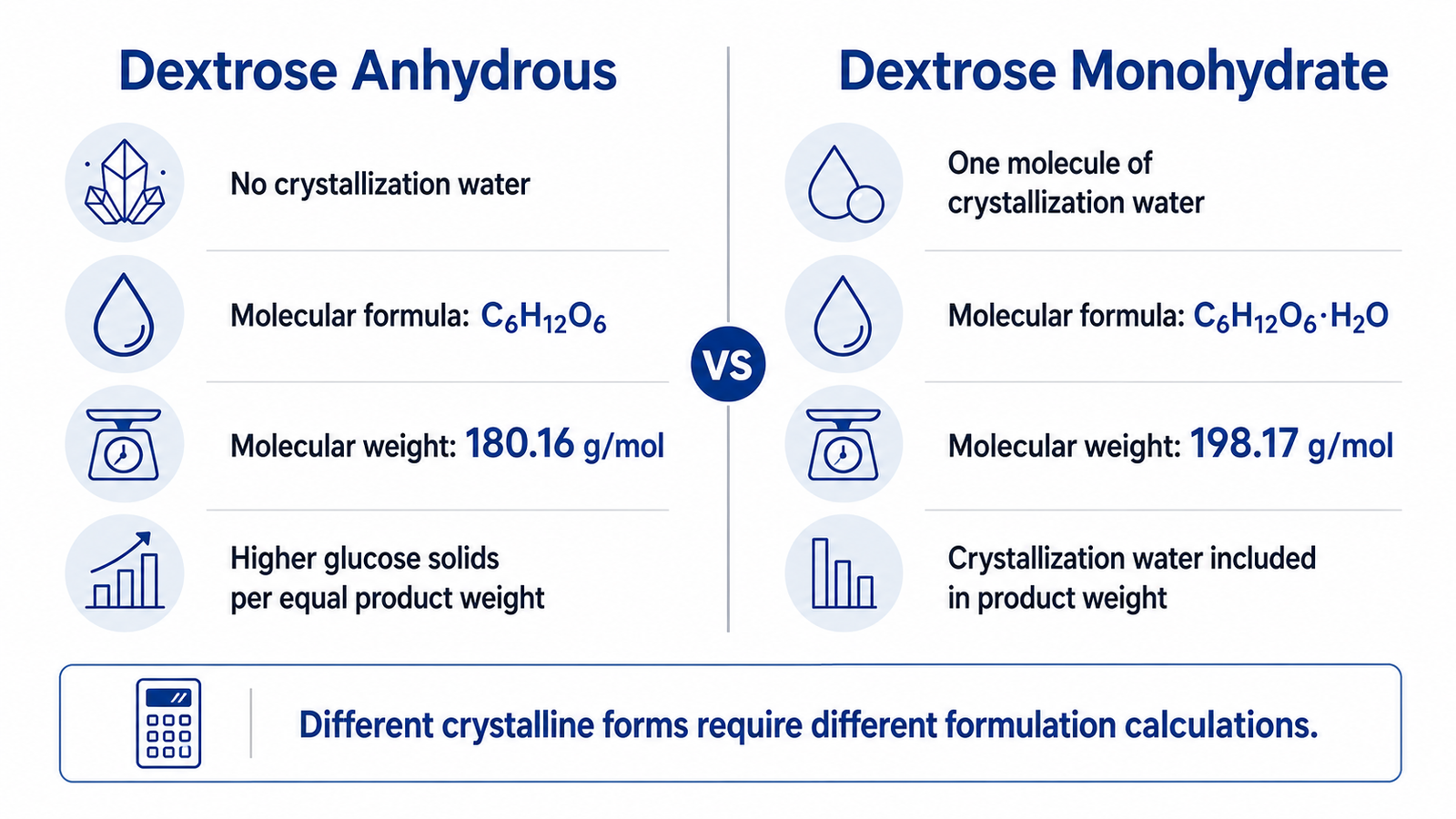
Dextrose anhydrous is a crystalline form of D-glucose that does not contain water of crystallization. Its molecular formula is C₆H₁₂O₆, and its molecular weight is approximately 180.16 g/mol.Manufacturers evaluating food-grade dextrose anhydrous should also review the available product specifications to confirm whether the commercial grade meets their formulation requirements.
Because it contains no crystallization water, a given weight of anhydrous dextrose provides a higher proportion of glucose solids than the same weight of the monohydrate form. This can make it suitable for formulations in which dry-solids calculations or moisture contribution need to be controlled carefully.
However, the term “anhydrous” should not be interpreted as a guarantee that a commercial product contains absolutely no measurable moisture. Actual moisture limits, purity, particle size, and other characteristics depend on the manufacturer’s specification and should be verified through the product specification sheet and Certificate of Analysis.
What Is Dextrose Monohydrate?
Dextrose monohydrate is D-glucose crystallized with one molecule of water, giving it a molecular formula of C₆H₁₂O₆·H₂O.Its molecular formula is C₆H₁₂O₆·H₂O, giving it a molecular weight of approximately 198.17 g/mol.
It is commonly supplied as a white crystalline powder and is widely used in food processing. The water molecule is part of the crystalline structure rather than simply free surface moisture. As a result, its contribution must be considered when comparing equal weights of dextrose monohydrate and dextrose anhydrous.
This does not mean that one form is automatically higher quality than the other. Both can be suitable food-grade ingredients when they meet the required specifications. The correct choice depends on the formulation, production process, quality requirements, and intended application.
Dextrose Anhydrous vs Dextrose Monohydrate: Key Differences
The distinction between the two forms may appear small, but it can become important when manufacturers calculate ingredient solids, control moisture, or replace one grade with another. The following comparison summarizes the main differences.
| Comparison Factor | Dextrose Anhydrous | Dextrose Monohydrate |
|---|---|---|
| Crystalline form | Contains no water of crystallization | Contains one molecule of crystallization water |
| Molecular formula | C₆H₁₂O₆ | C₆H₁₂O₆·H₂O |
| Molecular weight | Approximately 180.16 g/mol | Approximately 198.17 g/mol |
| Theoretical glucose solids | Higher per unit weight | Lower per unit weight due to crystallization water |
| Moisture contribution | No crystallization water, although commercial moisture limits still apply | Crystallization water forms part of the molecular structure |
| Formulation calculation | May be preferred when solids or moisture require tighter control | Crystallization water should be considered when calculating dry solids |
| Common selection consideration | Dry formulations, concentrated systems, and precise solids control | Broad food-processing applications and established monohydrate formulations |
| Quality evaluation | Based on grade-specific specifications and COA | Based on grade-specific specifications and COA |
These are general technical distinctions. The performance of a commercial product can also be influenced by particle size, production process, packaging, storage conditions, and the supplier’s quality specifications.
Molecular Structure and Crystallization Water
The most fundamental difference is that dextrose monohydrate contains one molecule of water for each molecule of D-glucose. In dextrose anhydrous, this crystallization water is absent.
Crystallization water should not be confused with moisture picked up from humid air or free water remaining because of inadequate drying. It is incorporated into the crystal structure of the monohydrate form. This means that a compliant batch of dextrose monohydrate naturally has a different molecular weight and solids composition from an anhydrous product.
The distinction matters most when ingredients are compared by weight. If a manufacturer adds the same number of kilograms of each product, the anhydrous material contributes more glucose solids because none of its molecular weight comes from crystallization water.
Molecular Weight and Glucose Solids
Dextrose anhydrous has a molecular weight of approximately 180.16 g/mol, compared with approximately 198.17 g/mol for dextrose monohydrate. Based on these molecular weights, pure dextrose monohydrate theoretically consists of about 90.9% anhydrous D-glucose and 9.1% crystallization water by weight.
This difference is particularly relevant when a formula specifies a target quantity of glucose solids. Substituting the same weight of monohydrate for anhydrous dextrose would reduce the amount of glucose solids added to the formulation. Conversely, replacing monohydrate with an equal weight of anhydrous material would increase the solids contribution.
That does not automatically mean one form produces noticeably greater sweetness in every finished food. Perceived sweetness depends on the full recipe, ingredient concentration, processing conditions, serving format, and interactions with acids, flavors, and other sweeteners. For accurate production planning, manufacturers should compare the two products on a dry-solids basis rather than relying on general sweetness assumptions.
Moisture Contribution and Formulation Control
In many liquid foods, the crystallization water introduced by dextrose monohydrate can be accounted for during normal formulation adjustment. Its practical effect may be relatively small when the product already contains a substantial amount of water.
The difference can be more relevant in moisture-sensitive systems, including powdered drink mixes, dry premixes, concentrated formulations, and products with closely controlled solids-to-water ratios. Even then, the appropriate choice depends on the complete formula rather than the ingredient form alone.
Manufacturers should also distinguish crystallization water from the moisture specification shown on a technical data sheet or COA. Commercial products may have grade-specific limits for loss on drying, water content, or related test parameters. The test method and acceptance limit should therefore be reviewed instead of assuming that every product sold under the same name has identical moisture characteristics.
Solubility and Processing Behavior
Both forms are water-soluble and can be used in a wide range of food-processing systems. It would be inaccurate, however, to conclude that one form will always dissolve faster based solely on whether it is anhydrous or monohydrate.
Dissolution behavior can be affected by:
- Particle size and crystal structure
- Water temperature
- Agitation and mixing time
- Ingredient addition order
- Dextrose concentration
- The presence of other dissolved solids
For this reason, manufacturers working with high-solids syrups or time-sensitive mixing processes should evaluate the actual commercial grade under their own production conditions. A supplier’s specification may provide useful information, but a plant trial offers a more reliable indication of processing performance.
Storage and Handling
Both dextrose anhydrous and dextrose monohydrate should be stored in sealed packaging in a cool, dry environment. Exposure to moisture, unsuitable temperatures, or damaged packaging may contribute to caking and reduced handling efficiency.
The word “anhydrous” should not be taken to mean that the product can be stored without humidity control. Nor should the presence of crystallization water in the monohydrate form be interpreted as evidence of poorer storage stability. Packaging quality, warehouse conditions, particle characteristics, shelf life, and handling practices can be just as important as the crystalline form.
Before purchasing either product, buyers should review the manufacturer’s storage recommendations, packaging format, shelf-life information, and batch documentation. These details provide a more dependable basis for comparison than the product name alone.
Can Dextrose Monohydrate and Anhydrous Dextrose Be Used Interchangeably?
Dextrose monohydrate and anhydrous dextrose may be interchangeable in some food formulations, but they should not automatically be substituted on an equal-weight basis. Although both provide D-glucose, the crystallization water in the monohydrate form changes the amount of glucose solids delivered by each kilogram of product.
Based on their molecular weights, pure dextrose monohydrate theoretically contains approximately 90.9% anhydrous glucose solids. A simplified conversion from anhydrous dextrose to dextrose monohydrate can therefore be expressed as:
This produces a theoretical conversion factor of approximately 1.10. For example, replacing 100 kg of pure anhydrous dextrose would require about 110 kg of pure dextrose monohydrate to provide a comparable quantity of glucose solids.
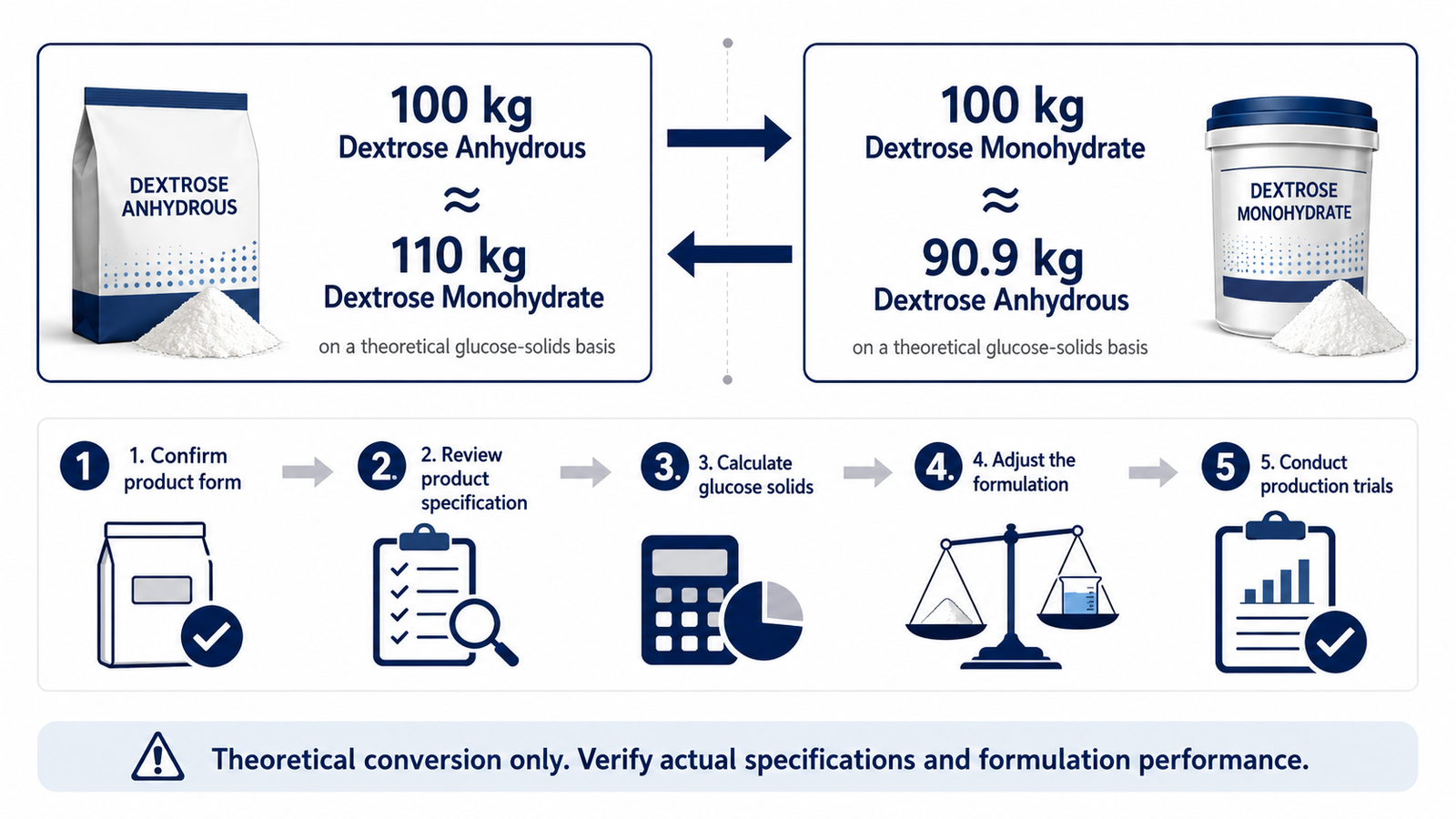
The calculation also works in reverse. An approximate conversion from monohydrate to anhydrous material can be made by multiplying the monohydrate quantity by 0.909. These figures are useful for preliminary formulation work, but they should not be treated as universal production instructions.
Commercial products may differ in assay, moisture, particle size, and other specification limits. Any substitution should therefore be calculated using the actual product specification or Certificate of Analysis rather than molecular weight alone.
Manufacturers should also consider whether the change affects total water, sweetness balance, viscosity, color development, fermentation performance, or processing behavior. The potential impact will vary with the application and the concentration of dextrose in the formula.
Before making a full-scale substitution, it is advisable to conduct a laboratory trial followed by a controlled production test. This confirms that the adjusted formula meets the required processing, sensory, stability, and finished-product specifications.
How Do Their Differences Affect Food Manufacturing?
The practical importance of choosing between dextrose anhydrous and dextrose monohydrate depends on the formulation. In products containing a large amount of water, the difference may be relatively easy to accommodate. In concentrated or moisture-sensitive systems, however, even a modest change in water or glucose solids may require a formulation adjustment.
Bakery Products
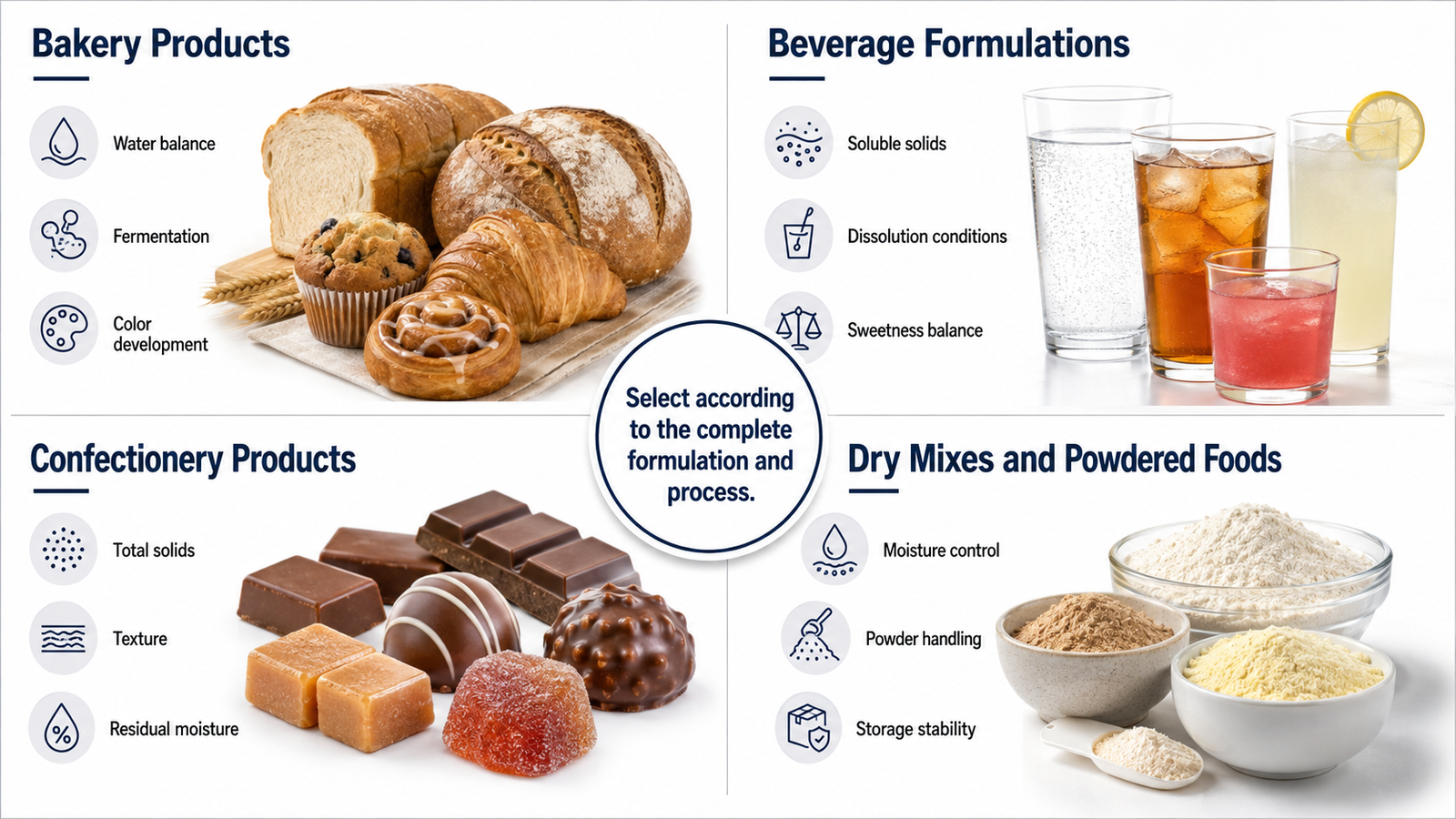
Dextrose may contribute sweetness, fermentable carbohydrates, and surface color development in bakery formulations. When changing from one form to the other, manufacturers should consider both glucose solids and the amount of water introduced into the dough or batter.
In many conventional bakery products, the crystallization water supplied by dextrose monohydrate can be balanced through a small adjustment to the added water. A trial may still be necessary where dough consistency, fermentation time, browning, or finished-product moisture is tightly controlled.
Beverage Formulations
Both forms can be used in beverage systems when they meet the required food-grade specifications. Because beverages already contain water, the difference in crystallization water can usually be addressed during formulation calculations.
The more important considerations may include target soluble solids, sweetness balance, dissolution conditions, acidity, and compatibility with other ingredients. Manufacturers producing concentrated beverage bases or powdered beverage mixes may need to evaluate the distinction more carefully than producers of standard ready-to-drink products.
Confectionery Products
Confectionery production often relies on close control of total solids, cooking conditions, texture, and residual moisture. Replacing one dextrose form with the other without recalculating the formulation could alter the balance between water and carbohydrate solids.
The practical effect depends on the amount of dextrose used and the type of product being manufactured. High-solids systems generally require more careful evaluation than formulations in which dextrose is present at a relatively low level.
Dry Mixes and Powdered Foods
Moisture control is particularly important in powdered beverages, bakery premixes, seasoning blends, and other dry formulations. Dextrose anhydrous may be considered when formulators need to minimize crystallization-water contribution or achieve a specific quantity of glucose solids with less ingredient weight.
This does not make it automatically superior for every dry product. Powder flow, particle size, caking behavior, packaging performance, storage humidity, and compatibility with other ingredients should also be evaluated using the actual commercial grade.
How to Choose Between Dextrose Anhydrous and Dextrose Monohydrate
Selecting a suitable form of food-grade dextrose requires more than comparing two product names. Manufacturers should begin with the technical needs of the finished product and then evaluate how each grade fits the formulation and production process.
Evaluate Moisture Requirements
The first consideration is how closely moisture must be controlled. In liquid foods, the crystallization water in dextrose monohydrate can often be included in the overall water calculation. For dry mixes, concentrated products, or moisture-sensitive systems, anhydrous dextrose may be considered when minimizing this contribution is important.
This decision should be based on the complete moisture balance. The crystalline form alone does not determine the finished product’s stability or shelf life.
Compare Glucose Solids
Purchase price per kilogram does not provide a complete cost comparison because equal weights of the two forms do not supply equal quantities of glucose solids.
Manufacturers should calculate the cost based on usable solids and the quantity required to meet the formulation target. Depending on purchasing conditions, they may also need to consider transportation, storage, handling, and dosing efficiency.
Consider the Production Process
Existing equipment and operating procedures may influence the decision. Important factors include the method of ingredient addition, mixing temperature, dissolution time, batch size, solids concentration, and dosing accuracy.
If a production line is already validated for one form, changing to the other may require adjustments even when the theoretical solids conversion is straightforward.
Review the Actual Product Specification
Not every commercial grade performs identically. Buyers should compare assay, moisture limits, particle size, appearance, solubility-related information, microbiological requirements, packaging, and shelf life.
The specification should also clearly identify whether the product is monohydrate or anhydrous. A Certificate of Analysis can then be used to confirm that a delivered batch meets the agreed limits.
Confirm Performance Through Trials
A calculated comparison is only the starting point. Before approving a new grade or changing the crystalline form, manufacturers should conduct formulation and production trials under representative conditions.
The evaluation may include processing efficiency, sensory properties, finished-product moisture, texture, color, stability, and compliance with internal quality standards. The most suitable choice is the product that performs consistently within the complete manufacturing system—not simply the one with the lower unit price or higher solids content.
What Should Buyers Check Before Purchasing Food-Grade Dextrose?
Once the appropriate crystalline form has been identified, buyers should confirm that the selected commercial grade consistently meets their production and quality requirements. The product name alone is not sufficient for supplier approval.
A technical specification should clearly state the product identity, assay or purity, moisture-related limits, appearance, and other relevant physical or microbiological parameters. Buyers should also confirm which testing methods are used, particularly when comparing documents from different manufacturers.
The Certificate of Analysis should correspond to the delivered batch and show results against the agreed specification. It is useful to review documentation from more than one batch when evaluating consistency, rather than relying only on a single representative sample.
Packaging also requires attention. The material should be supplied in sealed, food-compatible packaging suitable for transportation and warehouse storage. Pack size, inner lining, pallet configuration, shelf life, and recommended storage conditions may all affect handling efficiency and product protection.
A qualified dextrose supplier should be able to provide:
- A current product specification
- Batch-specific Certificates of Analysis
- Relevant food-grade compliance documents
- Packaging and shelf-life information
- Traceable batch identification
- Consistent supply and documentation support
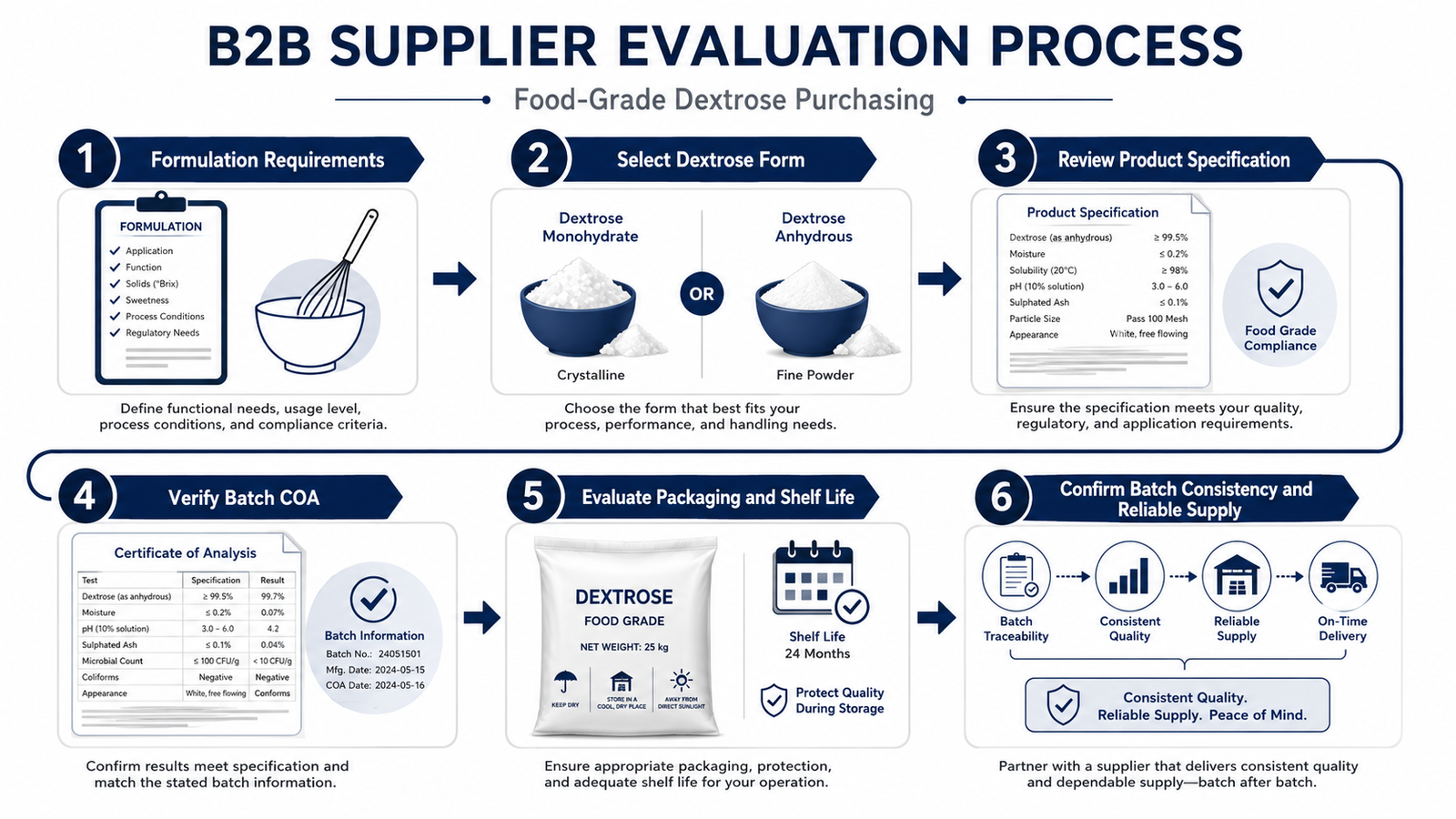
Before approving a supplier for routine purchasing, manufacturers should also assess production capacity, lead times, change-notification procedures, and the ability to maintain agreed specifications across shipments. Reliable documentation and batch consistency are often more important to long-term production than a small difference in quoted price.
Frequently Asked Questions
Is dextrose monohydrate the same as dextrose?
Dextrose is a general commercial name for D-glucose, while dextrose monohydrate identifies a specific crystalline form containing one molecule of water. Product documents should clarify whether the supplied dextrose is monohydrate or anhydrous.
Is dextrose monohydrate the same as glucose?
Dextrose is commonly used as the commercial name for D-glucose. Dextrose monohydrate is therefore a crystalline form of glucose, but its crystallization water distinguishes it from anhydrous D-glucose on a molecular-weight and solids basis.
What is the main difference between dextrose anhydrous and dextrose monohydrate?
The main difference is crystallization water. Dextrose anhydrous contains none, whereas the monohydrate form contains one water molecule per glucose molecule. This affects molecular weight, glucose solids per unit weight, and formulation calculations.
Can dextrose monohydrate replace dextrose anhydrous?
It may replace anhydrous dextrose in some formulations, but not automatically at the same weight. Manufacturers should recalculate glucose solids, review the actual product specifications, and confirm performance through formulation and production trials.
Conclusion
The choice of dextrose anhydrous vs dextrose monohydrate depends on more than the presence or absence of crystallization water. Their different molecular weights affect glucose solids, moisture contribution, and the quantities required in a formulation.
Neither form is automatically better for every food product. Manufacturers should select a grade according to the finished product’s moisture requirements, target solids, processing conditions, and existing production system. Any substitution should be based on the actual product specification and confirmed through appropriate trials.
Before purchasing food-grade dextrose, buyers should also verify batch documentation, packaging, compliance information, and supply consistency. A technically suitable product supported by reliable quality records provides a stronger foundation for stable commercial production.