



- Your cart is empty Browse Shop
What Is Erythritol? What It Is Made From, How It Is Produced and Used in Food
Introduction
Erythritol is a sugar alcohol widely used in food and beverage formulations as a reduced-sugar sweetening ingredient. It occurs naturally in small amounts in certain fruits and fermented foods, but food-grade erythritol is generally produced on a commercial scale through controlled fermentation, followed by purification and crystallization. Its mild sweetness, crystalline structure and distinctive cooling effect give it a different functional profile from sucrose and high-intensity sweeteners. For food manufacturers, understanding what erythritol is also means understanding how its raw materials, production process and physical properties can influence formulation performance. This guide explains what erythritol is made from, how it is produced, where it is used and which quality factors should be reviewed when sourcing food-grade material.
What Is Erythritol?
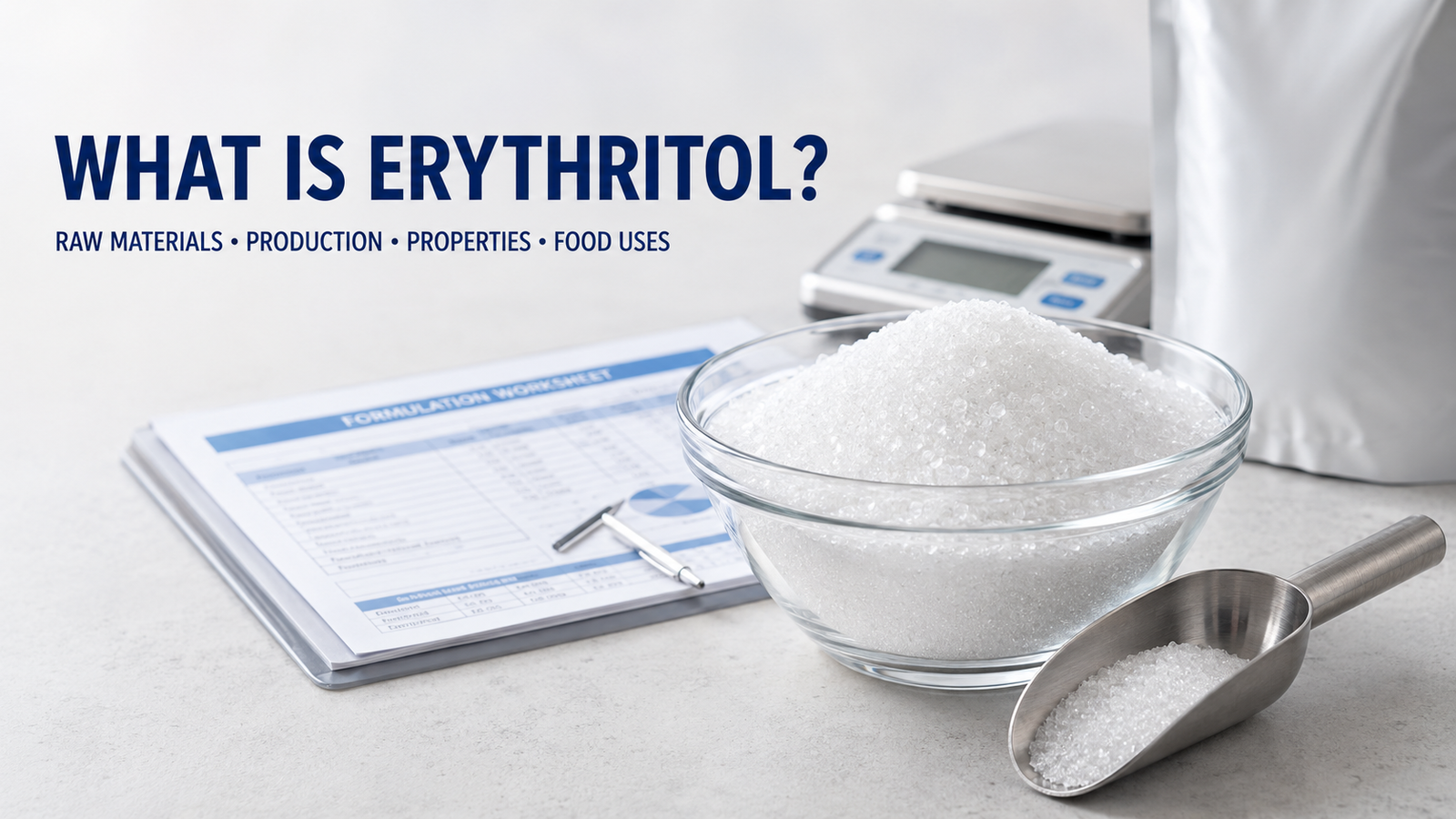
Erythritol is a four-carbon polyol, commonly described as a sugar alcohol, that is used as a sweetening and bulking ingredient in a range of food formulations. Despite the term “sugar alcohol,” it does not contain ethanol and should not be confused with alcoholic beverages. In its food-grade form, erythritol is typically supplied as a white crystalline powder or granule with a clean appearance and a mildly sweet taste.
Its sweetness is generally estimated at around 60–70% of that of sucrose, although perceived sweetness can vary according to concentration, serving temperature and the other ingredients present in a formulation. Unlike high-intensity sweeteners, erythritol is normally added in larger quantities and can contribute solids, volume and crystalline structure to the finished product. However, it does not reproduce every functional property of sucrose, so direct one-to-one replacement is not always suitable.
Several erythritol properties are particularly important in food development. These include its cooling sensation during dissolution, crystallization behavior, solubility and interaction with other sweeteners. Their practical effects depend on the complete formulation and processing conditions. It is also important to distinguish pure food-grade erythritol from retail sweetener blends, which may contain stevia, monk fruit extracts or other ingredients in addition to erythritol.
What Is Erythritol Made From?
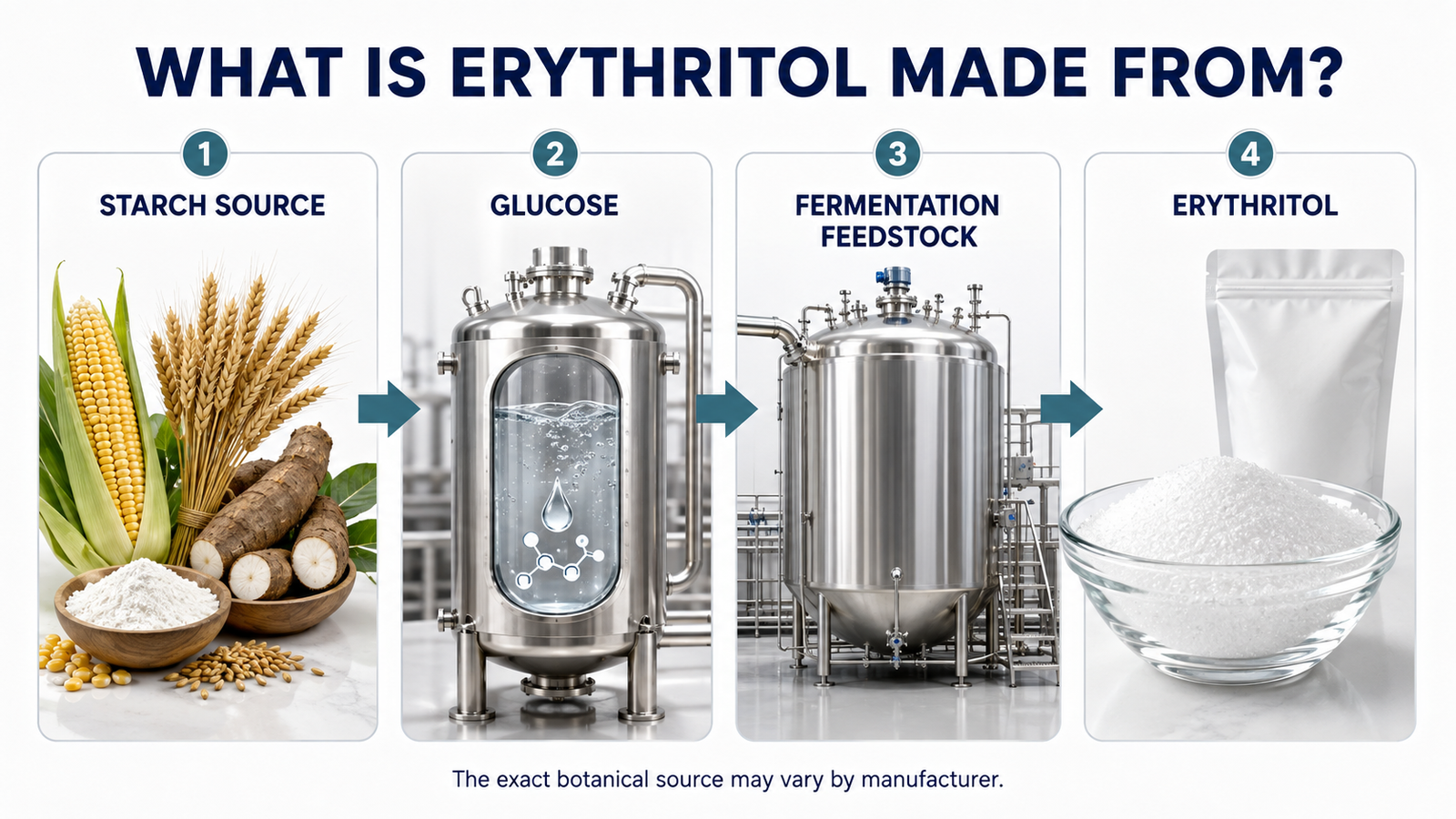
Erythritol occurs naturally in small amounts in certain fruits, mushrooms and fermented foods. However, extracting it directly from these sources would not be practical for large-scale food production. Commercial food-grade erythritol is therefore generally produced through fermentation, using a carbohydrate-based feedstock as the starting material.
In many industrial processes, the feedstock is a purified glucose solution obtained from starch. Corn is a common starch source, but it is not the only possible one. Wheat, tapioca or other starch-rich raw materials may also be used, depending on the manufacturer, production region and supply chain. For this reason, it is not accurate to state that all erythritol is made from corn. Buyers who need to confirm the exact botanical source should request a raw-material declaration or other supporting documentation from the supplier.
The starch itself is not converted directly into finished erythritol. It is first broken down into glucose, which can then be used in a controlled fermentation process. Selected microorganisms convert part of this glucose into erythritol. The resulting fermentation liquid must subsequently be separated, purified, concentrated and crystallized before a food-grade crystalline product is obtained.
When asking what erythritol is made from, it is therefore useful to distinguish between the original agricultural source, the glucose fermentation feedstock and the purified final ingredient. These are related stages, but they are not the same thing. This distinction is especially important when reviewing allergen statements, non-GMO documentation, origin information or customer-specific sourcing requirements.
How Is Erythritol Made?
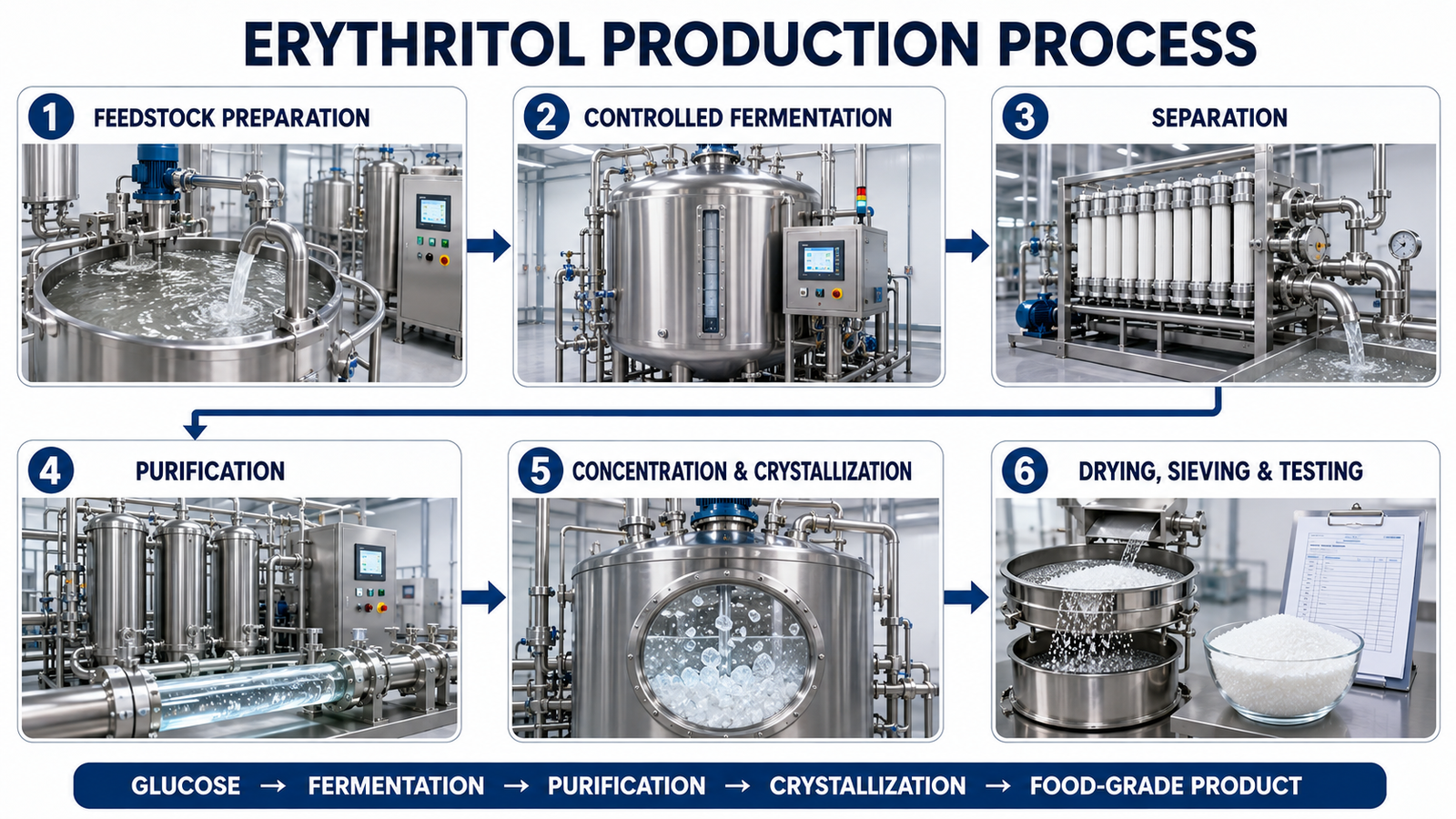
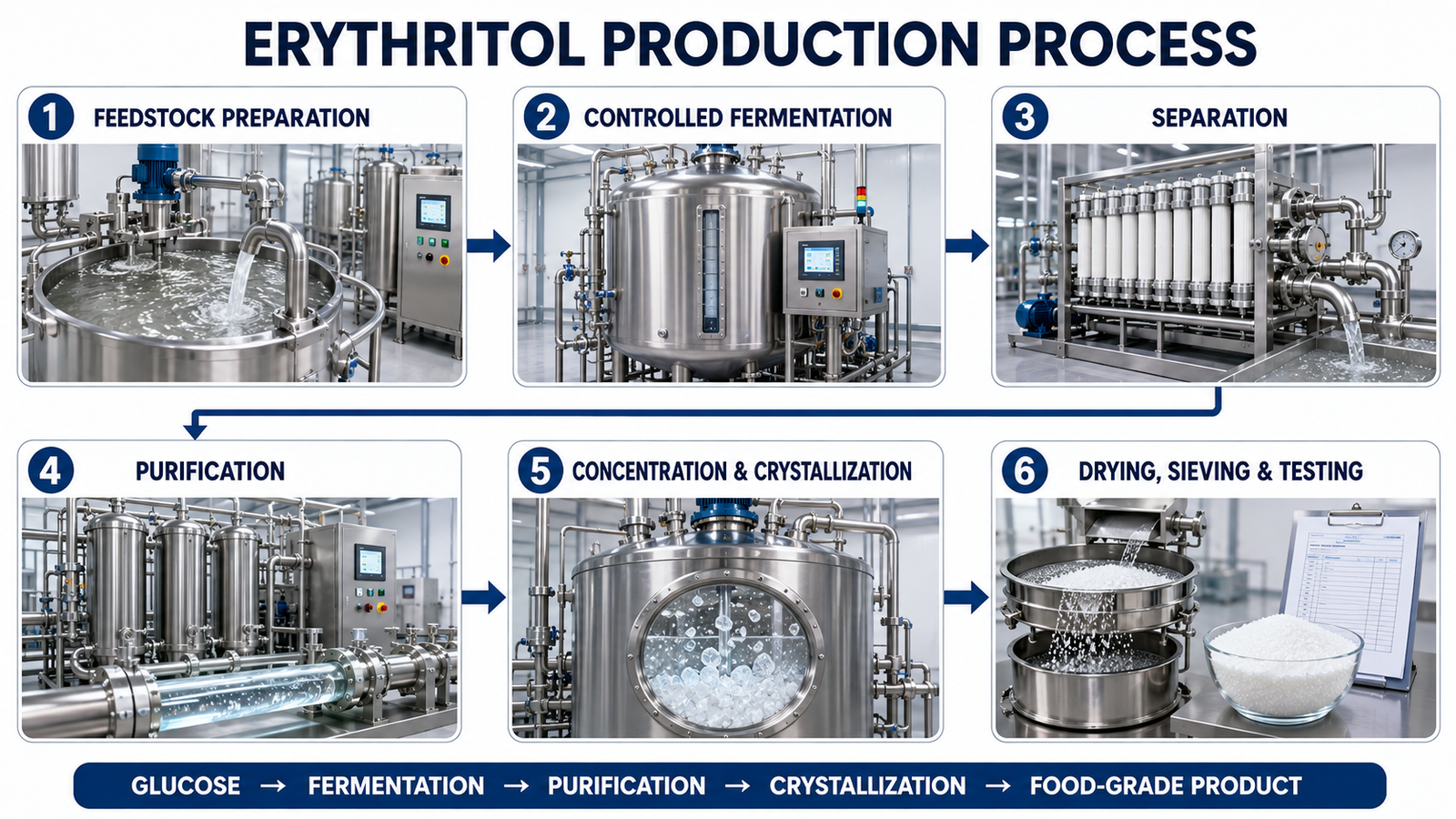
The commercial erythritol production process generally combines fermentation with a series of separation, purification and crystallization steps. Exact equipment and operating conditions vary between manufacturers, but the main stages follow a similar sequence. Careful process control is required because the quality of the fermentation liquid and the efficiency of downstream purification can influence the purity, appearance and consistency of the final product.
1. Preparation of the Fermentation Feedstock
Production usually begins with a purified carbohydrate source, most commonly a glucose solution derived from starch. The starch is processed and hydrolyzed to release glucose, after which the liquid is filtered and adjusted to create a suitable fermentation medium. Its composition must be controlled because excessive impurities or inconsistent glucose concentration may affect fermentation performance.
2. Controlled Fermentation
During erythritol fermentation, selected microorganisms convert glucose into erythritol under controlled conditions. Manufacturers monitor factors such as nutrient availability, temperature, aeration and fermentation time to maintain a stable process. The microorganisms and specific operating parameters used may differ according to the producer’s technology.
At the end of this stage, erythritol is present in a fermentation broth rather than as a finished crystalline ingredient. The liquid may also contain microbial biomass, residual feedstock and other fermentation-related components that must be removed.
3. Separation and Purification
The fermentation broth is clarified to separate microbial cells and suspended material from the liquid phase. Additional purification steps may then be used to reduce color, minerals, residual organic compounds and other unwanted components. Depending on the production system, these operations can include filtration, ion exchange, adsorption or related separation technologies.
Purification is a critical part of the erythritol production process. Inadequate removal of impurities may affect product color, taste, purity or performance in food applications.
4. Concentration and Crystallization
After purification, the erythritol-containing solution is concentrated under controlled conditions. As the concentration increases and the solution is cooled or otherwise adjusted, erythritol crystals begin to form. Crystallization conditions must be managed carefully because they can influence crystal formation, recovery efficiency and the physical characteristics of the finished material.
5. Drying, Sieving and Packaging
The recovered crystals are separated from the remaining liquid and dried to reduce moisture. The material may then be sieved or milled to obtain the required particle-size range. It is subsequently packed in suitable food-grade packaging designed to limit moisture exposure and contamination during storage and transportation.
6. Final Quality Testing
Before release, representative samples from the finished batch are tested against the manufacturer’s product specification. Typical evaluations may cover appearance, assay, moisture-related parameters, pH, particle size and microbiological limits. Approved batches are assigned traceable identification and documented in a batch Certificate of Analysis before shipment.
What Is in Food-Grade Erythritol?
When erythritol is sold as a single food-grade ingredient, the product should consist predominantly of erythritol rather than a mixture of different sweeteners. Its exact assay, moisture level and other quality parameters are defined in the product specification and confirmed for each manufactured batch through a Certificate of Analysis. Small amounts of water or process-related residues may be controlled within specified limits, but these should not be confused with deliberately added ingredients.
This is different from many retail sweetener products. A finished tabletop sweetener may combine erythritol with stevia, monk fruit extract, flavoring agents or other components to modify sweetness, aftertaste, texture or serving convenience. Such a blend may list erythritol as its main ingredient, but it is not the same as pure food-grade erythritol supplied for industrial formulation.
Manufacturers should therefore review the full ingredient declaration instead of relying only on the product name. For industrial purchasing, the specification, batch COA, allergen statement and raw-material declaration can help confirm what is in the erythritol product and whether it meets the intended formulation and labeling requirements.
Key Properties of Erythritol in Food Formulation
Understanding the key properties of erythritol is essential when deciding how it should be used in a food formulation. Its performance cannot be evaluated on sweetness alone, because it may also influence texture, solids content, crystallization and the overall sensory profile of the finished product.
Sweetness Profile
Erythritol typically provides around 60–70% of the sweetness of sucrose. The exact perception depends on concentration, temperature and the surrounding flavor system. When a formulation requires a sweetness level closer to that of sucrose, erythritol may be combined with another sweetening ingredient rather than simply added at a higher level.
Crystalline Bulk
Unlike high-intensity sweeteners used in very small quantities, erythritol can contribute measurable solids and volume. This makes it useful in products where the sweetening system also affects product structure or serving volume. However, its behavior is not identical to that of sucrose, so replacing sugar by weight does not automatically produce the same texture, sweetness or processing performance.
Cooling Effect
Erythritol absorbs heat as it dissolves, which can create a noticeable cooling sensation in the mouth. This effect may be desirable in mint-flavored confectionery, chewing gum or certain refreshing products. In bakery, chocolate or delicately flavored applications, however, an excessive cooling sensation may be less suitable and may need to be managed through dosage, particle size or sweetener blending.
Solubility and Crystallization
Erythritol has different solubility and crystallization characteristics from sucrose. Temperature, water content, solids concentration, cooling rate and interactions with other ingredients can all affect whether it remains dissolved or recrystallizes during processing and storage. Uncontrolled crystallization may lead to graininess or surface changes in some products.
Stability and Handling
Storage and handling conditions also matter. Packaging should remain sealed and protected from contamination and unnecessary moisture exposure. Manufacturers should confirm particle size, flow behavior and storage recommendations with the supplier, as these characteristics can influence dissolution, mixing accuracy and production consistency.
How Is Erythritol Used in Food Manufacturing?
Erythritol is used in a variety of food products, but its role differs according to the structure, processing conditions and sensory targets of each application. It may provide sweetness, crystalline solids or part of the bulk normally contributed by sugar. Because its sweetness and functional behavior differ from sucrose, it should be evaluated as one component of the complete formulation rather than treated as a universal one-to-one replacement.
In confectionery and chocolate-style products, erythritol may contribute sweetness and solids, although crystal size, cooling sensation and compatibility with fats and other ingredients require careful control. In bakery formulations, reducing sucrose can affect browning, moisture retention, spread and texture, so replacing sweetness alone may not reproduce the original product.
For beverages, solubility, serving temperature and flavor balance are important considerations. The cooling effect may suit some refreshing drinks but become more noticeable in delicate flavor systems. Erythritol is also used in tabletop sweeteners, powdered drink mixes and nutrition products, frequently in combination with high-intensity sweeteners to achieve a fuller sweetness profile without relying on erythritol alone.
In dairy and frozen applications, formulation trials should assess sweetness, freezing behavior, texture and stability throughout the intended shelf life. Similar testing is needed in nutrition bars and other low-moisture systems, where crystallization and ingredient distribution may influence the finished product.
The most suitable use level cannot be determined from a general guideline alone. Manufacturers should evaluate sweetness targets, processing temperature, water activity, texture and storage conditions through laboratory and pilot-scale testing. A more detailed review of erythritol applications and formulation considerations can help manufacturers assess these factors for specific food categories.
Food-Grade Erythritol Quality Requirements
Food-grade erythritol should be evaluated against a defined product specification rather than judged only by appearance or a general purity statement. The relevant requirements may vary according to the applicable food standard, destination market and intended application, so buyers should confirm which specification and test methods apply before approving a material.
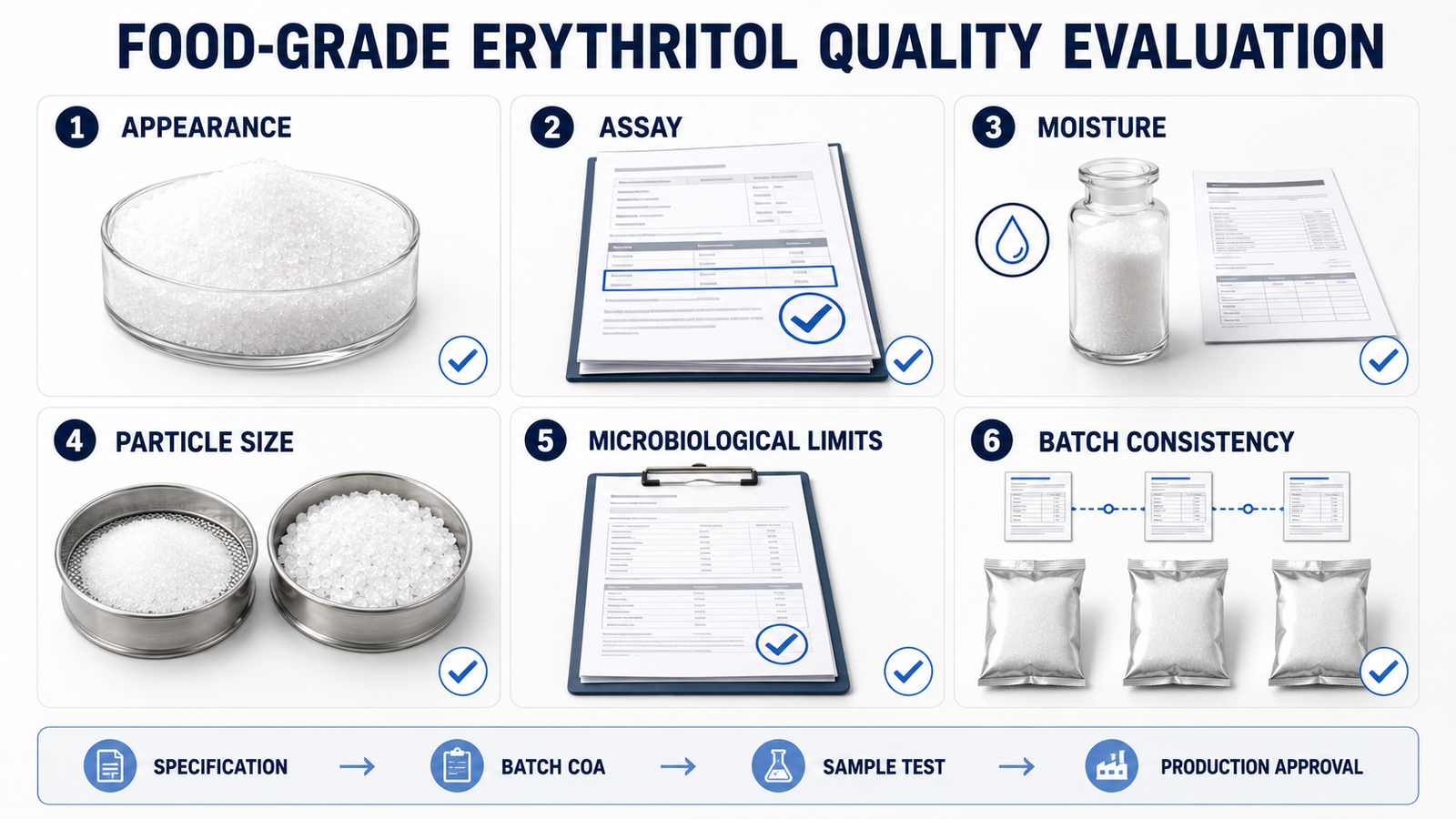
Appearance is usually the first basic check. Erythritol is commonly supplied as a white crystalline powder or granule, but visual inspection alone cannot confirm quality. Assay indicates the proportion of erythritol in the tested material, while moisture or loss-on-drying results help assess whether the product meets the supplier’s limits for water-related content. Other physicochemical parameters may include pH, ash, reducing sugars or related purity indicators, depending on the specification used.
Particle size is also commercially important. Fine and coarse grades may behave differently during dissolution, dry blending, conveying and packaging. A material can meet its chemical requirements while still being unsuitable for a particular process if its particle-size distribution does not match the application.
Microbiological limits should be reviewed where required for the ingredient and destination market. Packaging condition, net weight, batch identification and storage instructions should also form part of the incoming inspection process. These checks support traceability and help protect the material from contamination or unnecessary moisture exposure.
Buyers should review both the product specification and the batch Certificate of Analysis. The specification defines the acceptable limits for the product, whereas the COA reports the test results for a particular production batch. A general specification therefore cannot replace batch-specific documentation.
For ongoing supply, consistency across multiple batches is just as important as the approval of one sample. Food manufacturers should compare relevant test results over time and investigate any changes that could affect sweetness, dissolution, flow behavior or processing performance. Where an application is sensitive to physical characteristics, laboratory evaluation and pilot testing should be completed before commercial production.
What Should Food Manufacturers Check Before Purchasing Erythritol?
Before purchasing food-grade erythritol, manufacturers should first define the intended application, required quantity, preferred particle size and applicable quality standard. These requirements provide a practical basis for comparing suppliers and help prevent decisions based only on price per kilogram.
The supplier should provide a current product specification showing the relevant quality limits, together with a representative batch COA containing actual test results. Buyers may also need to review allergen information, raw-material origin, GMO status, shelf life, storage recommendations and other documents required by the destination market or customer approval process.
A representative sample should be tested in the intended formulation before a commercial order is confirmed. The evaluation should consider sweetness, dissolution, cooling sensation, crystallization and compatibility with the existing production process. When physical characteristics are important, the production material should match the approved sample as closely as possible.
Commercial evaluation should also cover packaging, minimum order quantity, lead time, production capacity and batch traceability. For repeat purchasing, manufacturers should monitor consistency across deliveries rather than treating the first approved batch as sufficient evidence of long-term performance.
For a more detailed review of documentation, supplier assessment and ordering considerations, see our bulk erythritol supplier and purchasing guide.
Frequently Asked Questions
What is erythritol?
Erythritol is a four-carbon sugar alcohol, or polyol, used as a sweetening and bulking ingredient in food manufacturing. It is generally supplied as a white crystalline powder or granule. Its sweetness is lower than that of sucrose, and its functional characteristics include a cooling sensation, crystalline structure and distinct solubility behavior.
What is erythritol made from?
Commercial erythritol is commonly produced from glucose obtained from starch-based raw materials. Corn is frequently used as a starch source, but wheat, tapioca or other carbohydrate sources may also be used. The exact botanical origin depends on the manufacturer and should be confirmed through supplier documentation when it is relevant to labeling, allergen or sourcing requirements.
How is erythritol made commercially?
Industrial production usually begins with the preparation of a glucose-rich fermentation medium. Selected microorganisms convert part of the glucose into erythritol under controlled conditions. The resulting liquid then passes through clarification, purification, concentration and crystallization. The crystals are subsequently separated, dried, sieved and tested before the finished batch is released.
Is food-grade erythritol the same as a blended sweetener?
No. Food-grade erythritol sold as a single ingredient should consist predominantly of erythritol and meet a defined specification. A blended sweetener may combine erythritol with stevia, monk fruit extract or other ingredients to adjust sweetness and flavor. Manufacturers should review the full ingredient declaration, product specification and batch COA to confirm exactly what the supplied product contains.
Conclusion
Erythritol is a crystalline sugar alcohol used in food manufacturing for its sweetness, bulk and distinctive functional properties. Commercial food-grade erythritol is generally produced from a glucose-based feedstock through fermentation, followed by purification, crystallization, drying and particle-size control. Its performance, however, depends on more than purity alone. Solubility, cooling sensation, crystal behavior and compatibility with other ingredients must also be evaluated within the intended formulation. Before approving a product or supplier, manufacturers should review the specification, batch COA, raw-material information, packaging and traceability records. Representative sample testing and pilot production remain essential for confirming that the selected grade performs consistently under actual processing and storage conditions.