



- Your cart is empty Browse Shop
Citric Acid Monohydrate vs Anhydrous: Differences, Applications and How to Choose
Introduction
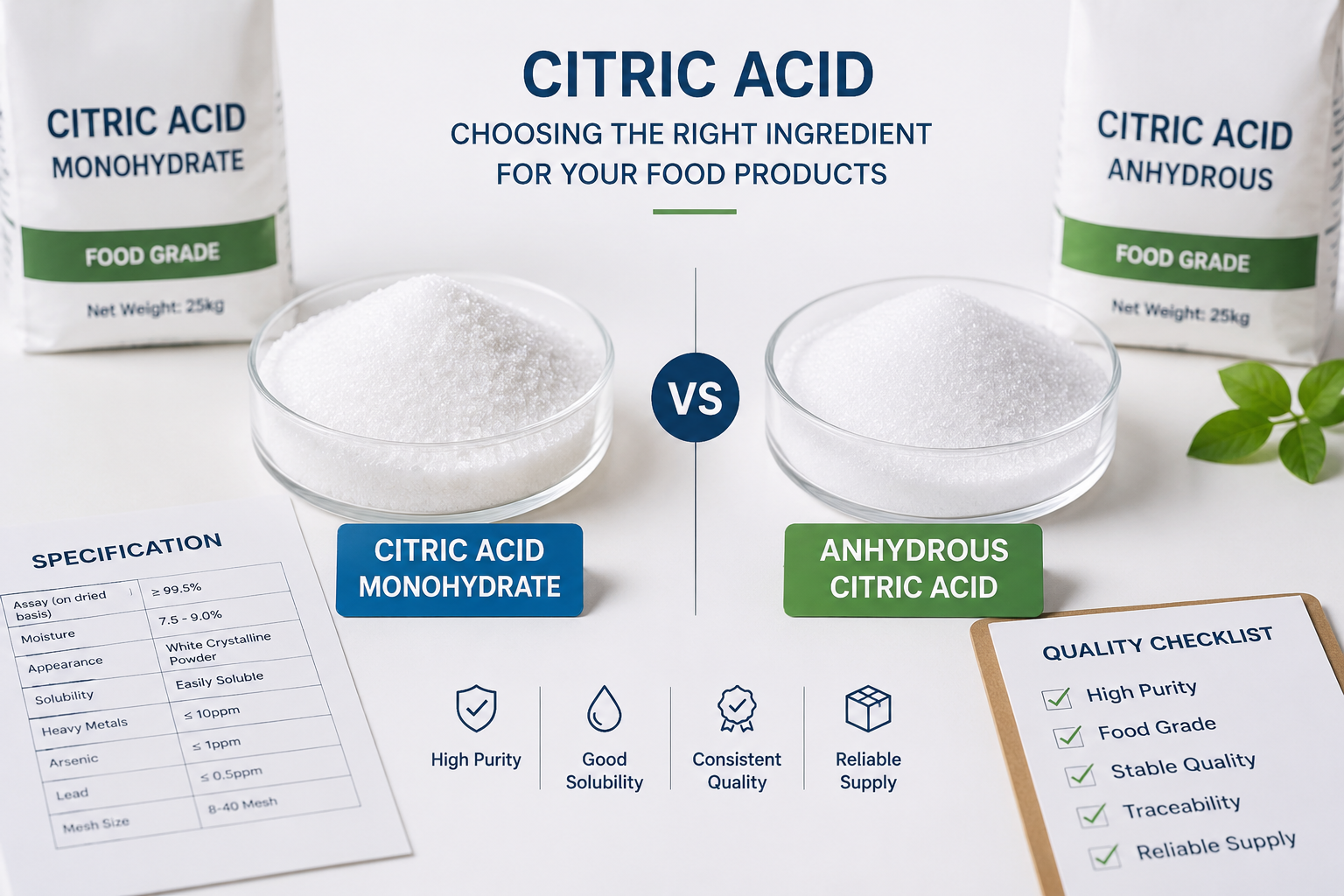
When sourcing citric acid for food production, many manufacturers focus mainly on purity, price, and supply availability. However, one important factor is often overlooked: choosing the right type of citric acid for a specific application.
Citric acid is commonly available in two main forms: citric acid monohydrate and anhydrous citric acid. Although both provide the same basic acidifying function, they are not exactly the same in terms of moisture content, physical characteristics, storage considerations, and application suitability.
For food manufacturers, the choice between citric acid monohydrate vs anhydrous is not simply about selecting one product over another. The better option depends on factors such as formulation requirements, processing conditions, moisture sensitivity, and the final product characteristics.
Understanding the differences between these two forms can help purchasing teams make more informed decisions, improve production consistency, and select the most suitable ingredient for their applications.
In this guide, we will compare citric acid monohydrate and anhydrous citric acid, explain their key differences, discuss common food applications, and provide practical guidance on how to choose the right type for your manufacturing needs.
What Are Citric Acid Monohydrate and Anhydrous Citric Acid?
Before comparing the differences between citric acid monohydrate and anhydrous citric acid, it is important to understand what makes these two forms different.
Both products are forms of food grade citric acid and share the same chemical foundation. The main difference comes from their crystal structure and moisture content. During the crystallization process, citric acid can form either a monohydrate structure containing one molecule of crystallization water or an anhydrous structure without bound water.
This difference may seem minor, but it can influence how the ingredient performs during storage, handling, and food manufacturing processes.
Citric Acid Monohydrate
Citric acid monohydrate is a crystalline form of citric acid that contains one molecule of water associated with each citric acid molecule within its crystal structure.
It is one of the most commonly used forms of citric acid in the food industry due to its stable physical characteristics and broad application range.
In practical food manufacturing, citric acid monohydrate is often selected for applications where standard acidity adjustment, flavor balance, and reliable processing performance are required.
Common characteristics include:
- White crystalline powder appearance
- Stable storage performance under normal conditions
- Good solubility in water-based formulations
- Widely used in beverage, confectionery, dairy, and processed food applications
For many general food applications, citric acid monohydrate provides a cost-effective and reliable option because it meets the functional requirements of most formulations without requiring extremely low moisture content.
Anhydrous Citric Acid
Anhydrous citric acid is a form of citric acid that does not contain crystallization water within its molecular structure.
Compared with citric acid monohydrate, anhydrous citric acid has a lower moisture content, making it more suitable for applications where controlling water content is an important consideration.
This form is often preferred in dry formulations or products where additional moisture may affect processing performance, shelf stability, or product texture.
Typical characteristics include:
- White crystalline powder appearance
- Lower moisture content compared with monohydrate form
- Suitable for moisture-sensitive formulations
- Commonly used in dry food products and specialized applications
However, choosing anhydrous citric acid does not automatically mean it is a better option. The appropriate choice depends on the specific production requirements, formulation design, and storage conditions of the final product.
Why Does the Difference Matter for Food Manufacturers?
For ingredient buyers, the distinction between citric acid monohydrate and anhydrous citric acid is mainly related to how the ingredient interacts with the overall production system.
For example:
- A beverage manufacturer may prioritize solubility and consistent acid adjustment.
- A dry powder product manufacturer may pay more attention to moisture control.
- A confectionery producer may consider factors such as texture stability and processing conditions.
Therefore, selecting the right citric acid type should be based on the application requirements rather than simply comparing product names or prices.
Understanding this basic difference provides the foundation for evaluating the detailed comparison between citric acid monohydrate vs anhydrous citric acid, which will be discussed in the next section.
Key Differences Between Citric Acid Monohydrate and Anhydrous Citric Acid
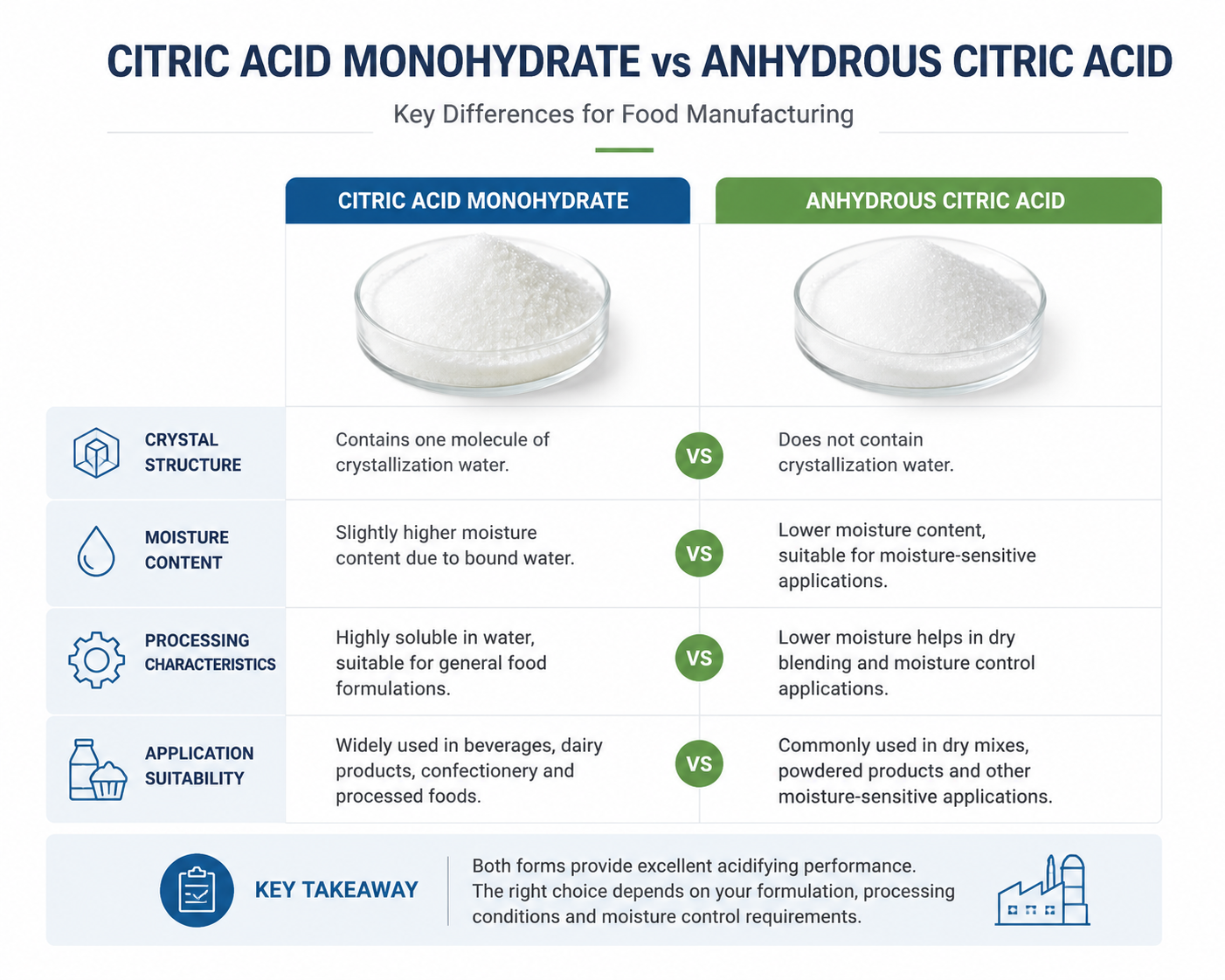
Although citric acid monohydrate and anhydrous citric acid provide similar acidifying functions in food production, their physical properties are different. These differences can affect ingredient handling, formulation design, storage requirements, and final product performance.
For food manufacturers, understanding these differences helps avoid choosing an ingredient based only on price or availability. The right choice should match the specific requirements of the production process.
The main differences between these two forms include crystal structure, moisture content, physical characteristics, and application suitability.
Citric Acid Monohydrate vs Anhydrous: Comparison Table
| Feature | Citric Acid Monohydrate | Anhydrous Citric Acid |
|---|---|---|
| Crystal structure | Contains one molecule of crystallization water | Does not contain crystallization water |
| Moisture content | Slightly higher due to bound water | Lower moisture content |
| Physical appearance | White crystalline powder | White crystalline powder |
| Solubility | Highly soluble in water-based systems | Highly soluble, commonly used where lower moisture is preferred |
| Storage considerations | Stable under standard dry storage conditions | Requires attention to moisture protection |
| Common applications | Beverages, dairy products, confectionery, processed foods | Dry mixes, powdered products, moisture-sensitive formulations |
| Selection focus | General food applications requiring reliable acid adjustment | Applications requiring tighter moisture control |
1. Crystal Structure and Moisture Content
The most fundamental difference between the two forms is their crystal structure.
Citric acid monohydrate contains crystallization water, meaning water molecules are incorporated into the crystal structure during production. This does not mean the product is wet or unstable; rather, the water exists as part of the molecular arrangement.
Anhydrous citric acid, as the name suggests, does not contain this crystallization water. As a result, it generally has a lower moisture content compared with the monohydrate form.
For most food applications, this difference does not significantly change the acidifying function of citric acid. However, in formulations where moisture level is carefully controlled, this distinction becomes more important.
For example, manufacturers producing dry powdered products may prefer anhydrous citric acid because maintaining low moisture content can help support product stability.
2. Processing and Handling Characteristics
During food manufacturing, ingredient handling performance can influence production efficiency and consistency.
Citric acid monohydrate is widely used because it provides stable performance in many traditional food formulations. Its characteristics make it suitable for applications where ingredients are dissolved into liquid systems or blended into products with sufficient moisture.
Anhydrous citric acid may offer advantages in formulations where manufacturers need to minimize additional moisture input. This can be particularly relevant in dry blending processes, powdered products, or formulations where water activity needs to be carefully managed.
However, the best choice depends on the entire formulation system. A lower moisture ingredient does not always create better results if the application does not require that characteristic.
3. Application Suitability
The choice between citric acid monohydrate and anhydrous citric acid is often determined by the final product category.
Citric Acid Monohydrate Is Commonly Used For:
- Beverage manufacturing
- Dairy applications
- Confectionery products
- Processed foods
- General food formulations
These applications often focus on acidity adjustment, flavor balance, and consistent processing performance.
Anhydrous Citric Acid Is Commonly Used For:
- Powdered beverage mixes
- Dry food formulations
- Moisture-sensitive products
- Specialized processing applications
These applications may place more emphasis on moisture control and storage stability.
It is important to note that there is no universal rule that one form is better than the other. Both forms are widely accepted in food manufacturing, and the final decision should be based on product requirements, processing conditions, and quality specifications.
Key Takeaway for Buyers
When evaluating citric acid monohydrate vs anhydrous, food manufacturers should consider:
- What type of product is being produced?
- Does the formulation require strict moisture control?
- How will the ingredient be stored and handled?
- What quality specifications are required?
A suitable citric acid supplier should be able to provide clear product specifications, quality documentation, and application guidance to help customers select the right ingredient.
Citric Acid Monohydrate Applications in Food Manufacturing
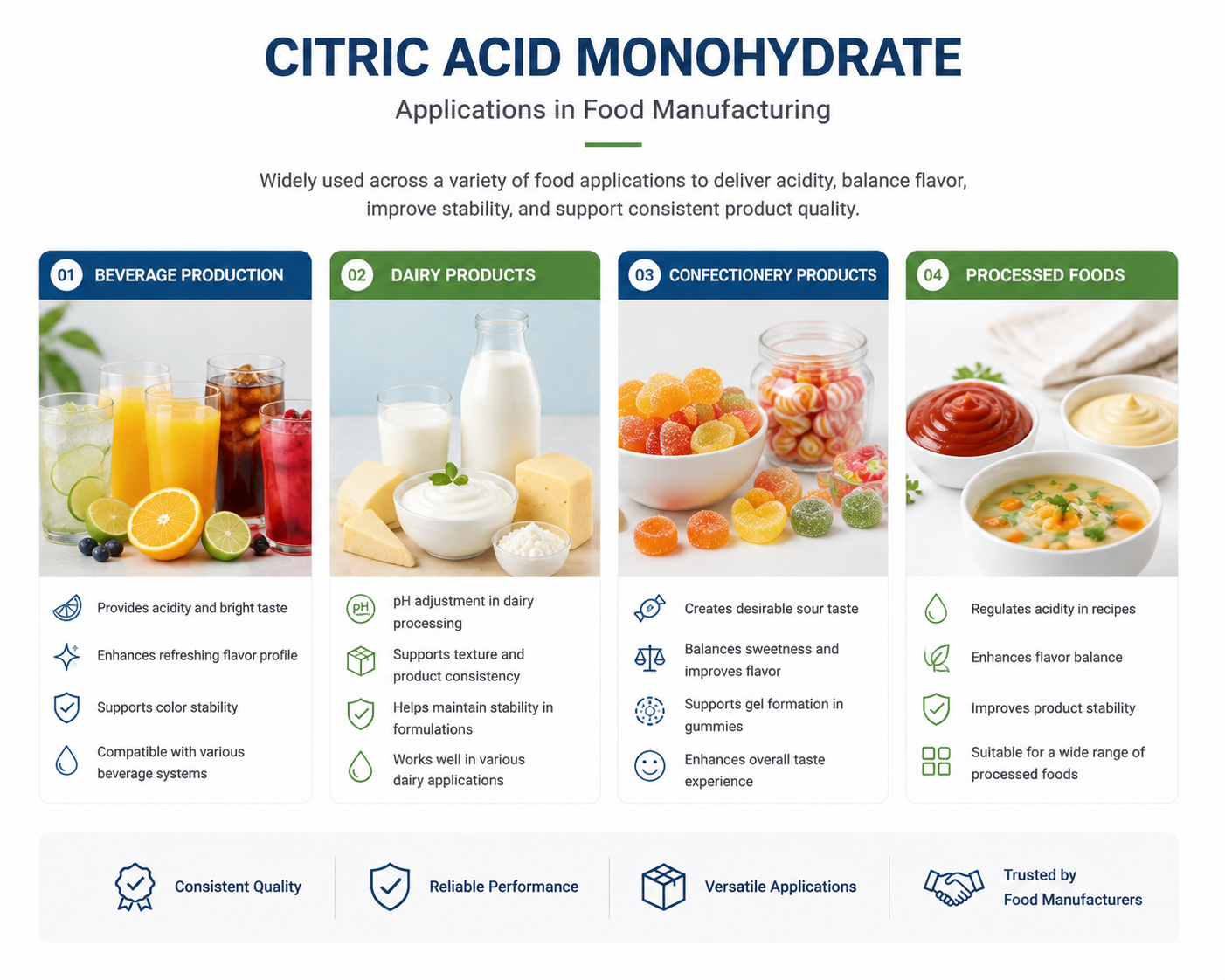
Because of its stable performance, good solubility, and broad compatibility with food formulations, citric acid monohydrate is widely used across different areas of food manufacturing.
For many producers, the choice of citric acid monohydrate is not only related to acidity adjustment. It is also about achieving consistent product quality, maintaining formulation stability, and ensuring reliable performance during large-scale production.
While the specific usage level depends on the product formula and processing requirements, citric acid monohydrate is commonly found in applications such as beverages, confectionery, dairy products, and processed foods.
Beverage Manufacturing
The beverage industry is one of the largest application areas for citric acid.
In beverage formulations, citric acid monohydrate is commonly used to provide acidity, balance sweetness, and improve overall flavor perception. It helps create the desired taste profile in products such as fruit beverages, carbonated drinks, and flavored drinks.
For beverage manufacturers, important considerations include:
- Consistent acidity adjustment
- Good solubility in liquid systems
- Compatibility with other ingredients
- Stable performance during production and storage
Because beverages typically involve water-based systems, the properties of citric acid monohydrate make it a practical choice for many manufacturers.
For example, in fruit-based beverages, citric acid can help enhance natural fruit flavors by providing a balanced acidic taste, while in carbonated beverages it can contribute to the overall flavor structure.
Confectionery Products
Citric acid monohydrate is also commonly used in confectionery manufacturing, including products such as gummies, candies, and sour-flavored sweets.
In these applications, citric acid is often added to create a specific sour taste profile and improve flavor balance.
Manufacturers typically consider factors such as:
- Acid intensity
- Flavor interaction
- Processing temperature
- Product texture requirements
For sour candies and gummy products, achieving the right balance between sweetness and acidity is important for consumer acceptance. Citric acid monohydrate provides a reliable acid source that can be accurately controlled during formulation.
Dairy Applications
In dairy processing, citric acid monohydrate may be used in selected applications where acidity adjustment and ingredient interaction are required.
For example, it can be used in processed dairy products to support:
- pH adjustment
- Texture control
- Processing consistency
However, dairy formulations are often highly specific, and ingredient selection depends heavily on the product type and manufacturing process.
For dairy manufacturers, factors such as protein interaction, processing conditions, and final product characteristics should be evaluated before selecting the appropriate citric acid form.
Processed Foods and Other Applications
Beyond beverages and dairy products, citric acid monohydrate is also used in various processed food applications.
Common examples include:
- Sauces and dressings
- Prepared foods
- Seasonings
- Food ingredient blends
In these products, citric acid can support acidity regulation and help maintain consistent product characteristics.
For manufacturers producing multiple product categories, citric acid monohydrate is often preferred because of its versatility and compatibility with different formulation systems.
Why Manufacturers Choose Citric Acid Monohydrate
For many food producers, citric acid monohydrate remains a popular choice because it offers a balance between functionality, availability, and application flexibility.
The main advantages include:
- Suitable for a wide range of food applications
- Reliable performance in water-based formulations
- Easy integration into existing production processes
- Widely available with established quality standards
However, selecting citric acid monohydrate should still be based on the specific requirements of the final product. Applications with strict moisture control requirements may require further evaluation of whether anhydrous citric acid would be more suitable.
Understanding the role of citric acid monohydrate in different food categories helps manufacturers make better ingredient decisions and ensures the selected ingredient matches their production goals.
Anhydrous Citric Acid Applications in Food Manufacturing
Compared with citric acid monohydrate, anhydrous citric acid is mainly selected for applications where moisture control is an important consideration.
Although both forms provide similar acidifying functions, the lower moisture content of anhydrous citric acid can provide advantages in specific food formulations, especially in dry products where controlling water content is critical.
For manufacturers, the decision to use anhydrous citric acid is usually based on product requirements rather than general performance differences.
Dry Powdered Beverage Products
One of the common applications of anhydrous citric acid is in dry beverage mixes.
Products such as powdered drink mixes require careful control of moisture because excess water content can affect:
- Powder flowability
- Storage stability
- Ingredient interaction
- Product shelf life
In these formulations, anhydrous citric acid can be a suitable option because its lower moisture characteristics align better with dry blending processes.
Dry Food Formulations
Anhydrous citric acid is also used in various dry food applications, including:
- Seasoning blends
- Instant food products
- Powdered ingredient mixtures
For these products, manufacturers often focus on maintaining consistent powder characteristics and preventing unwanted moisture-related issues during storage and transportation.
Selecting anhydrous citric acid can help manufacturers better manage formulation requirements where moisture sensitivity is a key factor.
Specialized Food Applications
Some food products require more specific ingredient control due to their processing conditions or storage requirements.
In these cases, manufacturers may evaluate anhydrous citric acid based on factors such as:
- Moisture limitations
- Processing environment
- Packaging requirements
- Final product stability
However, anhydrous citric acid is not necessarily the better choice for every application. If moisture control is not a major concern, citric acid monohydrate may provide a more practical and economical solution.
The best ingredient choice depends on the complete formulation system and production objectives.
Choosing Between Citric Acid Monohydrate and Anhydrous Citric Acid
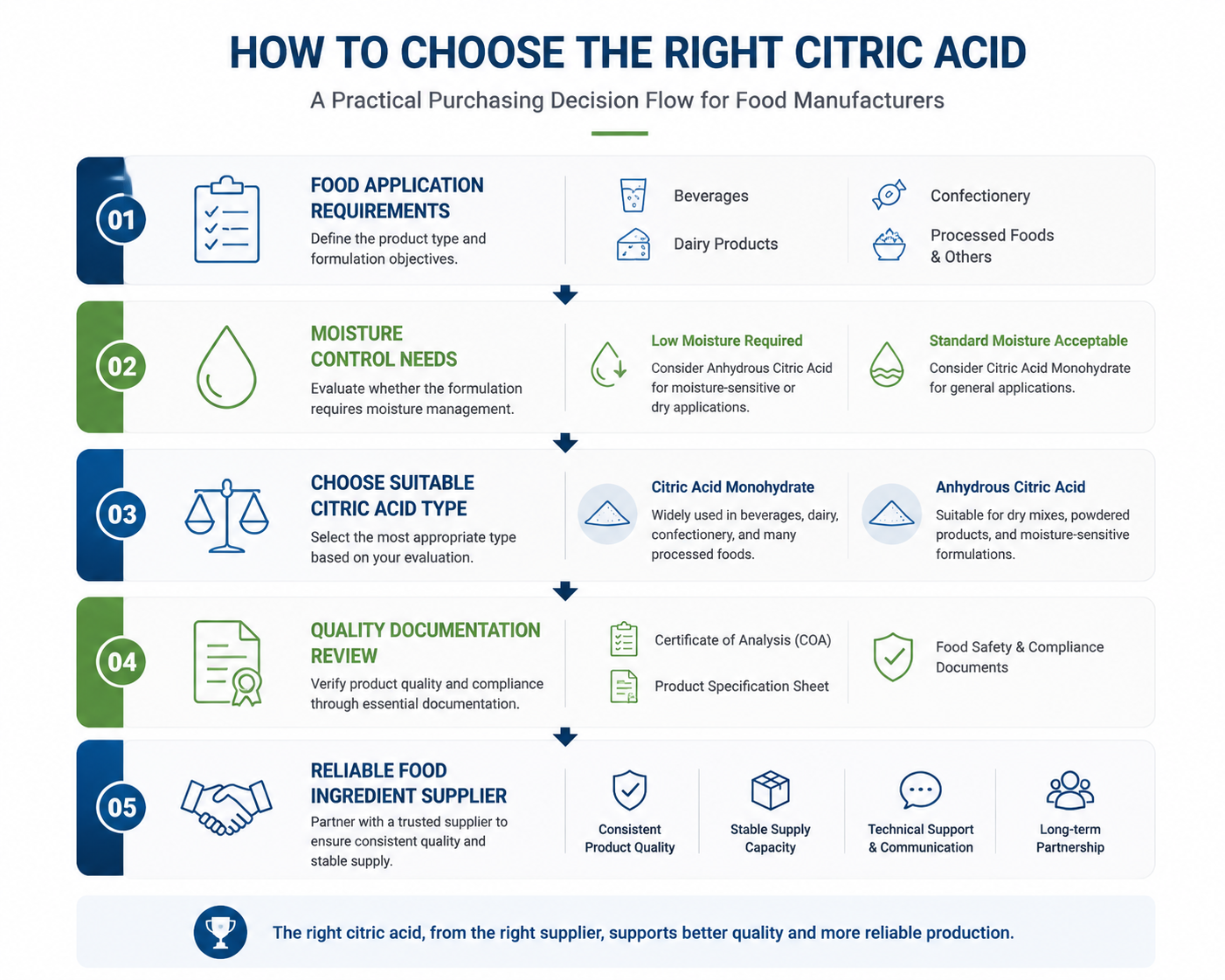
When comparing citric acid monohydrate vs anhydrous, food manufacturers should evaluate several factors rather than focusing on a single specification.
A simple decision approach is:
Choose Citric Acid Monohydrate When:
- The product is mainly water-based
- Standard acidity adjustment is required
- Broad application flexibility is important
- The formulation does not require strict moisture control
Common examples include beverages, dairy products, confectionery, and many processed foods.
Choose Anhydrous Citric Acid When:
- The product is moisture-sensitive
- Low moisture content is a priority
- The formulation involves dry mixing processes
- Powder stability is an important consideration
Common examples include powdered beverages and dry food formulations.
For purchasing teams, the selection process should also consider supplier capabilities, including product specifications, quality documentation, and batch consistency.
A reliable supplier should be able to provide technical information such as product specifications and COA documentation to support ingredient selection.
Quality Considerations When Purchasing Citric Acid
Choosing between citric acid monohydrate and anhydrous citric acid is only one part of the sourcing process. For food manufacturers, product quality, documentation, and supply reliability are also important factors when selecting a supplier.
Key factors to evaluate include:
Product Specifications
- Purity level
- Moisture content
- Appearance
- Solubility
- Particle size
Different applications may require different specifications, so product selection should always be based on actual production needs.
Quality Documentation and Supply Consistency
Reliable food ingredient suppliers should provide essential documentation, such as:
- Certificate of Analysis (COA)
- Product specification sheet
- Food safety documents
Consistent quality between batches and stable supply capability are also important for large-scale food production.
When selecting citric acid, buyers should consider not only the product type but also the supplier’s ability to provide reliable quality and long-term support.
Frequently Asked Questions
What is the difference between citric acid monohydrate and anhydrous citric acid?
The main difference is moisture content and crystal structure. Citric acid monohydrate contains crystallization water, while anhydrous citric acid does not, which can affect their suitability for different applications.
Is anhydrous citric acid better than monohydrate?
Neither form is universally better. Citric acid monohydrate is suitable for many general food applications, while anhydrous citric acid may be preferred where moisture control is important.
Which citric acid type is commonly used in beverages?
Citric acid monohydrate is commonly used in many beverage formulations due to its reliable performance in water-based systems. However, the best choice depends on the specific formula and production requirements.
Conclusion
When comparing citric acid monohydrate vs anhydrous, the right choice depends on application requirements, processing conditions, and moisture control needs.
Citric acid monohydrate offers broad application flexibility, while anhydrous citric acid can be a suitable option for moisture-sensitive formulations.