



- Your cart is empty Browse Shop
Citric Acid Specifications Guide: Food Grade Standards and Quality Requirements
Introduction
Citric acid is one of the most widely used food ingredients in modern food manufacturing. It is widely used in beverages, dairy products, confectionery, and other food applications.It plays an important role in beverages, dairy products, confectionery, sauces, and many other processed food applications because of its acidity regulation, flavor enhancement, and formulation stability.
However, for food manufacturers and ingredient buyers, selecting citric acid is not only about finding a competitive price. Product consistency, quality standards, documentation support, and supplier reliability are equally important factors that directly affect production performance.
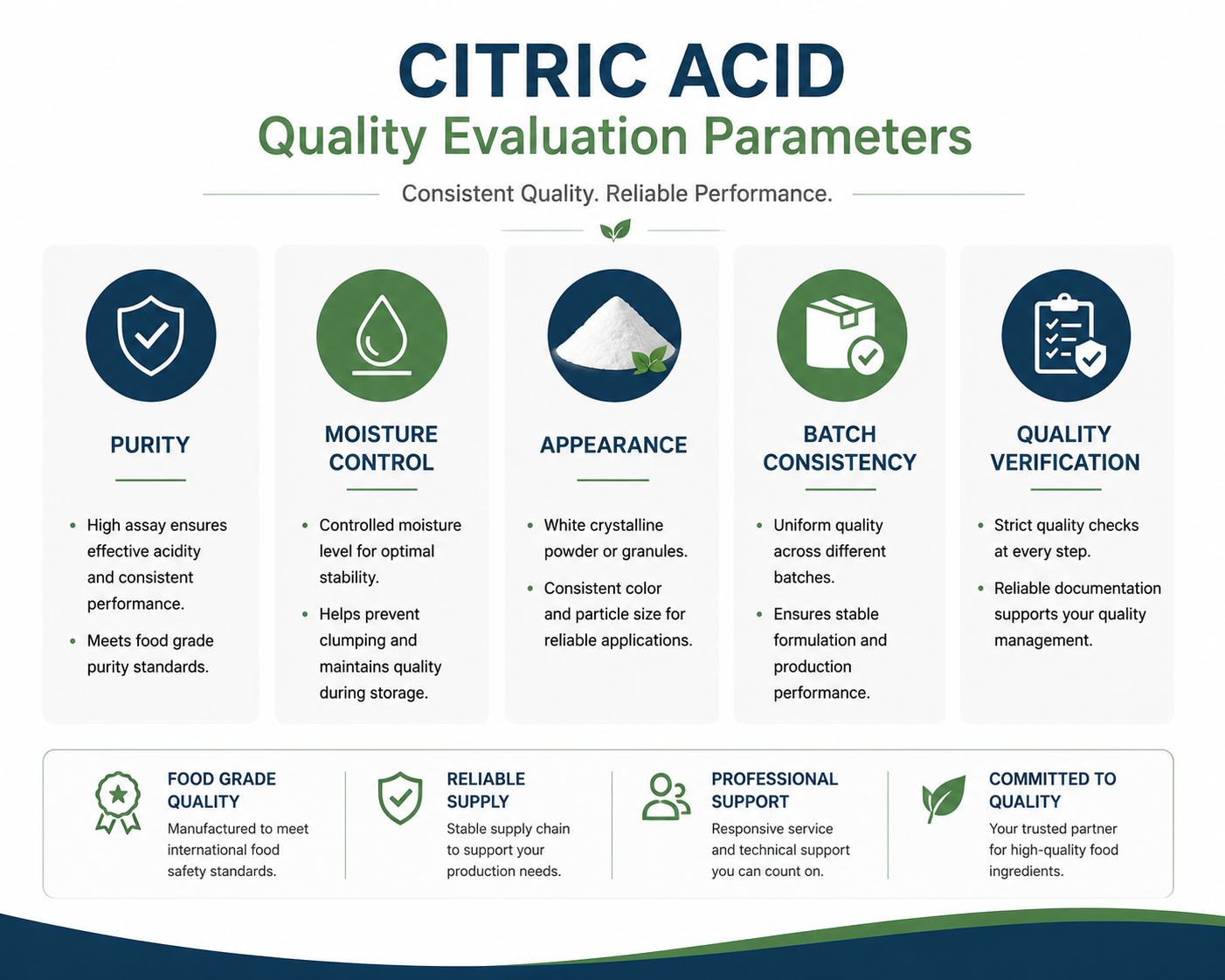
Understanding citric acid specifications helps manufacturers evaluate whether a product meets their application requirements and quality expectations. Key factors such as purity level, moisture content, physical appearance, solubility, and quality documentation should all be considered before making a purchasing decision.
This guide explains the essential specifications of food grade citric acid and the quality requirements buyers should review when evaluating suppliers.
What Are Citric Acid Specifications?
Citric acid specifications refer to the technical characteristics and quality requirements used to define the identity, purity, and performance of citric acid products.
For food manufacturers, specifications are more than just a product description. They provide a standard reference to ensure that every batch performs consistently during production.
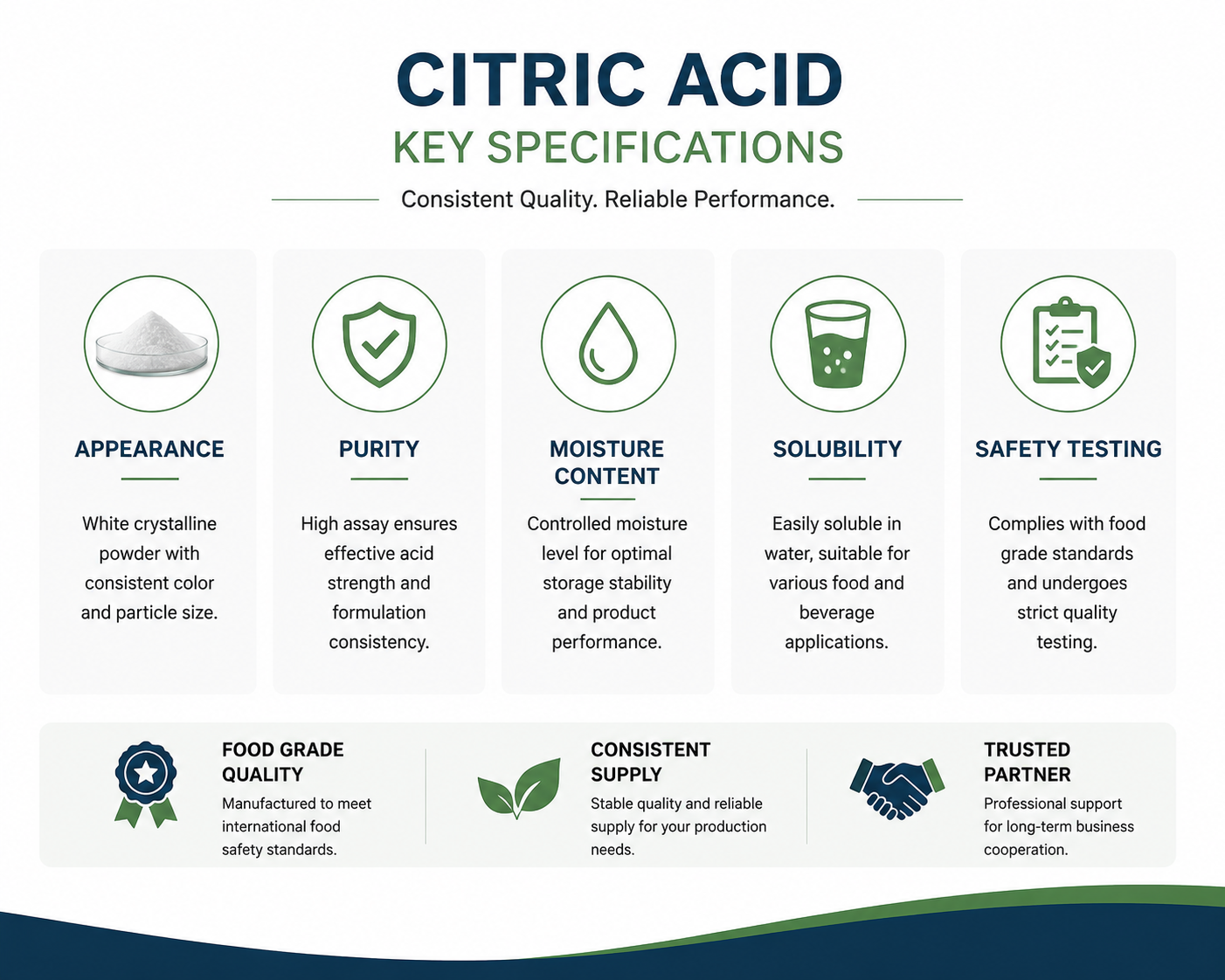
Although different applications may have slightly different requirements, most buyers typically focus on several key specification parameters, including appearance, purity, moisture content, solubility, and safety-related indicators.
Understanding these factors allows purchasing teams and technical departments to compare suppliers more effectively and reduce potential quality risks.
1. Appearance and Physical Characteristics
The appearance of citric acid is one of the first quality indicators evaluated during purchasing and incoming inspection.
Food grade citric acid is typically supplied as:
- White crystalline powder
- Free-flowing crystals
- Uniform particle appearance
- No visible foreign materials
Consistent physical characteristics are important because they influence handling, storage, and processing efficiency.
For example, in beverage production, good solubility and consistent particle characteristics help manufacturers achieve stable formulation and efficient mixing processes.
While appearance alone does not determine overall quality, it is an important part of a complete citric acid specification sheet and quality evaluation process.
2. Purity and Assay Level
Purity is one of the most important specifications considered by food manufacturers.
The assay value indicates the percentage of citric acid content in the product and reflects its chemical consistency. Higher and more consistent purity levels help manufacturers maintain predictable formulation results across different production batches.
For many food applications, buyers commonly evaluate citric acid based on:
- Assay percentage
- Chemical consistency
- Batch-to-batch stability
- Compliance with required food standards
A reliable supplier should provide clear product specifications and supporting quality documents to verify the purity level.
When comparing suppliers, focusing only on price without considering purity and consistency can create additional risks, including formulation adjustments, production delays, or inconsistent final products.
3. Moisture Content and Storage Stability
Moisture content is another important factor in citric acid specifications, especially for products stored and transported in bulk quantities.
Controlled moisture levels help maintain:
- Product stability during storage
- Better powder flow characteristics
- Reduced risk of clumping
- Easier handling during production
For food manufacturers purchasing larger quantities, stable storage performance is essential because raw materials may remain in inventory for weeks or months before use.
A detailed specification sheet should clearly indicate moisture requirements and recommended storage conditions to help buyers maintain product quality throughout the supply chain.
4. Solubility and Application Performance
Citric acid is widely used in liquid food systems, including beverages and concentrates, where solubility directly affects processing efficiency.
Good solubility allows citric acid to:
- Dissolve efficiently during production
- Mix evenly with other ingredients
- Support consistent product formulation
Different food applications may have different processing requirements, so buyers should consider whether the product specifications match their specific manufacturing process.
For example, beverage manufacturers may pay particular attention to dissolution performance, while dry food manufacturers may focus more on storage stability and handling properties.
5. Safety Parameters and Quality Control Indicators
In addition to basic physical and chemical specifications, food manufacturers also evaluate safety-related quality indicators.
These may include:
- Heavy metal control
- Contaminant limits
- Microbiological requirements
- Production quality control records
These parameters help ensure that the ingredient meets food manufacturing expectations and supports consistent product quality.
A professional supplier should be able to provide appropriate documentation to demonstrate that the product has been tested and meets the required quality standards.
Food Grade Citric Acid Standards and Requirements
For food manufacturers, choosing the right ingredient grade is one of the first steps in ensuring product quality and regulatory compliance.
Food grade citric acid is specifically produced and controlled for use in food applications, where consistency, purity, and safety are essential. Unlike general industrial-grade materials, food grade ingredients require stricter quality control throughout production, testing, and documentation.
Food Grade Compliance and Quality Control
Key aspects that buyers should consider include:
- Consistent product specifications between batches
- Defined quality testing procedures
- Proper product documentation
- Traceability of production batches
These factors help manufacturers maintain stable production and reduce unexpected variations during formulation.
For companies producing beverages, dairy products, confectionery, or processed foods, ingredient consistency is especially important because even small differences in raw materials may affect taste, texture, or processing performance.
Purity Standards for Food Applications
Purity is a critical part of citric acid quality requirements.
High-quality food grade citric acid should demonstrate consistent chemical characteristics and meet the specifications required for its intended application.
Important quality indicators may include:
- Assay level
- Moisture content
- Appearance
- Solubility
- Impurity control
A complete specification sheet allows buyers to verify whether the product meets their internal quality standards before placing an order.
Rather than focusing only on the lowest purchase price, professional buyers usually evaluate the overall value of the ingredient, including quality consistency, documentation support, and supply reliability.
Documentation Support for Food Ingredient Purchasing
Documentation is another important difference between a basic supplier and a professional ingredient partner.
For food grade citric acid purchases, buyers commonly request documents such as:
- Product specification sheet
- Certificate of Analysis (COA)
- Quality inspection records
- Batch-related information
These documents help purchasing teams verify product quality and support internal quality control processes.
A supplier that provides complete and transparent documentation can make the purchasing process easier and help manufacturers maintain consistent standards across their production operations.
Key Parameters in Citric Acid Specifications
When evaluating citric acid suppliers, purchasing teams usually review a specification sheet to confirm whether the product meets their manufacturing requirements.
A complete citric acid specification sheet provides detailed information about the product’s physical and chemical characteristics, helping buyers compare different suppliers and ensure consistent quality.
Although specific requirements may vary depending on the application, several key parameters are commonly reviewed when purchasing food grade citric acid.
Parameter | Description | Why It Matters |
|---|---|---|
| Appearance | White crystalline powder with consistent physical characteristics | Helps verify product consistency and proper handling performance |
| Assay / Purity | Indicates the percentage of citric acid content in the product | Ensures formulation accuracy and stable production results |
| Moisture Content | Measures the amount of water contained in the product | Affects storage stability, flowability, and shelf life |
| Solubility | Describes how efficiently citric acid dissolves in production systems | Important for beverages and liquid food applications |
| Heavy Metals / Impurity Control | Indicates safety-related quality control parameters | Supports food safety requirements and quality assurance |
Appearance and Physical Characteristics
Appearance is one of the first indicators reviewed during incoming quality inspection.
Food manufacturers typically expect citric acid to have a consistent crystalline appearance, clean color, and uniform physical characteristics.
Although appearance does not determine the complete quality profile of the ingredient, noticeable differences may indicate potential issues with handling, storage, or product consistency.
Assay and Purity Level
Among all citric acid specifications, purity is one of the most important factors for industrial buyers.
The assay value reflects the concentration of citric acid in the product and helps manufacturers evaluate whether the ingredient can deliver consistent performance in their formulations.
Stable purity levels are especially important for large-scale food production because manufacturers need predictable ingredient behavior across multiple production batches.
For this reason, professional buyers usually review both the stated purity specification and supporting quality documentation before approving a supplier.
Moisture Content and Storage Performance
Moisture content directly influences how citric acid behaves during storage and transportation.
Controlled moisture levels help maintain:
- Better powder flow
- Reduced clumping
- Improved storage stability
- Easier production handling
For bulk ingredient purchasing, proper moisture control is essential because raw materials may be stored for extended periods before being used in production.
Solubility and Processing Compatibility
Solubility is particularly important for manufacturers producing liquid-based products such as beverages and concentrates.
Citric acid with good solubility can dissolve efficiently and distribute evenly throughout the formulation, helping maintain consistent product quality.
When selecting a supplier, buyers should consider whether the product specifications match their specific processing requirements.
Citric Acid Purity and Testing Requirements
Purity is one of the most important factors when evaluating citric acid quality for food manufacturing applications.
For ingredient buyers, a high-quality product is not only defined by the stated purity level but also by the consistency of that quality across different production batches. Stable purity helps manufacturers maintain predictable formulation results and avoid unnecessary adjustments during production.
When reviewing citric acid purity, buyers should consider both the specification value and the supplier’s quality control process behind that value.
Why Citric Acid Purity Matters
In food production, ingredient consistency directly affects the final product performance.
A consistent purity level helps manufacturers achieve:
- Stable acidity adjustment
- Reliable formulation performance
- Consistent taste and product characteristics
- Reduced production variation
For example, beverage manufacturers often require precise ingredient performance because changes in acidity levels may influence flavor balance and overall product quality.
Similarly, processed food manufacturers rely on consistent raw materials to maintain standardized production processes across multiple batches.
Therefore, purity should be evaluated together with other citric acid quality requirements, rather than considered as an isolated specification.
How Citric Acid Quality Is Verified
Professional suppliers typically use quality control procedures to verify product specifications before shipment.
Common quality evaluation steps may include:
- Raw material inspection
- Production process monitoring
- Finished product testing
- Batch quality verification
The purpose of these procedures is to ensure that each batch meets the agreed product specifications and maintains consistent performance.
For purchasing teams, documentation from these quality checks provides additional confidence when selecting a supplier.
Beyond Purity: Evaluating Overall Product Consistency
While purity is an important specification, experienced buyers usually evaluate the complete quality profile of citric acid.
Other factors that should be considered include:
- Physical appearance
- Moisture control
- Solubility performance
- Documentation availability
- Batch consistency
A supplier with strong quality management practices can provide more reliable support for long-term ingredient sourcing.
For this reason, food manufacturers should evaluate citric acid based on overall quality performance rather than focusing only on a single specification number.
Citric Acid COA and Specification Sheet: What Buyers Should Check
For professional food manufacturers, product documentation is an essential part of the ingredient purchasing process.Similar quality evaluation principles also apply when choosing a food ingredient supplier.
A reliable supplier should provide clear and complete quality documents that allow buyers to verify product specifications before production use.
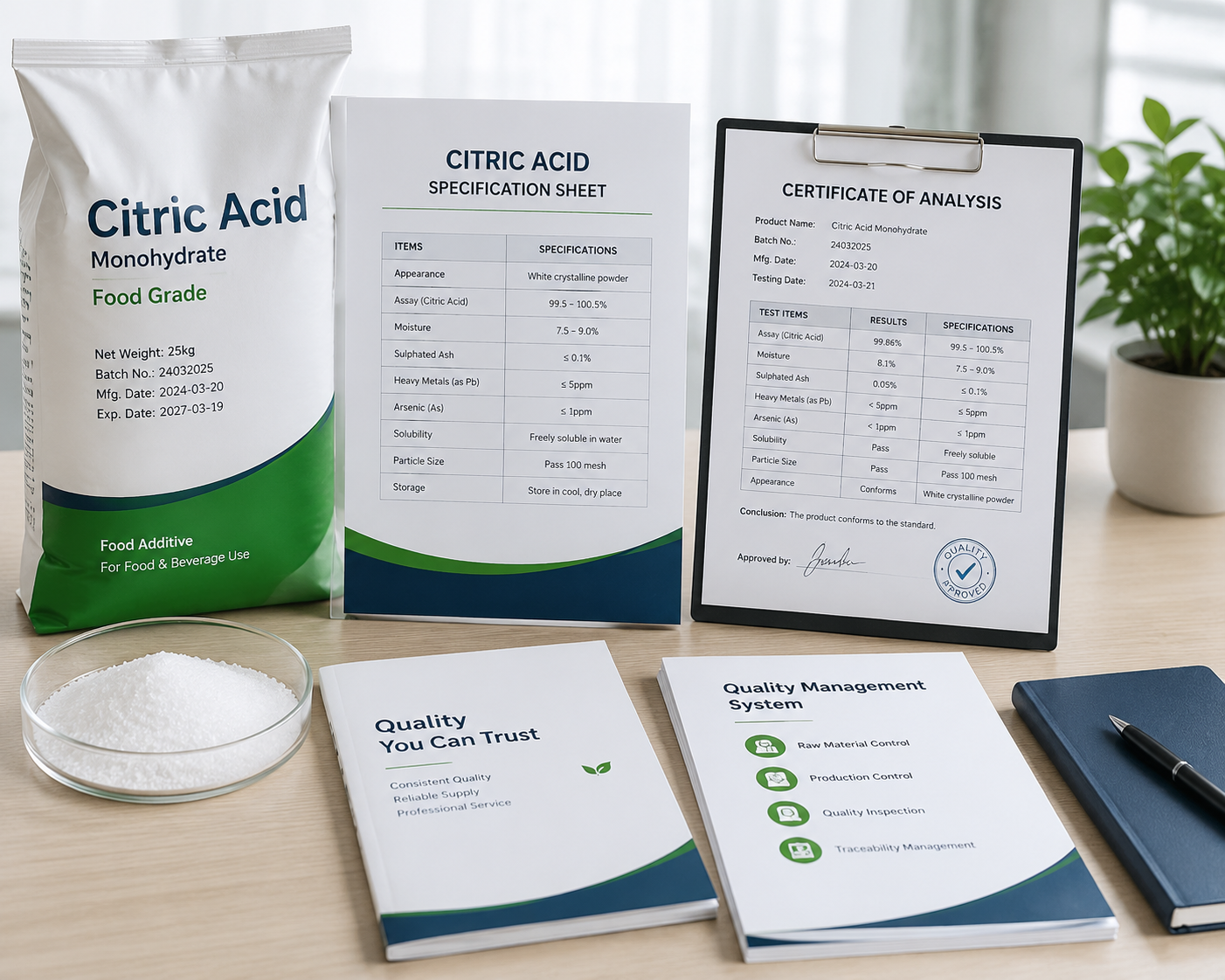
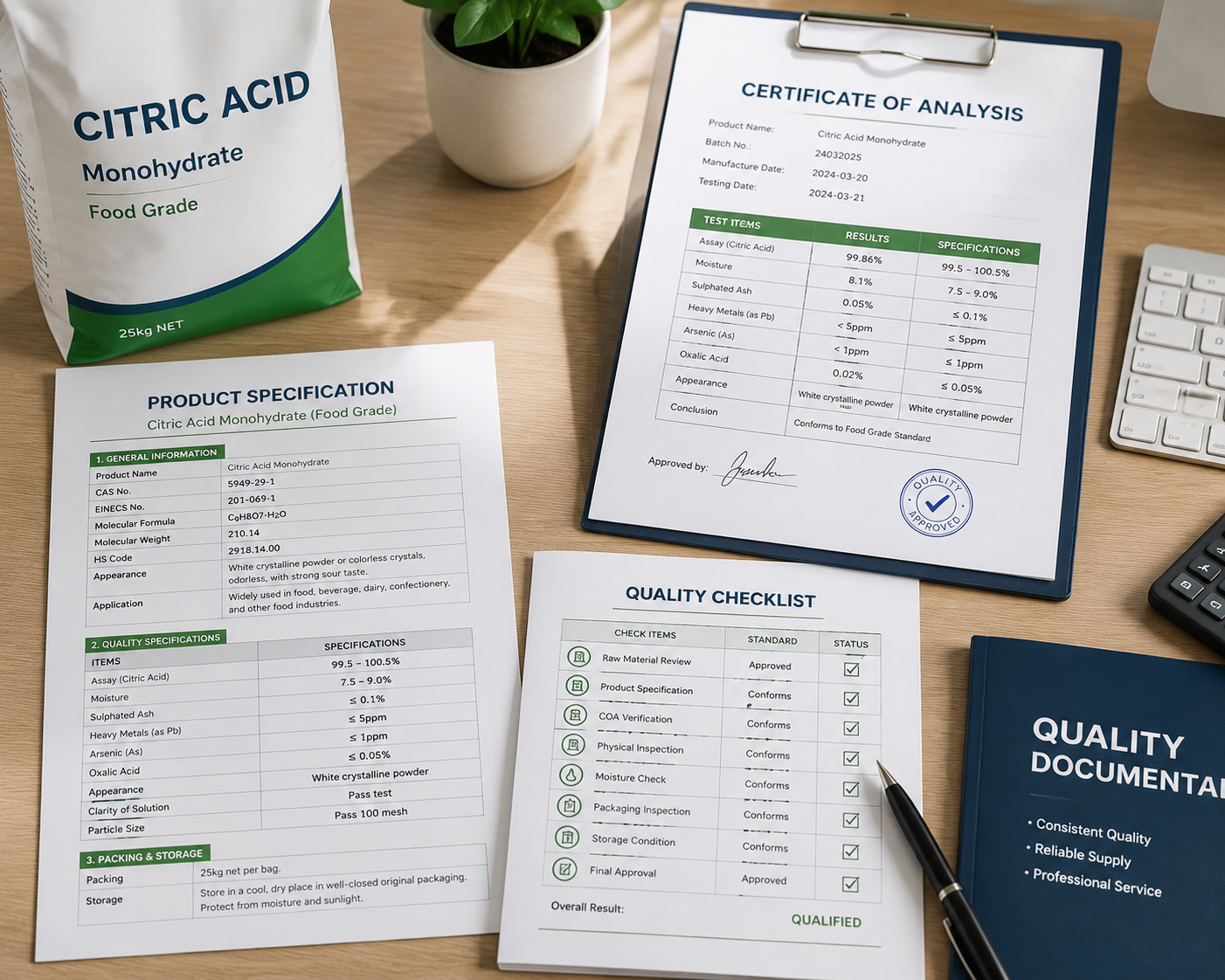
Two of the most important documents buyers commonly review are the citric acid Certificate of Analysis (COA) and the product specification sheet.
These documents help purchasing teams confirm product quality, compare supplier information, and maintain internal quality control standards.
Understanding a Citric Acid Certificate of Analysis (COA)
A Certificate of Analysis (COA) is a quality document that provides testing results for a specific production batch.
Unlike a general product specification sheet, which describes the standard requirements of a product, a COA shows the actual test results of a particular batch.
A typical citric acid COA may include:
- Product name and grade
- Batch or lot number
- Test items and results
- Specification limits
- Testing date or quality verification information
This information allows buyers to confirm that the delivered product matches the agreed quality requirements.
For food manufacturers, batch-level documentation is especially important because it supports traceability and helps maintain consistent production standards.
What to Review in a Citric Acid Specification Sheet
A product specification sheet provides the technical information used to define the product standard.
When reviewing a citric acid specification sheet, buyers should pay attention to:
Product Information
Including:
- Product name
- Product grade
- Product form
- Intended applications
Quality Parameters
Including:
- Purity or assay level
- Moisture content
- Appearance
- Solubility characteristics
- Other relevant quality indicators
Storage and Handling Requirements
Proper storage information helps manufacturers maintain ingredient stability throughout transportation and inventory periods.
Why Documentation Matters When Selecting Suppliers
Complete documentation is not only about meeting purchasing requirements. It also reflects a supplier’s quality management capability.
Suppliers that provide accurate specifications and supporting documents can help buyers:
- Reduce quality risks
- Improve incoming inspection efficiency
- Maintain production consistency
- Support internal quality audits
For long-term ingredient sourcing, transparent documentation is often a key difference between a basic supplier and a reliable manufacturing partner.
Citric Acid Monohydrate vs Anhydrous Citric Acid Specifications
When purchasing citric acid, food manufacturers may encounter two common forms: citric acid monohydrate and anhydrous citric acid.
Both forms provide the same core acidifying function, but they have different physical characteristics due to their water content. Understanding these differences helps buyers select the most suitable product for their manufacturing requirements.
Type | Main Difference | Common Considerations |
|---|---|---|
| Citric Acid Monohydrate | Contains one molecule of crystallization water | Commonly used in many food and beverage applications |
| Anhydrous Citric Acid | Contains no crystallization water | Often selected when lower moisture content is preferred |
When reviewing citric acid monohydrate specifications or anhydrous citric acid specifications, buyers should pay attention to key quality factors such as:
- Purity level
- Moisture content
- Physical appearance
- Solubility characteristics
- Storage requirements
The choice between monohydrate and anhydrous citric acid depends on the specific formulation, processing conditions, and quality requirements of the final product.
For this reason, manufacturers should evaluate not only the product type but also whether the supplier can provide consistent specifications and reliable quality documentation.
How to Evaluate a Reliable Citric Acid Supplier
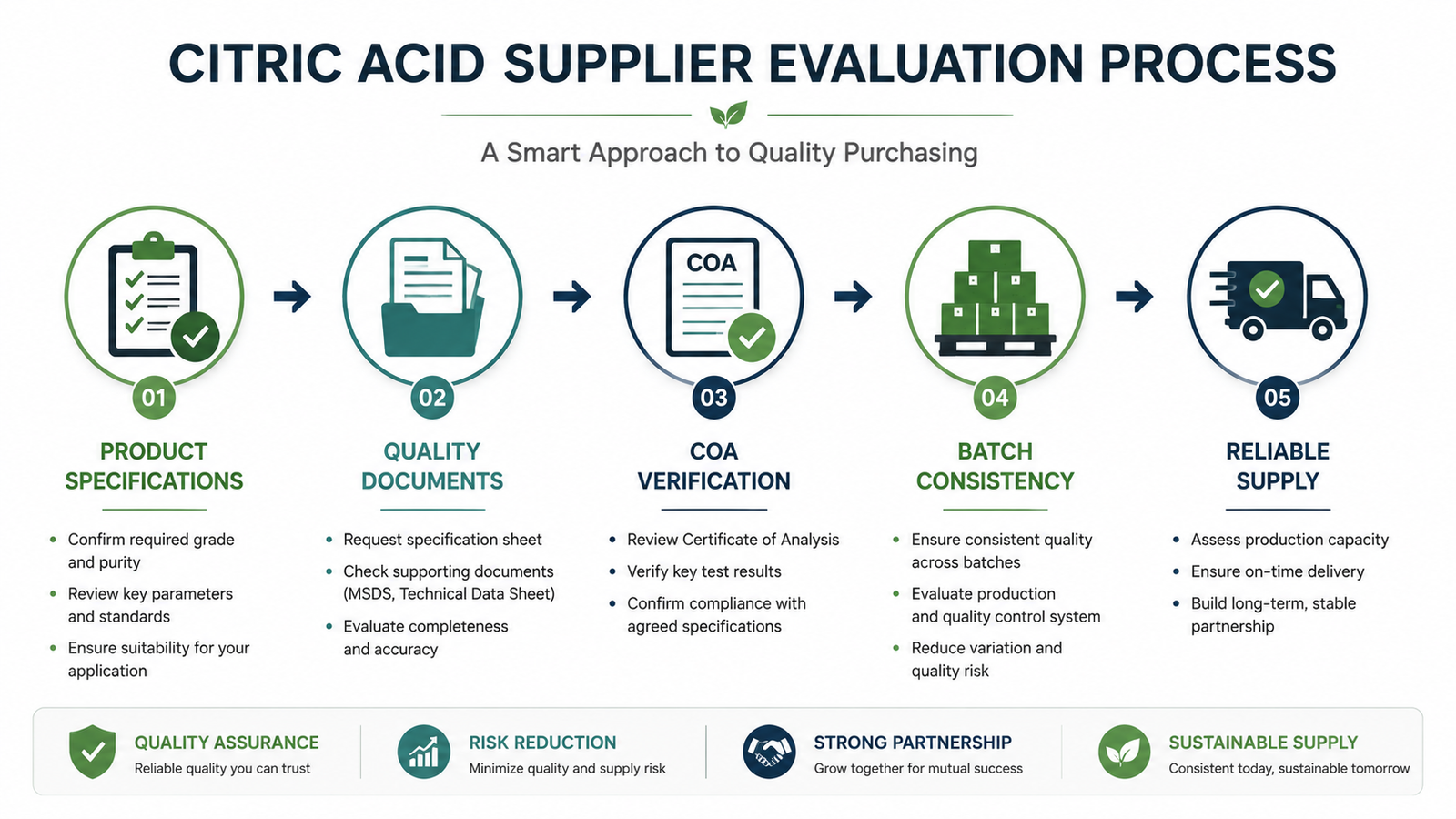
A professional supplier should provide:
- Clear product specifications
- Reliable quality documentation
- Consistent batch performance
- Stable supply capability
Complete technical documents, such as a specification sheet and Certificate of Analysis (COA), allow buyers to verify product quality and ensure the ingredient meets their production requirements.
In addition, consistent product performance and dependable communication are important factors for long-term cooperation.
By evaluating both product specifications and supplier capabilities, manufacturers can reduce quality risks and build a more stable ingredient supply chain.
Frequently Asked Questions About Citric Acid Specifications
What are the main specifications of citric acid?
The main citric acid specifications evaluated by food manufacturers usually include appearance, purity or assay level, moisture content, solubility, and safety-related quality indicators.
These parameters help buyers understand product consistency and determine whether the ingredient is suitable for their manufacturing process.
What purity level is required for food grade citric acid?
The required purity level depends on the specific application and product standards. For most food manufacturing uses, buyers typically review the assay value together with other quality parameters, such as moisture, appearance, and impurity control.
A reliable supplier should provide detailed specifications and supporting quality documentation to verify product consistency.
Why is COA important when purchasing citric acid?
A Certificate of Analysis (COA) provides batch-specific testing information and helps buyers confirm that the delivered product meets the agreed specifications.
For food manufacturers, reviewing a citric acid COA supports quality control, traceability, and supplier evaluation during the purchasing process.
What should buyers check in a citric acid specification sheet?
A citric acid specification sheet usually includes product information, physical characteristics, purity requirements, storage conditions, and quality parameters.
Reviewing these details helps manufacturers select a product that matches their application needs and production requirements.