



- Your cart is empty Browse Shop
Dextrose Monohydrate Uses in Food Manufacturing: Functions, Applications and Formulation Considerations
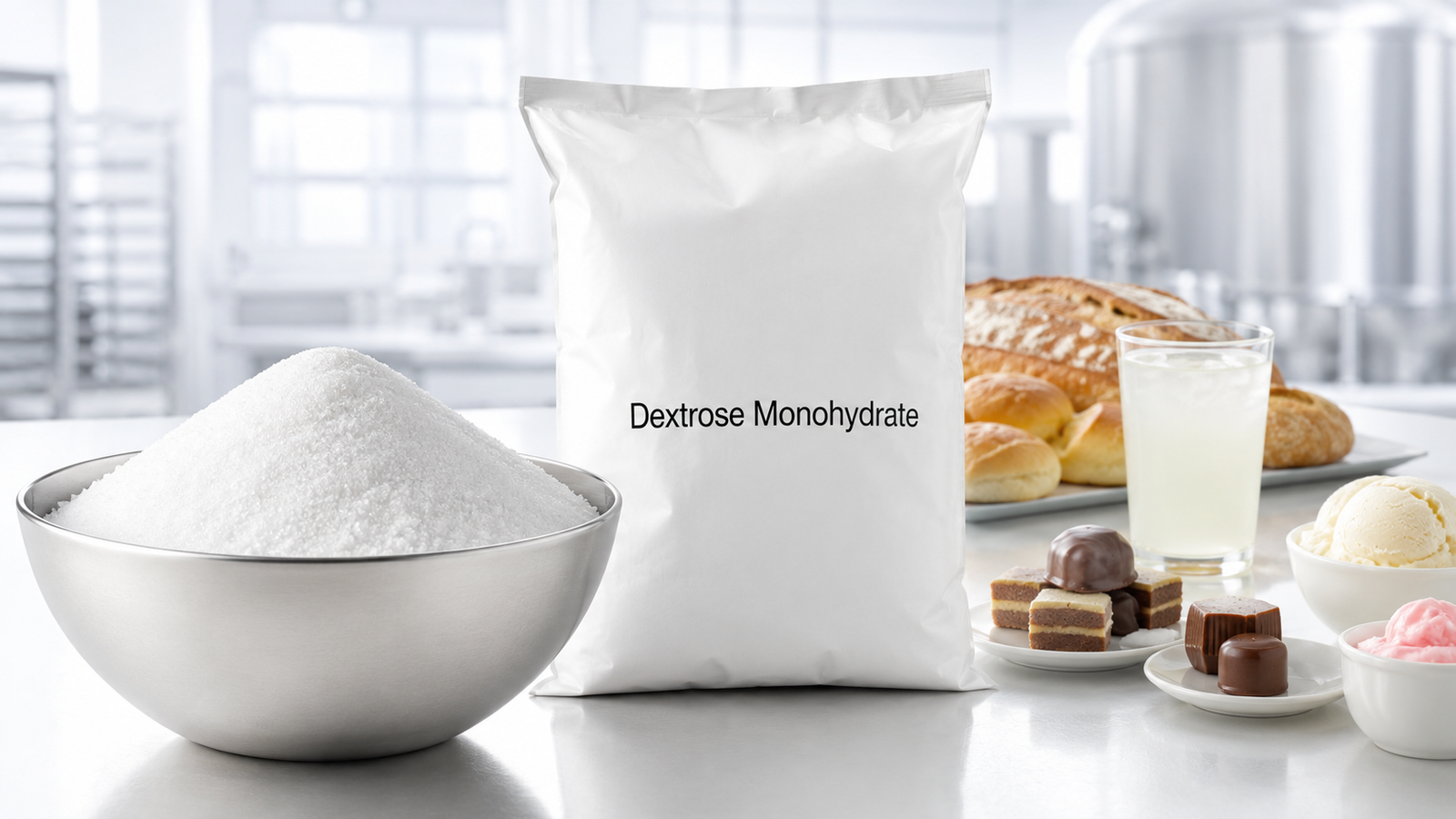
Dextrose monohydrate is widely used in food manufacturing for more than its sweetness. As a functional carbohydrate ingredient, it may also contribute to fermentation, browning, texture, crystallization behavior and the solids balance of a formulation.
These properties make it suitable for a range of products, including bakery goods, beverages, confectionery, dairy products, frozen desserts and dry food mixes. Its role, however, varies from one application to another. The effect depends on the amount used, the presence of other sugars, moisture content, pH and processing conditions such as heating, cooling and storage temperature.
For a broader introduction to the ingredient, including its general properties and common applications, see ourDextrose Monohydrate food ingredient guide.For food manufacturers, the key question is not simply whether dextrose monohydrate can be added to a product. It is whether the ingredient supports the intended formulation and processing requirements. This guide examines the main dextrose monohydrate uses in food manufacturing and the factors that should be considered when applying it in different food systems.
What Is Dextrose Monohydrate Used for in Food Production?
In food production, dextrose monohydrate is commonly used to provide controlled sweetness and carbohydrate solids. Because it is generally perceived as less sweet than sucrose, it can offer additional flexibility when manufacturers need to balance sweetness, flavor and total solids.
Its reducing-sugar properties also allow it to participate in Maillard browning when suitable amino compounds, moisture levels and heating conditions are present. This can be relevant to color and flavor development in baked and thermally processed foods. In yeast-fermented products, dextrose may serve as an available carbohydrate source, although the result depends on the complete formulation and fermentation process.
Dextrose monohydrate can also form part of the sugar system in confectionery and frozen products. In these applications, it may influence crystallization, texture and freezing behavior. Beverage and dry-mix manufacturers may use it as a soluble carbohydrate ingredient, with dissolution and handling performance affected by particle characteristics, mixing conditions and surrounding ingredients.
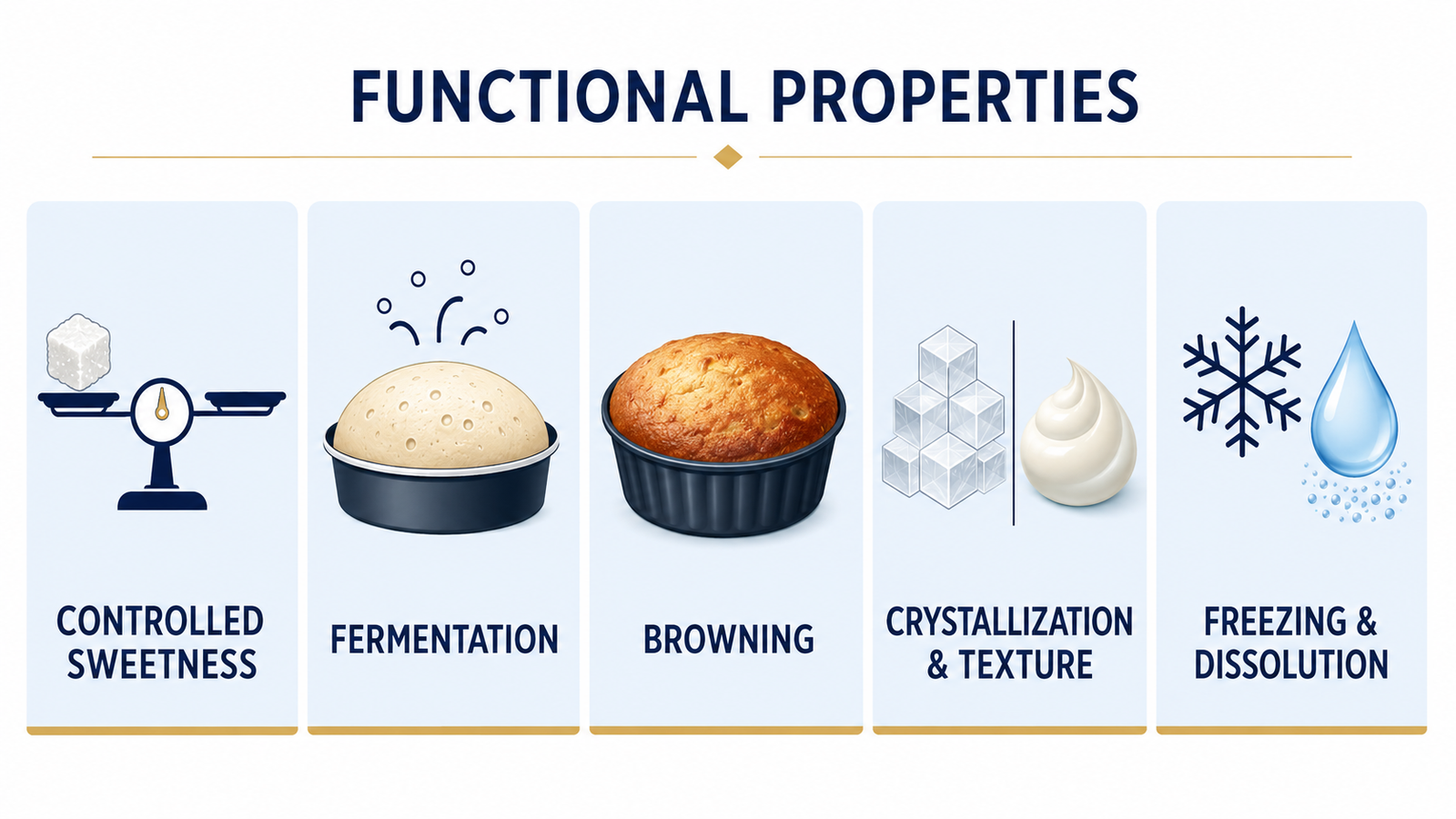
The main functions of dextrose monohydrate in food manufacturing include:
- providing controlled sweetness and carbohydrate solids;
- supplying fermentable carbohydrate;
- contributing to browning and flavor development;
- influencing crystallization and product texture;
- contributing to the freezing behavior of frozen formulations;
- providing a soluble carbohydrate source in beverages and dry mixes.
Not every application requires all of these functions. Dextrose monohydrate should therefore be evaluated within the complete food system rather than selected on the basis of sweetness alone.
Key Functional Properties of Dextrose Monohydrate
Dextrose monohydrate can perform several functions in food manufacturing, but its effect depends on the complete formulation. The amount used, other ingredients and processing conditions should all be considered when evaluating its suitability.
Controlled Sweetness and Solids
Dextrose is generally perceived as less sweet than sucrose. This can be useful when a formulation requires additional carbohydrate solids without the same level of sweetness that sucrose might provide.
Its relative sweetness is not fixed in every product. Temperature, acidity, concentration, flavor composition and the presence of other sweeteners can all influence perception. Replacing sucrose with dextrose monohydrate may also affect moisture balance, browning and processing behavior, so direct weight-for-weight substitution is not always appropriate.
Fermentable Carbohydrate
Dextrose can provide a readily available carbohydrate source for yeast and certain other microorganisms. This function is particularly relevant in fermented food systems, where the type and availability of sugar can influence the fermentation process.
The result depends on factors such as microorganism activity, temperature, time, pH, water availability and the concentration of soluble sugars. Increasing the amount of dextrose does not necessarily improve fermentation, so the appropriate level should be established for the individual formulation.
Browning and Flavor Development
As a reducing sugar, dextrose can participate in Maillard reactions when amino compounds and suitable processing conditions are present. These reactions may contribute to color and flavor development in baked or heated foods.
The degree of browning is influenced by temperature, processing time, pH, moisture and the concentration of reacting ingredients. Dextrose monohydrate can support controlled color development, but excessive browning may occur if the formulation or heating process is not properly balanced.
Crystallization and Texture
In concentrated sugar systems, the types and proportions of sugars can influence crystal formation and finished-product texture. When used with sucrose or other carbohydrates, dextrose monohydrate changes the composition of the sugar phase and may help manufacturers manage crystallization behavior.
It should not be described as simply preventing crystallization. The result also depends on total solids, water content, cooking temperature, cooling rate, agitation and storage conditions. These factors should be evaluated together when developing the desired firmness, smoothness or structure.
Freezing and Dissolution Behavior
Sugars affect the freezing behavior of food formulations. When dextrose monohydrate is included as part of the total sugar system, it may influence freezing temperature, hardness and serving texture. The final effect depends on the combination of sugars, water, fat, protein, stabilizers and storage conditions.
In beverages and dry mixes, dextrose monohydrate provides soluble carbohydrate solids. However, practical dissolution and handling performance also depend on particle size, mixing method, water temperature, packaging and moisture exposure during storage.
These functional properties explain why dextrose monohydrate can be used across different food categories. Its most appropriate role becomes clearer when each product system is considered separately.
Dextrose Monohydrate in Bakery Products
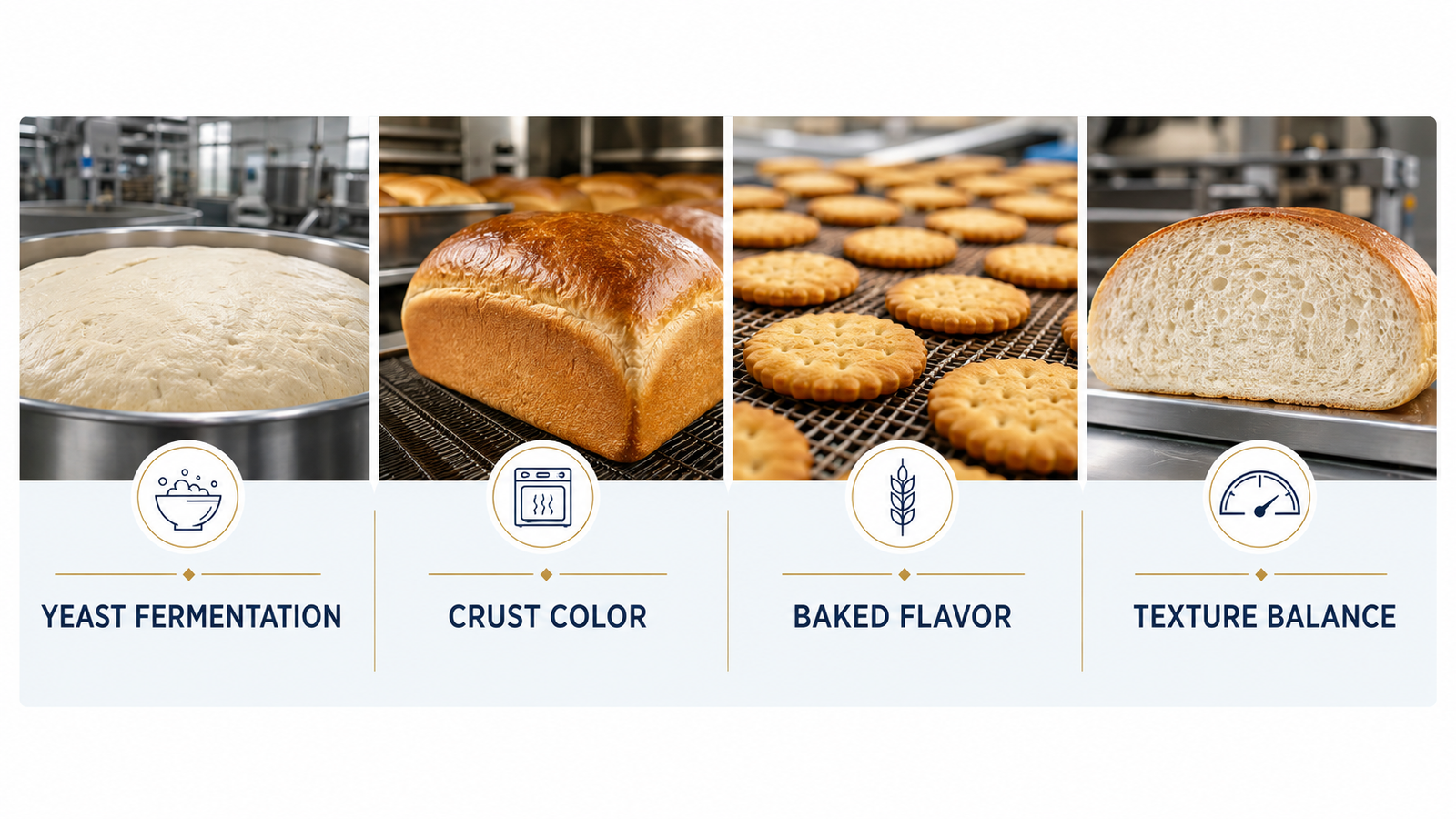
Dextrose monohydrate is used in bakery formulations for its contribution to fermentation, sweetness, color and overall product structure. Its role varies depending on whether the product is yeast-fermented, chemically leavened or produced with a low-moisture baking process.
In bread and other yeast-fermented products, dextrose can provide a readily available carbohydrate source for yeast. This may support fermentation and gas production, but the outcome depends on factors such as yeast activity, fermentation time, dough temperature, salt level and the presence of other sugars. Excessive sugar concentrations can also change the fermentation environment, so the appropriate amount should be established through formulation testing.
Dextrose may also contribute to crust color and baked flavor because it is a reducing sugar. Under suitable heating and moisture conditions, it can participate in Maillard reactions with amino compounds present in the formulation. This can be useful in bread, biscuits, crackers and similar products where controlled browning is desirable. However, the same reactivity may lead to excessive darkening if the baking temperature, processing time or dextrose level is too high.
Its contribution to sweetness and solids can also influence texture and eating quality. These effects are closely connected to water availability and interactions with flour, starch, protein and fat. Dextrose monohydrate should therefore be evaluated as part of the complete bakery formulation rather than as a direct replacement for sucrose.
When using dextrose monohydrate in bakery products, manufacturers should consider:
- the required level of sweetness;
- the target crust and crumb color;
- the type and duration of fermentation;
- dough or batter moisture;
- baking temperature and time;
- the desired texture during storage.
Small-scale baking trials are advisable when changing the sugar system, as even a modest adjustment may affect fermentation, browning and finished-product texture at the same time.
Dextrose Monohydrate in Beverage Formulations
Dextrose monohydrate is used in beverage formulations as a source of controlled sweetness and soluble carbohydrate solids. Because it is generally perceived as less sweet than sucrose, it can provide flexibility when balancing sweetness with acidity, flavor intensity and the intended body of a beverage.
In liquid products, dextrose monohydrate generally dissolves readily under suitable mixing conditions. Actual dissolution performance, however, depends on water temperature, agitation, total solids, ingredient order and the presence of acids, minerals or other powdered materials. Manufacturers should evaluate these factors under production conditions rather than relying on solubility alone.
Dextrose monohydrate may also be used in powdered beverages and instant drink mixes. In these systems, particle size and distribution can affect blending uniformity, powder handling and dissolution after preparation. Exposure to moisture during storage may also influence flow and caking, making suitable packaging and storage conditions important.
When evaluating dextrose monohydrate in beverages, formulators should consider:
- the target sweetness and flavor profile;
- total carbohydrate solids;
- acidity and other sweeteners;
- dissolution temperature and mixing method;
- clarity or appearance requirements;
- powder flow and storage stability.
Dextrose monohydrate should be assessed as part of the complete beverage system. Pilot trials can help confirm whether the selected ingredient grade and process conditions deliver the intended sweetness, dissolution and sensory performance.
Dextrose Monohydrate in Confectionery
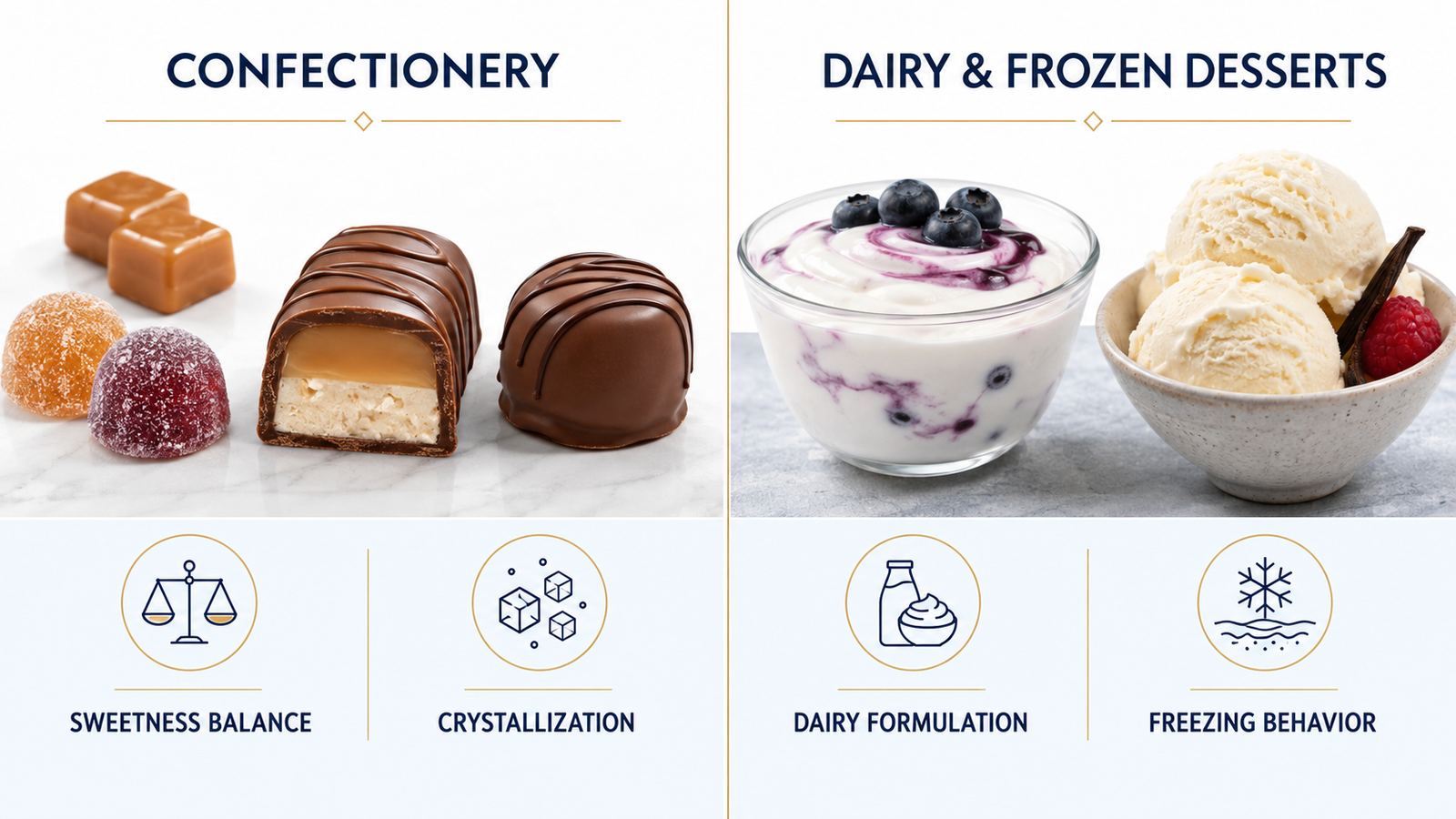
Dextrose monohydrate can be used as part of the sugar system in confectionery products, including candies, fillings, syrups and coatings. Its contribution depends on the required sweetness, solids content, crystal structure and processing method.
Sweetness and Solids Balance
Because dextrose is generally perceived as less sweet than sucrose, it can help formulators adjust carbohydrate solids without producing the same level of sweetness. This may be useful when several sugars or syrups are combined to develop a specific flavor and texture.
Dextrose monohydrate should not be treated as a direct weight-for-weight substitute for sucrose. Changing the sugar ratio may also affect moisture, viscosity, cooking behavior and the structure of the finished product.
Crystallization and Texture
The composition of a confectionery sugar system influences how crystals form and how they affect firmness, smoothness or graininess. When combined with sucrose and other carbohydrates, dextrose monohydrate may help manage crystallization behavior.
The desired result varies by product. Some confectionery applications require a smooth, non-grainy texture, while others depend on controlled crystal formation. For this reason, the effect of dextrose should be evaluated against the intended product structure rather than described simply as crystallization prevention.
Processing Considerations
Cooking temperature, final solids, cooling rate and agitation can all affect confectionery texture. Storage temperature and moisture exposure may also influence the product after manufacturing.
Trials should therefore reproduce the intended production and storage conditions. This allows manufacturers to assess how changes in dextrose level affect sweetness, viscosity, crystal development and finished-product consistency.
Dextrose Monohydrate in Dairy and Frozen Products
Dextrose monohydrate can be used in dairy and frozen food formulations to adjust sweetness, carbohydrate solids and product texture. Its role should be evaluated alongside milk solids, fat, protein, stabilizers and the other sugars present in the formulation.
Dairy Product Applications
In flavored milk, yogurt and other formulated dairy products, dextrose monohydrate may provide mild sweetness while contributing to total solids. This can give formulators additional flexibility when balancing dairy flavors, acidity and the overall sweetness profile.
In fermented dairy systems, dextrose may also be available to certain microorganisms. The actual effect depends on the starter culture, fermentation temperature, time and product composition. It should not be assumed that adding more dextrose will automatically improve fermentation or produce the desired acidity.
Manufacturers should also consider how changes to the sugar system may affect viscosity, flavor perception and stability during storage.
Frozen Desserts and Freezing Behavior
In ice cream and other frozen desserts, sugars influence the temperature range over which water freezes. Dextrose monohydrate may be used as part of the total sugar system to balance sweetness with hardness and serving texture.
The final result depends on more than the choice of sugar. Water content, milk solids, fat, protein, stabilizers, freezing rate and storage temperature all affect ice formation and product structure.
Dextrose monohydrate should therefore be assessed within the complete frozen formulation. Pilot trials under realistic freezing and storage conditions can help determine whether the selected sugar balance produces the intended sweetness, firmness and texture.
Key Formulation Factors to Evaluate
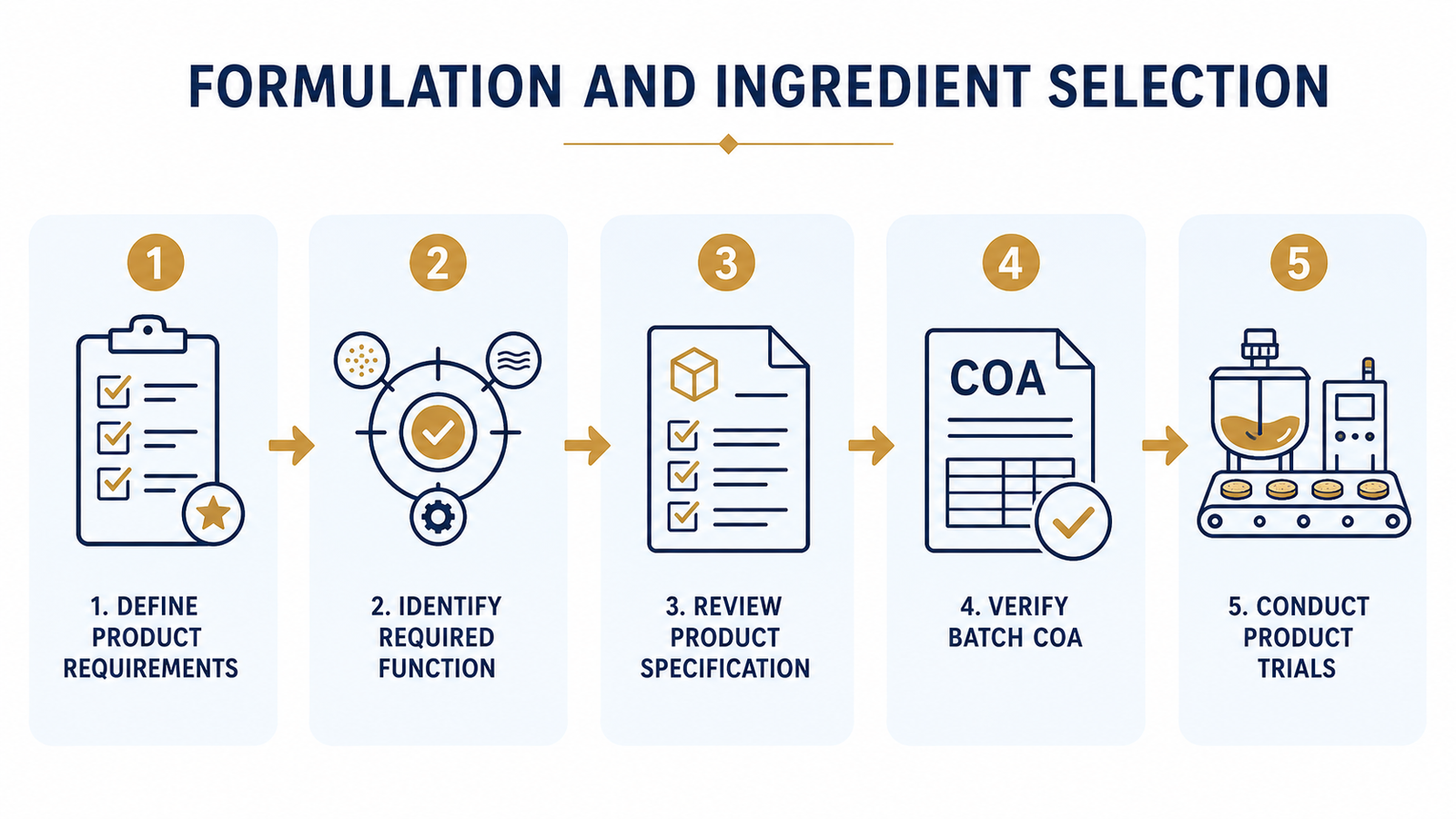
Selecting dextrose monohydrate for a food application requires more than confirming that it is suitable for the product category. Manufacturers should first define the function the ingredient is expected to perform and then evaluate how it interacts with the complete formulation and production process.
In some formulations, dextrose is evaluated alongside maltodextrin rather than as a standalone choice. Dextrose is generally more relevant to sweetness, fermentation and reducing-sugar activity, while maltodextrin may provide body, bulk or carrier performance. See the full maltodextrin and dextrose comparison for application-specific selection factors.
Product and Process Requirements
The following factors should be considered during dextrose monohydrate formulation and ingredient selection:
| Formulation factor | What manufacturers should evaluate |
|---|---|
| Sweetness target | Required sweetness and the contribution of other sugars or sweeteners |
| Total solids | Effects on product body, concentration and processing behavior |
| Browning requirement | Desired color development in relation to temperature, time, pH and moisture |
| Fermentation | Microorganism, sugar concentration, fermentation time and temperature |
| Texture | Target firmness, smoothness, crispness or serving characteristics |
| Crystallization | Sugar ratios, cooking conditions, cooling rate and agitation |
| Freezing behavior | Total sugar system, water content and intended serving temperature |
| Dissolution | Particle size, water temperature, mixing method and ingredient order |
| Storage conditions | Moisture exposure, temperature changes and packaging protection |
Not every factor carries the same importance in every product. Browning and fermentation may be central to a bakery formulation, while dissolution and flavor balance may be more relevant to a beverage.
Validation Under Production Conditions
Laboratory calculations provide a useful starting point, but they cannot fully predict how a formulation will perform during manufacturing and storage. Small-scale and pilot trials should reproduce the intended mixing, heating, cooling, freezing and packaging conditions as closely as possible.
Manufacturers can then assess sweetness, color, viscosity, texture, processing consistency and storage behavior before making larger production changes. This helps ensure that dextrose monohydrate is selected for a defined technical purpose rather than added on the basis of a general application claim.
How to Select Food Grade Dextrose Monohydrate
Selecting food grade dextrose monohydrate requires both technical and quality review. The material should meet the requirements of the intended food application, target market and manufacturer’s internal specification.
Review the Product Specification and Batch Documents
Manufacturers should review the product specification before approving an ingredient. Relevant parameters may include appearance, dextrose content, moisture, solubility and microbiological limits. The exact requirements should be determined by the intended product and applicable regulatory framework.
A batch-specific Certificate of Analysis should then be checked against the agreed specification. This helps confirm that the delivered batch meets the required parameters rather than relying only on a general product description.
Evaluate Processing and Supply Consistency
Particle characteristics can affect powder handling, blending and dissolution, particularly in beverages and dry mixes. Packaging should also provide suitable protection from moisture and contamination during transportation and storage.
For ongoing production, manufacturers should consider consistency between batches as well as initial compliance. Changes in moisture, particle properties or other relevant parameters may influence processing performance even when the material remains within a broad specification.
Before supplier approval or routine purchasing, manufacturers should complete a more detailed review of Dextrose Monohydrate specifications and food grade requirements, including the relevant quality parameters and batch documentation.
Frequently Asked Questions
Is Dextrose Monohydrate the Same as Glucose?
Dextrose is the common name used for D-glucose in many food and ingredient contexts. Dextrose monohydrate is a crystalline form of D-glucose that contains one associated molecule of water. The terms are closely related, but the exact material form should still be confirmed through the product specification.
Is Dextrose Monohydrate the Same as Dextrose?
“Dextrose” may be used as a general ingredient name, while dextrose monohydrate identifies a specific hydrated crystalline form. Manufacturers should check whether a product is monohydrate or anhydrous, particularly when moisture contribution and formulation calculations are important.
Can Dextrose Monohydrate Replace Sucrose?
Dextrose monohydrate can replace part of the sucrose in some formulations, but direct weight-for-weight substitution is not always suitable. The two sugars differ in relative sweetness, molecular properties and processing behavior. Any replacement should be assessed for its effects on sweetness, browning, texture, solids and moisture balance.
Can Dextrose Monohydrate and Anhydrous Dextrose Be Used Interchangeably?
They are both forms of dextrose, but they differ in water content. Our detailed comparison of dextrose anhydrous vs dextrose monohydrate explains how these differences may affect formulation calculations, handling and ingredient selection. This difference can affect dry-solids calculations, ingredient quantities and processing performance. Manufacturers should adjust formulations according to the product specification rather than assuming that the two forms can always be exchanged at the same amount.
Conclusion
Dextrose monohydrate uses in food manufacturing extend beyond sweetness. Depending on the formulation, it may contribute to fermentation, browning, crystallization behavior, texture, soluble solids and the freezing characteristics of food products.
Its performance is influenced by the other ingredients present and by processing conditions such as mixing, heating, cooling and storage. For this reason, dextrose monohydrate should not be selected or substituted on the basis of a general application claim alone.
Food manufacturers should first define the required technical function, review the relevant product specification and confirm performance through appropriate trials. Batch documentation, packaging and consistency should also be evaluated before the ingredient is approved for routine production.