



- Your cart is empty Browse Shop
Dextrose Monohydrate Specifications: How to Evaluate COA, Quality and Suppliers
Introduction
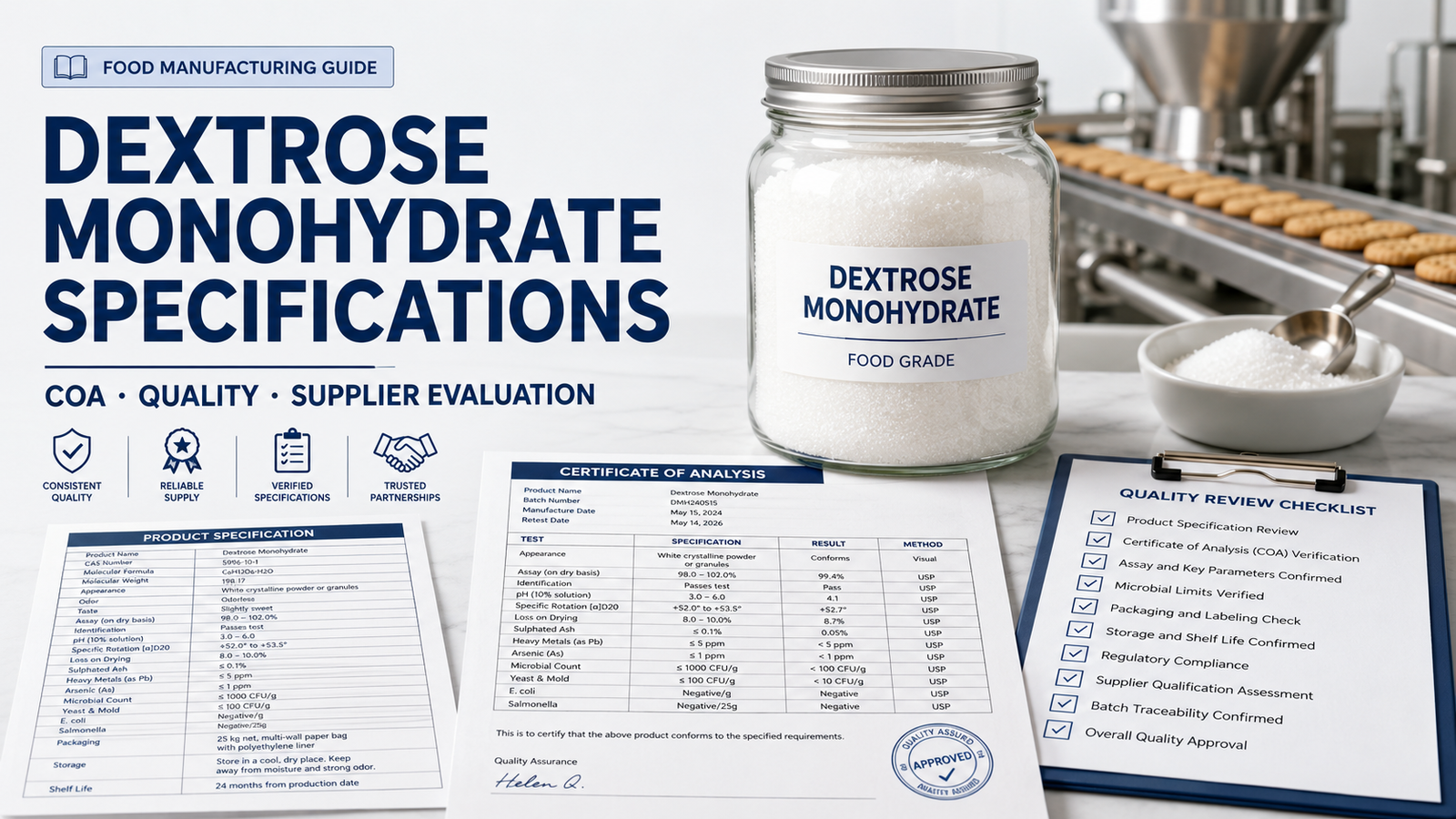
For food manufacturers, choosing dextrose monohydrate is not simply a matter of finding a product labelled “food grade” and comparing prices. Two suppliers may offer materials under the same product name, yet the products can differ in moisture, particle size, documentation, packaging and batch-to-batch consistency. Those differences may not always be obvious on a quotation, but they can become important once the ingredient enters production.
That is why reviewing dextrose monohydrate specifications should be treated as a practical purchasing and quality-control step, rather than a paperwork exercise. A specification sheet shows the limits a product is expected to meet. A Certificate of Analysis, or COA, reports the results for a particular batch. Neither document, however, can confirm on its own that the material will perform as required in a specific formulation.
The intended application also matters. A beverage manufacturer may be particularly concerned with dissolution and solution appearance, while a producer of powdered mixes may place greater importance on particle size, flowability and blending uniformity. The same food grade dextrose monohydrate can therefore be evaluated differently depending on how and where it will be used.
A reliable assessment brings these considerations together. It reviews the technical specification, checks the batch COA, examines the supporting documents and considers whether the supplier can maintain consistent quality over time.
This guide explains how food manufacturers and purchasing teams can evaluate dextrose monohydrate quality before placing a bulk order. It covers the main specification parameters, the correct way to read a COA, the difference between key supplier documents and the practical checks that help reduce purchasing and production risks.
Understanding Food Grade Dextrose Monohydrate Specifications
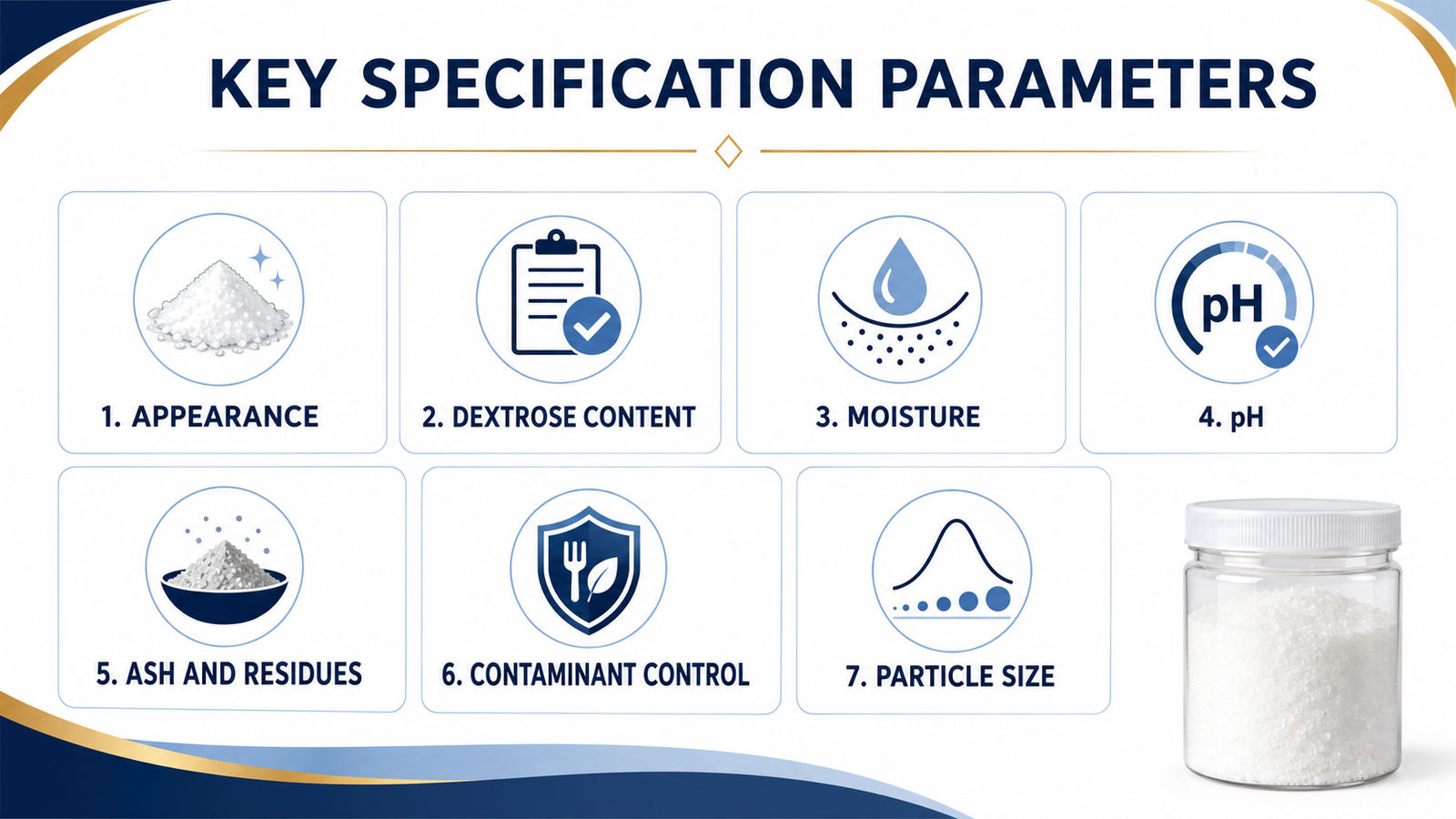
A product specification defines the technical and quality requirements that food grade dextrose monohydrate is expected to meet. Depending on the supplier and applicable standard, it may cover appearance, dextrose content, moisture, pH, ash, contaminants, microbiological limits and physical characteristics such as particle size.
These parameters should not be viewed as an isolated list of laboratory values. Each one helps answer a practical question about the material: Is it correctly identified? Does the batch meet the approved limits? Is its physical form suitable for the production process? Can the supplier deliver the same quality consistently?
A complete evaluation normally considers four connected areas:
- Product identity: Is the material clearly identified as the required form and grade?
- Specification conformity: Does the batch meet the approved technical limits?
- Application suitability: Will the ingredient behave as expected in the intended formulation?
- Supply consistency: Can comparable quality be maintained across future batches?
The phrase “food grade” is therefore a starting point, not a complete quality conclusion. Buyers who need a broader overview of the ingredient can first review our Dextrose Monohydrate Guide, including its basic properties, food-grade requirements and general applications.It indicates the intended use category, but it does not mean that every supplier follows an identical specification or provides the same supporting documents. Requirements may differ according to the destination market, finished-product category, customer standards and the test methods used.
For that reason, buyers should request a current product specification before approving a new source. The document should clearly identify the product, grade, test items, limits, units and, where relevant, the reporting basis or analytical method.
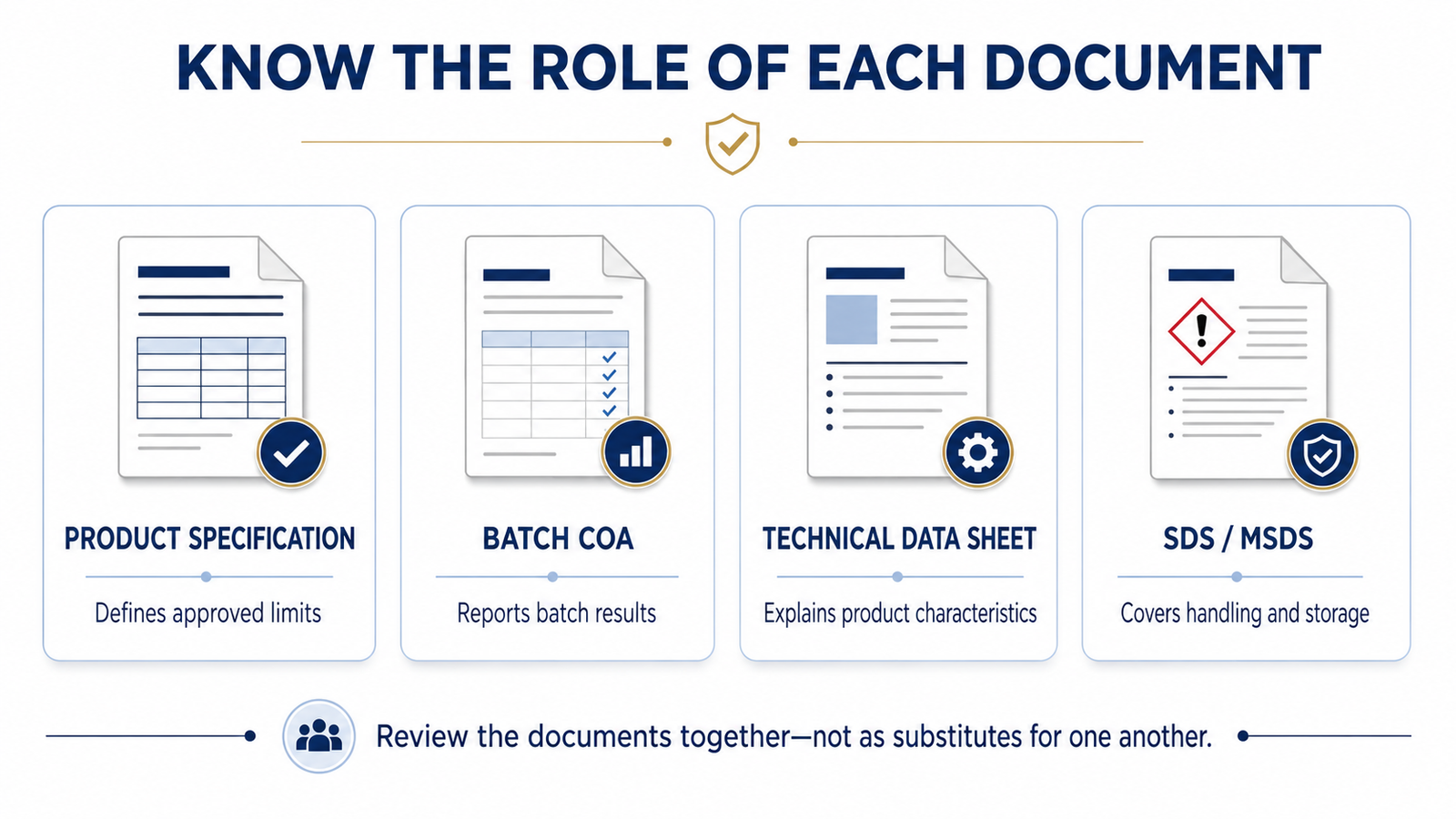
The specification must then be compared with a batch-specific COA. These two documents perform different but complementary roles:
| Document | What it tells the buyer |
|---|---|
| Product specification | The limits and requirements the product is expected to meet |
| Batch COA | The reported test results for one identified production batch |
| Technical data sheet | The product’s physical, technical and handling characteristics |
| SDS or MSDS | Safety, storage and handling information |
This distinction matters. A specification may state that a parameter must fall within a certain range, while the COA should show the result—or an appropriate conformity statement—for the batch being supplied. A generic COA template without traceable batch information provides much less assurance than a document linked to the actual shipment.
Buyers should also confirm that the specification, COA, quotation, sample and packaging all refer to the same product grade. Dextrose monohydrate should not be evaluated using limits intended for dextrose anhydrous, because the two forms differ in water content and dry-solids contribution. Similarly, terms such as food grade, FCC-related and USP-related should not be treated as interchangeable unless the supplier’s documentation clearly supports the stated standard.
Once the product and document basis have been confirmed, the next step is to examine the individual quality parameters and understand what each one can reveal about the supplied material.
Key Dextrose Monohydrate Specifications Buyers Should Review
A specification becomes useful only when the buyer understands what its individual parameters mean. Some values confirm the ingredient’s composition and identity, while others provide information about cleanliness, physical condition or likely processing behavior.
Not every supplier uses exactly the same specification format. Test methods, reporting units and acceptance limits may also vary according to the declared standard and destination market. Buyers should therefore evaluate the complete specification rather than compare individual figures without considering how they were measured.
Appearance and Physical Condition
Food grade dextrose monohydrate is generally supplied as a white crystalline powder or granulated material. Appearance is usually listed as a qualitative parameter, but it remains useful during both document review and incoming inspection.
Discoloration, foreign particles, damaged packaging or unusual caking may indicate handling, storage or moisture-related problems. These observations do not replace analytical testing, but they can help identify a batch that requires further investigation before it is released into production.
The description on the specification should also be consistent with the physical form ordered. If a manufacturer needs a fine powder or a particular granular grade, a general statement such as “white crystalline powder” may not provide enough information. Particle-size requirements should then be confirmed separately.
Dextrose Content and Reducing Sugars
Dextrose content—or reducing sugars expressed as D-glucose—is one of the main composition-related parameters used to evaluate the product. Buyers should pay close attention to whether the result is reported on a dry basis or on an as-is basis.
A dry-basis result excludes the product’s water content from the calculation, while an as-is result reflects the material in its supplied condition. Two figures based on different reporting methods should not be compared directly.
The term dextrose equivalent, commonly abbreviated as DE, also needs to be interpreted carefully. DE describes reducing sugars relative to dextrose on a dry basis and is especially useful when comparing starch hydrolysates such as maltodextrin and glucose syrup. Dextrose itself is the reference point. For a crystalline dextrose monohydrate product, buyers should focus on the exact test item, method and reporting basis stated in the supplier’s specification rather than rely on the term “DE” alone.
Moisture or Water Content
Moisture is particularly important when evaluating dextrose monohydrate because water is part of its crystalline form. This is one of the main reasons dextrose monohydrate and dextrose anhydrous differ in composition and dry-solids contribution.
The moisture result can influence:
- Dry-solids calculations
- Cost comparisons between different dextrose forms
- Storage stability
- Powder condition
- Caking behavior
- Formulation adjustments
A higher moisture value is not automatically a defect if it remains within the approved monohydrate specification. The relevant question is whether the result complies with the correct specification and remains consistent across commercial batches.
When comparing quotations, buyers should also avoid looking only at price per kilogram. The effective dry-solids contribution may differ between monohydrate and anhydrous material, so the comparison should account for both composition and intended use.
pH and Acidity-Related Parameters
The pH value is normally measured in a solution prepared under specified conditions. It can help indicate whether the product remains within the expected quality range and may be relevant in formulations sensitive to acidity.
However, a pH result is meaningful only when the test conditions are known. Solution concentration, water quality, temperature and analytical method can affect the reported value. Buyers should therefore avoid comparing pH figures from different suppliers unless the measurement basis is reasonably consistent.
A product that meets its pH specification may still need application testing in beverages, dairy systems or other formulations where the finished product has a narrow pH target.
Ash, Chloride and Inorganic Residues
Parameters such as sulfated ash, chloride and other inorganic residues help evaluate the level of non-sugar material remaining after production and purification. They provide additional information about product cleanliness and process control.
For purchasing purposes, the main objective is not to interpret each test as a standalone chemical analysis. Buyers should confirm that:
- Relevant parameters are included;
- The units are clearly stated;
- Results meet the approved limits;
- The same control approach is maintained between batches.
Unexplained changes in these results may justify further discussion with the supplier, even when the batch technically remains within specification.
Contaminants and Microbiological Requirements
Food grade dextrose specifications may include limits for relevant contaminants and microbiological indicators. The required test items depend on the applicable standard, destination market, finished-food category and the manufacturer’s own risk assessment.
There is no single universal list that should be copied into every purchasing specification. Instead, buyers should confirm that the supplier’s testing scope matches the actual regulatory and food-safety requirements of the intended application.
A certificate or general “food grade” declaration should not be used as a substitute for reviewing the relevant limits and batch results.
Particle Size, Solubility and Handling Performance
Two products can meet the same chemical requirements and still perform differently during manufacturing. Particle-size distribution can affect flowability, dust formation, blending uniformity and dissolution rate. It may also influence how consistently the ingredient feeds through automated handling equipment.
Solubility is usually expected for dextrose monohydrate, but the speed and practical behavior of dissolution can vary with particle size, temperature, agitation and formulation conditions. A clear solution under one test condition does not guarantee identical performance in every production system.
For applications where these properties are important, buyers should request particle-size information and evaluate a representative sample. A production trial is often more informative than relying on a general solubility description alone.
Together, these parameters provide a technical picture of the product. The next step is to determine whether the COA for the actual batch reports them clearly and demonstrates conformity with the approved specification.
The importance of these properties can vary across bakery, beverage, confectionery and dairy formulations. For application-specific considerations, read our guide to dextrose monohydrate uses in food manufacturing.
How to Read a Dextrose Monohydrate COA
A Certificate of Analysis should do more than confirm that a product has “passed.” A useful dextrose monohydrate COA should identify the supplied batch, show the requirements against which it was tested and provide enough information for the buyer to verify conformity.
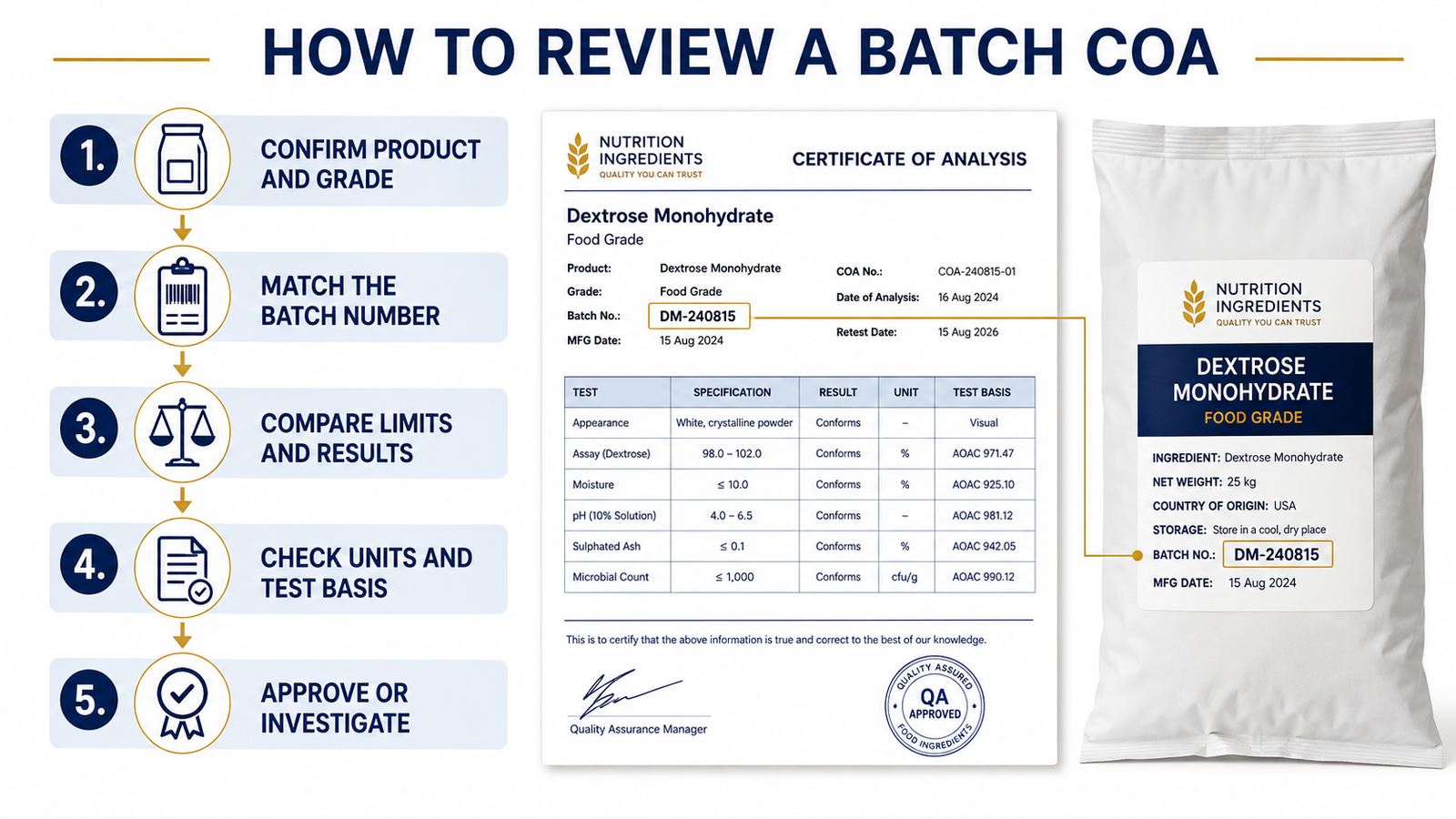
The most reliable approach is to read the document in a fixed sequence: first confirm its identity, then review the results, and finally compare it with the approved specification.
1. Confirm the Product and Batch Identity
Begin with the information at the top of the COA. The product name and grade should match the purchase order, specification sheet, packaging label and any sample previously approved.
The document should normally include:
- Product name and grade
- Batch or lot number
- Manufacturing or production date
- Testing or certificate date
- Expiry or retest date, where applicable
- Manufacturer or issuing supplier
- Quantity or packaging reference, where provided
The batch number is particularly important. It connects the COA to the material delivered and allows the supplier to trace production and testing records if a quality issue arises.
A technically detailed COA has limited value if it cannot be linked to the shipment. Buyers should therefore compare the number on the certificate with the number printed on the bags, labels or shipping documents before releasing the batch.
2. Separate Specification Limits from Actual Results
Most COAs contain three basic types of information:
| COA field | What it means |
|---|---|
| Test item | The quality parameter being evaluated |
| Specification | The approved limit, range or requirement |
| Result | The reported outcome for the identified batch |
The result should comply with the corresponding specification. For example, a maximum limit means the reported value should not exceed that limit, while a stated range requires the result to remain between its upper and lower boundaries.
Qualitative results such as “Conforms,” “Passes” or “Complies” may be appropriate for tests such as appearance. For important quantitative parameters, however, an actual numerical result generally gives the buyer more useful information for comparing batches and monitoring consistency.
A COA containing only “Pass” in every row may confirm basic release status, but it offers little visibility into whether results are gradually moving closer to a specification limit.
3. Check Units, Methods and Reporting Basis
A result cannot be interpreted correctly without understanding how it is expressed. Buyers should check whether the COA clearly indicates:
- Percentage, mg/kg, ppm or another unit
- Dry-basis or as-is reporting
- Minimum, maximum or acceptable range
- Test method or reference standard
- Detection limit, where relevant
This is especially important for dextrose content and moisture. A dry-basis value should not be directly compared with an as-is value, and results obtained using different methods may not be fully equivalent.
Expressions such as “not detected” and “below the detection limit” also require context. Neither should automatically be interpreted as absolute zero; they mean that the result was not measurable under the stated analytical conditions.
4. Compare the COA with the Approved Specification
A COA should always be reviewed alongside the current dextrose monohydrate specification sheet. The product name, test items, units and acceptance limits should be consistent across both documents.
Further clarification may be needed if:
- A test shown in the approved specification is missing from the COA;
- The COA uses different limits or units;
- The product grade is unclear;
- The specification has been revised without a version reference;
- The certificate does not identify the actual batch;
- Results appear altered, incomplete or inconsistent with the product label.
It is also useful to compare COAs from several commercial batches. Results do not need to be identical, and normal variation should be expected. However, unusually repetitive values, unexplained changes or a gradual movement toward specification limits may justify additional discussion with the supplier.
A Quick COA Review Sequence
Before approving a batch, the buyer should be able to answer five questions:
- Does this COA refer to the correct product and grade?
- Does the batch number match the delivered material?
- Does every reported result meet the approved limit?
- Are the units, methods and reporting basis clear?
- Can the document and batch be traced if a problem occurs?
If any answer is uncertain, the batch should not be approved solely because the certificate ends with an overall “Pass” statement.
Once the COA has been verified, the buyer can move to the broader question: whether the supplier’s documentation, quality controls and delivery capability are strong enough to support consistent long-term supply.
How to Evaluate Dextrose Monohydrate Suppliers
A compliant batch is important, but it does not by itself prove that a supplier can support long-term production. Food manufacturers also need to consider whether the supplier can maintain comparable specifications, documentation and physical performance across future deliveries.
Start by reviewing the complete documentation package. The specification sheet defines the product requirements, while the COA reports the results for an individual batch. The SDS or MSDS provides handling and storage information. Other documents may address food-safety systems, allergen status, origin, traceability or market-specific requirements.
These documents serve different purposes. A general certificate cannot replace a batch-specific COA, and an SDS should not be treated as proof that the product meets the buyer’s technical specification. Buyers should check that each document is current, issued by an identifiable organization and clearly connected to the product and manufacturing source being evaluated.
For bulk dextrose monohydrate, batch consistency deserves particular attention. Comparing several recent COAs can reveal whether key results remain reasonably stable over time. Normal variation is expected, but large unexplained shifts in moisture, pH, particle size or other relevant parameters may affect production even when every batch technically passes.
Documentation should therefore be combined with practical evaluation. Before approving a new source, manufacturers may test a representative sample for dissolution, flowability, blending or finished-product performance. The sample should come from material that is representative of normal commercial production—not a specially prepared laboratory sample with no clear relationship to future shipments.
Packaging and logistics also form part of quality control. Buyers should confirm:
- Packaging type and net weight;
- Food-contact suitability of the inner liner;
- Seal integrity and moisture protection;
- Batch identification on each package;
- Storage conditions and stated shelf life;
- Remaining shelf life at the expected delivery date;
- Lead time and available supply capacity.
A reliable dextrose monohydrate manufacturer or supplier should also have a clear process for handling changes and complaints. Buyers should know whether they will be notified if the manufacturing site, raw-material source, specification, test method or packaging changes. If a nonconforming batch is identified, the supplier should be able to trace it, investigate the cause and provide an appropriate corrective response.
The strongest supplier is therefore not simply the company offering the lowest price or the widest specification limits. It is the one that can demonstrate transparent documentation, consistent commercial batches, suitable packaging and dependable technical communication.
Practical Dextrose Monohydrate Purchasing Checklist
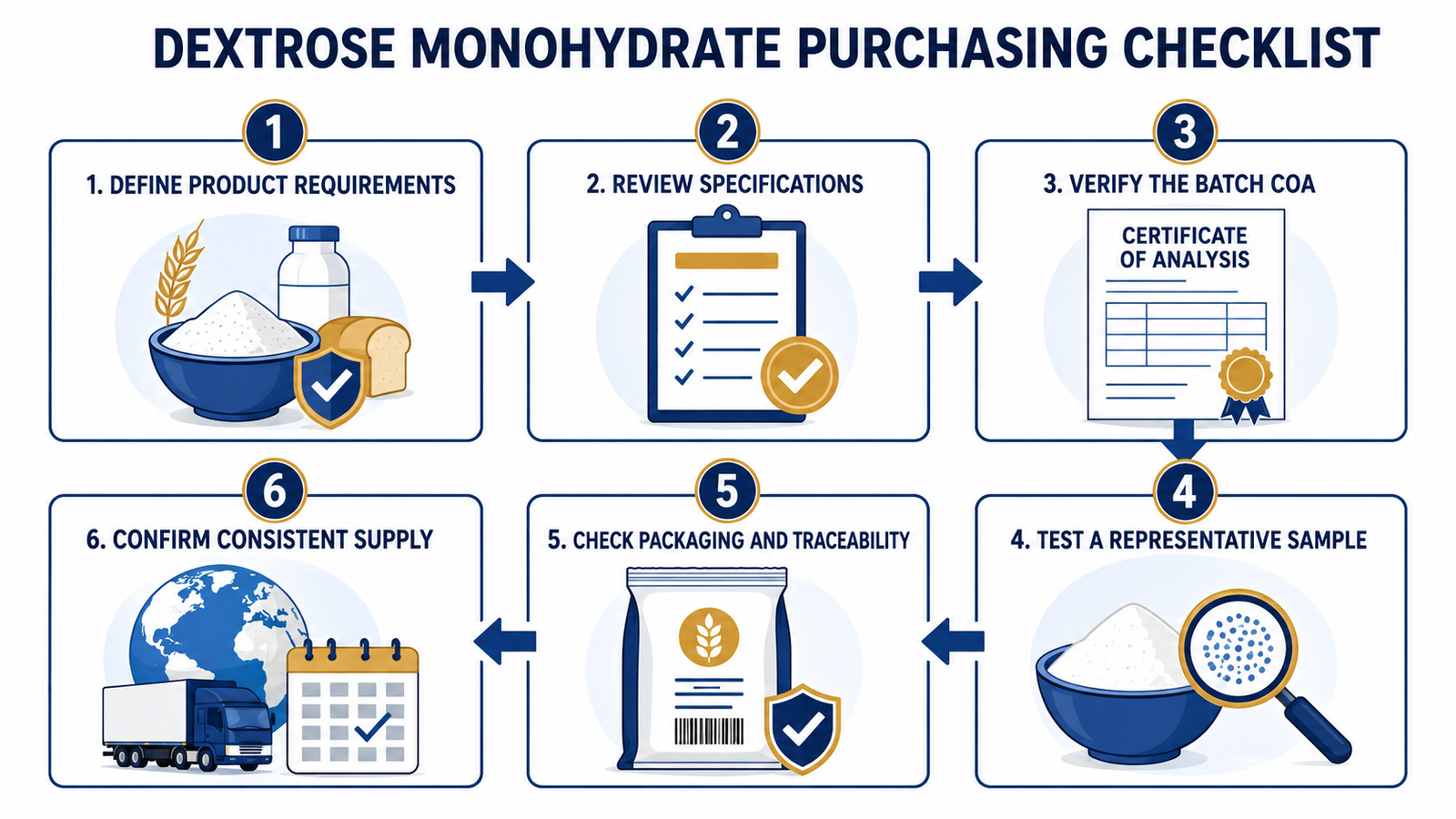
Before placing a commercial order, purchasing and quality teams should confirm the following:
Before Supplier Approval
- Define the intended food application and processing requirements.
- Confirm the required product form and grade.
- Review the current specification sheet.
- Request a representative batch COA.
- Check applicable quality and food-safety documents.
- Confirm particle size, packaging and storage requirements.
- Test a representative sample where processing performance is important.
- Review supply capacity, lead time and change-notification procedures.
Before Releasing a Delivered Batch
- Match the product name and grade with the purchase order.
- Match the COA batch number with the packaging label.
- Compare every reported result with the approved specification.
- Check units, dates, methods and reporting basis.
- Inspect the packaging for damage, moisture or contamination.
- Examine the material for unusual caking, discoloration or foreign matter.
- Confirm the remaining shelf life.
- Record the batch and approval decision for traceability.
A low price per kilogram should not override an unresolved technical or documentation issue. When comparing monohydrate with anhydrous dextrose, buyers should also account for differences in water content and dry-solids contribution rather than relying on purchase price alone.
Once the specification and batch documentation have been reviewed, purchasing teams can follow a broader dextrose monohydrate supplier evaluation process to assess samples, packaging, pricing, traceability and long-term supply capability.
Conclusion
Evaluating dextrose monohydrate quality requires more than confirming that the product is described as food grade. A sound purchasing decision connects the approved specification with the actual batch COA, supporting documents, physical condition, application performance and the supplier’s ability to maintain consistency.
By reviewing these elements together, food manufacturers can identify potential issues before the ingredient enters full-scale production. The goal is not merely to find a batch that passes, but to establish a supply source that remains technically suitable, traceable and dependable over time.