



- Your cart is empty Browse Shop
How to Choose a Bulk Corn Starch Supplier: Specifications, COA and Quality Guide
Introduction
Choosing a reliable bulk corn starch supplier involves more than comparing quotations or requesting a standard product specification. Corn starch may appear to be a relatively straightforward food ingredient, but differences in moisture, particle characteristics, viscosity and batch consistency can affect how it performs during mixing, heating, filling and storage.
The right purchasing decision therefore begins with the finished product and processing requirements. A grade that performs well in a dry bakery mix may not be the best option for a sauce, confectionery filling or processed food system. Even when two products meet general food-grade requirements, they may behave differently under specific production conditions.
Buyers should also consider the quality documentation and supply support behind the material. A complete evaluation normally includes the product specification, batch-specific Certificate of Analysis, food safety documents, packaging details, traceability system and the supplier’s ability to maintain consistent quality over repeated deliveries. Price remains important, but it should be assessed together with testing requirements, shipping conditions, lead time and the potential cost of inconsistent material.
This guide explains how food manufacturers can evaluate bulk corn starch from both technical and commercial perspectives. It covers purchasing requirements, core specifications, functional performance, COA and MSDS review, pricing factors, packaging, storage and supplier approval.
What Buyers Should Confirm Before Sourcing Bulk Corn Starch
Before contacting suppliers, buyers should define what the corn starch needs to do in the finished product. This step may appear basic, but it determines which specifications are relevant and prevents the purchasing process from becoming a simple comparison of price lists.
A supplier can provide more appropriate information when the buyer clearly explains the intended application, processing conditions, expected order volume and destination market. Without that context, a quotation may refer to a technically acceptable product that is not necessarily the best match for the production line.
Define the Application and Required Function
Corn starch can provide thickening, binding, moisture control, texture development or processing support, depending on the formulation. For a broader explanation of these functions, see our guide to corn starch in food manufacturing.The primary function should therefore be identified before samples are requested.
For example, a sauce manufacturer may focus on viscosity development, smooth dispersion and stability during heating. A bakery producer may be more concerned with water management, structure and consistency after cooling. In powdered foods, particle size and flow behavior may be more important than the characteristics evaluated in a liquid formulation.
Processing conditions should be considered at the same time. Heating temperature, mixing intensity, pH, shear and storage conditions can all influence starch performance. A sample should not be approved only because it produces an acceptable result in a simple laboratory mixture. Where the ingredient has a meaningful effect on finished-product quality, testing under representative processing conditions provides a more reliable basis for approval.
Confirm the Required Starch Type and Grade
Buyers should confirm whether the application requires native corn starch or a modified starch. These terms describe different ingredient categories and should not be treated as interchangeable.
Native corn starch is separated from corn without the functional modification used to produce modified starches. It is widely used where its natural thickening, binding and texture-building properties are suitable for the formulation. Modified starches are selected when the process requires particular resistance to heat, acid, shear, freezing or other demanding conditions.
“Food grade” should also be treated as a starting requirement rather than a complete purchasing specification. It indicates that the material is intended for food use, but it does not tell the buyer everything about moisture, viscosity, particle size, microbiological limits or application performance. These parameters still need to be defined in an agreed specification and verified through appropriate documentation and testing.
Establish Volume, Packaging and Market Requirements
The expected purchasing volume affects more than the unit price. It may influence minimum order quantity, packaging format, production scheduling, lead time and freight efficiency. Buyers should clarify whether they need trial samples, a small initial order, regular container quantities or a long-term supply program.
Packaging requirements should also be discussed early. Bulk corn starch is commonly supplied in industrial bags with protective inner liners, but bag size, pallet configuration, labeling and moisture protection may vary. The selected packaging should suit the buyer’s handling system, warehouse conditions and transportation route.
Finally, the destination market must be identified before supplier approval. Documentation, labeling, microbiological criteria, contaminant limits and certification requirements may differ by country and finished-food category. A supplier that serves several markets should therefore confirm that the offered grade and supporting documents are appropriate for the buyer’s intended use and destination, rather than relying on a general statement that the product is food grade.
Corn Starch Manufacturer, Supplier or Distributor: What Is the Difference?
When sourcing bulk corn starch, buyers may receive quotations from manufacturers, export suppliers and local distributors. These companies can all provide food-grade material, but their roles, service capabilities and commercial terms are not necessarily the same.
The best sourcing channel depends on purchasing volume, delivery frequency, documentation requirements and the level of technical support needed. Buyers should therefore evaluate what each company actually controls instead of relying only on the way it describes itself.
Buying From a Corn Starch Manufacturer
A corn starch manufacturer produces the ingredient at its own facility and normally has direct control over raw material selection, processing conditions, quality testing and production scheduling. This can be advantageous for buyers that require stable specifications, regular container quantities or long-term supply arrangements.
Direct communication with a manufacturer may also make it easier to discuss technical parameters, batch consistency and changes in production. If a buyer requires a particular moisture limit, particle-size range, packaging format or testing item, the manufacturer is usually in the strongest position to determine whether the requirement can be supported.
However, purchasing directly from a factory is not automatically the best option in every situation. Some manufacturers focus on large domestic or industrial orders and may have relatively high minimum order quantities. They may also provide limited assistance with export documentation, mixed shipments or small trial orders. Buyers should confirm whether the manufacturer has experience with the destination market and can provide the required certificates, labels and shipping documents.
It is also important to verify whether a company claiming to be a manufacturer actually operates the production facility. Factory information, quality-system certificates, production records and traceability documents can help establish the relationship between the company, the facility and the product being offered.
Working With a Corn Starch Supplier
The term corn starch supplier is broader. A supplier may be the original manufacturer, an affiliated export company or an independent business sourcing from one or more approved factories.
A capable supplier can add value by coordinating samples, documentation, packaging, quality inspection and international shipping. This may be especially useful for overseas buyers that need English-language documents, flexible order handling or support combining several food ingredients in one purchasing program.
The key question is not simply whether the supplier owns a factory. Buyers should determine whether the supplier can clearly identify the production source, provide batch-specific documents and maintain consistent material across repeated orders. If products are sourced from different facilities without notification, specifications and processing performance may change even though the commercial product name remains the same.
A reliable bulk corn starch supplier should therefore be able to explain:
- where the product is manufactured;
- which specification applies to the offered grade;
- whether the same production source will be maintained;
- how each shipment is linked to its COA and batch number;
- how quality complaints and specification changes are managed;
- what export, logistics and after-sales support is available.
These points provide a more meaningful basis for supplier evaluation than company type alone.
Purchasing Through a Corn Starch Distributor
A corn starch distributor typically purchases larger quantities and resells the material from local or regional inventory. This model can offer shorter lead times, smaller order quantities and more convenient domestic delivery.
Distribution may be suitable for production trials, urgent replenishment or manufacturers that do not have enough storage capacity for full-container purchases. A local distributor may also simplify customs clearance, payment and communication.
The main limitation is that the distributor may not control production or have immediate access to detailed technical information. Buyers should confirm the original manufacturer, product grade, repacking conditions and batch traceability. If the material is repacked, the distributor should be able to explain how contamination is prevented and how the original lot number is retained.
Price comparisons should also account for the service being provided. A distributor’s unit price may be higher than a direct factory quotation, but local inventory and smaller minimum quantities can reduce warehousing, freight and working-capital pressure. Conversely, buyers with stable high-volume demand may achieve better long-term efficiency through a manufacturer or export supplier.
There is no single sourcing model that is best for every food producer. The appropriate choice depends on total purchasing cost, technical requirements, delivery reliability and the buyer’s ability to manage international procurement. Regardless of the channel selected, the offered product should be evaluated against the same agreed specification, documentation and batch-control requirements.
Core Food Grade Corn Starch Specifications
A product specification defines the quality requirements that each approved batch is expected to meet. It should be reviewed before sample testing or commercial purchasing because the term “food grade corn starch” does not, by itself, describe every physical, chemical and functional characteristic of the product.
Specifications may differ according to the starch type, production process, destination market and intended application. Values provided by one corn starch supplier should therefore not be treated as universal limits. The buyer and supplier should agree on the relevant parameters, test methods and acceptance ranges before regular orders begin.
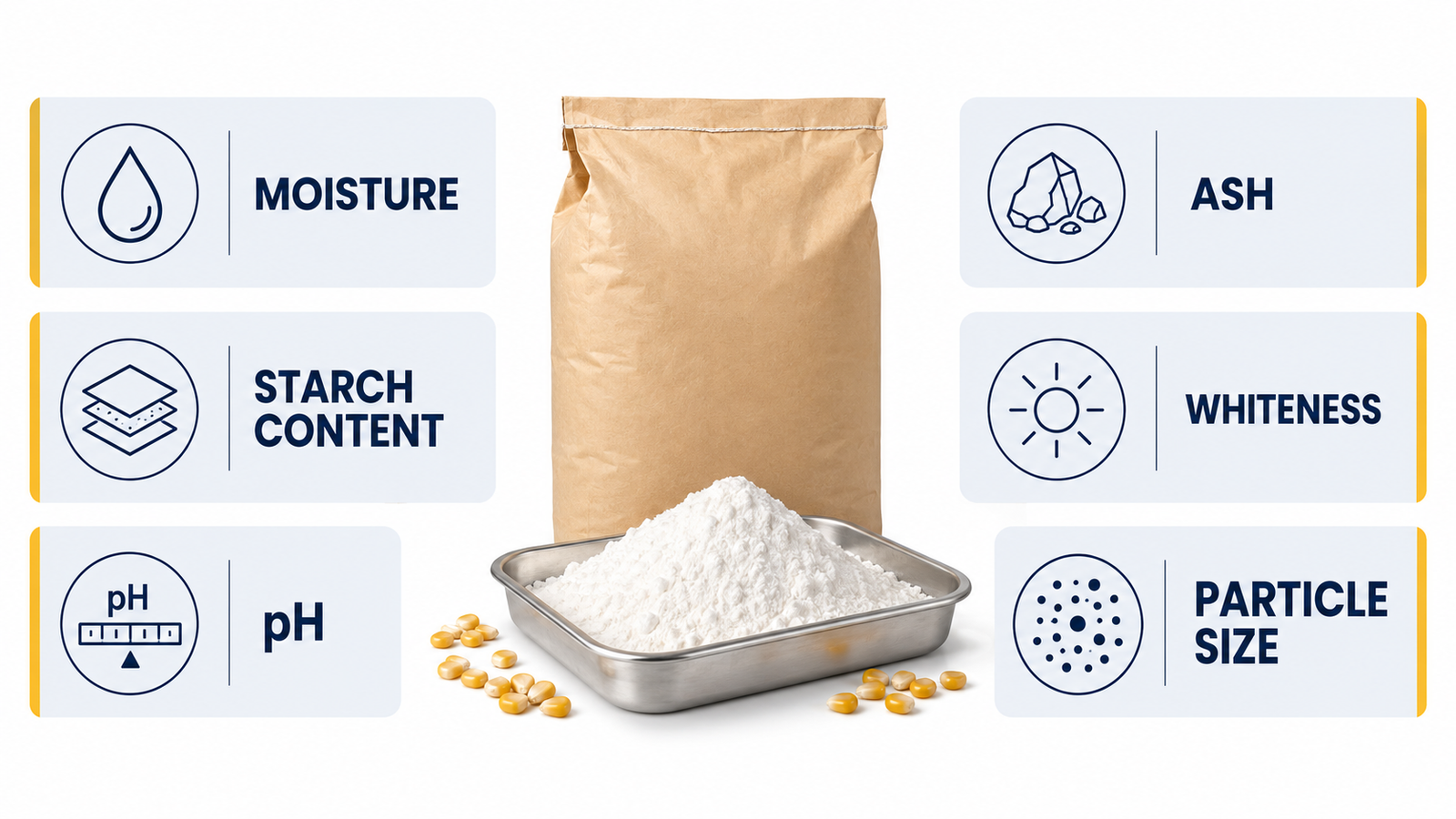
| Specification item | What buyers should review | Why it matters |
|---|---|---|
| Appearance and odor | Color, powder condition and absence of abnormal odor | Helps identify contamination or unusual batch conditions |
| Moisture | Maximum limit and actual batch result | Affects storage stability, flow and dry-matter content |
| Starch content | Minimum value and reporting basis | Helps assess composition and refining consistency |
| pH | Acceptable range and test method | May influence compatibility with certain formulations |
| Ash | Maximum limit | Indicates residual inorganic material |
| Protein and fat | Maximum limits where required | Helps evaluate refining consistency |
| Whiteness | Minimum value and test method | May affect light-colored finished foods |
| Particle size | Mesh result or size distribution | Influences flow, dispersion, hydration and texture |
| Sulfur dioxide | Maximum limit where applicable | May be relevant to processing and market requirements |
Appearance and Moisture
Food grade corn starch is generally expected to be a clean, fine powder without abnormal odor, visible foreign material or excessive agglomeration. Appearance checks can reveal obvious problems caused by contamination, moisture exposure or unsuitable storage, but they cannot replace analytical testing.
Moisture is especially important because it affects flow, caking and storage stability. Buyers should focus not only on whether a batch remains below the agreed maximum, but also on whether results remain consistent over time. Transportation distance, warehouse humidity and packaging protection should be considered when setting the requirement.
Starch Content and Purity Indicators
Starch content provides a general indication of product composition. When comparing results, buyers should confirm whether values are reported on an as-is or dry basis, as figures calculated on different bases are not directly comparable.
Ash, protein and fat are commonly reviewed as indicators of refining consistency. Unexpected changes may suggest variation in the raw material or separation process. No single value provides a complete assessment, so these results should be evaluated together rather than in isolation.
pH, Whiteness and Particle Size
The pH of corn starch may affect its suitability for formulations that are sensitive to acidity or operate under defined processing conditions. Because the result depends on sample preparation, the specification should identify the test method or testing conditions used.
Whiteness can be important in dairy products, sauces, fillings and other light-colored foods. If color is critical to the finished product, a numerical requirement supported by a defined test method is more useful than a general description such as “white powder.”
Particle size influences powder flow, dispersion, hydration and mouthfeel. It may also affect dust generation and mixing time. Buyers with specific handling or texture requirements should request mesh data or particle-size distribution instead of relying only on the description “fine powder.”
Application-Specific Parameters
Some purchasing specifications require additional parameters such as viscosity, gelatinization behavior, sulfur dioxide, microbiological limits, heavy metals or other contaminant tests. The appropriate items depend on the application, production process and destination market.
Including more tests does not automatically make a specification more reliable. Each parameter should have a clear purpose, an agreed test method and a practical acceptance limit. The most useful food grade corn starch specification is one that supports safety, consistent processing and regulatory acceptance without adding requirements that are unrelated to the intended use.
Once the specification has been agreed, it should remain connected to sample approval, batch-specific COA review and incoming-material inspection. This allows the buyer to confirm not only that the product meets stated limits, but also that its quality remains stable across repeated bulk deliveries.
Functional Performance and Food Safety Requirements
A corn starch batch may meet its basic physical and chemical specifications but still perform differently in a finished food system. For this reason, technical approval should consider both analytical compliance and actual processing behavior.
Functional Performance in Food Production
Viscosity, gelatinization and water-binding behavior can influence how corn starch performs during heating, mixing and cooling. These characteristics may be affected by processing temperature, pH, shear, starch concentration and the other ingredients used in the formulation.
The most relevant tests depend on the intended application. Sauce and filling manufacturers may focus on viscosity development, smoothness and stability after cooling. Bakery producers may place greater emphasis on moisture control and structure, while powdered-food manufacturers may be more concerned with dispersion and flow.
Supplier data can provide a useful starting point, but it should not replace application testing. Buyers should evaluate a representative sample under conditions that are reasonably close to their actual production process. Where corn starch has a major effect on texture or process stability, a pilot trial may provide more reliable evidence than a basic laboratory test.
Microbiological and Contaminant Controls
Food safety evaluation should reflect the destination market, finished-food category and intended consumer group. Common microbiological parameters may include total plate count, yeast and mold, coliforms, E. coli and Salmonella. Required limits should be defined according to the applicable regulations and the buyer’s risk assessment rather than copied from an unrelated supplier specification.
Depending on the market and product risk, buyers may also need information on heavy metals, mycotoxins, pesticide residues or other contaminants. Not every parameter needs to appear on every routine COA, but the supplier should be able to explain how relevant hazards are monitored and controlled.
Analytical results should be supported by suitable manufacturing, hygiene, storage and traceability systems. Testing confirms the condition of a sample or batch, while effective quality controls help reduce the risk of the same problem occurring in future deliveries. A reliable bulk corn starch supplier should therefore demonstrate both compliant results and a consistent system for maintaining them.
How to Review a Corn Starch COA and MSDS
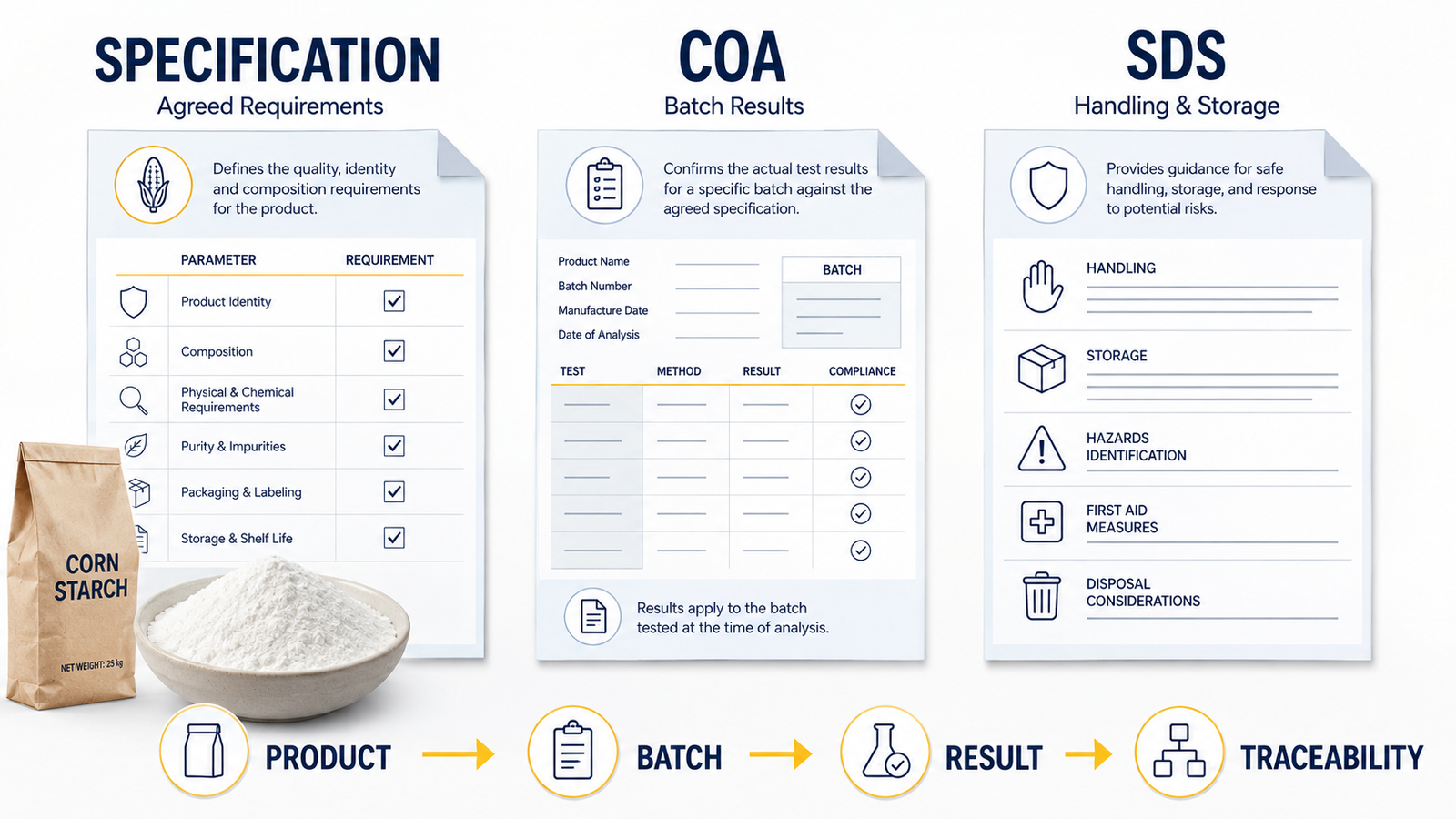
A product specification defines the agreed quality requirements, while a Certificate of Analysis shows whether a particular batch meets those requirements. Buyers should review both documents because a general specification cannot confirm the actual condition of the material being shipped.
Check Product and Batch Information
A corn starch COA should clearly identify the product name, grade, batch or lot number, production date and testing date. Where applicable, it may also include shelf-life or retest information.
The batch number should match the label and shipping documents. If the COA cannot be connected to the delivered material, it provides limited support for traceability. Buyers should also confirm that the product name and grade are consistent with the approved sample and purchase specification.
Compare Limits With Actual Results
Each test item should be compared with the agreed acceptance limit. Where possible, the COA should show the actual batch result rather than only stating “Pass” or “Conforms,” especially for important parameters such as moisture, pH or ash.
The reporting basis and test method also matter. Results should not be compared directly if one is reported on a dry basis and another on an as-is basis, or if substantially different methods were used. Unusual changes within the permitted range may still require discussion when they could influence processing performance.
Understand the Role of the MSDS
A corn starch MSDS, now more commonly called an SDS, serves a different purpose. It provides information on identification, handling, storage, exposure controls, transport considerations and emergency measures. It does not report the quality results of a specific production batch.
An MSDS therefore cannot replace a COA, and a COA cannot replace the safety and handling information contained in an MSDS. For a complete purchasing review, buyers may also request a technical data sheet, allergen statement, GMO statement, country-of-origin declaration, packaging specification and relevant quality-system certificates.
The value of these documents depends on their accuracy and connection to the offered product. Buyers should confirm that company names, manufacturing information, product descriptions and document versions remain consistent across the complete file package.
Bulk Corn Starch Price, Packaging and Shipping Considerations
The quoted price of bulk corn starch is influenced by more than production cost. Order quantity, product grade, packaging, testing requirements, delivery terms and market conditions can all affect the final offer. Buyers should therefore compare quotations on the same commercial and technical basis.
What Affects the Cost of Corn Starch?
Larger orders may reduce the unit cost, but the lowest quotation is not always the most economical option. A price comparison should confirm whether each offer covers the same specification, packaging size, testing scope and Incoterm.
Important cost factors include:
- native or modified starch grade;
- order quantity and minimum order requirement;
- packaging and pallet configuration;
- additional testing or certification;
- freight route and destination;
- payment and delivery terms;
- customized labeling or documentation.
Buyers should also consider the cost of inconsistent quality. Additional incoming inspection, production adjustments, rejected batches or delayed delivery can outweigh a small difference in purchase price. For regular demand, total purchasing cost and supply reliability are usually more meaningful than the lowest initial quotation.
Packaging, Storage and Transportation
Bulk corn starch is commonly supplied in industrial bags with protective inner liners, although bag size and pallet arrangement vary by supplier and market. Packaging should remain sealed, clean and resistant to moisture throughout storage and transportation.
Labels should clearly identify the product, grade, batch number, net weight and relevant production information. These details should correspond with the COA and shipping documents so that each delivered batch can be traced.
Corn starch should be stored in a cool, dry and well-ventilated area, protected from moisture, pests and materials with strong odors. Buyers should inspect incoming shipments for damaged bags, unclear labels, water exposure or unusual caking before the material enters production.
For international orders, freight time, container condition and humidity protection should be discussed before shipment. Shelf life should be confirmed from the supplier’s current documentation rather than assumed from a general industry figure. Proper packaging and transport controls help ensure that the product arriving at the buyer’s facility remains consistent with the sample and specifications originally approved.
How to Evaluate and Approve a Corn Starch Supplier in China or Asia
When sourcing from a corn starch supplier in China or another Asian market, buyers should evaluate more than price and production capacity. Export experience, document accuracy, traceability and communication can directly affect whether an approved product is delivered consistently.
The first step is to understand the supplier’s role. Some companies manufacture corn starch at their own facilities, while others coordinate production and export through partner factories. Either model can be workable, provided that the production source is transparent and the supplier can maintain the agreed specification.
Buyers should confirm:
- the name and location of the manufacturing facility;
- the food-grade specification offered;
- current quality-system certificates;
- sample and batch-specific COA availability;
- traceability and change-notification procedures;
- minimum order quantity and normal lead time;
- packaging and export-document capabilities;
- complaint handling and corrective-action procedures.
Certificates should be checked for validity, scope and connection to the facility supplying the product. A certificate carrying a familiar standard name is of limited value if it has expired or applies to a different company or production site.
A Practical Supplier Approval Process
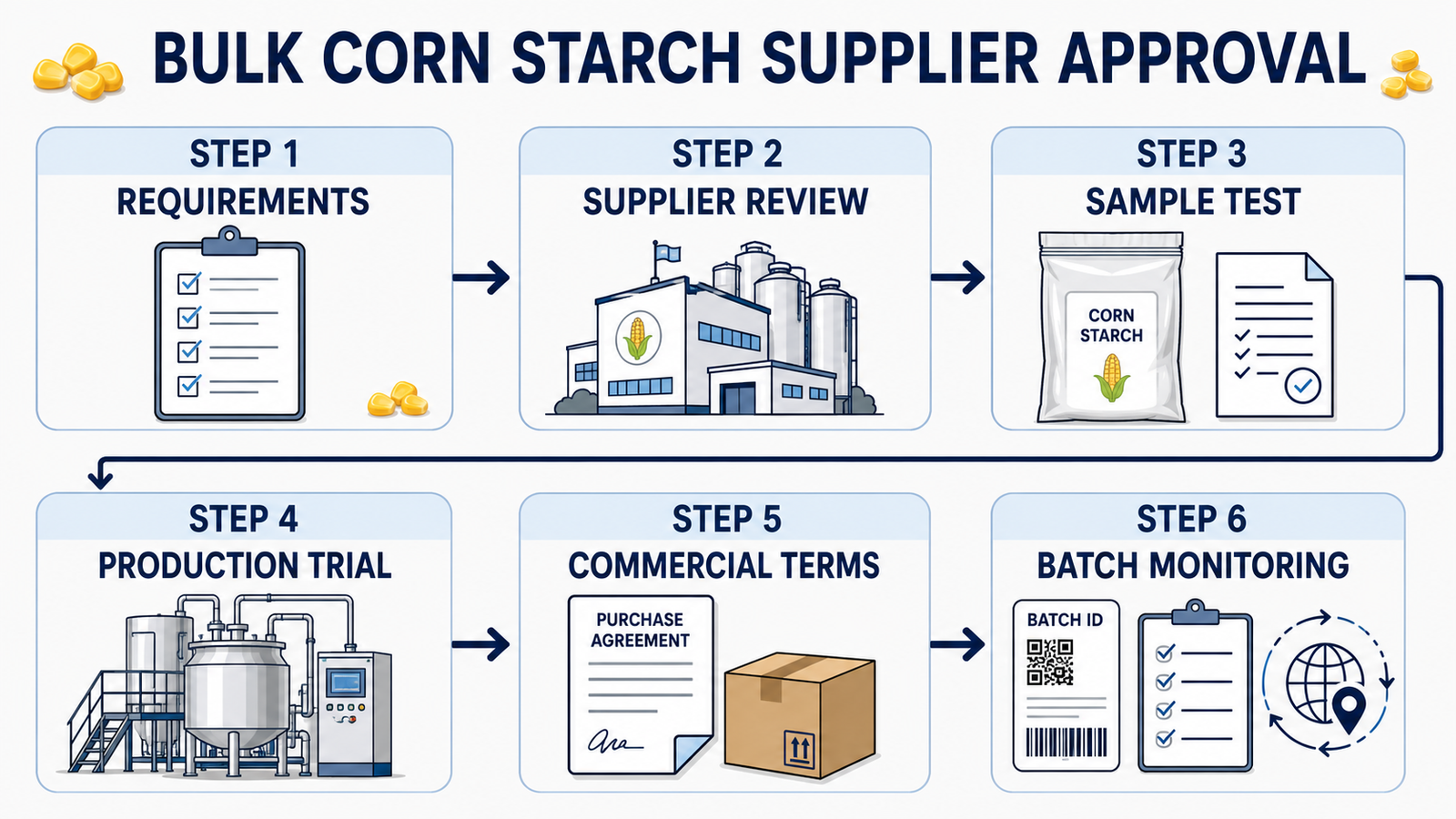
A structured approval process helps buyers compare corn starch suppliers consistently:
- Define requirements. Confirm the application, required grade, specification, purchasing volume and destination market.
- Review supplier information. Examine the manufacturing source, quality systems, technical documents and export capability.
- Evaluate a representative sample. Compare the sample with the proposed specification and test the parameters relevant to the finished product.
- Conduct an application trial. Where corn starch affects texture or processing stability, test it under representative production conditions.
- Approve the commercial terms. Confirm price basis, packaging, MOQ, lead time, payment terms and responsibilities for inspection or claims.
- Monitor future batches. Review incoming COAs, inspect delivered material and track performance over repeated shipments.
For large orders or new supply relationships, buyers may also consider pre-shipment inspection, retained samples or third-party testing. The appropriate level of control should reflect the purchasing value, product risk and difficulty of replacing a non-compliant shipment.
Supplier approval should not end after the first successful order. Ongoing monitoring helps identify gradual changes in analytical results, processing behavior or delivery performance. The objective is not only to find a bulk corn starch supplier capable of meeting the initial requirement, but to establish a supply relationship that remains reliable over time.
Frequently Asked Questions
Where Can Food Manufacturers Buy Bulk Corn Starch?
Food manufacturers can purchase bulk corn starch from manufacturers, export suppliers or regional distributors. The appropriate channel depends on order volume, delivery frequency, technical requirements and whether the buyer can manage international shipping. Before purchasing, confirm the production source, specification, batch documentation and traceability arrangements.
Is a Corn Starch COA the Same as an MSDS?
No. A COA reports the quality results of a specific production batch and compares them with the applicable specification. An MSDS or SDS provides information about product identification, handling, storage and safety considerations. Buyers may need both documents because they serve different purposes.
What Affects the Price of Bulk Corn Starch?
Bulk corn starch price may be influenced by product grade, order quantity, packaging, testing requirements, freight route, market conditions and delivery terms. Quotations should be compared using the same specification and Incoterm. Buyers should also consider batch consistency and supply reliability rather than focusing only on the quoted unit price.
Conclusion
Choosing a bulk corn starch supplier requires a balanced review of technical quality, commercial terms and long-term supply capability. Product specifications establish the agreed requirements, while batch-specific COAs, supporting documents and application trials help confirm whether the offered material is suitable for production.
Buyers should define their requirements before comparing quotations, verify the relationship between the supplier and manufacturing facility, and continue monitoring quality after approval. This approach reduces the risk of selecting material based only on price or a general food-grade description.
Food manufacturers evaluating food grade corn starch can request a current specification sheet, batch COA, packaging details and representative sample before confirming a commercial order.