



- Your cart is empty Browse Shop
Corn Starch in Food Manufacturing: Functions, Applications and Selection Guide
Corn starch is a familiar ingredient, but its role in food manufacturing is more complex than simply making a product thicker. Depending on the formulation and processing method, it may contribute to viscosity, structure, moisture control, binding, or the final texture of a food product. Its performance, however, is not determined by the ingredient name alone.
Heating temperature, available water, mixing conditions, acidity, sugar content, and storage requirements can all affect how corn starch behaves in a formulation. A starch that performs well in one product may not deliver the same result in another, even when the required function appears similar. For manufacturers, this makes application testing just as important as reviewing the technical specification.
This guide examines the main functions and applications of corn starch in food manufacturing, the processing factors that influence its performance, and the quality information buyers should review before approving a product for production.
What Is Corn Starch?
Corn starch is a fine carbohydrate powder obtained primarily from the endosperm of the corn kernel. During production, corn is generally cleaned and steeped before the starch-containing portion is separated from components such as fiber, protein, and germ. The recovered starch is then refined, dried, and sieved to produce a consistent powder suitable for further use.
Food grade corn starch is commonly supplied as a white to slightly yellowish powder with a mild, neutral character. In food manufacturing, it is valued mainly for its functional properties rather than for sweetness or flavor. When combined with water and exposed to suitable heating conditions, starch granules absorb water and swell, helping the surrounding system develop viscosity and structure. The extent of this change depends on both the starch itself and the conditions under which it is processed.
It is also important to distinguish standard corn starch from modified corn starch. Modified starch has been physically, enzymatically, or chemically treated to alter specific performance characteristics, such as resistance to heat, acidity, shear, or freezing and thawing. These products may be appropriate for demanding processing conditions, but they should not be treated as interchangeable with standard food grade corn starch. Selection must be based on the actual product specification and the requirements of the intended application.
For purchasing and formulation teams, the term “corn starch” therefore identifies the raw material category, but it does not provide all the information needed for approval. Product specifications, batch documentation, processing conditions, and application trials must be considered together. Understanding the functions corn starch can perform is the next step in determining whether it is suitable for a particular food formulation.
Functions of Corn Starch in Food Manufacturing
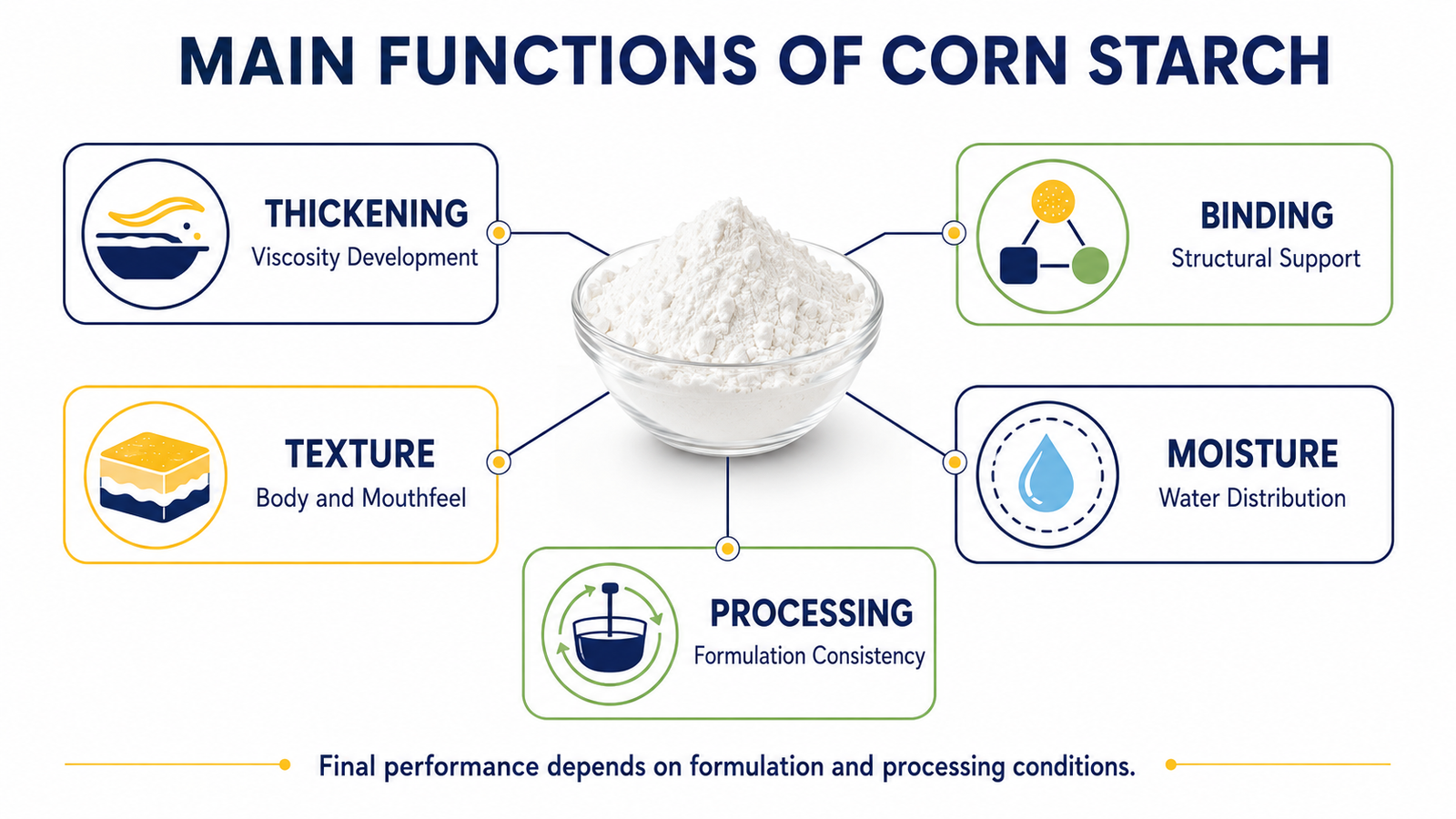
Corn starch can perform several related functions in food manufacturing. Its exact contribution depends on the formulation, the amount used, and the processing conditions. In many products, a change in viscosity also affects structure, moisture distribution, and the texture perceived by the consumer. Manufacturers should therefore begin by defining the required result rather than treating corn starch as a general-purpose solution.
Thickening and Viscosity Development
Thickening is the most widely recognized function of corn starch. When properly dispersed in water and heated, starch granules absorb water and swell, increasing the viscosity of the surrounding system. The degree of thickening depends on factors such as starch concentration, available water, temperature, heating time, and formulation composition. The required viscosity should be verified under conditions that represent the actual production process.
Binding and Structure Formation
Corn starch may help bind ingredients and support a more cohesive product structure. This can be useful when a formulation needs improved shape retention, reduced separation, or greater consistency during processing and handling. Its binding effect does not operate independently, however. Proteins, fats, sugars, salts, and other functional ingredients may all influence the structure that develops.
Texture and Mouthfeel Control
By changing viscosity and structure, corn starch can influence the body, firmness, smoothness, or softness of a finished product. The desired result varies significantly between food categories. A pourable sauce, a bakery filling, and a confectionery product require different texture profiles, even if all three contain corn starch. The starch level must therefore be adjusted according to the target texture rather than a standard addition rate.
Moisture Management
Corn starch can affect how water is distributed within a food system. This may contribute to processing consistency, product softness, filling stability, or the control of free moisture. Its effectiveness depends on the complete formulation and may change during cooling or storage. For products with specific shelf-life requirements, moisture-related performance should be evaluated over time.
Processing Support
In some formulations, corn starch also supports manufacturing by adding body, improving consistency, or helping ingredients remain more evenly distributed. In dry blends, it may influence powder handling and uniformity. These effects depend on particle characteristics and the other materials present.
Corn starch should therefore be assessed as part of the complete food system. A technical specification can confirm important quality parameters, but it cannot fully predict how the ingredient will perform in a particular formulation. Understanding these functions provides the basis for evaluating its use across different food applications.
Common Corn Starch Applications in the Food Industry
Corn starch is used in a wide range of manufactured foods, but its purpose varies by application. Some products require viscosity, while others depend more on binding, moisture control, or texture development. The appropriate use level and processing method should therefore be determined according to the finished product rather than copied from an unrelated formulation.
Sauces, Soups, and Gravies
In sauces, soups, and gravies, corn starch is mainly used to develop viscosity and provide a consistent body. It can help a sauce coat other food components and reduce unwanted separation during serving.
Performance depends on proper dispersion and sufficient heating. The presence of acids, sugars, salts, fats, and proteins may also affect the final viscosity. Manufacturers should evaluate the product after cooking, filling, cooling, and reheating where relevant, rather than measuring its consistency at only one stage.
Bakery Products and Fillings
Corn starch may contribute to texture, structure, and moisture distribution in bakery products. Its role differs between baked goods and fillings. In cakes, biscuits, and similar products, it may form part of the dry-ingredient system used to adjust the finished texture. In creams or fruit fillings, viscosity and shape retention may be more important.
The formulation should be tested under the intended baking or filling conditions. A filling that performs well before baking may soften, dry out, or change consistency when exposed to heat and subsequent storage.
Confectionery Products
Corn starch can be used in confectionery fillings and other systems that require controlled viscosity or structure. It may help the product develop body during processing and achieve the intended consistency after cooling.
High sugar concentrations can limit the water available for starch hydration, so performance in a simple water test may not reflect performance in the final product. Depending on the manufacturing process, depositing behavior, cooling time, firmness, and shape retention may all need to be assessed.
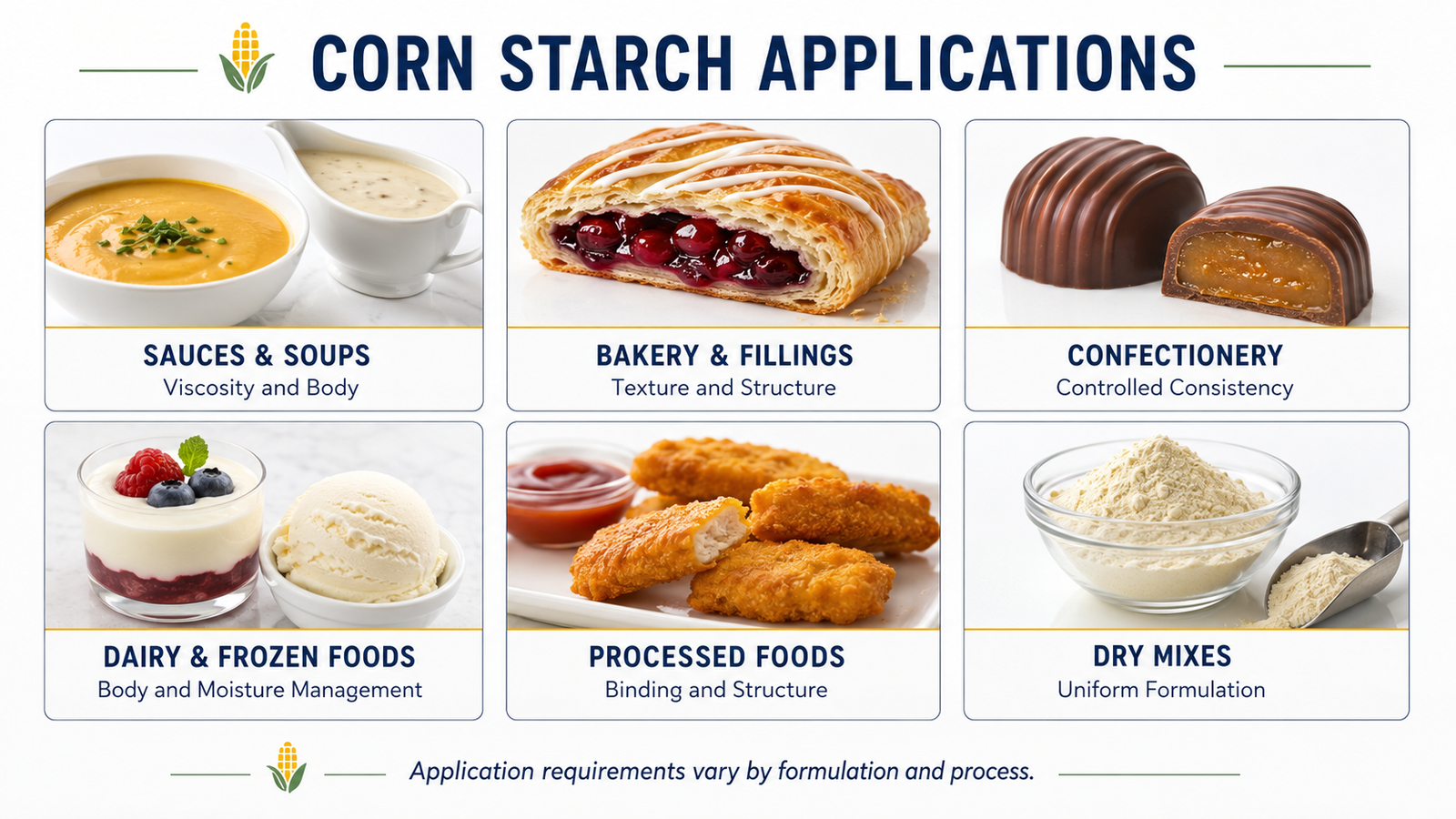
Dairy and Frozen Products
In selected dairy-based formulations, corn starch may support viscosity, body, and texture. However, milk proteins, minerals, sugars, and fats can influence how the starch hydrates and develops structure. Evaluation should therefore take place in the complete formulation.
Frozen applications require additional care. Freezing and thawing can alter moisture distribution and texture, and standard corn starch may not provide sufficient stability for every frozen product. Manufacturers should confirm suitability through storage trials under the expected temperature conditions.
Meat and Processed Foods
Corn starch may be used in certain meat and processed food products to support binding, moisture management, and structural consistency. Its performance can be affected by protein content, salt concentration, mixing conditions, and cooking temperature.
The correct addition level must be established through trials. Too little may provide limited functional benefit, while excessive use can create an undesirable or overly firm texture. Testing should reflect the complete production sequence, including mixing, forming, cooking, cooling, and storage where applicable.
Dry Mixes and Prepared Foods
Corn starch is also used in soup powders, sauce mixes, bakery premixes, dessert mixes, and other dry formulations. In these products, uniform distribution and powder handling are important before the starch is hydrated.
Manufacturers must determine how the final product will be prepared. Standard corn starch generally requires suitable heating to develop its expected viscosity and should not automatically be treated as an instant or cold-water-thickening starch. Both the packaged dry mix and the prepared product should be evaluated.
Across these applications, food category alone is not enough to determine suitability. The same corn starch can perform differently when formulation composition, heating conditions, or storage requirements change. Application trials should therefore be designed around the intended product and production process.
How Processing Conditions Affect Corn Starch Performance
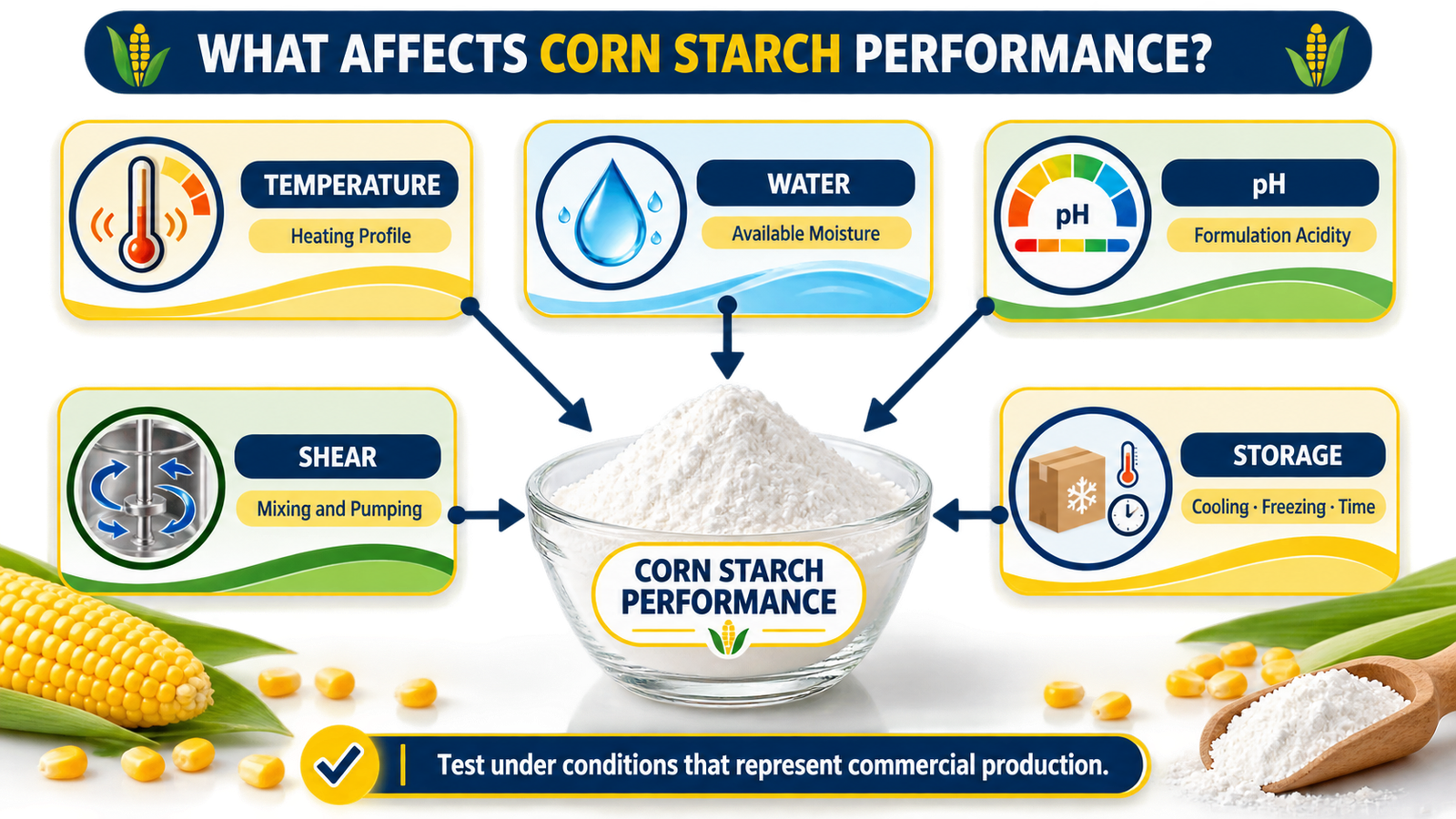
Corn starch performance is shaped by the conditions under which it is processed. A product may meet its written specification but still produce different results when the formulation, equipment, or production parameters change. The following factors should therefore be considered during application trials.
Temperature and Heating Time
Corn starch requires sufficient heat and time to absorb water, swell, and develop viscosity. Inadequate heating may result in incomplete thickening, while prolonged or excessive heating can weaken the structure that has formed. Trials should reflect the actual heating profile used in production.
Available Water
The amount of water in a formula does not always indicate how much is available to the starch. Sugar, salt, protein, and other ingredients may compete for water and affect hydration. This is one reason why performance measured in water alone may differ from performance in a finished food system.
Acidity
The pH of a formulation can influence viscosity development and stability, particularly when starch is exposed to acid during heating. Acidic sauces, fruit fillings, and similar products should be tested under their actual processing conditions rather than evaluated through a neutral model formula.Where citric acid is used to control acidity, manufacturers should also consider how its concentration and point of addition affect the complete food system.
Mixing and Shear
Mixing is necessary for even starch dispersion, but the intensity and duration of shear can affect the developed structure. High-speed mixing, pumping, or repeated mechanical handling may reduce viscosity in some systems. Laboratory trials should therefore reproduce the main mechanical stresses expected during production.
Cooling and Storage
Corn starch performance may continue to change after heating. As a product cools, its viscosity and texture may develop further, while extended storage can lead to changes in firmness or moisture distribution. Products intended for refrigeration or freezing require evaluation under their expected storage conditions.
These variables often interact, so changing one factor may alter the effect of another. For reliable approval, manufacturers should test corn starch in the complete formulation using processing conditions that closely represent commercial production.
Corn Starch Specifications Buyers Should Review
Technical specifications provide the basis for comparing corn starch products and confirming whether a delivered batch meets the agreed quality requirements. Buyers should review each parameter in relation to the intended application rather than relying only on a general food grade description.
Common specification items include:
| Specification Item | Why It Matters |
|---|---|
| Appearance | Helps confirm that the powder matches the expected color and physical condition. |
| Moisture | Supports storage stability, powder handling, and batch consistency. |
| pH | Helps determine compatibility with the formulation and agreed product requirements. |
| Ash | Provides an indication of mineral residue and processing consistency. |
| Particle Size | May influence powder handling, dispersion, and production uniformity. |
| Microbiological Limits | Confirms compliance with established microbiological quality requirements. |
| Contaminant Limits | Supports food safety and regulatory review for the target market. |
Specifications should include clearly stated limits, test units, and, where relevant, the analytical methods used. A value without a unit or testing basis may be difficult to interpret or compare with another supplier’s documentation.
The product specification and batch Certificate of Analysis serve different purposes. The specification defines the agreed acceptance criteria, while the COA reports the results obtained for a particular production batch. Buyers should confirm that the product name, grade, batch number, test items, units, limits, and reported results are consistent across both documents.
Not every functional property is fully represented by a routine specification. Parameters such as moisture, pH, and particle size can support quality evaluation, but they do not independently predict how the starch will behave in a sauce, filling, bakery product, or other complete formulation. Where viscosity or another functional measurement is included, the buyer should also review the test conditions because results obtained through different methods may not be directly comparable.
The final specification should reflect the buyer’s application, quality system, target market, and regulatory requirements. Once the written requirements have been reviewed, a representative sample should be tested before the product is approved for regular production.
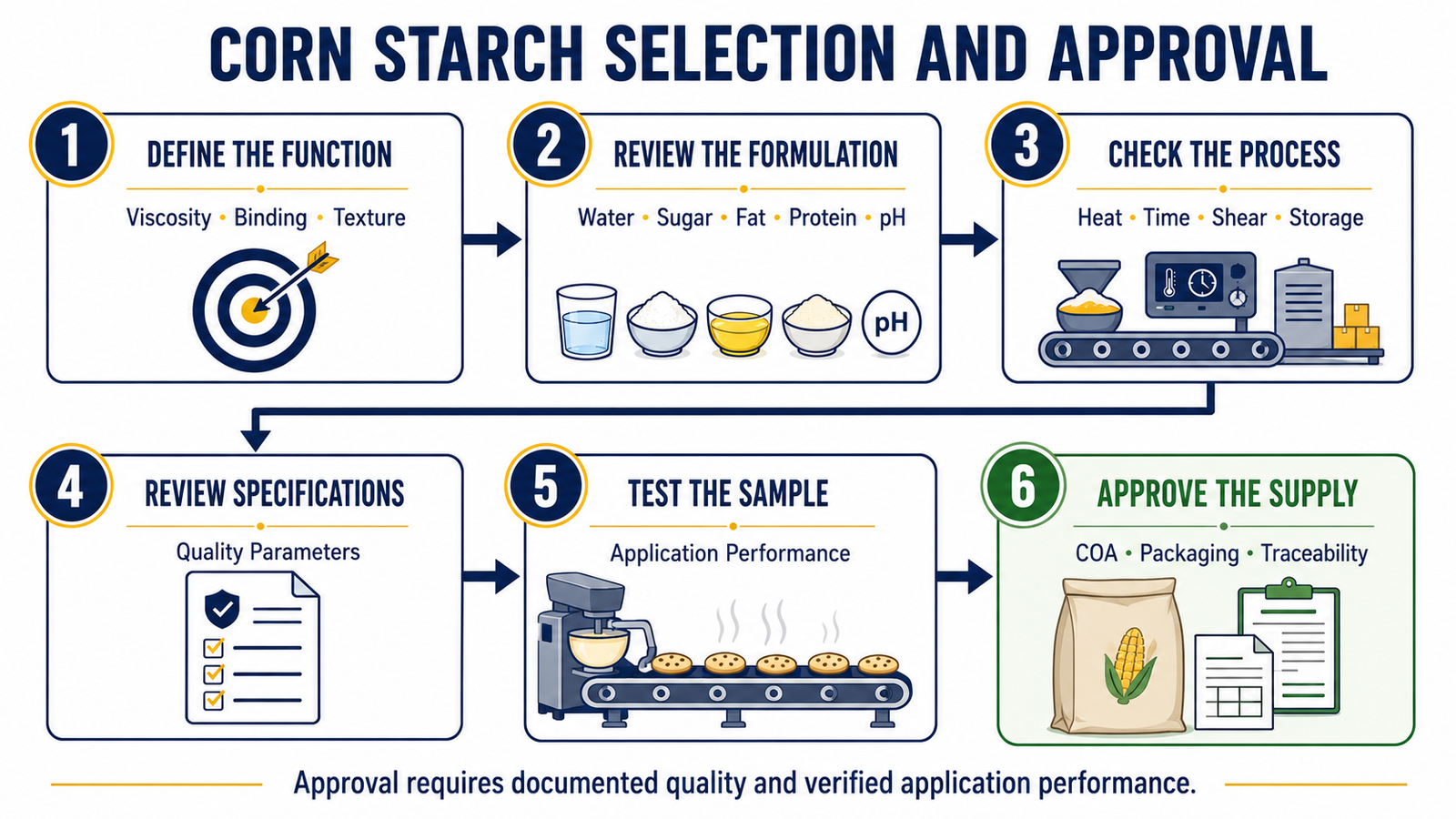
How to Select Corn Starch for a Food Application
Selecting corn starch should begin with the requirements of the finished product, not with price or a general product description. A structured evaluation helps formulation and purchasing teams compare options using the same criteria.
1. Define the Required Function
Identify what the starch must achieve in the formulation. The primary requirement may be thickening, binding, texture development, moisture management, or a combination of functions. The target should be described as clearly as possible, using measurable criteria where available.
2. Review the Complete Formulation
Consider the amount of water available to the starch and the presence of sugar, salt, fat, protein, acids, and other functional ingredients. These components can influence hydration, viscosity, and the final product structure.
3. Examine the Production Process
Record the expected heating temperature, processing time, mixing intensity, filling conditions, cooling method, and storage environment. Laboratory testing should reproduce the most important production conditions rather than use an unrelated standard preparation method.
4. Compare Product Specifications
Review appearance, moisture, pH, ash, particle size, microbiological limits, contaminants, and any relevant functional parameters. Confirm that limits and test methods are clearly defined and suitable for the buyer’s quality requirements.
5. Test a Representative Sample
Evaluate the sample in the intended formulation and compare it with an approved reference or defined performance target. Testing may include viscosity, texture, processing behavior, product appearance, and stability during storage.
6. Confirm Consistency Before Approval
A successful sample trial is only one part of supplier approval. Buyers should also verify the batch COA, packaging, labeling, traceability, storage requirements, and the supplier’s ability to maintain consistent quality over repeated deliveries.
Following these steps reduces the risk of selecting corn starch on the basis of limited technical information. Final approval should reflect both documented quality and demonstrated performance in the intended food application.
Documents and Supplier Factors to Review Before Approval
Application testing should be supported by a review of the supplier’s technical and quality documents. The product specification defines the agreed requirements, while the batch Certificate of Analysis confirms the reported results for a specific lot. Buyers should check that the product name, grade, batch number, test items, units, limits, and results are consistent.
For a more detailed purchasing framework, see our guide on how to choose a bulk corn starch supplier, including specifications, COA review and quality evaluation.
A Technical Data Sheet may provide additional information on product characteristics, handling, and intended applications. The Safety Data Sheet supports storage, transport, and workplace procedures. Depending on the buyer’s quality system and target market, other documents may include allergen information, traceability records, regulatory statements, and relevant ISO, FSSC 22000, Halal, or Kosher documentation.
Documents alone, however, do not establish whether a supplier can support regular production. Buyers should also review packaging integrity, label accuracy, batch traceability, storage recommendations, lead times, and the supplier’s process for managing quality concerns. The ability to provide representative samples and respond clearly to technical questions is also important during qualification.
Supplier approval should therefore combine three forms of evidence: documented product quality, acceptable performance in the intended application, and confidence in consistent supply. Buyers seeking information on available specifications, documentation, packaging, and bulk supply options can review our Food Grade Corn Starch product page or contact the supplier for requirements related to a specific application.
Conclusion
Corn starch can contribute to thickening, binding, texture development, moisture management, and processing consistency across a range of food applications. Its actual performance depends on the complete formulation and the conditions used during production and storage.
For reliable selection, manufacturers should define the required function, review the technical specification, reproduce the intended processing conditions, and test a representative sample. Purchasing approval should also consider batch documentation, traceability, packaging, and the supplier’s ability to maintain consistent quality over time.
Frequently Asked Questions
What is corn starch used for in food manufacturing?
Corn starch is used to develop viscosity, support binding, manage moisture, and adjust texture in products such as sauces, bakery fillings, confectionery, processed foods, and dry mixes. Its exact function depends on the formulation and processing method.
How does corn starch thicken a food product?
When properly dispersed in water and heated, starch granules absorb water and swell, increasing the viscosity of the surrounding system. Temperature, heating time, available water, pH, and other ingredients can influence the result.
What specifications should buyers review?
Common items include appearance, moisture, pH, ash, particle size, microbiological limits, and contaminant limits. Buyers should compare the product specification with the batch COA and confirm that the limits, units, and results are clearly reported.
Can the same corn starch be used in every food application?
Not necessarily. A product that performs well in one formulation may behave differently when the water content, acidity, sugar level, temperature, shear, or storage conditions change. Suitability should be confirmed through application testing.
Why should manufacturers test a sample before bulk purchasing?
A specification confirms important quality parameters but cannot fully predict performance in a finished food system. Sample testing allows manufacturers to evaluate viscosity, texture, processing behavior, appearance, and storage stability before approving regular supply.