



- Your cart is empty Browse Shop
Erythritol Solubility and Crystallization: A Guide for Food Manufacturers
Introduction
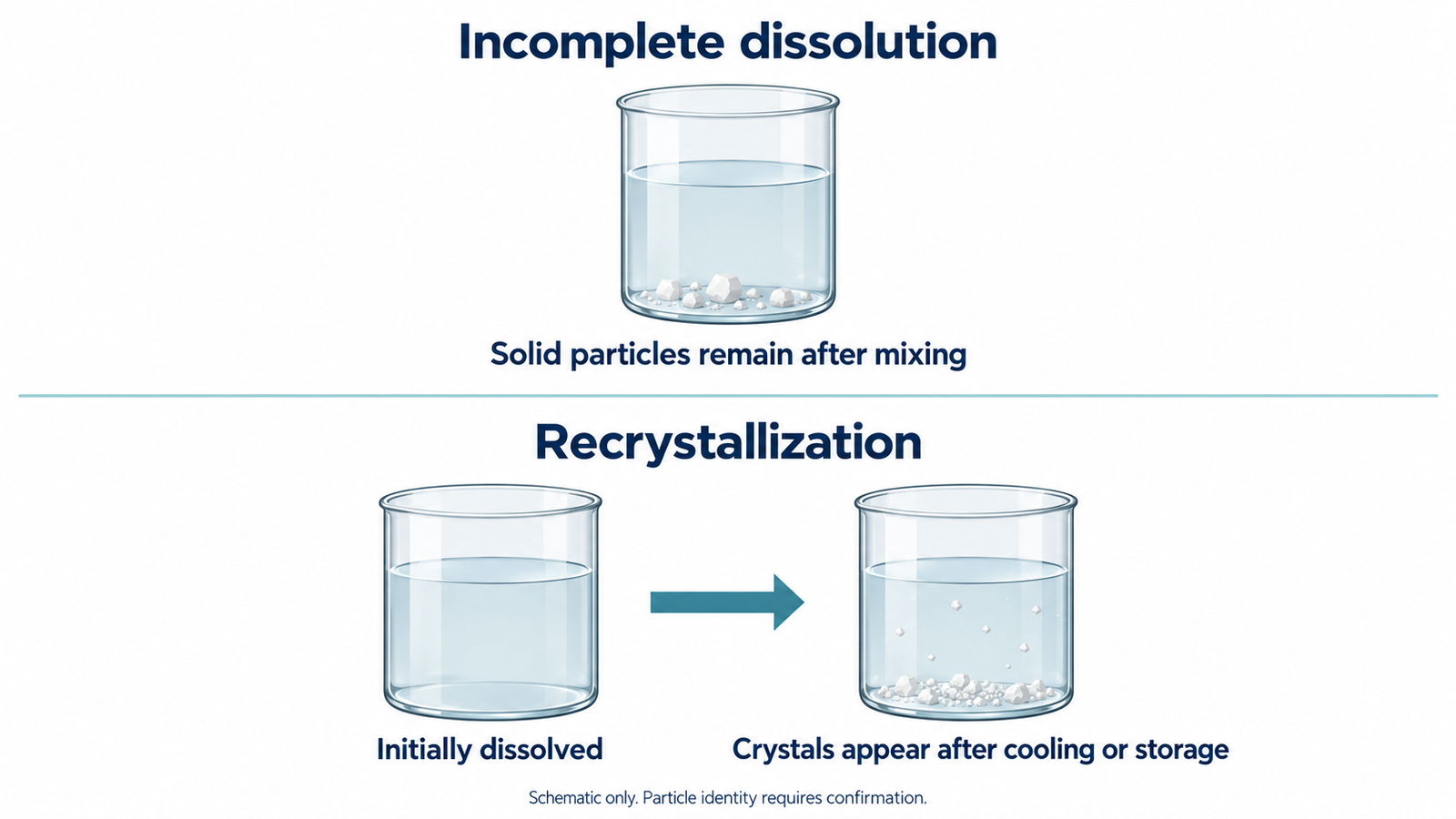
An erythritol formulation may look clear after warm mixing, only to develop visible particles as it cools or during storage. In another batch, granules may remain at the bottom of the vessel despite continued stirring. Although these problems can look similar, they do not necessarily have the same cause.
Understanding erythritol solubility starts with distinguishing incomplete dissolution from recrystallization. Incomplete dissolution means some of the ingredient never entered solution. Recrystallization occurs when previously dissolved erythritol forms crystals again as conditions change. Particles or sediment may also come from other ingredients, so appearance alone is not enough to identify the problem.
For food manufacturers, that distinction helps determine what to check before changing the formula or questioning the raw material. This guide explains how temperature, concentration and processing conditions affect erythritol, how to investigate common dissolution and texture problems, and what to record during sample testing. The aim is to support practical decisions based on the complete formulation and its intended processing and storage conditions.

Understanding Erythritol Solubility in Water
Before investigating particles in a formulation, it helps to separate two questions: how quickly erythritol dissolves, and how much can remain dissolved under the conditions being tested. These describe dissolution rate and solubility, respectively. Confusing them can lead to unnecessary changes in mixing time, particle size or ingredient dosage.
For background on the ingredient and its main properties, see our guide to what erythritol is.
Solubility vs. Dissolution Rate
Dissolution rate describes how quickly solid erythritol enters the liquid phase. Particle size, agitation, water temperature and the surrounding formulation can all influence this process. Smaller particles generally provide more surface area for contact with water, while effective mixing helps bring fresh liquid into contact with the crystals.
Solubility describes the amount that can dissolve at a specified temperature and composition once equilibrium is reached. Using finer material may shorten dissolution time, but it does not, by itself, increase the equilibrium solubility of erythritol in water.
This distinction matters when granules remain after mixing. Additional agitation may help if dissolution is simply slow. If the solution has reached its solubility limit, however, longer mixing alone will not allow all the remaining material to dissolve.
Why Temperature and Concentration Matter
Erythritol solubility in water increases with temperature. A quantity that dissolves during warm processing may therefore exceed what can remain dissolved after cooling. Whether visible crystals subsequently appear also depends on crystal formation and growth, which are discussed in the next section.
Concentration must be interpreted carefully. The percentage of erythritol in the complete recipe does not necessarily describe its concentration in the aqueous phase, particularly in products containing substantial fat or other solids. Other dissolved ingredients can also affect its behavior.
When using published solubility data, check both the temperature and the reporting basis. Grams per 100 grams of water and grams per 100 grams of solution are different measurements. Pure-water data provide a useful starting point, but the finished formulation should be tested under its intended processing and storage conditions.
Why Does Erythritol Crystallize After Cooling?
A clear solution at the end of warm mixing is a useful observation, but it does not establish how the product will behave after cooling. As temperature falls, the amount of erythritol that can remain dissolved may decrease. If the dissolved concentration exceeds the equilibrium solubility under the new conditions, the solution becomes supersaturated.
From a Dissolved Solution to Supersaturation
Supersaturation creates the conditions for crystallization, although crystals do not necessarily appear immediately. Crystal formation begins with nucleation: the development of small, stable crystal nuclei. These nuclei can then grow as dissolved erythritol joins the crystal structure.
Residual erythritol crystals or suitable surfaces may provide sites for this process. A sample can therefore remain visibly clear for a period before crystals become noticeable. Differences in nucleation and growth also help explain why batches with similar starting compositions may develop particles at different times.
This is distinct from incomplete dissolution. If granules were present throughout mixing, the initial problem may have been insufficient dissolution. If a solution was clear and particles appeared later, recrystallization is one possibility, but the particles should still be identified before drawing that conclusion.
What Changes During Cooling and Storage
Cooling is only part of the picture. Water loss during heating or storage can increase the concentration of dissolved ingredients. Temperature changes during distribution may also alter the balance between dissolved erythritol and solid crystals. The complete formulation influences how these changes affect the finished product.
Cooling rate and agitation can affect crystal formation and growth, but there is no single cooling method that prevents unwanted crystallization in every application. Conditions must be evaluated against the intended product texture and processing requirements.
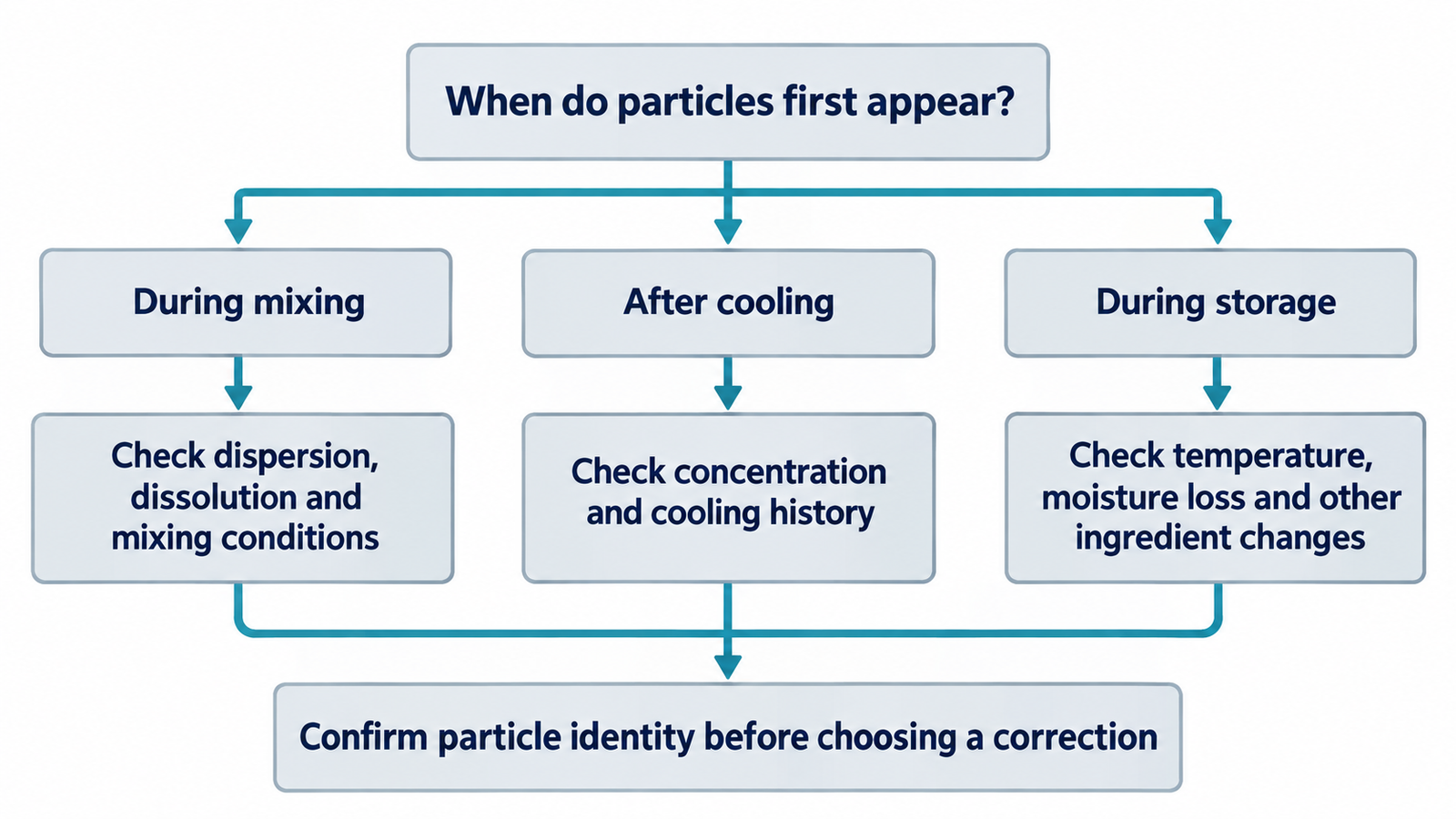
For manufacturers, the practical question is when particles first appear and what changed beforehand. Recording temperature, holding time, water loss and storage conditions helps narrow the investigation. Those observations provide a stronger basis for adjusting the process than judging stability from a freshly prepared sample alone.
Processing Factors to Check Before Changing the Formula
Once the timing of particle formation is understood, review the formulation and process records together. A problem that appears to require a different ingredient level may instead reflect water loss, incomplete mixing or a change in cooling conditions. Establishing a consistent baseline makes subsequent trials easier to interpret.
Available Water and Ingredient Concentration
Start with the actual quantities used, including water contributed by syrups, concentrates and other liquid ingredients. Compare these with the intended recipe and check whether evaporation during heating changed the final batch weight.
Total moisture alone may not fully describe the environment in which erythritol dissolves. Other ingredients can affect water distribution, viscosity and solubility. Review the complete formulation rather than estimating performance from the erythritol-to-water ratio alone. Record ingredient weights, any water added during processing and the final yield.
Particle Size and Mixing Conditions
Confirm whether the material is powdered or granular and whether its particle size matches the specification used in earlier trials. Finer particles may dissolve more quickly, but they can also be harder to disperse evenly if addition and mixing are poorly controlled.
Check the actual liquid temperature, mixing time and equipment settings. Observe whether material collects at the vessel bottom or remains in poorly circulated areas. Increasing mixing time is useful only when insufficient contact or slow dissolution is part of the problem.
Ingredient Addition Order
The order of addition can change the conditions erythritol encounters. For example, adding it after a thickener has developed viscosity may make dispersion and mass transfer more difficult than adding it to a less viscous liquid.
Compare alternative addition sequences in controlled trials while keeping ingredient quantities and other process settings consistent. Follow any application-specific requirements for the remaining ingredients; an improved dissolution step must still fit the overall manufacturing process.
Cooling Profile and Storage Conditions
Record the temperature after mixing, holding time before cooling and the cooling profile. Note whether the sample was agitated during cooling and when particles first became visible.
Use storage conditions relevant to the intended product and distribution route. Keep sample containers and fill levels consistent, and account for possible moisture loss. If crystallization appears later, compare those records with the baseline batch before changing the formula. This helps distinguish a repeatable formulation issue from a variation in processing or sample handling.
Application Checks for Beverages, Drink Powders and Confectionery
The same erythritol ingredient can behave differently across applications because water content, processing conditions and the desired texture vary. A clear beverage, an instant drink powder and a crystalline candy therefore require different evaluation criteria. The aim is to determine whether the ingredient performs as intended in the finished product.
For a broader overview of its role in reduced-sugar formulations, read about erythritol as a sugar substitute.
| Application | Main Checks | Relevant Test Conditions |
|---|---|---|
| Ready-to-drink beverages | Dissolution, clarity and particle development | After processing, cooling and representative storage |
| Powdered drink mixes | Dispersion, dissolution time and residue | Intended dilution, water temperature and consumer mixing method |
| Confectionery and fillings | Crystal texture, particle size and mouthfeel | Actual processing, cooling and storage conditions |
Ready-to-Drink Beverages
For a beverage intended to remain clear, inspect samples after cooling as well as immediately after production. Continue observations during storage, recording when any haze, sediment or crystals appear. Evaluate the complete formula, including acids, flavors and other sweeteners. If particles develop, confirm their identity rather than assuming erythritol is responsible.
Powdered Drink Mixes
Test reconstitution according to the intended preparation instructions. Warm water and laboratory mixing equipment may produce results that consumers cannot reproduce with cold water and a spoon or shaker.
Keep dilution, mixing time and the interval before observation consistent. Distinguish erythritol dissolution from the dispersion of other powder components, since some formulations contain ingredients that are not expected to dissolve completely.
Confectionery and Fillings
Crystallization is not automatically a defect. Some products require a controlled crystalline structure, while others depend on a smooth texture. Define the intended result before deciding whether crystal formation is undesirable.
In low-moisture or fat-rich systems, particle size and distribution may be more relevant than complete dissolution. Investigate graininess in relation to the whole product: residual ingredient particles, erythritol crystals, other sugar crystals or fat crystallization may require different corrective actions. Increasing water or temperature without considering the formulation could create additional processing or texture problems.
Troubleshooting Undissolved Particles and Grainy Texture
When particles appear, begin with their timing and location. Material present during mixing suggests a different investigation from crystals that develop in a previously clear sample. Graininess in a filling may require a different approach again, especially when the product contains little water.
The following checks help narrow the cause. They are starting points for investigation, not confirmation that erythritol is responsible.
| Observation | Possible Explanations | First Checks |
|---|---|---|
| Particles remain immediately after mixing | Incomplete dissolution, poor dispersion or insoluble ingredients | Actual temperature, concentration, mixing conditions and particle identity |
| Crystals appear after cooling | Recrystallization or crystallization of another dissolved ingredient | Initial clarity, cooling profile and crystal composition |
| Sediment develops during storage | Crystal growth, aggregation or separation of other components | Storage records, sediment identity and formulation stability |
| The finished product tastes grainy | Residual particles, crystal growth or changes in another solid phase | When graininess develops, particle size and the complete formulation |
Start with a Repeatable Observation
Keep a retained sample and photograph the problem under consistent lighting. Record whether particles float, settle or collect on the container walls, and whether they were visible before cooling. Compare affected and unaffected batches using their formulation and processing records.
A clear-looking sample does not prove that every ingredient has dissolved. Fine particles may be difficult to see, so visual inspection should be supported by appropriate examination when the cause remains uncertain.
Confirm the Cause Before Choosing a Correction
Warming a sample may help investigate whether particles dissolve again, but that response alone does not establish their identity. Other ingredients can also dissolve or change with temperature. Microscopy or suitable analytical testing may be needed, particularly when sediment contains several components.
Choose the next trial according to the evidence. Suspected incomplete dissolution calls for a review of mixing, addition order and processing conditions. Suspected recrystallization requires attention to concentration, cooling and storage behavior. Change one variable at a time and compare the result with an unchanged control.
Avoid treating filtration as proof that the underlying problem has been resolved. Removing visible particles may change product composition, while crystals could form again later. Likewise, crystallization alone does not demonstrate poor raw-material quality. A supplier-quality investigation should consider the agreed specification, batch documentation and comparative sample results.
A Practical Sample Testing Workflow
Once a likely cause has been identified, use a controlled trial to evaluate the proposed adjustment. Keep the original formulation as a reference so that changes in dissolution, texture or storage behavior can be compared meaningfully.
1. Establish the baseline.Record the erythritol batch number, physical form and available particle-size information. Document the complete recipe, ingredient weights, equipment and processing sequence. Define what an acceptable result looks like for the intended product.
2. Reproduce the intended process. Prepare the reference sample using representative mixing, heating and cooling conditions. Measure actual temperatures and times rather than relying only on equipment settings. Record the final batch weight where evaporation may affect concentration.
3. Change one variable at a time. Test a selected adjustment, such as mixing time or addition order, while keeping other conditions consistent. If several changes are introduced together, it becomes harder to identify which caused the observed difference.
4. Observe beyond initial preparation. Examine samples after processing, after cooling and at planned storage intervals. Use consistent containers and representative storage conditions. Record particle development, clarity and texture against the baseline.
5. Verify during scale-up. A promising laboratory result should be checked under pilot or production conditions. Changes in circulation, heat transfer and holding time can affect performance.
| Trial Record | Information to Capture |
|---|---|
| Sample identity | Formula version and ingredient batch numbers |
| Processing | Addition order, temperature, mixing and cooling |
| Storage | Container, conditions and observation intervals |
| Results | Particle appearance, clarity, texture and deviations |
Repeat promising trials to assess consistency. Dissolution testing supports formulation decisions, but it does not replace the broader quality, safety and shelf-life evaluation required for the finished product.

What to Confirm with Your Erythritol Supplier
Application trials are easier to interpret when the supplied material is clearly specified. Before comparing samples or placing a bulk order, ask the supplier to confirm the physical form, particle-size specification and relevant product documentation.
Powdered and granular erythritol may behave differently during handling and dissolution. Confirm whether the trial sample represents the grade intended for commercial supply, and identify any differences before using its results to approve a purchase.
Request the current specification sheet and the batch certificate of analysis (COA). A COA can support checks against the agreed specification, but it does not establish how erythritol will perform in your complete formulation.
If the supplier provides solubility data, check the temperature, units, test medium and measurement method. Pure-water results should not be treated as a finished-product guarantee.
For broader checks covering supplier documentation, sample approval, packaging and delivery, consult our bulk erythritol purchasing guide.
Frequently Asked Questions
Does erythritol dissolve in cold water?
Yes, erythritol can dissolve in cold water, but both the amount that can remain dissolved and the time required depend on the conditions. A quantity that dissolves in warm water may not remain fully dissolved after cooling. Test the intended concentration at the actual preparation and storage temperatures, especially for cold beverages and drink powders.
Does powdered erythritol dissolve faster than granular erythritol?
Powdered erythritol generally offers more surface area, which can help it dissolve faster when it is well dispersed. However, fine powder can clump during addition, reducing that advantage. Particle size affects dissolution rate; it does not, by itself, increase equilibrium solubility. Compare both forms using the same formulation, temperature and mixing conditions.
Why does erythritol recrystallize after cooling?
Cooling can reduce the amount of erythritol that remains dissolved. If its concentration exceeds the solubility limit under the new conditions, the solution becomes supersaturated and crystals may form. Their appearance can be delayed because nucleation and growth take time. Water loss and other formulation changes may also contribute, so review the complete process.
Does crystallization mean the erythritol is poor quality?
Not necessarily. Material that meets its specification can still crystallize under particular formulation, cooling or storage conditions. First confirm that the particles are erythritol, then compare affected and reference samples. If the evidence suggests a raw-material difference, review batch documentation and agreed specifications with the supplier. Appearance alone is insufficient to establish a quality failure.
Conclusion
Understanding erythritol solubility helps manufacturers distinguish slow or incomplete dissolution from recrystallization during cooling and storage. Before adjusting a formula, identify the particles, review the processing records and test the suspected cause against a consistent baseline.
Temperature, concentration, particle size and mixing conditions should be assessed within the complete formulation. A clear sample after warm mixing is only one observation; performance after cooling, storage and scale-up also matters.
For sourcing, confirm that the sample and commercial supply match the agreed specification. Contact us for current food-grade erythritol specifications, available batch documentation and sample options for your application trials.