



- Your cart is empty Browse Shop
Sodium Citrate vs Citric Acid: Differences, Applications and Selection Guide for Food Manufacturers
Introduction
Sodium Citrate vs Citric Acid: Differences, Applications and Selection Guide for Food Manufacturers。
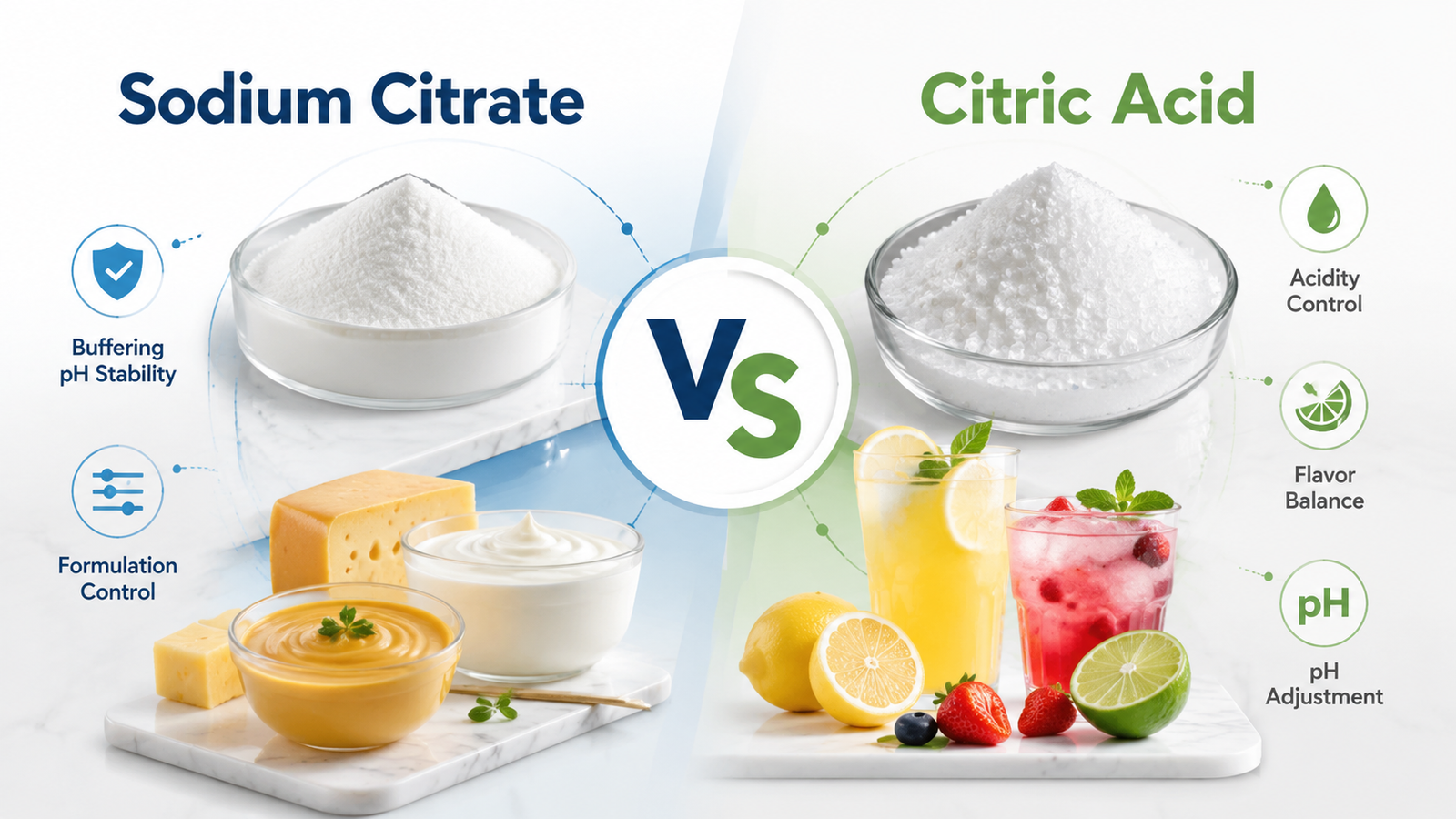
When developing food formulations, manufacturers often need to choose the right ingredient to control acidity, improve stability, and achieve consistent product quality. Two commonly compared ingredients are sodium citrate and citric acid.
Although both ingredients are closely related and derived from citric acid, they serve different functions in food manufacturing. The main difference comes down to how they interact with a formulation: citric acid is mainly used for acidity adjustment and flavor control, while sodium citrate is commonly used for buffering and pH stabilization.
Understanding the differences between sodium citrate vs citric acid can help food producers select the right ingredient based on their application, processing requirements, and desired product characteristics.
In this guide, we will compare sodium citrate and citric acid, explore their key differences and food applications, and explain how manufacturers can choose the most suitable option for their formulations.
What Is Sodium Citrate?
Sodium citrate is the sodium salt of citric acid and is widely used as a functional ingredient in food manufacturing. Unlike citric acid, which is mainly used to increase acidity, sodium citrate works primarily as a buffering agent that helps maintain a more stable pH level in food formulations.
In practical applications, sodium citrate helps manufacturers control product consistency, improve formulation stability, and manage acidity without creating a strong sour taste. This makes it especially useful in products where pH balance and texture are important factors.
One of the most recognized applications of sodium citrate is in dairy processing, particularly in cheese products. It can support emulsification by helping fat and protein components blend more evenly, resulting in a smoother texture. It is also commonly used in sauces, processed foods, and other formulations where stable quality is required.
For food manufacturers, understanding what is sodium citrate is important because its role goes beyond simple acidity adjustment. It is often selected when a formulation requires better pH control, improved stability, or specific functional properties.
To learn more about its properties, production methods, and general characteristics, you can explore our detailed guide on what is sodium citrate.
What Is Citric Acid?
Citric acid is a naturally occurring organic acid that is widely used as an acidity regulator and flavoring ingredient in food and beverage manufacturing. It is commonly found in products such as beverages, confectionery, sauces, and processed foods where manufacturers need to adjust acidity levels or create a fresh sour taste.
Unlike sodium citrate, which mainly functions as a buffering agent, citric acid directly increases acidity by lowering the pH of a formulation. This makes it a popular choice when manufacturers need precise acidification, flavor enhancement, or improved product stability through acidity control.
Citric acid is often selected for applications where taste is an important consideration. For example, in beverages and fruit-based products, its natural acidic profile can help create the desired flavor balance while supporting product consistency.
When comparing citric acid vs sodium citrate, the key difference is not simply the chemical structure but the role each ingredient plays in a formulation. Citric acid is generally chosen for acidity adjustment, while sodium citrate is typically preferred when manufacturers need buffering capacity and more stable pH control.
Understanding these functional differences helps food manufacturers make better ingredient choices based on their specific product requirements.
Sodium Citrate vs Citric Acid: Key Differences
When comparing sodium citrate vs citric acid, the most important factor is not where they come from, but how they function in a food formulation. Although sodium citrate is derived from citric acid, the two ingredients provide different benefits during food processing.
The main distinction is that citric acid is primarily used for acidity adjustment, while sodium citrate is mainly used for buffering and pH stabilization. The right choice depends on the specific requirements of the final product, including taste, texture, processing conditions, and desired pH control.
Sodium Citrate vs Citric Acid Comparison
| Feature | Sodium Citrate | Citric Acid |
|---|---|---|
| Chemical Type | Sodium salt of citric acid | Organic acid |
| Primary Function | pH buffering and stabilization | Acidity adjustment |
| Effect on pH | Helps maintain a stable pH range | Lowers pH levels |
| Taste Impact | Mild taste with limited sourness | Provides a noticeable acidic taste |
| Common Applications | Cheese, dairy products, sauces, processed foods | Beverages, confectionery, flavor systems |
| Main Manufacturing Role | Supports formulation stability and texture | Controls acidity and enhances flavor |
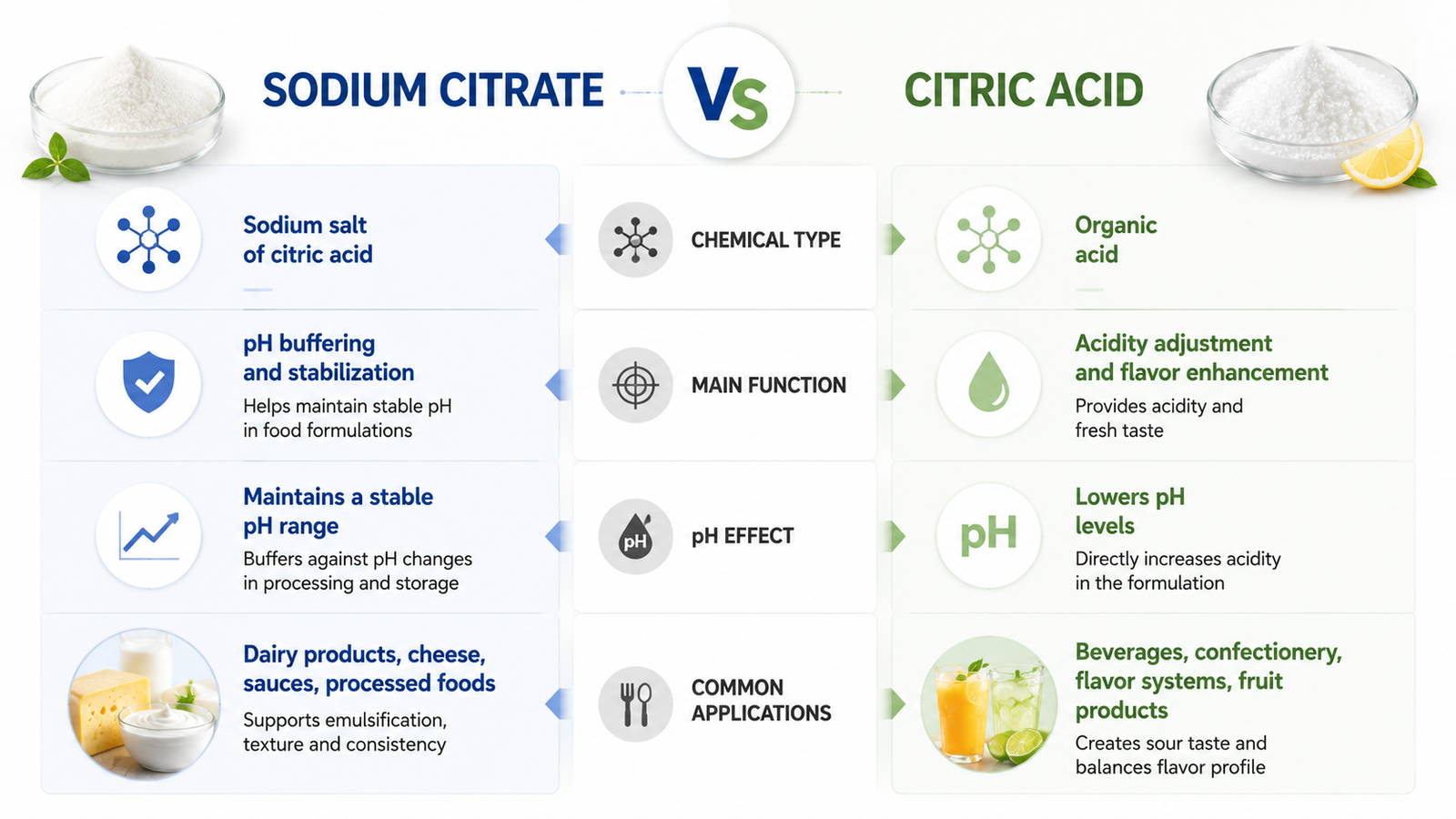
The difference in pH behavior is one of the key reasons manufacturers choose one ingredient over the other. Citric acid directly increases acidity, making it suitable when a lower pH or sour flavor profile is required. For example, beverage manufacturers often use citric acid to create a balanced acidic taste.
Sodium citrate, on the other hand, works as a buffer that helps prevent rapid changes in acidity. This property makes it particularly valuable in formulations where maintaining consistency is important, such as dairy products, cheese processing, and emulsified foods.
In many cases, the choice between citric acid vs sodium citrate depends on the role the ingredient needs to perform. If the goal is stronger acidity adjustment, citric acid may be the better option. If the formulation requires pH stability, improved texture, or buffering capacity, sodium citrate is often more suitable.
Sodium Citrate and Citric Acid Applications in Food Manufacturing
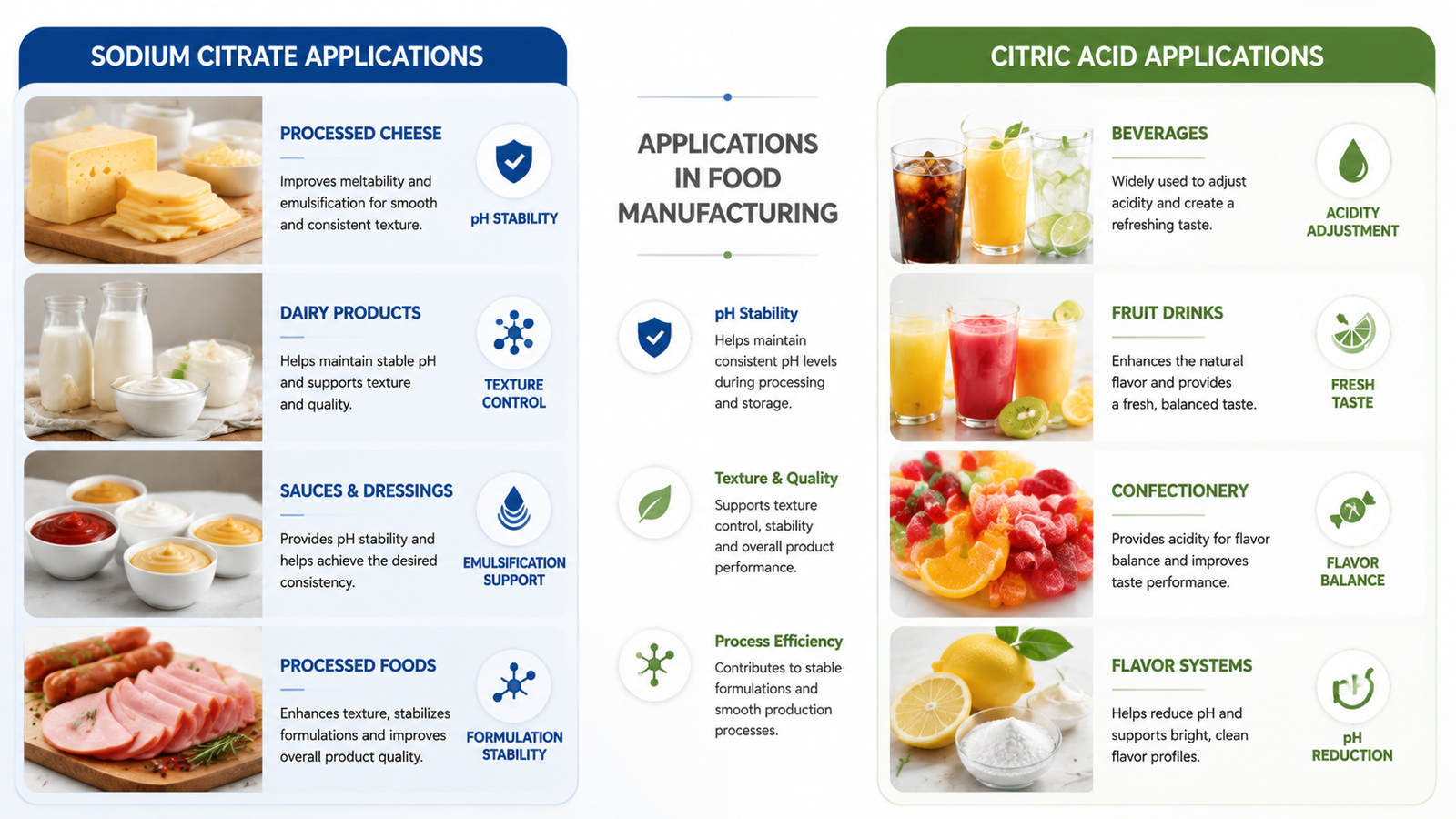
Both sodium citrate and citric acid are widely used in food manufacturing, but their applications are usually based on different functional requirements. Choosing between them depends on whether a manufacturer needs pH buffering, acidity adjustment, flavor control, or formulation stability.
Dairy Products and Cheese Processing
Sodium citrate is one of the most recognized functional ingredients in dairy applications. It is commonly used in processed cheese formulations because it helps improve emulsification, allowing fat and protein components to blend more evenly. This can contribute to a smoother texture and more consistent product quality.
In these applications, manufacturers often choose sodium citrate because its buffering properties help maintain stability during processing, rather than simply increasing acidity.
Beverages and Flavor-Based Products
Citric acid is widely used in beverage manufacturing, including juices, soft drinks, and flavored drinks. Its ability to provide acidity and a fresh sour taste makes it suitable for products where flavor balance is an important consideration.
Compared with sodium citrate, citric acid is typically selected when manufacturers need to lower pH levels or create a more noticeable acidic profile.
Sauces, Processed Foods, and Other Formulations
In sauces and processed food products, both ingredients may be considered depending on the desired outcome. Sodium citrate can support pH stability and texture control, while citric acid can help adjust acidity and improve flavor characteristics.
Understanding the different sodium citrate uses in food allows manufacturers to select ingredients more effectively based on their formulation goals.
How to Choose Between Sodium Citrate and Citric Acid?
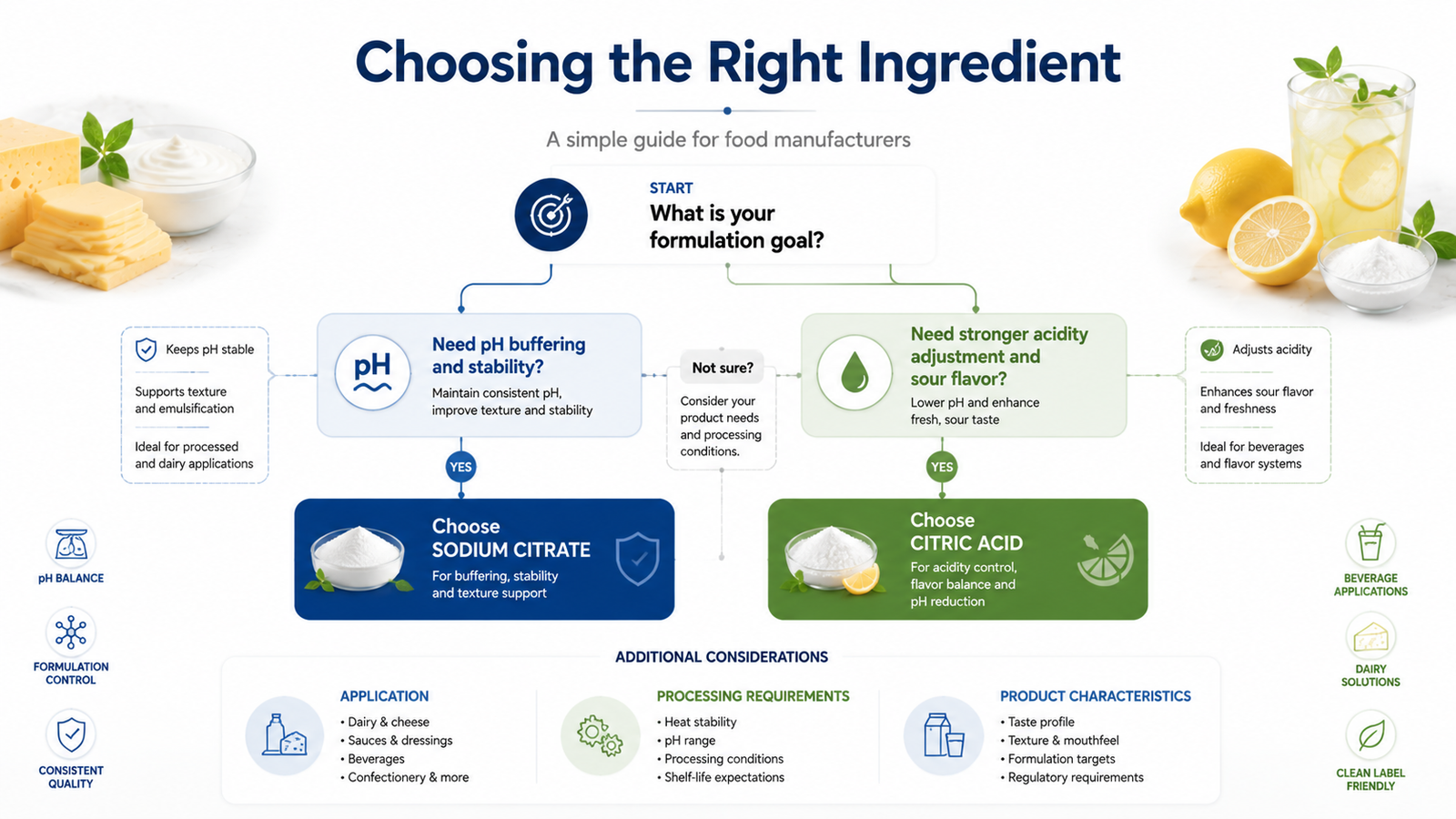
Choosing between sodium citrate and citric acid depends on the specific goals of a food formulation. Instead of considering one ingredient as universally better than the other, manufacturers should evaluate the function they need from the ingredient and how it affects the final product.
Choose Sodium Citrate When pH Stability Is Important
Sodium citrate is often preferred when a formulation requires buffering capacity and better control of pH changes. It is particularly suitable for products where consistency, texture, and processing stability are important.
Manufacturers may consider sodium citrate when:
- Stable pH control is required during processing
- The formulation needs buffering support
- Texture and emulsification are important factors
- The product involves dairy, cheese, sauces, or processed food applications
Choose Citric Acid When Acidity Adjustment Is the Main Goal
Citric acid is generally selected when manufacturers need to increase acidity, create a sour flavor profile, or achieve a lower pH level. It is commonly used in beverages, confectionery products, and formulations where taste balance is a key consideration.
Manufacturers may choose citric acid when:
- Stronger acidity adjustment is needed
- A fresh acidic taste is desired
- Flavor enhancement is part of the product goal
Some manufacturers also search for a sodium citrate alternative when adjusting formulations. However, citric acid is not always a direct replacement for sodium citrate because the two ingredients perform different functions. The best choice depends on the required outcome, processing conditions, and product category.
Choosing a Reliable Sodium Citrate Supplier
Once manufacturers determine that sodium citrate is the right choice for their formulation, selecting a reliable supplier becomes an important part of the sourcing process. Product quality, documentation, and supply consistency can directly influence production efficiency and final product performance.
When evaluating a sodium citrate supplier, food manufacturers should consider several key factors:
- Food grade quality and specifications: The supplier should provide clear product specifications and quality information suitable for food manufacturing applications.
- Certificate of Analysis (COA) availability: Reliable suppliers should be able to provide batch-specific documentation to support quality verification.
- Consistent supply capacity: For manufacturers purchasing in larger quantities, stable production and reliable logistics are essential.
- Packaging and export experience: Suppliers with experience serving international markets can better support different packaging requirements and shipping conditions.
For companies looking to purchase bulk sodium citrate, it is also important to evaluate not only the product itself but the supplier’s ability to provide consistent quality over time.
A reliable ingredient partner should offer transparent communication, proper documentation, and solutions that match the requirements of different food applications. For more information on evaluating suppliers, you can explore our detailed sodium citrate supplier guide.
Frequently Asked Questions
Is sodium citrate the same as citric acid?
No. Sodium citrate and citric acid are related but serve different functions in food manufacturing. Sodium citrate is the sodium salt of citric acid and is mainly used as a buffering agent to help maintain stable pH levels. Citric acid is an organic acid primarily used for acidity adjustment and flavor control.
When comparing sodium citrate vs citric acid, the main difference is their role in a formulation rather than their origin. The choice depends on whether a manufacturer needs pH stability or stronger acidity adjustment.
Can sodium citrate replace citric acid?
Sodium citrate can be used as an alternative to citric acid in some formulations, but it is not always a direct replacement. The two ingredients perform different functions during food processing.
Citric acid is mainly selected when manufacturers need to increase acidity or create a sour taste, while sodium citrate is preferred when buffering capacity and pH control are more important.
Before replacing one ingredient with another, manufacturers should evaluate the formulation requirements, processing conditions, and desired product characteristics.
Which is better for food manufacturing, sodium citrate or citric acid?
Neither ingredient is universally better. The right choice depends on the specific application and manufacturing goals.
Sodium citrate is often preferred for products that require pH stability, emulsification support, or texture control, such as dairy and processed food applications. Citric acid is commonly chosen for beverages and products where acidity adjustment and flavor balance are important.
Food manufacturers should select the ingredient that best matches their formulation needs, product category, and processing requirements.