



- Your cart is empty Browse Shop
Maltodextrin vs Dextrose: Key Differences and How to Choose for Food Manufacturing
Maltodextrin and dextrose may share a starch-based origin, but they perform different jobs in food formulation. Dextrose is generally used when a manufacturer needs sweetness, fermentable glucose or reducing-sugar activity. Maltodextrin is more commonly selected to add solids, carry other ingredients or support body without producing the same level of sweetness.
That difference provides a useful starting point, but it does not make either ingredient universally better. The right choice depends on the finished product. A bakery formulation may require fermentation and controlled color development, while a powdered beverage may place more importance on carrier performance, solubility or sweetness balance. In some products, the two ingredients can be used together because their functions complement one another.
This guide compares their composition, dextrose equivalent, formulation behavior and major food applications. It also provides a practical framework for deciding whether maltodextrin, dextrose or a combination of both is the more suitable option.
For clarity, the dextrose discussion mainly refers to food-grade dextrose monohydrate, a common commercial form used in food manufacturing.Dextrose anhydrous and dextrose monohydrate have different moisture and solids profiles, so changing between the two forms may require a separate formulation adjustment.
What Are Maltodextrin and Dextrose?
Both ingredients can be produced through the controlled hydrolysis of starch from sources such as corn, wheat, potato or tapioca. The main difference is how far the starch is broken down.
Dextrose consists primarily of individual glucose molecules. Maltodextrin contains a distribution of shorter and longer glucose chains. This difference in molecular size helps explain why the two ingredients vary in sweetness, body, fermentation behavior and other processing properties.
What Is Maltodextrin?
Maltodextrin is a water-soluble starch hydrolysate normally supplied as a white powder. Food-grade maltodextrin generally has a dextrose equivalent below 20, although the exact range varies by grade.
Its primary value is functional rather than strongly sweetening. Depending on the grade and use level, it can add dry solids, provide body and act as a carrier for flavors, colors or other ingredients. It is also widely used in powdered and spray-dried systems.
Maltodextrin should not be treated as a single uniform product. Its performance can vary with DE value, raw-material source, particle properties and processing method.
What Is Dextrose?
Dextrose is the commercial name commonly used for D-glucose, a monosaccharide obtained through more complete starch hydrolysis. Dextrose monohydrate contains water within its crystalline structure and is widely used as a food-grade carbohydrate ingredient.
It provides moderate sweetness and functions as a reducing sugar. It can also supply readily fermentable carbohydrate and influence color development, freezing behavior and crystallization in suitable formulations.
These properties distinguish dextrose from maltodextrin, even when both ingredients are derived from the same type of starch. The next section compares those differences directly and explains why DE value is central to understanding their performance.
Maltodextrin vs Dextrose: Key Differences
The difference between maltodextrin and dextrose begins with molecular size, but it extends into nearly every important formulation decision. Dextrose consists mainly of individual glucose molecules, while maltodextrin contains glucose chains of varying lengths. As a result, they contribute different levels of sweetness, body, reducing-sugar activity and osmotic effect.
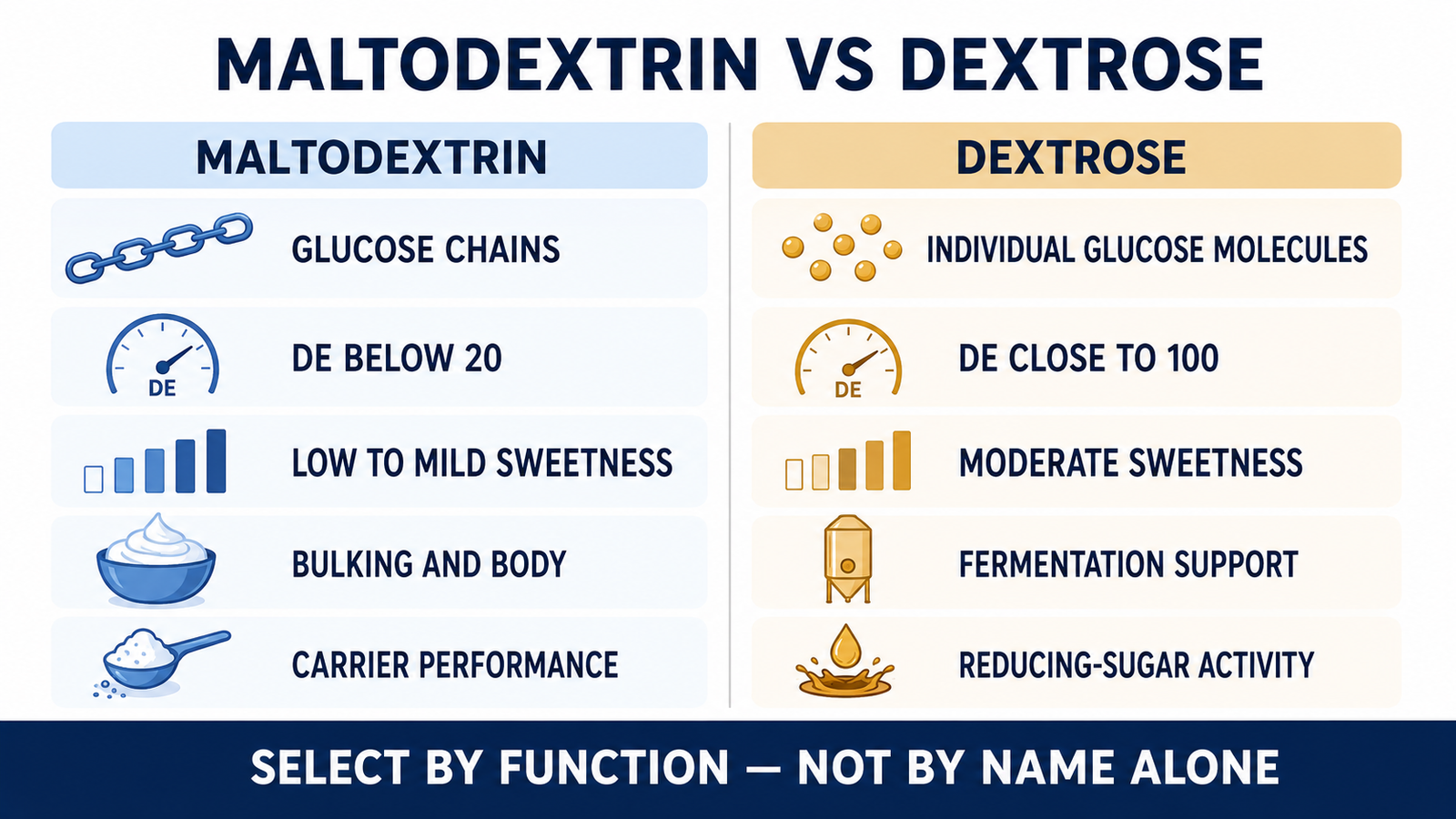
The following comparison summarizes their typical characteristics in food manufacturing. These are general tendencies rather than fixed performance guarantees; results can vary with grade, concentration and the complete formulation.
| Comparison factor | Maltodextrin | Dextrose monohydrate |
|---|---|---|
| Composition | Glucose chains of varying lengths | Primarily individual glucose molecules with crystalline water |
| Typical DE value | Below 20 | Close to 100 on a dry-solids basis |
| Sweetness | Low to mild, depending on grade | Noticeably sweeter, but less sweet than sucrose |
| Main function | Bulking, carrier performance and body | Sweetening, fermentation and reducing-sugar activity |
| Texture contribution | Can add solids and support mouthfeel | Usually contributes less body at a similar use level |
| Browning potential | Generally lower | More active in reducing-sugar browning |
| Fermentation | Depends on chain length and the microorganism | Readily available to yeast and many microorganisms |
| Osmotic effect | Generally lower at equal solids, especially at a lower DE | Generally higher because of the smaller molecular size |
| Common selection factor | DE range and functional grade | Monohydrate or anhydrous form, purity and moisture |
This comparison shows why the two ingredients cannot normally be exchanged on a simple weight-for-weight basis. Replacing dextrose with maltodextrin may reduce sweetness, fermentation performance or browning. Replacing maltodextrin with dextrose may increase sweetness while reducing the body or carrier performance expected from the original formula.
Why Dextrose Equivalent Matters
Dextrose equivalent, or DE, indicates the amount of reducing sugars in a starch hydrolysate relative to dextrose on a dry-solids basis. It provides a practical measure of how extensively the original starch has been broken down.
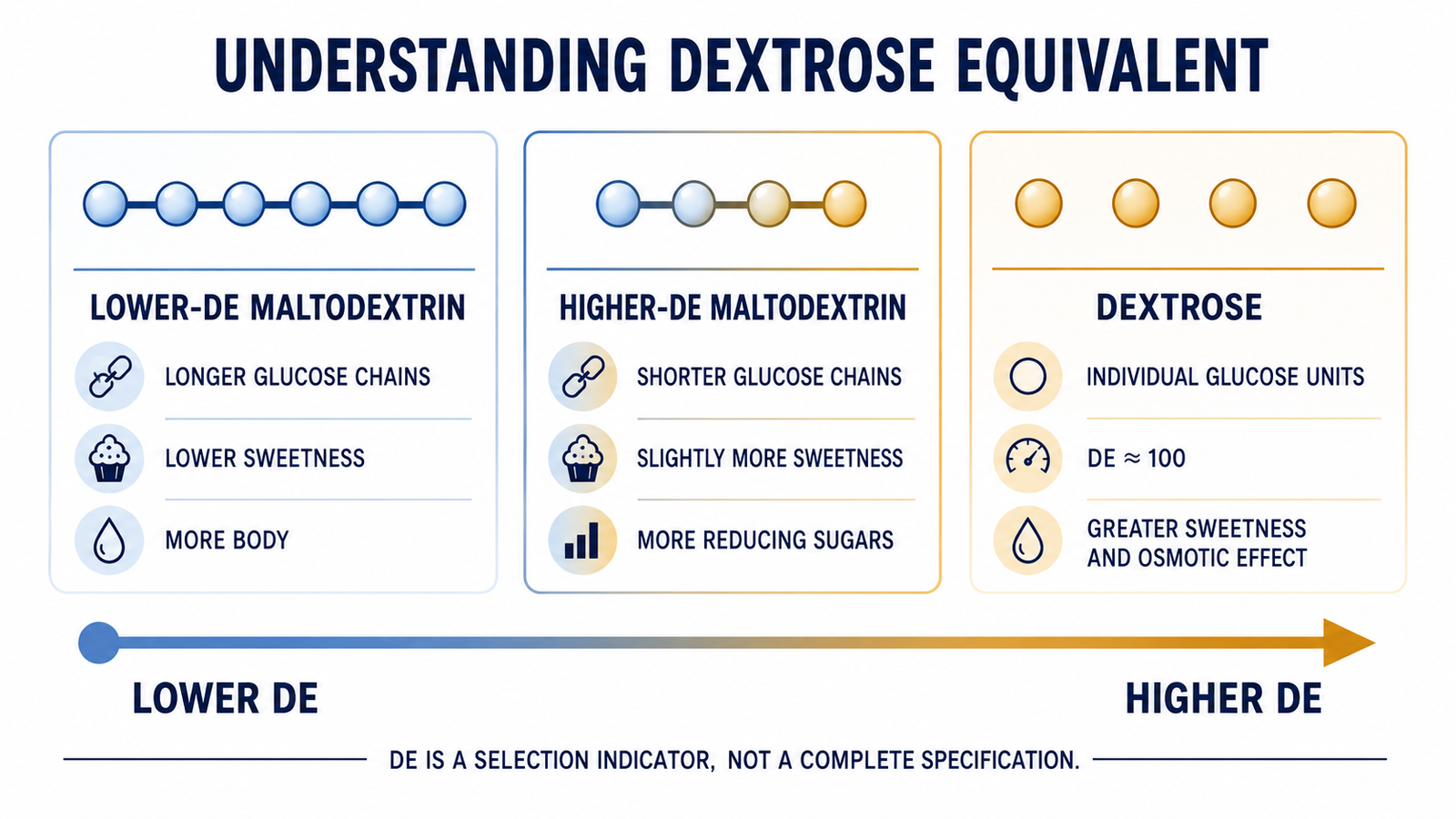
As starch hydrolysis progresses, its carbohydrate chains become shorter and the DE value rises. Food-grade maltodextrin normally has a DE below 20, while dextrose is used as the reference point with a DE close to 100.
Within the maltodextrin category, DE can help predict general performance:
- Lower-DE grades usually provide less sweetness and contain a higher proportion of longer carbohydrate chains.
- Higher-DE grades generally contain more short-chain material and reducing sugars.
- Sweetness, osmotic effect and hygroscopicity may increase as DE rises.
- Body, solubility and powder behavior may also change, although not always in a simple linear pattern.
DE is therefore an important selection parameter, but it is not a complete description of a maltodextrin product. Two grades with the same stated DE can still differ in molecular-weight distribution, botanical source, particle size, bulk density and dispersion behavior.
For manufacturers comparing maltodextrin vs dextrose monohydrate, DE explains the broad structural difference, but it should not be used as the only purchasing criterion. The intended function, full product specification and performance in the finished formulation remain equally important.
Functional Differences in Food Formulation
The functional difference between maltodextrin and dextrose is more important than their shared starch origin. Changing from one to the other can affect several properties at once, so manufacturers should evaluate the complete formulation rather than compare only sweetness or ingredient cost.
Sweetness, Solids and Mouthfeel
Dextrose provides a clean, moderate sweetness. Its perceived intensity varies with concentration, temperature, acidity and the presence of other sweeteners, but it is generally much sweeter than maltodextrin.
Maltodextrin is often selected when a formulation needs additional solids without a similar rise in sweetness. Depending on its DE and use level, it can contribute body and help a beverage, dairy product or reduced-sugar formulation feel less thin.
However, maltodextrin should not automatically be classified as a conventional thickener. Its contribution may be experienced as body or sensory weight rather than a large increase in measured viscosity. If strong thickening or gel formation is required, a starch or hydrocolloid may be more appropriate.
Dextrose also adds solids, but its smaller molecular size generally provides less body at an equivalent weight. Replacing maltodextrin with dextrose can therefore make a product sweeter without preserving the same mouthfeel.
Browning and Fermentation
As a reducing sugar, dextrose can participate readily in Maillard browning when amino compounds are present. This can support desirable color and cooked flavor in bakery and heat-processed products.
The result is not automatic. Browning also depends on temperature, processing time, pH, water activity and the composition of the food. In products where a pale color is required, excessive dextrose may be undesirable.
Maltodextrin generally has lower reducing-sugar activity, although the level increases with DE. It may therefore contribute less browning than dextrose under comparable conditions, but it should not be described as completely non-reactive.
Dextrose is also readily fermentable by yeast and many microorganisms. Maltodextrin utilization is more dependent on chain length and the organism’s enzyme system. Where fermentation is a critical function, substituting maltodextrin for dextrose requires testing rather than assuming equivalent performance.
Moisture, Freezing and Osmotic Behavior
Because dextrose consists of small molecules, it creates more dissolved particles than maltodextrin at the same weight of solids. This gives it a stronger influence on osmotic pressure and freezing-point depression.
That difference is particularly relevant in concentrated beverages and frozen desserts. Dextrose can help soften a frozen product by lowering its freezing point, while maltodextrin can add solids and body without producing the same effect. Exchanging the two may therefore change hardness, scoopability or solution concentration.
Both ingredients can also influence moisture behavior, but neither should be presented as a universal moisture-retention solution. Hygroscopicity and storage stability depend on grade, concentration, surrounding ingredients, packaging and environmental humidity.
Carrier and Powder Performance
Maltodextrin has a distinct role as a carrier ingredient in dry blends and spray-dried systems. It can help distribute flavors, colors or oils, increase powder volume and support more consistent dosing.
Its performance depends on DE, particle properties, carrier-to-active ratio and drying conditions. The term “maltodextrin” alone does not guarantee identical behavior across suppliers or grades.
Dextrose is also suitable for many powdered products, particularly when sweetness and rapid dissolution are required. It does not, however, provide the same carrier or encapsulation performance as maltodextrin in every system.
These functional differences provide the basis for application-specific selection. The next step is to consider which properties matter most in beverages, bakery products, dairy systems and dry food formulations.
Choosing Maltodextrin or Dextrose by Food Application
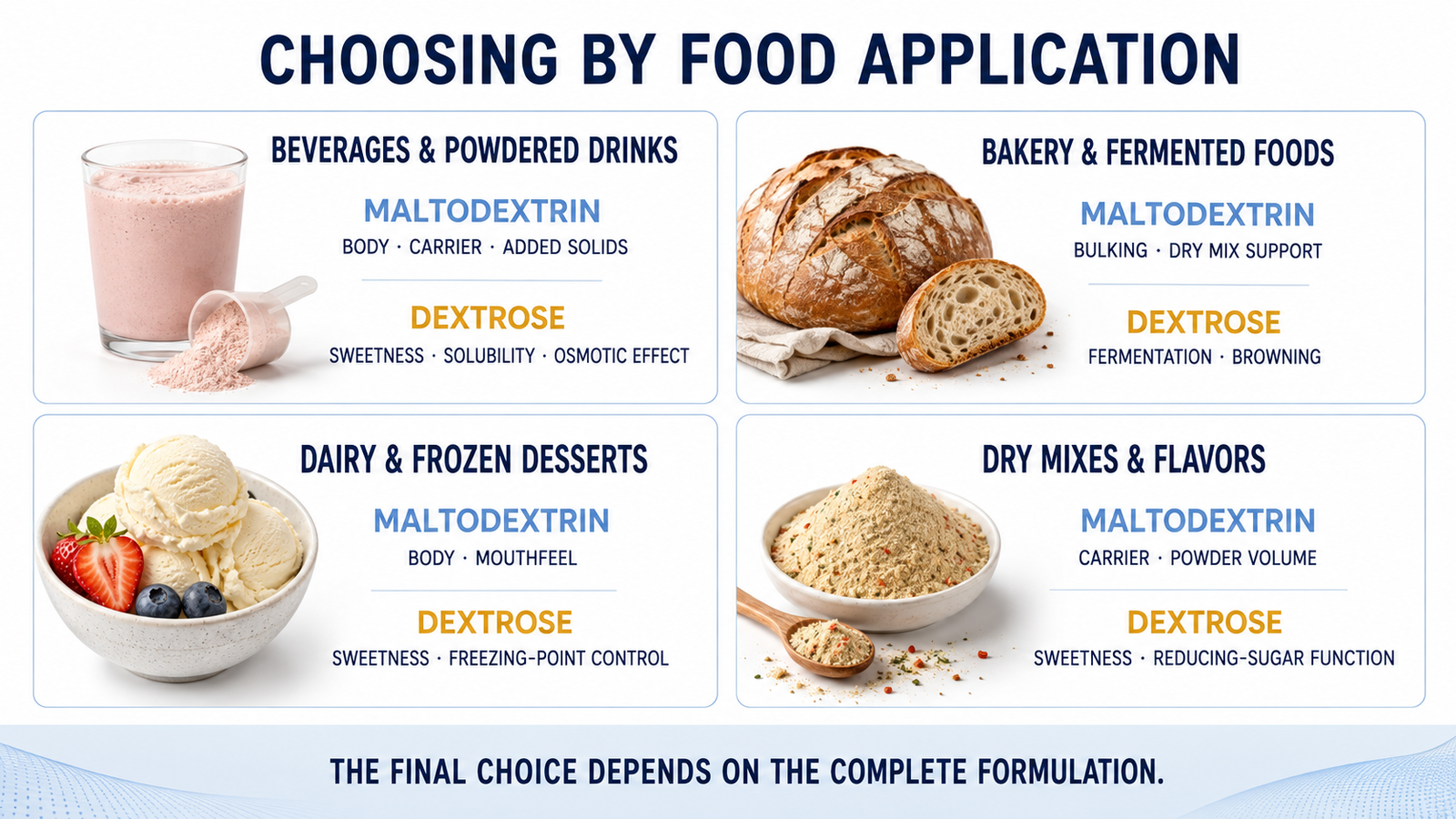
Application category can provide useful direction, but it should not replace formulation analysis. Two products in the same category may have different sweetness, texture and processing requirements. The following comparisons are therefore starting points rather than fixed rules.
Beverages and Powdered Drinks
Dextrose may be appropriate when a beverage requires moderate sweetness, readily available glucose solids or a stronger osmotic contribution. It dissolves readily and can be used alongside other sweeteners to build the desired flavor profile.
Maltodextrin is more relevant when additional solids or body are needed without a comparable increase in sweetness. In powdered drinks, it can also carry flavors and help distribute low-dose ingredients through the dry blend.
Selection should account for clarity, dissolution, sediment and osmolality. A maltodextrin grade that performs well in an opaque nutrition drink may not be suitable for a clear beverage. The finished system should therefore be evaluated rather than judging either ingredient in water alone.
Bakery and Fermented Foods
In yeast-leavened products, dextrose can provide fermentable carbohydrate while also supporting sweetness and crust color. Its contribution depends on yeast activity, fermentation time and the amount of other available sugars.
Maltodextrin may be used to increase solids, support body or assist ingredient distribution in a dry bakery mix. However, it will not necessarily provide the same fermentation rate or browning as dextrose.
A direct substitution may therefore change volume, color and flavor at the same time. The choice should reflect whether fermentation, browning, bulking or texture is the primary objective.
Manufacturers that need a closer examination of bakery, beverage, confectionery and dairy uses can review this guide to dextrose monohydrate in food manufacturing.
Dairy Products and Frozen Desserts
Maltodextrin can contribute body and mouthfeel in dairy beverages, cultured products and desserts, particularly when sugar or fat reduction has removed part of the product’s sensory weight. Its performance still depends on the selected grade and the surrounding protein, fat and stabilizer system.
Dextrose provides sweetness and has a stronger effect on freezing-point depression. This can help manage hardness and scoopability in frozen desserts.
The two ingredients are not equivalent in frozen systems. Replacing dextrose with maltodextrin may produce a firmer product, while the reverse change may soften it more than intended. Any adjustment should consider total solids, sweetness and storage temperature together.
Dry Mixes, Flavors and Processed Foods
Food-grade maltodextrin is widely used in seasonings, instant mixes and spray-dried flavor systems because it can add volume and act as a carrier for concentrated ingredients. In suitable systems, it may also support powder flow and more consistent dosing.
Food-grade dextrose is more likely to be chosen when the dry product requires sweetness, rapid dissolution or reducing-sugar functionality during later heating.
In some processed foods, using both ingredients is more practical than selecting only one. Dextrose can provide the required sweetness or process reaction, while maltodextrin supplies bulk or carrier performance. The ratio should be determined through formulation trials because it affects total solids, moisture sensitivity and the sensory profile of the finished product.
How to Choose Between Maltodextrin and Dextrose
A reliable selection starts with the function required in the finished product. Choosing by ingredient name or price alone can lead to unexpected changes in sweetness, texture and processing performance.
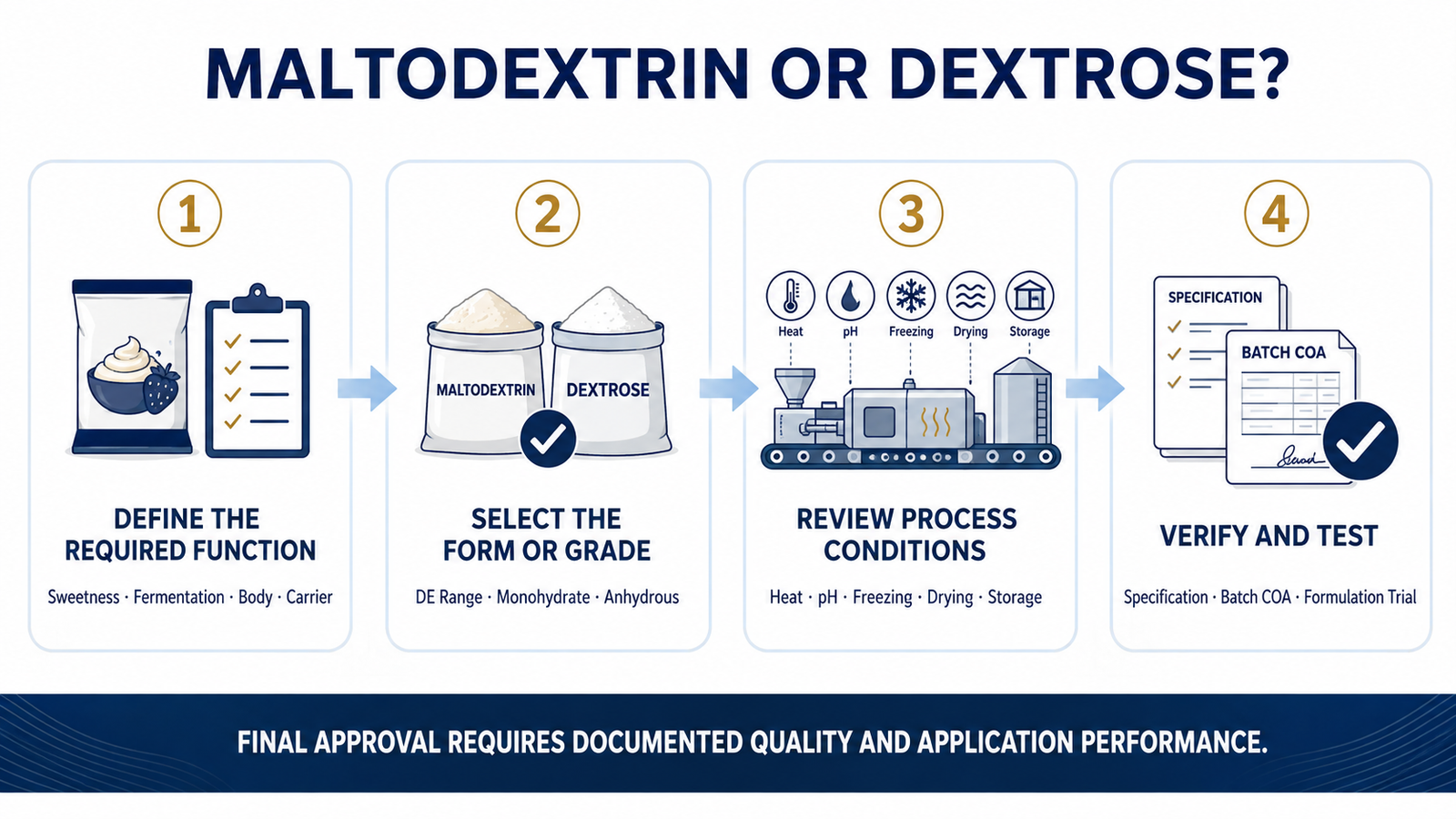
1. Define the Primary Function
Identify the main reason for adding the carbohydrate ingredient.
Dextrose is generally the more relevant starting point when the formulation requires:
- Noticeable sweetness.
- Readily fermentable glucose.
- Reducing-sugar browning.
- Stronger freezing-point or osmotic effects.
Maltodextrin is more likely to suit formulations that require:
- Additional solids with limited sweetness.
- Body and mouthfeel.
- A carrier for flavors or concentrated ingredients.
- Powder bulking and handling support.
Where several functions are equally important, using both may be more effective than expecting one ingredient to perform every role.
If the primary requirement is heat-developed viscosity, binding, or starch-based structure, neither ingredient should automatically be treated as a substitute for corn starch. Our guide to corn starch in food manufacturing explains its functions, application areas, and key processing considerations.
2. Select the Appropriate Form or Grade
For maltodextrin, DE value is an important screening parameter, but buyers should also review source, moisture, solubility, bulk density and particle characteristics. Products with similar DE values may still behave differently during mixing or storage.
For dextrose, manufacturers should confirm whether the material is monohydrate or anhydrous. These forms do not provide the same amount of dextrose solids on an equal-weight basis. Purity, moisture, particle size and dissolution behavior may also affect production.
3. Consider Processing and Storage Conditions
Ingredient performance should be evaluated against the actual process, including heat treatment, pH, fermentation, freezing, spray drying and storage humidity.
For example, dextrose may increase browning during heating, while an unsuitable maltodextrin grade may create dispersion or powder-handling problems. Packaging also matters because moisture exposure can affect caking, flowability and shelf stability.
4. Verify Documentation and Trial Performance
The supplier’s product specification and Certificate of Analysis should be reviewed before approval. Relevant information may include DE value, dextrose content, moisture, pH, microbiological limits, and other application-specific parameters.
The COA confirms reported results for one batch; it does not replace the product specification or practical testing.
Final approval should be based on trials under representative processing and storage conditions. Testing should focus on the properties that drove the selection, such as sweetness, color, fermentation rate, body, dissolution, powder flow or frozen texture. For critical formulations, more than one production batch should be evaluated to confirm consistent performance.
Frequently Asked Questions
Is Maltodextrin the Same as Dextrose?
No. Both can be produced from starch, but their molecular structures are different. Dextrose consists primarily of individual glucose molecules, while maltodextrin contains glucose chains of varying lengths. This difference affects sweetness, body, fermentation, browning and osmotic behavior, so the two should not be treated as identical ingredients.
Is Dextrose Monohydrate the Same as Dextrose?
Dextrose is the general commercial name for D-glucose. Dextrose monohydrate is a crystalline form that contains water within its structure; dextrose anhydrous contains little or no bound water. Both provide glucose functionality, but they supply different amounts of dry dextrose solids at the same weight.
Can Maltodextrin Replace Dextrose?
Not as a universal one-to-one replacement. Substituting maltodextrin for dextrose may reduce sweetness, browning, fermentation and freezing-point depression while increasing body. The feasibility of replacement depends on the original function of dextrose and should be confirmed through formulation trials.
The same applies in reverse: dextrose cannot always reproduce maltodextrin’s bulking or carrier performance.
Can Maltodextrin and Dextrose Be Used Together?
Yes. Their functions can be complementary. Dextrose may provide sweetness, fermentation support or reducing-sugar activity, while maltodextrin contributes bulk, body or carrier performance.
The appropriate ratio depends on the product because combining them changes total solids, sweetness, moisture behavior and processing performance. There is no universal proportion suitable for every formulation.
Conclusion
The difference between maltodextrin and dextrose goes beyond sweetness. Dextrose consists mainly of individual glucose molecules and is commonly selected for sweetening, fermentation, browning and freezing-point control. Maltodextrin contains glucose chains and is generally more useful for bulking, carrier applications and adding body with limited sweetness.
Neither ingredient is universally better, and they are not normally interchangeable by equal weight. The correct choice depends on the required function, selected grade, processing conditions and finished-product target.
Food manufacturers should use DE value and product form as initial screening tools, then review the full specification and batch COA. Final approval should be based on representative application trials and consistent performance across commercial batches.