



- Your cart is empty Browse Shop
Citric Acid in Beverage Manufacturing: Functions, Applications and Selection Guide
Introduction
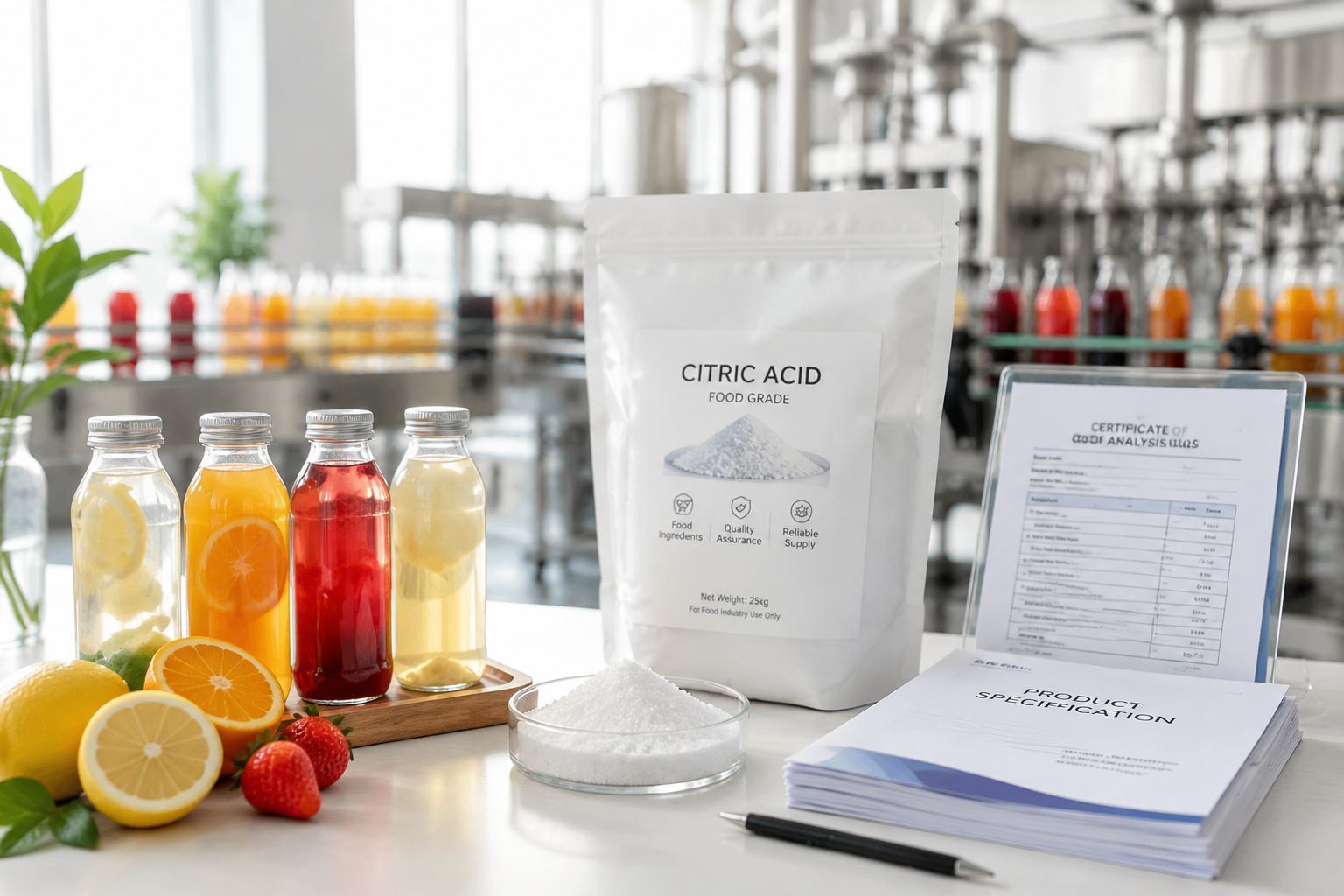
In beverage manufacturing, citric acid is widely used as more than just an acidulant for adding sourness. For many beverage producers, it plays an important role in balancing flavor, controlling acidity, and maintaining product consistency during processing and storage.
However, selecting the right citric acid for beverage production requires more than simply choosing a food-grade ingredient. Factors such as acid strength, moisture content, product specifications, and supplier reliability can all influence the final formulation.
This guide explains the key functions of citric acid in beverage manufacturing, common application areas, and important considerations when choosing the right ingredient for beverage production.
Why Is Citric Acid Used in Beverage Production?
Citric acid has become one of the most common ingredients used in beverage formulations because it provides multiple functions within a single ingredient.
For beverage manufacturers, its value is not limited to creating acidity. It also helps improve flavor balance, support formulation stability, and maintain consistency across different production batches.
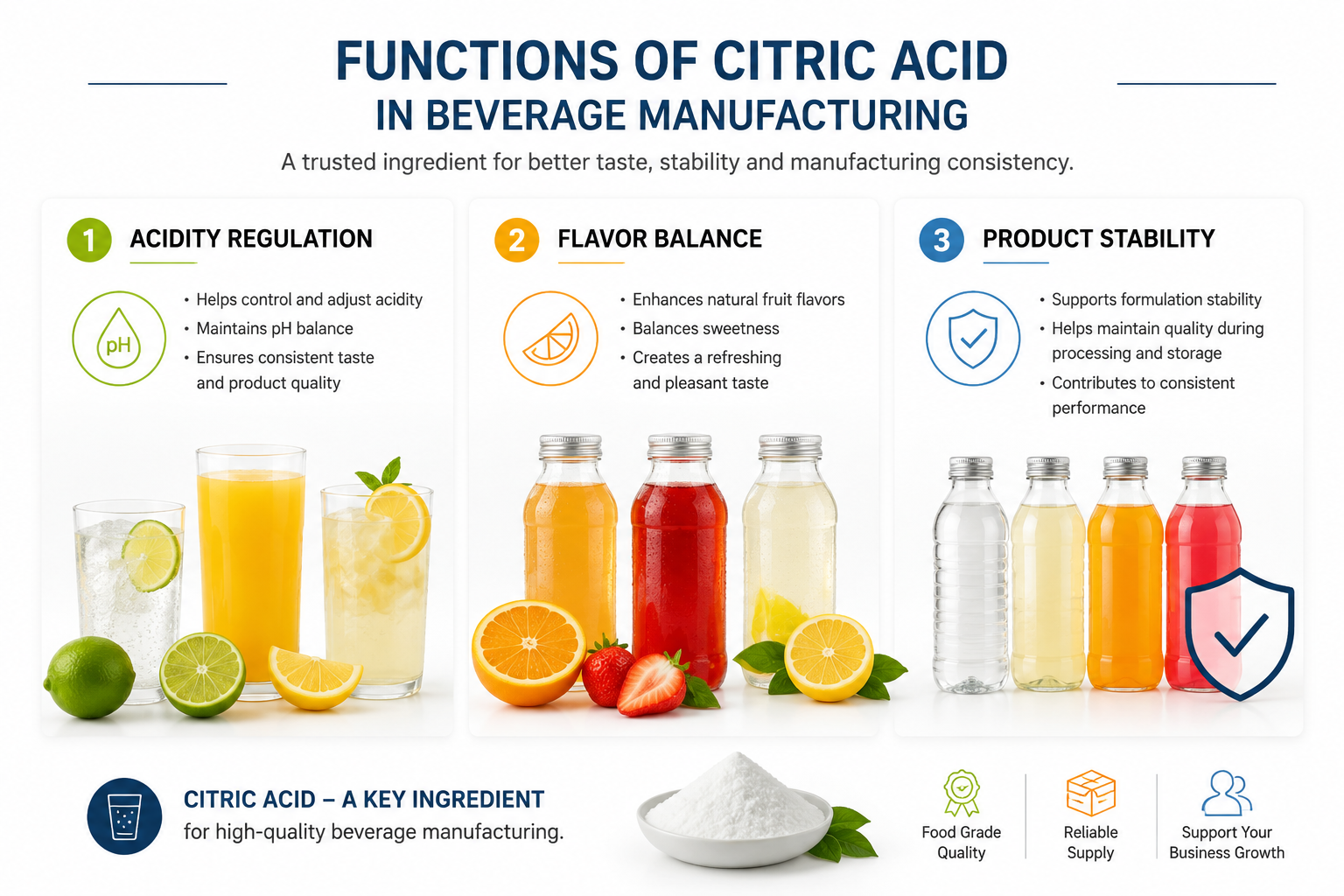
Acidity Regulation and pH Control
One of the primary reasons manufacturers use citric acid in beverages is to regulate acidity levels.
The acidity of a beverage directly affects its taste, freshness, and overall consumer experience. By adjusting pH levels, citric acid allows producers to create a more balanced flavor profile and maintain consistency between production batches.
For example, fruit-based beverages often require controlled acidity to achieve a taste closer to natural fruit flavors, while soft drinks may use citric acid to provide a clean and refreshing acidic note.
For beverage manufacturers, accurate acidity control is especially important because small changes in pH can affect:
- Flavor perception
- Product stability
- Processing consistency
Using properly specified food-grade citric acid helps manufacturers maintain predictable results during large-scale production.
Flavor Enhancement and Taste Balance
Besides acidity adjustment, citric acid also plays an important role in flavor development.
In many beverages, sweetness from sugar or sweeteners needs to be balanced with acidity. Without sufficient acidity, drinks can taste overly sweet or lack freshness.
Citric acid helps create a brighter and cleaner taste by:
- Enhancing fruit flavors
- Balancing sweetness
- Improving overall taste perception
This is why citric acid is commonly found in fruit drinks, flavored beverages, sports drinks, and other products where a refreshing taste profile is required.
Supporting Product Stability
Consistency is a major concern for beverage manufacturers, especially when producing products at commercial scale.
Citric acid can contribute to formulation stability by helping maintain consistent acidity throughout production and storage. A stable acid profile helps ensure that each batch delivers a similar taste and quality experience.
When selecting citric acid for beverage applications, manufacturers usually consider factors such as:
- Purity level
- Moisture content
- Solubility
- Documentation support, including COA
These specifications help ensure the ingredient performs reliably in different beverage formulations.
Common Beverage Applications of Citric Acid
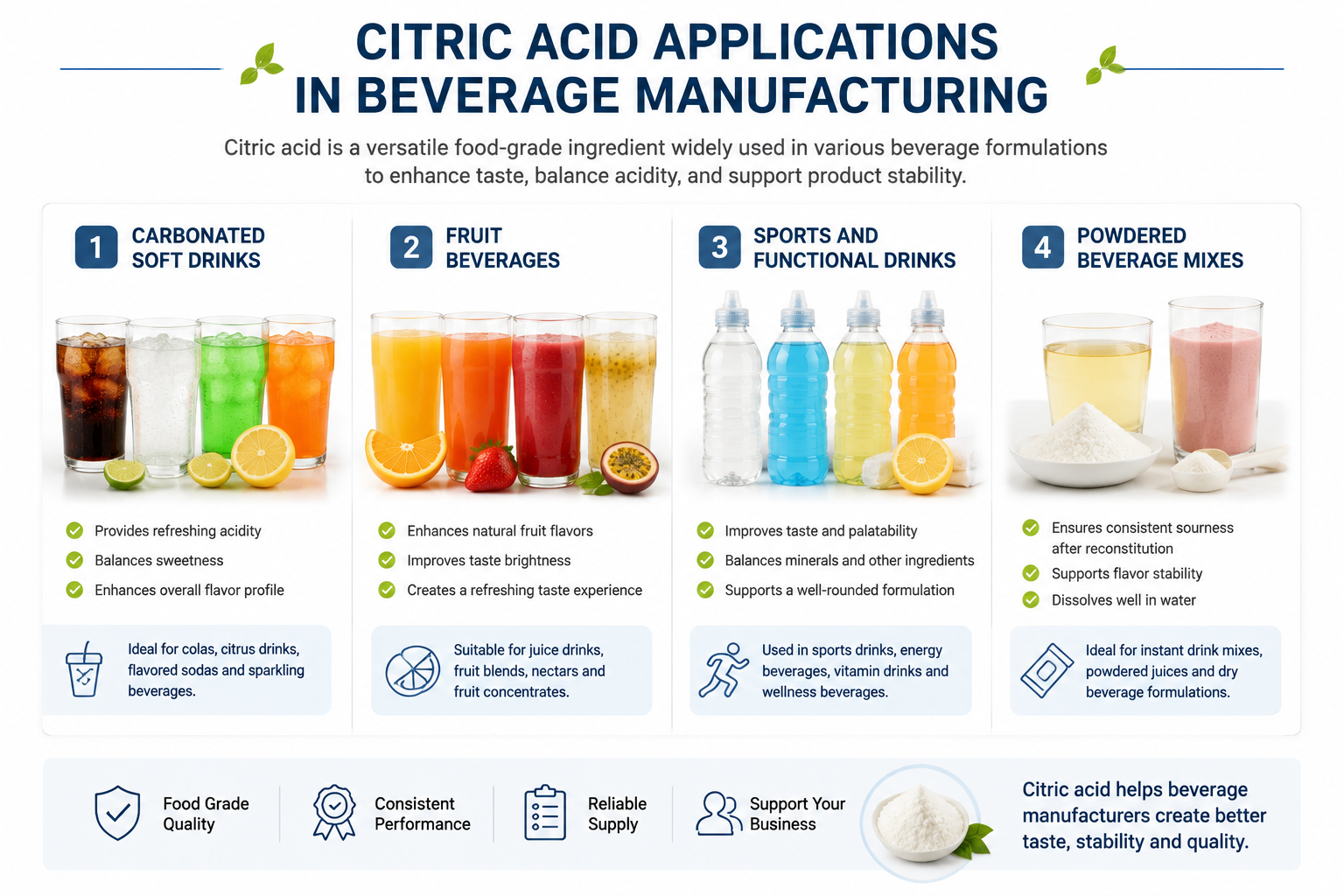
Citric acid is used across a wide range of beverage categories because it provides a reliable way to control acidity and improve flavor balance.
Although different beverage products have different formulation goals, manufacturers usually select citric acid based on factors such as desired acidity level, processing requirements, and final product characteristics.
The following are some of the most common beverage applications.
Citric Acid in Carbonated Soft Drinks
Carbonated soft drinks are one of the most common applications for citric acid in the beverage industry.
In these products, citric acid helps create a refreshing acidic taste that balances sweetness from sugar or sweeteners. It also contributes to the clean, sharp flavor profile that consumers expect from many flavored carbonated beverages.
For soft drink manufacturers, citric acid is often used to support:
- Acidity adjustment
- Flavor enhancement
- Taste consistency between batches
Compared with some other acidulants, citric acid provides a mild and familiar acidic profile, making it suitable for a wide range of flavored beverages.
When selecting citric acid for soft drinks, manufacturers typically pay attention to:
- Food-grade compliance
- Consistent acidity performance
- Reliable supply quality
These factors help ensure stable production results, especially for large-volume beverage manufacturing.
Citric Acid in Fruit-Based Beverages
Fruit beverages are another major application area for citric acid.
Many fruits naturally contain citric acid, so adding food-grade citric acid during beverage production can help maintain or enhance the natural acidic characteristics of fruit flavors.
In juice drinks, fruit-flavored beverages, and fruit concentrates, citric acid is commonly used to:
- Improve flavor brightness
- Balance sweetness
- Create a more refreshing taste
For manufacturers, maintaining the right acidity level is important because excessive acidity can negatively affect taste, while insufficient acidity may result in a flat or overly sweet flavor profile.
Therefore, precise control of citric acid levels is an important part of beverage formulation.
Citric Acid in Sports and Functional Beverages
The growing demand for functional and wellness-oriented beverages has expanded the use of citric acid in sports drinks and other specialty beverage categories.
In these products, citric acid is mainly used to improve taste and support a balanced formulation.
Many functional beverages contain ingredients such as minerals, vitamins, or botanical extracts, which can create strong or unusual flavors. Citric acid helps manufacturers create a more pleasant overall taste experience by balancing these flavor characteristics.
Common applications include:
- Sports hydration drinks
- Energy beverages
- Vitamin-enriched drinks
- Functional beverage products
For these formulations, ingredient compatibility and consistent quality are especially important because multiple ingredients must work together within the final product system.
Citric Acid in Powdered Beverage Products
Citric acid is also widely used in powdered beverage formulations, including instant drink mixes and dry beverage products.
Unlike ready-to-drink beverages, powdered products require ingredients that can maintain stability during storage and dissolve effectively during preparation.
In these applications, citric acid can help provide:
- Consistent sourness after reconstitution
- Balanced flavor performance
- Reliable formulation results
Manufacturers producing powdered beverages often evaluate factors such as particle characteristics, moisture content, and solubility when selecting citric acid.
Choosing a suitable citric acid specification helps ensure the final product performs consistently from production to consumer use.
Key Considerations Across Beverage Applications
Although citric acid is used in many beverage categories, the required specifications may vary depending on the formulation.
A beverage manufacturer producing carbonated drinks may focus more on acidity consistency and flavor balance, while a powdered beverage producer may place greater importance on moisture control and solubility.
Therefore, selecting the right citric acid is not only about choosing a food-grade ingredient, but also about matching the ingredient specifications with the specific production requirements.
Choosing the Right Citric Acid Type for Beverage Manufacturing
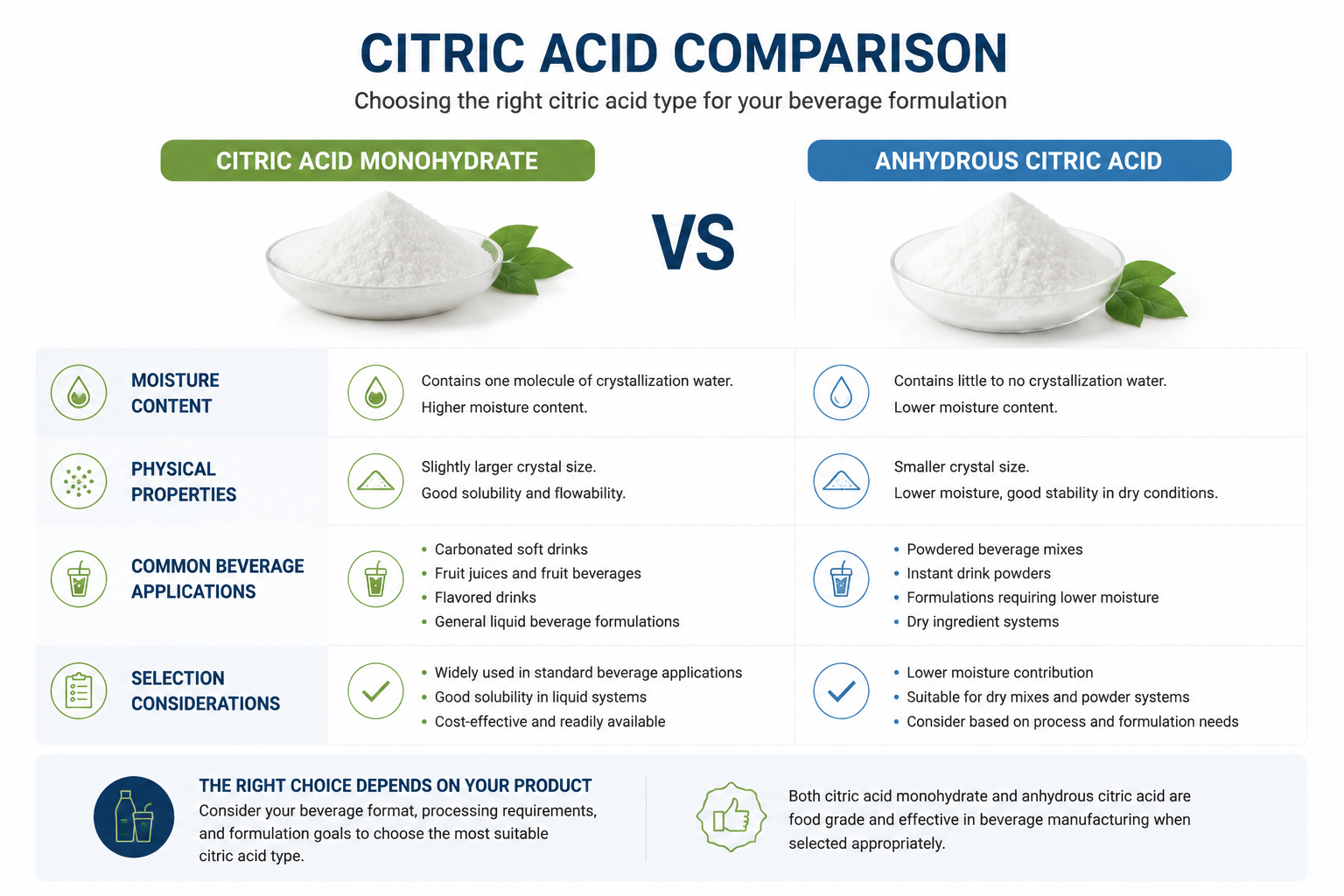
For beverage manufacturers, choosing the right type of citric acid is an important part of product formulation.
Although citric acid monohydrate and anhydrous citric acid share the same basic chemical function, their physical characteristics are different. These differences can affect moisture content, handling properties, and suitability for specific beverage applications.
Understanding these differences helps manufacturers select the ingredient that best matches their production requirements.
Citric Acid Monohydrate for Beverage Applications
Citric acid monohydrate is one of the most commonly used forms of citric acid in food and beverage manufacturing.
It contains one molecule of crystallization water, which gives it slightly different physical properties compared with anhydrous citric acid.
In beverage production, citric acid monohydrate is widely used because it provides:
- Reliable acidity adjustment
- Good solubility in liquid formulations
- Stable performance in standard beverage applications
It is commonly found in products such as:
- Fruit beverages
- Flavored drinks
- Carbonated beverages
- Powdered drink mixes
For many beverage manufacturers, citric acid monohydrate is a practical choice due to its availability, consistent quality, and suitability for general beverage formulations.
Anhydrous Citric Acid for Beverage Applications
Anhydrous citric acid is a form of citric acid that contains little to no crystallization water.
Compared with citric acid monohydrate, it has a lower moisture content, which can make it suitable for applications where moisture control is an important consideration.
In beverage manufacturing, anhydrous citric acid may be considered for formulations that require:
- Lower moisture contribution
- Specific processing requirements
- Improved control over dry ingredient systems
It is often used in dry beverage products, powdered mixes, and applications where ingredient handling characteristics are particularly important.
However, the choice between anhydrous and monohydrate citric acid should be based on the complete formulation requirements rather than simply selecting the product with the highest purity.
How Beverage Manufacturers Choose Between Monohydrate and Anhydrous Citric Acid
When selecting a citric acid type, manufacturers usually evaluate several factors:
1. Product Format
The physical form of the final beverage product is an important consideration.
For ready-to-drink beverages, solubility and consistent dissolution are often key factors.
For powdered beverages, moisture content and storage stability may receive more attention.
2. Processing Requirements
Different production processes may require different ingredient characteristics.
Manufacturers should consider:
- Mixing conditions
- Storage environment
- Processing temperature
- Ingredient compatibility
These factors help determine which citric acid type performs best within the formulation.
3. Quality Documentation and Supply Consistency
Beyond product type, reliable quality documentation is essential for beverage production.
Professional beverage manufacturers typically evaluate:
- Product specifications
- Certificate of Analysis (COA)
- Batch-to-batch consistency
- Supplier quality management
A stable supply of consistent ingredients helps reduce production variation and supports long-term manufacturing reliability.
For a detailed comparison of the differences between these two forms, manufacturers can refer to:
Citric Acid Monohydrate vs Anhydrous: Differences, Applications and How to Choose
Quality Requirements for Beverage Grade Citric Acid
For beverage manufacturers, ingredient quality directly affects product consistency, production efficiency, and final product performance.
While citric acid is a widely used food ingredient, not all specifications are equally suitable for every beverage application. Manufacturers typically evaluate several quality factors to ensure the ingredient meets their formulation and processing requirements.
Selecting a reliable food-grade citric acid supplier requires attention to both product specifications and quality documentation.
Key Quality Factors for Beverage Grade Citric Acid
Purity and Food Grade Compliance
Purity is one of the most important factors when selecting citric acid for beverage production.
Food-grade citric acid should meet relevant food safety requirements and maintain consistent quality across different production batches.
For beverage manufacturers, high-quality citric acid helps ensure:
- Stable acidity performance
- Predictable flavor adjustment
- Reliable production results
In addition to purity, manufacturers often review supplier documentation to confirm that the product meets required food-grade standards.
Moisture Content and Physical Properties
Moisture content is another important consideration, especially for manufacturers producing powdered beverages or dry mixes.
Different citric acid forms have different moisture characteristics, which may influence:
- Storage stability
- Handling performance
- Processing requirements
For liquid beverages, solubility and dissolution speed may be more critical, while dry beverage manufacturers may pay closer attention to moisture control.
Choosing the right specification helps prevent unnecessary formulation adjustments during production.
Solubility and Processing Performance
Citric acid needs to dissolve effectively during beverage processing to ensure uniform distribution throughout the product.
Good solubility supports:
- Consistent acidity levels
- Efficient mixing processes
- Stable beverage formulations
This is particularly important for large-scale beverage production, where small variations can affect the quality of the final product.
Manufacturers should consider whether the citric acid specification matches their production process, including mixing conditions and formulation requirements.
Certificate of Analysis (COA) and Quality Documentation
For professional beverage manufacturers, product documentation is an essential part of supplier evaluation.
A complete Certificate of Analysis (COA) provides important information about each batch, including:
- Product specifications
- Testing results
- Quality parameters
- Batch information
Reliable documentation allows manufacturers to verify ingredient consistency and maintain quality control throughout production.
Beyond COA, many buyers also review:
- Product specification sheets
- Quality certificates
- Supplier quality systems
These documents provide greater confidence when establishing long-term ingredient supply relationships.
Why Quality Consistency Matters in Beverage Manufacturing
In beverage production, consistency is just as important as ingredient functionality.
A supplier may provide citric acid that meets basic requirements, but variations between batches can create challenges during large-scale manufacturing.
Consistent ingredient quality helps manufacturers:
- Maintain the same taste profile
- Reduce production adjustments
- Improve supply reliability
- Support long-term product stability
For this reason, experienced beverage producers usually evaluate not only the ingredient itself but also the supplier’s quality control capability.
For a more detailed evaluation process, beverage manufacturers can refer to:
How to Evaluate Food Grade Citric Acid Quality Before Purchasing
How Beverage Manufacturers Select a Reliable Citric Acid Supplier
Choosing the right citric acid supplier is an important decision for beverage manufacturers, especially for companies that rely on consistent ingredient quality and stable production schedules.
While product specifications are essential, a reliable supplier should provide more than just the ingredient itself. Factors such as quality control, documentation support, supply capability, and communication efficiency all influence long-term cooperation.
For beverage producers, supplier evaluation should focus on whether the supplier can consistently meet production requirements rather than simply offering the lowest price.
Key Factors When Choosing a Citric Acid Supplier
Product Quality and Specification Consistency
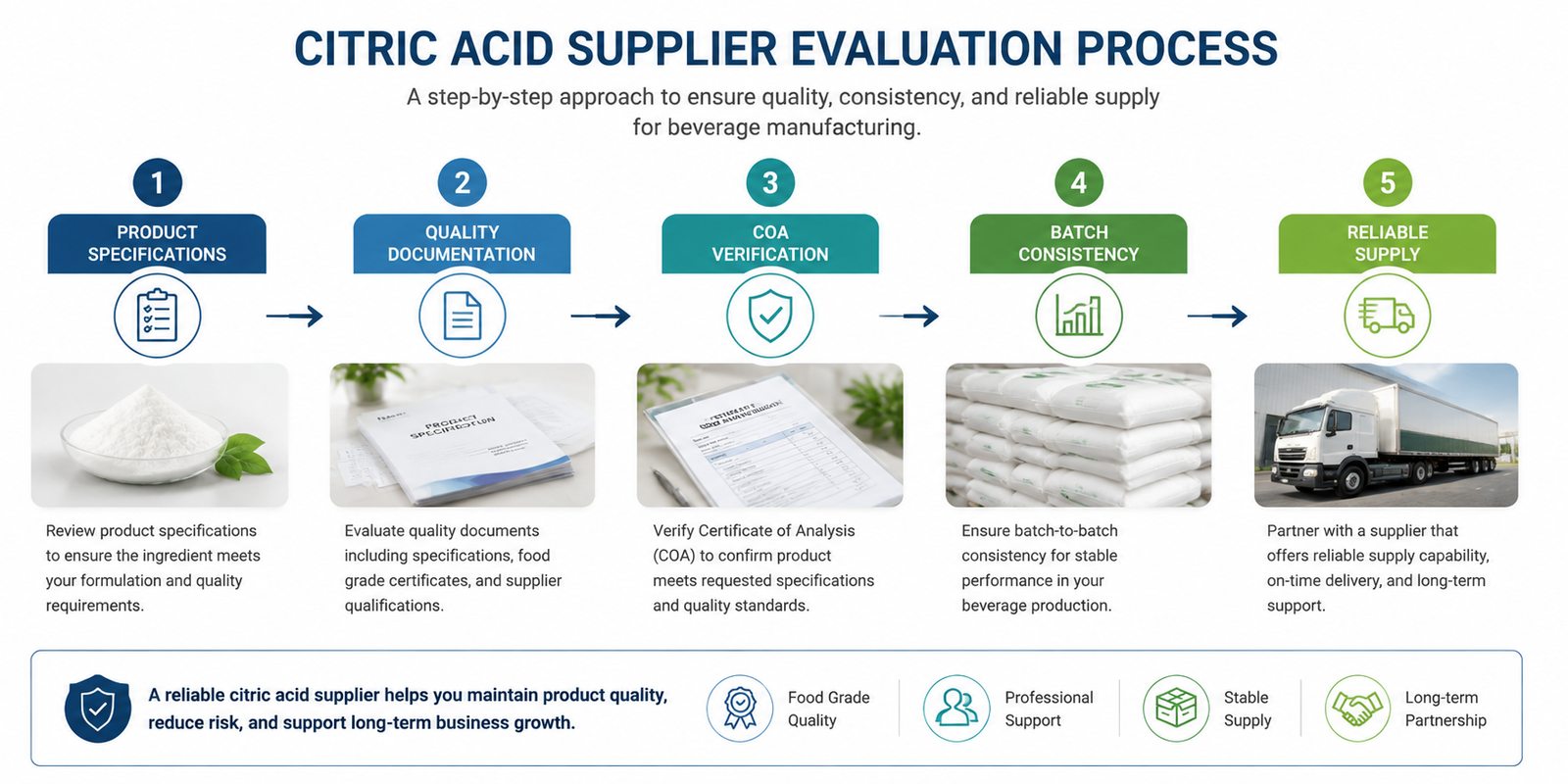
The first consideration when evaluating a citric acid supplier is whether the product quality remains consistent from batch to batch.
For beverage production, even small variations in ingredient characteristics may affect:
- Acidity adjustment
- Flavor balance
- Production efficiency
A professional supplier should provide clear product specifications and ensure that delivered products match the agreed quality standards.
Important specifications may include:
- Purity level
- Moisture content
- Appearance
- Solubility
- Food-grade compliance
Consistent product quality helps beverage manufacturers reduce formulation adjustments and maintain stable production.
Quality Documentation and Transparency
Reliable documentation is a key part of professional ingredient sourcing.
For beverage manufacturers, suppliers should be able to provide supporting documents such as:
- Certificate of Analysis (COA)
- Product specification sheets
- Quality-related documentation
These materials allow buyers to verify product information and support their internal quality control processes.
A transparent supplier relationship also makes communication easier when manufacturers need specific product requirements or technical information.
Supply Capability and Delivery Reliability
Ingredient supply stability is another important factor for beverage manufacturers.
Production delays caused by ingredient shortages can affect manufacturing schedules and customer deliveries.
When selecting a supplier, companies often consider:
- Production capacity
- Inventory availability
- Packaging options
- Shipping capability
A supplier with reliable supply management can better support long-term production planning.
Communication and Technical Support
Beyond product quality and supply capability, communication efficiency also plays an important role in supplier selection.
During product development or large-scale production, manufacturers may need support regarding:
- Product specifications
- Application requirements
- Packaging details
- Order planning
A responsive supplier can help solve issues faster and create a smoother cooperation process.
Building a Long-Term Partnership with a Citric Acid Supplier
For beverage manufacturers, sourcing citric acid is not only a purchasing decision but also part of maintaining consistent product quality.
A strong supplier partnership is built on:
- Stable product performance
- Reliable documentation
- Consistent supply
- Clear communication
By evaluating suppliers based on these factors, beverage producers can reduce sourcing risks and establish a more reliable ingredient supply chain.
For more information about evaluating citric acid suppliers, manufacturers can refer to:
How to Choose a Reliable Citric Acid Supplier for Food Manufacturing
Frequently Asked Questions About Citric Acid in Beverage Manufacturing
Why is citric acid used in beverage production?
Citric acid is commonly used in beverage manufacturing to regulate acidity, balance flavors, and improve overall taste consistency.
In products such as soft drinks, fruit beverages, and functional drinks, citric acid helps create a refreshing acidic profile while balancing sweetness from sugars or other sweeteners.
For manufacturers, its main value is not only flavor improvement but also providing predictable acidity control during large-scale production.
Can citric acid be used in soft drinks?
Yes. Citric acid is widely used in soft drink formulations as an acidity regulator and flavor-enhancing ingredient.
It helps create the characteristic refreshing taste found in many flavored carbonated beverages and supports a balanced relationship between sweetness and acidity.
When selecting citric acid for soft drinks, manufacturers typically consider factors such as food-grade compliance, purity, solubility, and batch consistency.
What type of citric acid is suitable for beverage manufacturing?
Both citric acid monohydrate and anhydrous citric acid can be used in beverage applications, but the suitable choice depends on the specific formulation and production requirements.
Citric acid monohydrate is commonly used in many standard beverage applications due to its reliable performance and availability.
Anhydrous citric acid may be preferred in certain applications where lower moisture content or specific processing characteristics are required.
Manufacturers should evaluate factors such as beverage format, processing conditions, and ingredient specifications before making a selection.
Conclusion
Citric acid plays an important role in modern beverage manufacturing, supporting not only acidity adjustment but also flavor balance, formulation consistency, and product quality.
From carbonated drinks and fruit beverages to functional drinks and powdered formulations, the right citric acid specification can help manufacturers achieve reliable production results.
However, choosing the right ingredient requires more than selecting a food-grade product. Beverage producers should also consider quality documentation, supplier reliability, and long-term supply capability.
By working with a dependable citric acid supplier and selecting the appropriate product specifications, manufacturers can build more stable and efficient beverage production processes.