



- Your cart is empty Browse Shop
Sodium Citrate in Dairy Applications: Functions, Benefits and Food Manufacturing Uses
Introduction
The dairy industry requires precise control over product texture, stability, and processing performance. From processed cheese to dairy-based sauces and beverages, manufacturers need ingredients that can help maintain consistent quality throughout production and storage.
Sodium citrate is widely used in dairy applications because of its functional properties, especially in products where protein stability and texture control are important. As a food-grade ingredient, sodium citrate can help improve emulsification, support formulation stability, and enhance processing performance in various dairy systems.
In modern dairy manufacturing, selecting the right ingredient is not only about meeting formulation requirements but also about achieving reliable production results at scale. Understanding how sodium citrate works in dairy processing can help manufacturers make better decisions when developing and optimizing dairy products.Manufacturers can also review the broader sodium citrate uses in food industry when comparing dairy applications with beverages and other processed foods.
This article explores the main applications of sodium citrate in dairy products, its key functions in food manufacturing, and the factors manufacturers should consider when selecting a suitable sodium citrate ingredient.
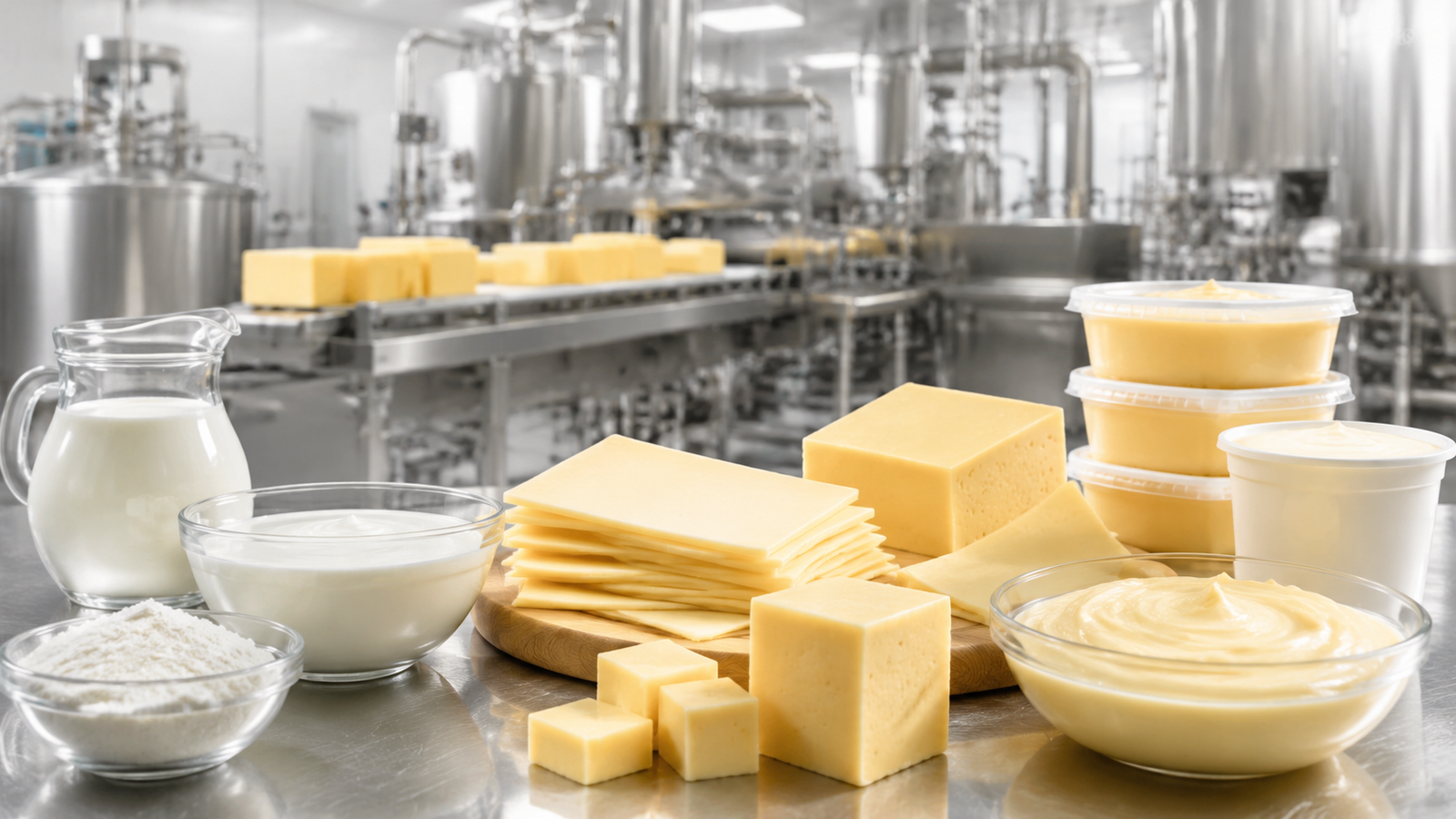
Why Is Sodium Citrate Used in Dairy Applications?
Dairy products are complex food systems where proteins, fats, minerals, and water interact with each other during processing. Maintaining a stable structure is one of the biggest challenges for manufacturers, especially when products need to withstand heating, mixing, storage, and transportation.
In many dairy formulations, changes in protein behavior can affect important product characteristics such as texture, consistency, and overall processing performance. For example, cheese-based products need to achieve a smooth and uniform structure, while dairy sauces and beverages require good stability throughout their shelf life.
This is where sodium citrate plays an important role. In dairy applications, sodium citrate is commonly used as a functional ingredient that helps manage protein interactions and improve formulation stability. Its ability to work as an emulsifying salt makes it particularly valuable in processed cheese production and other dairy systems where consistent texture and performance are required.
Supporting Dairy Processing Through Emulsification
One of the main reasons sodium citrate is used in dairy manufacturing is its emulsification capability.
In products containing both milk proteins and fat, maintaining a stable mixture can be challenging. During processing, sodium citrate helps improve the interaction between casein proteins and fat components, allowing manufacturers to create smoother and more consistent dairy formulations.
This function is especially important in processed cheese applications, where manufacturers need a product that melts evenly, maintains a uniform texture, and performs consistently during further processing.
Supporting Product Stability During Processing
Beyond emulsification, sodium citrate also contributes to better control of dairy formulations during manufacturing.
Food processors often need ingredients that can provide predictable performance across different production conditions. Sodium citrate can help maintain formulation stability by supporting pH control and improving the behavior of dairy components during processing.
For manufacturers, this means more consistent production results and fewer variations between batches.
Sodium Citrate in Cheese Manufacturing
Cheese manufacturing is one of the most common applications where sodium citrate demonstrates its functional value. In particular, processed cheese products rely on carefully balanced formulations to achieve the desired texture, melting behavior, and consistency.In particular, the use of sodium citrate in processed cheese production depends on carefully balanced formulations that control texture, melting behavior, and consistency.
During cheese processing, natural dairy components such as casein proteins, milk fat, and water need to form a stable and uniform system. Without proper control, separation between fat and protein phases may occur, affecting the final product quality.
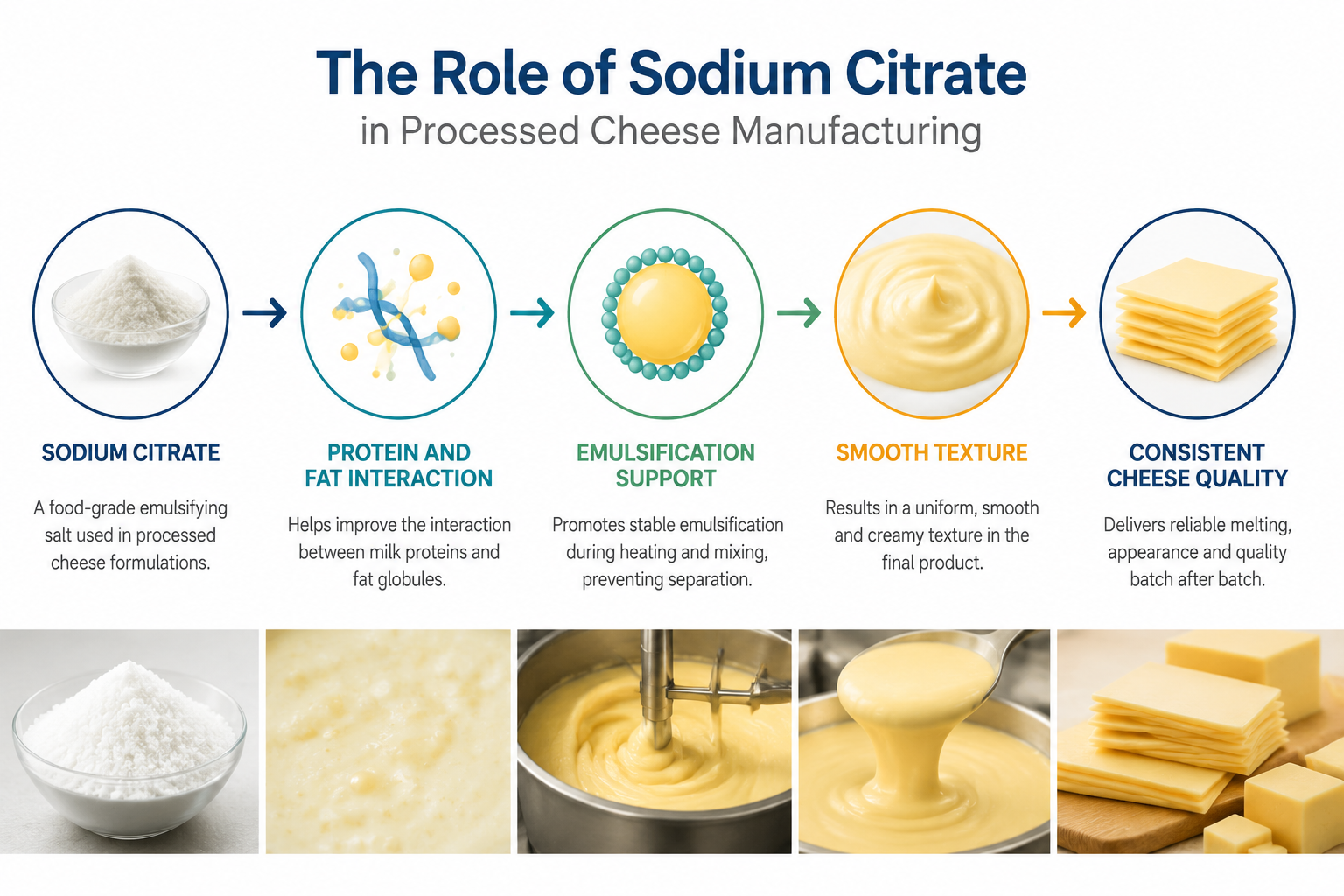
Sodium citrate is commonly used as an emulsifying salt in processed cheese production because it helps improve the interaction between dairy proteins and fat components. This allows manufacturers to develop cheese products with smoother texture, better uniformity, and more predictable processing performance.
Improving Emulsification and Texture Consistency
One of the primary functions of sodium citrate in cheese making is supporting the emulsification process.
Processed cheese formulations typically require a stable combination of water, fat, and protein. During heating and mixing, sodium citrate helps modify the behavior of casein proteins, allowing them to interact more effectively with fat components.
As a result, manufacturers can achieve:
- smoother product texture
- more uniform consistency
- improved processing characteristics
This is particularly important for products such as processed cheese slices, cheese spreads, and cheese sauces, where texture directly influences the manufacturing process and final product performance.
Supporting Melting and Heating Performance
Cheese products often undergo additional heating during production, packaging, or consumer preparation. Maintaining consistent melting characteristics is therefore an important consideration for manufacturers.
Sodium citrate helps create a more stable cheese structure that can perform consistently under different processing conditions. This makes it a valuable ingredient for cheese applications that require controlled melting behavior and a smooth appearance after heating.
For food manufacturers, consistent melting performance can help improve production reliability and maintain product quality across different batches.
Enhancing Production Consistency for Food Manufacturers
Beyond improving individual product characteristics, sodium citrate also supports more reliable cheese manufacturing processes.
Large-scale food production requires ingredients that deliver consistent results from batch to batch. Variations in raw materials, processing conditions, and formulation parameters can influence the final product, making ingredient selection an important part of quality control.
Using suitable food-grade sodium citrate allows manufacturers to better manage formulation performance and maintain consistent product standards throughout production.
Applications of Sodium Citrate in Different Dairy Products
While sodium citrate is widely recognized for its role in processed cheese production, its applications extend beyond traditional cheese products. In dairy manufacturing, sodium citrate can be used in different formulations where manufacturers need better control over texture, stability, and processing performance.
The specific role of sodium citrate depends on the product formulation, processing conditions, and desired product characteristics. Below are some common dairy applications where sodium citrate provides functional value.
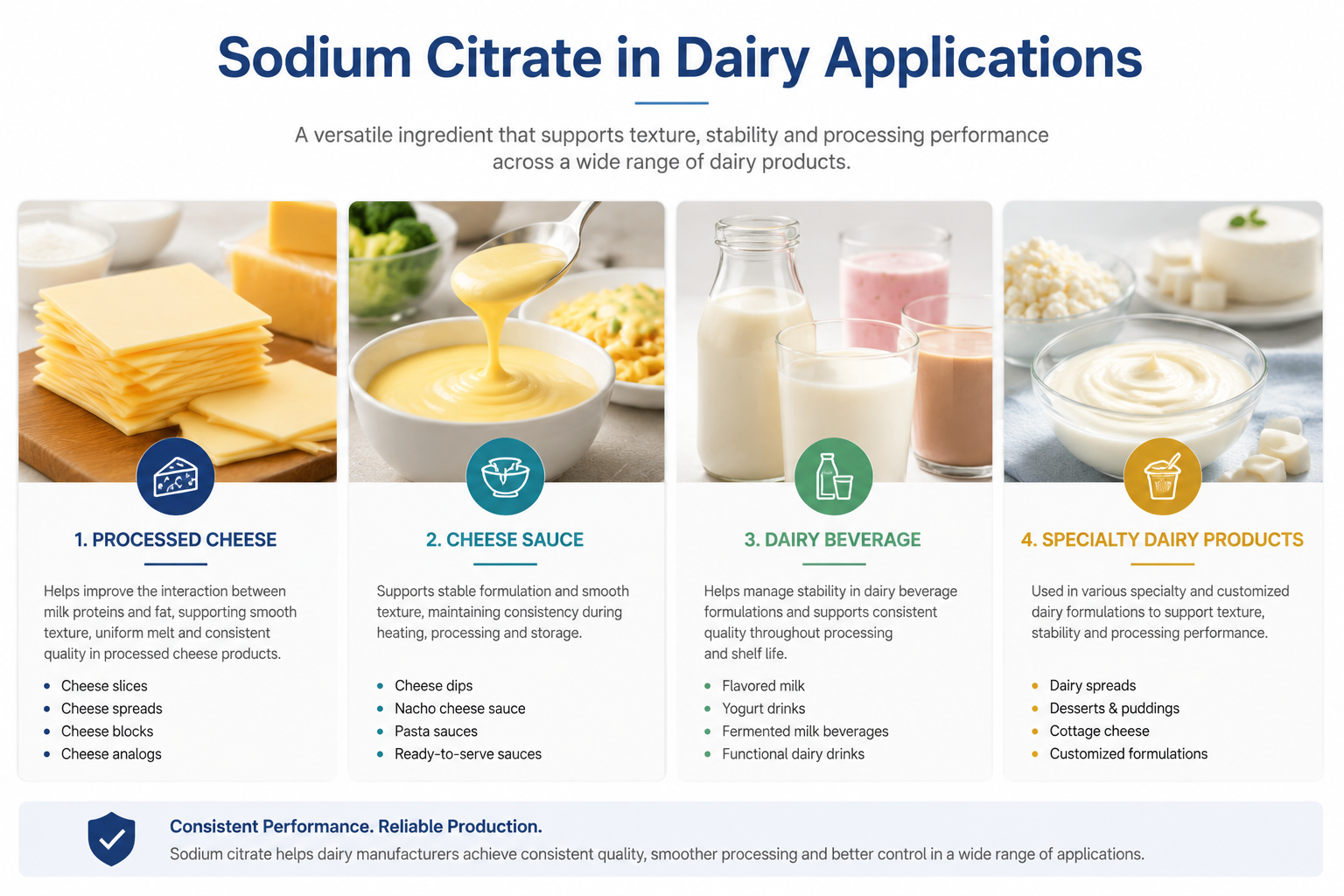
1. Processed Cheese Products
Processed cheese is one of the most established applications of sodium citrate in dairy manufacturing.
During production, manufacturers need to create a stable system where milk proteins, fat, and water remain evenly distributed. Sodium citrate helps support this structure by functioning as an emulsifying salt, allowing processed cheese products to achieve a smooth texture and consistent appearance.
Common applications include:
- Cheese slices
- Cheese spreads
- Cheese sauces
- Processed cheese blocks
For manufacturers, the use of sodium citrate helps achieve predictable processing behavior, especially during heating and mixing stages.
2. Cheese-Based Sauces and Dairy Formulations
Cheese sauces require a smooth and stable texture that can maintain consistency during processing, storage, and reheating.
Sodium citrate can support these formulations by helping maintain the interaction between dairy components. This makes it useful in applications where manufacturers need:
- uniform texture
- stable formulation performance
- consistent appearance after heating
For commercial food production, these characteristics are important because cheese sauces are often produced at large scale and must maintain quality throughout distribution.
3. Dairy Beverages and Liquid Dairy Products
Some dairy beverage formulations require careful control of stability due to the interaction between proteins, minerals, and other ingredients.
In these applications, sodium citrate may be used as part of the formulation strategy to support processing stability and maintain product consistency.
Depending on the specific recipe and processing requirements, manufacturers evaluate sodium citrate together with other ingredients to achieve the desired product performance.
4. Other Dairy-Based Food Applications
Beyond cheese and dairy beverages, sodium citrate may also be considered in other dairy-based formulations where manufacturers need functional ingredients that support processing control.
Examples may include:
- Dairy-based sauces
- Specialty dairy products
- Customized food formulations
In each application, the appropriate ingredient selection depends on factors such as formulation requirements, processing conditions, and product specifications.
Dairy Application Overview
| Dairy Application | Main Function of Sodium Citrate | Manufacturing Benefit |
|---|---|---|
| Processed cheese | Supports emulsification and protein-fat interaction | Smooth texture and consistency |
| Cheese sauces | Helps maintain formulation stability | Uniform appearance and processing performance |
| Dairy beverages | Supports formulation control | Improved stability during processing |
| Other dairy products | Provides functional support | More predictable manufacturing results |
Key Benefits of Using Food Grade Sodium Citrate in Dairy Processing
For dairy manufacturers, selecting an ingredient is not only about its basic function. The performance of an ingredient throughout the production process is equally important, especially in large-scale food manufacturing where consistency and reliability directly affect final product quality.
Food grade sodium citrate is widely selected for dairy applications because it provides predictable functional performance and supports stable manufacturing processes. By choosing a suitable sodium citrate ingredient, manufacturers can better manage formulation requirements and maintain consistent production results.
1. Consistent Processing Performance
One of the key advantages of using food grade sodium citrate in dairy processing is its ability to provide reliable performance across different production batches.
Dairy formulations can be affected by many variables, including raw material differences, processing conditions, and formulation adjustments. A consistent ingredient helps manufacturers reduce variations and maintain stable product characteristics.
For applications such as processed cheese and cheese sauces, consistent performance is especially important because small changes in formulation can influence:
- texture
- melting behavior
- product appearance
- processing efficiency
Using a reliable sodium citrate ingredient helps manufacturers achieve more predictable results during production.
2. Better Control Over Product Formulation
Every dairy product has specific formulation requirements. Manufacturers need ingredients that can work effectively within their production systems and support the desired product characteristics.
Sodium citrate provides functional support in dairy formulations by helping manufacturers manage the interaction between different components, including proteins, fats, and water.
This allows food processors to develop products with more controlled characteristics while maintaining flexibility during formulation development.
For example, manufacturers producing processed cheese products may adjust ingredient ratios and processing parameters depending on the desired texture and application. Sodium citrate can be an important part of this formulation strategy.
3. Supporting Efficient Dairy Manufacturing
Large-scale dairy production requires ingredients that can integrate smoothly into existing manufacturing processes.
A suitable sodium citrate ingredient can support efficient production by providing:
- predictable processing behavior
- compatibility with different dairy formulations
- consistent quality between batches
For manufacturers, ingredient reliability is an important factor because it helps reduce production uncertainty and supports long-term product consistency.
4. Meeting Food Manufacturing Quality Requirements
When sourcing sodium citrate for dairy applications, manufacturers typically consider more than just functional performance.
Important factors may include:
- food-grade compliance
- consistent product specifications
- quality documentation
- reliable supply capability
These considerations help ensure that the selected ingredient can meet the requirements of professional food production environments.
How Dairy Manufacturers Select Sodium Citrate Suppliers
Choosing the right sodium citrate supplier is an important part of maintaining consistent dairy production. While the functional performance of sodium citrate is a key consideration, manufacturers also need to evaluate supplier reliability, product quality, and documentation support.
For dairy processors, a reliable ingredient partner should not only provide a suitable product but also support long-term production requirements through consistent supply and quality control.
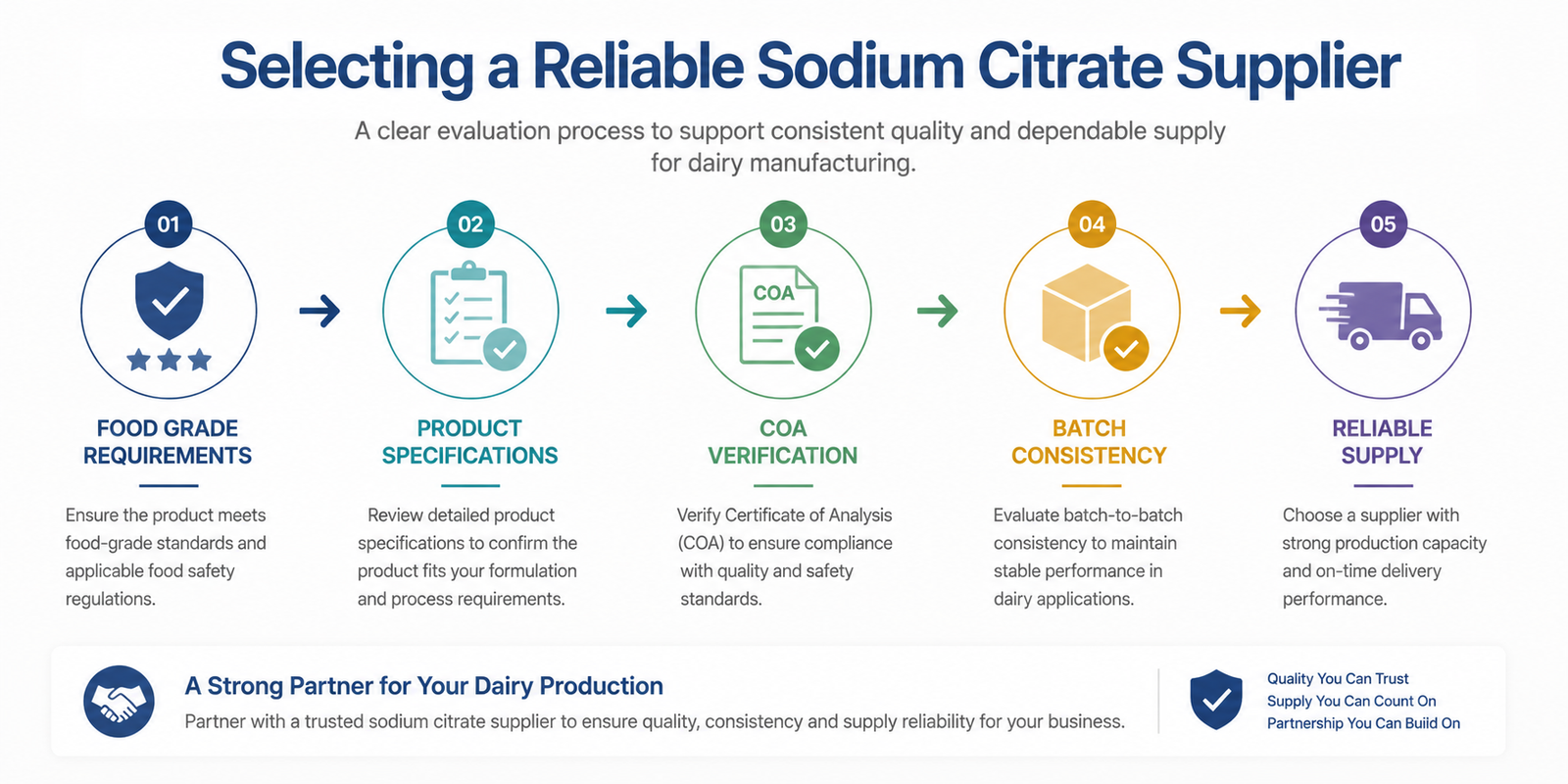
When evaluating a sodium citrate supplier for dairy applications, manufacturers commonly consider several important factors.
1. Food Grade Quality and Product Compliance
The first consideration for dairy manufacturers is whether the sodium citrate meets the required food manufacturing standards.
A professional food ingredient supplier should provide clear product information, including:
- Product specifications
- Quality documentation
- Certificate of Analysis (COA)
- Batch-related quality records
These documents help manufacturers verify product consistency and ensure that the ingredient meets their internal quality requirements.
For dairy applications, maintaining reliable ingredient quality is especially important because formulation performance depends on consistent raw material characteristics.
2. Consistent Batch Quality
Consistency is one of the most important factors when selecting a sodium citrate supplier.
Even when products meet basic specifications, variations between batches may affect formulation performance during large-scale manufacturing.
A reliable supplier should have effective quality control processes to monitor:
- Raw material selection
- Production processes
- Product testing
- Batch consistency
For dairy manufacturers, stable ingredient performance helps reduce production fluctuations and supports consistent final products.
3. Technical Support and Supply Reliability
Beyond product quality, manufacturers often look for suppliers who can provide dependable support throughout the purchasing process.
This may include:
- Clear technical information
- Responsive communication
- Stable supply capability
- Support with product documentation
For companies producing dairy products at commercial scale, a reliable supply relationship can help improve operational efficiency and reduce unexpected challenges.
Selecting the Right Sodium Citrate Partner for Dairy Applications
Sodium citrate plays an important role in dairy manufacturing, especially in applications where texture control, formulation stability, and processing consistency are required.
However, achieving reliable results depends not only on the ingredient itself but also on selecting a supplier that can provide consistent quality and professional support.
Manufacturers evaluating sodium citrate suppliers should consider product quality, documentation availability, batch consistency, and supply reliability as part of their decision-making process.
Frequently Asked Questions About Sodium Citrate in Dairy Applications
1. Why is sodium citrate used in processed cheese?
Sodium citrate is commonly used in processed cheese as an emulsifying salt. It helps improve the interaction between milk proteins, fat, and water, supporting a smoother texture and more consistent product structure.
For cheese manufacturers, sodium citrate can help improve processing performance, especially during heating and mixing stages where stable formulation control is important.
2. What is the function of sodium citrate in dairy processing?
In dairy applications, sodium citrate is mainly used to support emulsification, formulation stability, and processing consistency.
Depending on the product type, sodium citrate can help manufacturers achieve more predictable results in products such as processed cheese, cheese sauces, and other dairy-based formulations.
3. What should manufacturers consider when selecting a sodium citrate supplier?
When choosing a sodium citrate supplier, dairy manufacturers should consider factors such as food-grade quality, product specifications, COA availability, batch consistency, and supply reliability.
A reliable supplier should provide consistent product quality and clear documentation to support long-term food manufacturing requirements.
Conclusion
Sodium citrate is an important functional ingredient in dairy manufacturing, particularly in applications where texture control, formulation stability, and consistent processing performance are required.
From processed cheese to other dairy formulations, sodium citrate helps manufacturers achieve reliable production results when used as part of a well-designed formulation system.
For dairy manufacturers, selecting the right sodium citrate ingredient and supplier is essential to maintaining consistent quality and meeting production requirements.