



- Your cart is empty Browse Shop
Sodium Citrate in Dairy Processing: Role, Cheese Applications and Formulation Considerations

Introduction
In dairy manufacturing, maintaining consistent texture, stability, and processing performance is often one of the key challenges for producers. Ingredients that work well at the formulation level can directly influence the quality and consistency of the final product.
Sodium citrate is widely used in dairy processing, especially in cheese manufacturing, due to its ability to support emulsification, improve texture stability, and help manufacturers achieve more consistent processing results.
Unlike ingredients that are mainly used for flavor adjustment, sodium citrate plays a functional role during production. It helps manage the interaction between fat, protein, and water components, making it particularly valuable in processed cheese products and other dairy formulations.
For dairy manufacturers, selecting the right sodium citrate is not only about choosing a food additive that meets basic requirements. Factors such as product specifications, quality documentation, and supply consistency are also important when evaluating a long-term ingredient partner.
This article explores the role of sodium citrate in dairy processing, its applications in cheese production, and key considerations when selecting a suitable food-grade sodium citrate for manufacturing needs.
Why Is Sodium Citrate Used in Dairy Processing?
Supporting Texture and Processing Stability
One of the main reasons sodium citrate is used in dairy processing is its ability to support product texture and stability during manufacturing.
Dairy products, especially processed cheese, contain complex structures of proteins, fats, and water. During heating and processing, maintaining a stable structure can be challenging. Sodium citrate helps improve the interaction between these components, allowing manufacturers to achieve a smoother and more uniform product texture.
For processed dairy applications, this functional role can help improve:
- texture consistency between batches
- product smoothness
- processing stability
- overall formulation performance
This is why sodium citrate is commonly considered an important functional ingredient in cheese-related manufacturing.
Improving Emulsification Performance
In cheese production, controlling the relationship between fat and water is critical.
During processing, fat separation and uneven texture can affect the final product quality. Sodium citrate works as an emulsifying salt, helping maintain a more stable distribution of fat and protein components throughout the product.
This is especially important for products such as:
- processed cheese
- cheese sauces
- cheese spreads
By supporting emulsification, sodium citrate helps manufacturers create products with consistent melting behavior and smoother texture characteristics.
Helping Maintain Formulation Consistency
For large-scale food production, consistency is often as important as the ingredient itself.
Dairy manufacturers need ingredients that perform reliably across different production batches. Variations in ingredient quality, solubility, or specifications may influence processing results.
Food-grade sodium citrate with stable specifications can help manufacturers maintain better control over:
- production processes
- product uniformity
- quality expectations
Therefore, when sourcing sodium citrate, manufacturers usually consider not only functionality but also factors such as purity, documentation, and batch-to-batch consistency.
Sodium Citrate Applications in Cheese Manufacturing
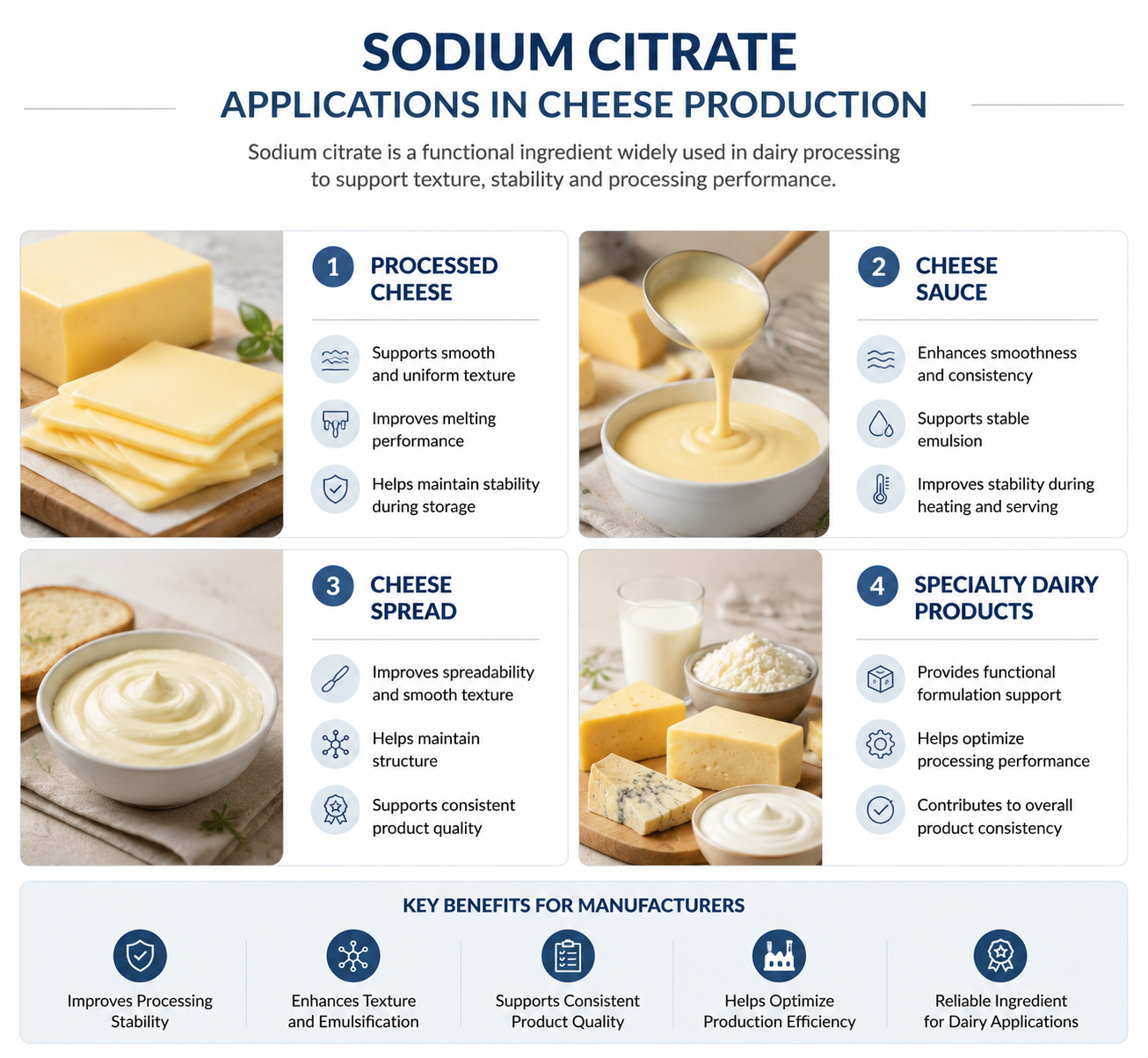
Among different dairy applications, cheese manufacturing is one of the most common areas where sodium citrate is used. Especially in processed cheese production, manufacturers rely on sodium citrate as a functional ingredient to improve texture, stability, and processing performance.
Cheese products contain a complex combination of milk proteins, fats, and water. During heating and mixing, maintaining a stable structure is essential for achieving the desired product characteristics.
Sodium citrate helps manufacturers manage these challenges by supporting emulsification and improving the interaction between different components within the cheese system.
The specific application depends on the type of cheese product and the required processing performance.
Sodium Citrate in Processed Cheese Production
Processed cheese is one of the most recognized applications of sodium citrate in the dairy industry.
During production, natural cheese is heated and blended with other ingredients to create a smooth and consistent final product. However, heating can affect the original protein structure and may lead to issues such as uneven texture or fat separation.
Sodium citrate is added as an emulsifying salt to help stabilize the cheese matrix during processing.
Its functions in processed cheese production include:
- supporting a smooth and uniform texture
- improving melting characteristics
- helping maintain product stability during storage
- reducing separation between fat and water components
For manufacturers producing sliced cheese, cheese blocks, or processed cheese products, sodium citrate can be an important ingredient for achieving consistent quality across production batches.
Sodium Citrate in Cheese Sauces and Liquid Dairy Products
Cheese sauces require different processing considerations compared with solid cheese products.
Because these products contain a higher moisture content, manufacturers need to carefully control viscosity, texture, and stability throughout production and storage.
Sodium citrate can support cheese sauce formulations by helping create a stable emulsion between dairy components.
This can contribute to:
- smoother sauce texture
- more consistent viscosity
- improved stability during heating and serving
For large-scale food manufacturers, maintaining the same texture and appearance across different production batches is especially important. Functional ingredients such as sodium citrate help provide greater control over these processing requirements.
Sodium Citrate in Cheese Spreads and Specialty Dairy Products
Beyond processed cheese and cheese sauces, sodium citrate is also used in various spreadable and specialty dairy formulations.
Products such as cheese spreads require specific texture characteristics, including:
- easy spreading ability
- smooth mouthfeel
- stable structure
In these applications, sodium citrate can help manufacturers balance texture requirements with processing conditions.
The amount and usage level depend on factors such as:
- cheese formulation
- moisture content
- processing temperature
- desired final texture
Therefore, manufacturers usually evaluate sodium citrate together with other formulation components rather than considering it as an isolated ingredient.
Common Dairy Applications of Sodium Citrate
| Dairy Application | Main Processing Role |
|---|---|
| Processed Cheese | Supports emulsification and texture consistency |
| Cheese Sauces | Helps maintain smooth texture and stability |
| Cheese Spreads | Supports spreadability and formulation balance |
| Specialty Dairy Products | Provides functional support during processing |
For dairy manufacturers, the value of sodium citrate is not simply its presence in the formulation, but how effectively it performs under specific processing conditions. Selecting the appropriate grade and specification is an important step in achieving reliable production results.
How Sodium Citrate Works as an Emulsifying Salt in Dairy Processing
In dairy processing, especially cheese manufacturing, achieving a stable and consistent texture requires careful control of the interaction between milk proteins, fat, and water.
This is where sodium citrate plays an important functional role. As an emulsifying salt, sodium citrate helps modify the structure of cheese during processing, allowing manufacturers to create smoother and more stable dairy products.
Understanding how sodium citrate works can help food manufacturers better evaluate its role in different formulations.
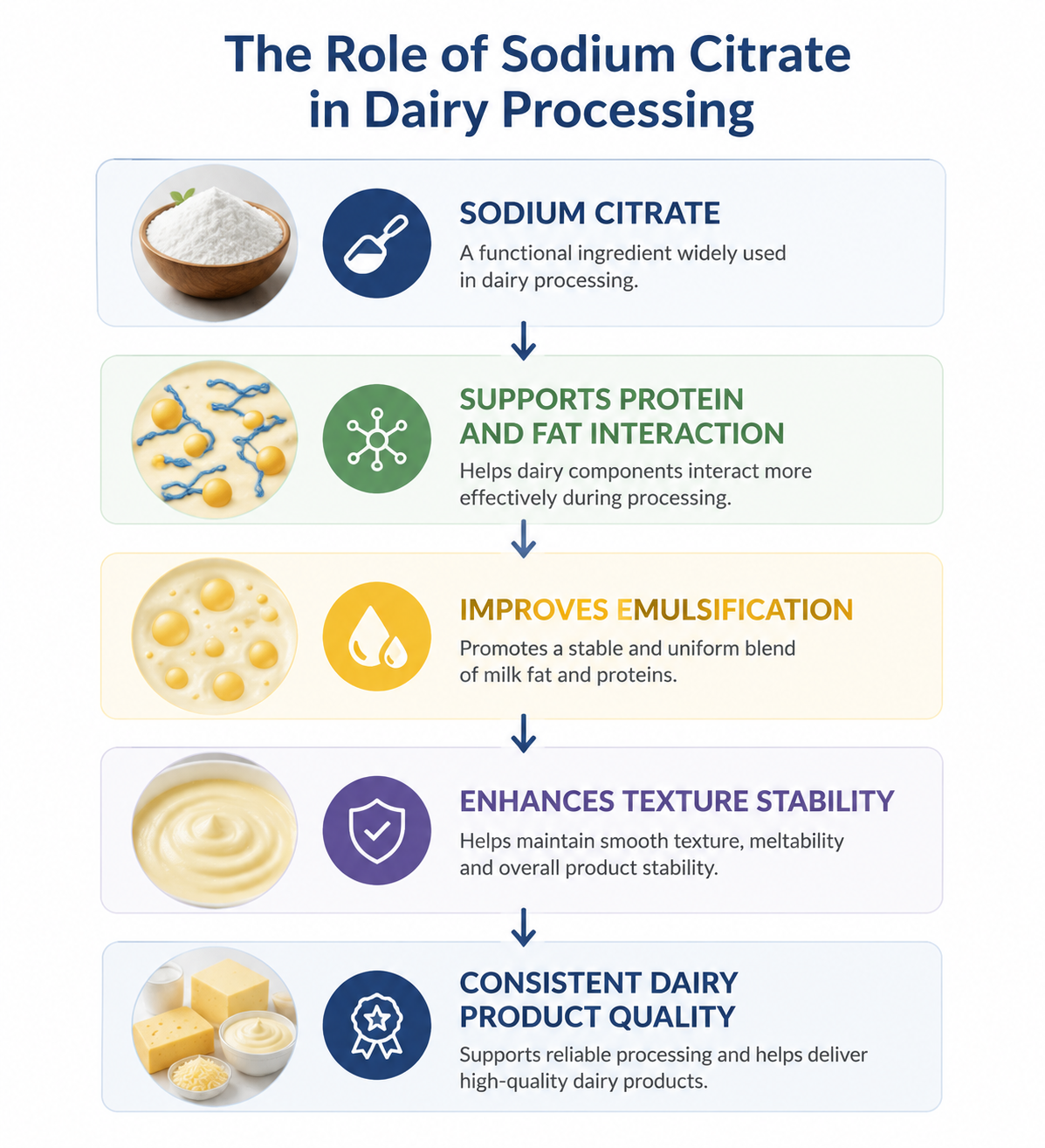
Supporting Protein and Fat Interaction
Cheese products are naturally complex systems that contain protein networks, fat components, and moisture.
During heating and processing, these components can behave differently. Without proper control, manufacturers may experience challenges such as:
- uneven texture
- oil separation
- inconsistent melting behavior
Sodium citrate helps improve the interaction between casein proteins and fat components, creating a more uniform structure throughout the product.
This function is particularly valuable in processed cheese applications, where manufacturers need a smooth texture and stable product performance after heating.
Improving Melting and Texture Characteristics
For many cheese products, melting behavior is an important quality factor.
Processed cheese, cheese sauces, and similar dairy products often require a balance between firmness, smoothness, and meltability.
By supporting the cheese matrix during processing, sodium citrate can help manufacturers achieve:
- smoother melting performance
- improved texture uniformity
- better consistency during production
However, the final product characteristics depend on multiple factors, including the cheese base, formulation design, processing conditions, and ingredient ratios.
Sodium citrate works as part of the overall formulation system rather than acting as a standalone solution.
Supporting Stable Dairy Formulations
Large-scale dairy production requires consistent results across different production cycles.
Small variations in processing conditions or ingredient performance may influence the final product quality. Therefore, manufacturers often focus on maintaining reliable formulation control.
When used appropriately, sodium citrate can support:
- stable processing performance
- consistent product structure
- predictable manufacturing results
This is one reason why food producers typically evaluate sodium citrate together with factors such as ingredient specifications, quality documentation, and supplier reliability.
Why Food Manufacturers Evaluate Sodium Citrate Quality
Although sodium citrate provides important functional properties, the performance of the ingredient also depends on its quality characteristics.
For industrial dairy applications, manufacturers usually consider factors such as:
- purity level
- moisture content
- solubility
- consistency between batches
- compliance with food-grade requirements
A stable and well-documented sodium citrate supply helps manufacturers reduce formulation uncertainty and maintain reliable production standards.
For this reason, selecting the right sodium citrate supplier is an important part of dairy ingredient sourcing.
Factors to Consider When Selecting Sodium Citrate for Dairy Processing
For dairy manufacturers, choosing sodium citrate is not only about finding an ingredient with the right functional properties. The quality, specifications, and consistency of the ingredient can directly influence processing performance and final product quality.
Different dairy applications may have different requirements. A sodium citrate grade suitable for one formulation may not always meet the needs of another production process.
Therefore, manufacturers usually evaluate several key factors before selecting a sodium citrate supplier.
Food Grade Requirements and Quality Standards
The first consideration for dairy applications is whether the sodium citrate meets relevant food-grade requirements.
Food manufacturers typically evaluate:
- product purity
- appearance and physical characteristics
- compliance with food ingredient standards
- quality control documentation
A reliable food-grade sodium citrate product should have clear specifications and supporting documentation to help manufacturers verify ingredient quality before use.
For industrial dairy production, transparency in quality information is especially important because ingredient consistency affects not only formulation performance but also production efficiency.
Product Specifications and Processing Compatibility
Sodium citrate specifications can influence how effectively the ingredient performs during dairy processing.
Important characteristics manufacturers may review include:
Purity
Purity levels can affect formulation reliability and overall ingredient performance.
Moisture Content
Moisture content may influence storage stability, handling properties, and processing consistency.
Solubility and Physical Properties
Good solubility is important for efficient incorporation into dairy formulations, especially in products requiring uniform mixing.
Particle Size
Particle size can affect dissolution speed and handling during production.
For this reason, dairy manufacturers often compare product specifications carefully rather than selecting ingredients based only on price.
Quality Documentation and Batch Consistency
In large-scale food manufacturing, consistent supply is essential.
A supplier should be able to provide relevant quality documents, such as:
- Certificate of Analysis (COA)
- product specification sheet
- quality certificates
- batch information
These documents help manufacturers verify that each batch meets the expected requirements.
Beyond documentation, batch-to-batch consistency is also an important factor. Even small variations in ingredient characteristics may affect processing results when production volumes are large.
Supply Reliability and Supplier Support
For dairy manufacturers, ingredient sourcing is part of long-term production planning.
A reliable sodium citrate supplier should provide:
- stable product availability
- consistent quality control
- clear communication
- professional technical support
Working with a dependable supplier can help manufacturers reduce unexpected production issues and maintain smoother supply chain operations.
When evaluating suppliers, companies usually consider both the product itself and the supplier’s ability to support long-term cooperation.
For dairy processing applications, the best sodium citrate choice is usually based on a combination of functionality, quality standards, documentation, and supply reliability.
Sodium Citrate vs Other Dairy Processing Ingredients: Understanding the Differences
In dairy manufacturing, selecting the right ingredient depends largely on the specific function required during processing.
Although different food ingredients may share some similar characteristics, they often serve different purposes in a formulation. For example, sodium citrate and citric acid are both citrate-based ingredients, but their roles in dairy processing are not the same.
Understanding these differences helps manufacturers make better decisions when developing dairy products and optimizing production processes.
Sodium Citrate: Focused on Texture and Emulsification Support
Sodium citrate is mainly valued in dairy processing for its functional role as an emulsifying salt.
Its primary purpose is to help improve the interaction between dairy components, particularly in products where manufacturers need:
- smooth texture
- stable emulsion
- consistent melting characteristics
- reliable processing performance
This makes sodium citrate especially suitable for applications such as:
- processed cheese
- cheese sauces
- cheese spreads
In these applications, manufacturers are usually focused on controlling texture and maintaining product stability during heating and storage.
Citric Acid: Mainly Used for Acidity Adjustment
Compared with sodium citrate, citric acid is more commonly associated with acidity regulation.
In food manufacturing, citric acid is often used to:
- adjust pH levels
- provide tartness
- support formulation balance
- improve certain product characteristics
However, in dairy processing, its role is generally different from sodium citrate.
While citric acid can influence acidity, sodium citrate is typically selected when manufacturers need stronger control over emulsification and texture-related properties.
For a deeper sodium citrate vs citric acid comparison, manufacturers can review the differences in functionality, applications, and ingredient selection.
Choosing the Right Ingredient Based on Processing Goals
The best ingredient choice depends on the desired outcome of the final product.
| Processing Goal | Common Ingredient Consideration |
|---|---|
| Improve cheese texture and melting properties | Sodium Citrate |
| Support emulsification in processed dairy products | Sodium Citrate |
| Adjust acidity level | Citric Acid |
| Control pH balance in specific formulations | Citric Acid |
Rather than viewing these ingredients as direct substitutes, food manufacturers usually select them based on the technical requirements of each formulation.
Why Ingredient Selection Matters in Dairy Manufacturing
For industrial food production, ingredient selection affects more than just the formulation stage.
The right ingredient choice can influence:
- production efficiency
- product consistency
- processing stability
- overall quality control
Therefore, manufacturers need to evaluate both ingredient functionality and supplier capabilities when developing dairy products.
Understanding the specific role of each ingredient helps companies create more reliable formulations and avoid unnecessary adjustments during production.
Choosing a Reliable Sodium Citrate Supplier for Dairy Manufacturing
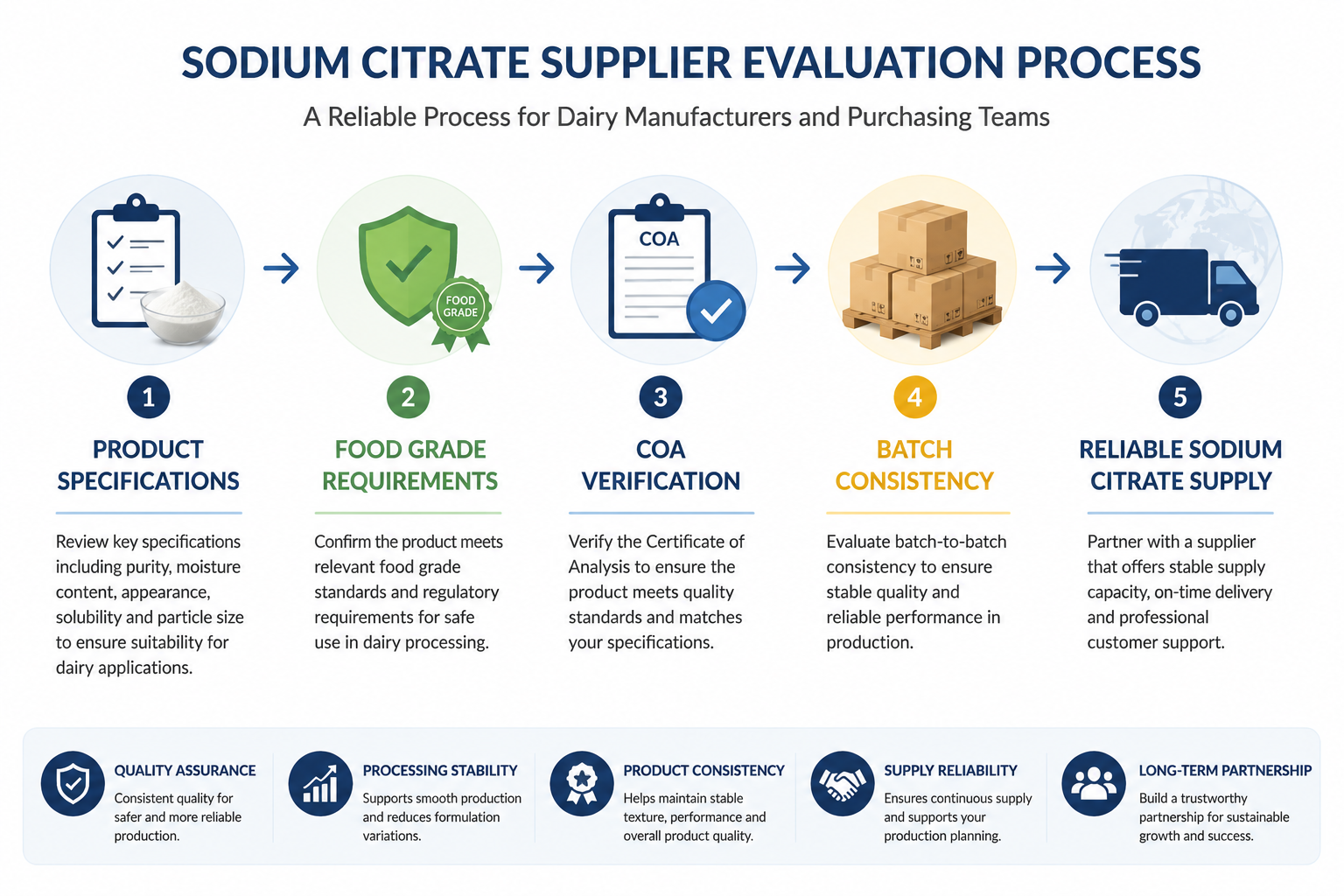
For dairy manufacturers, sourcing sodium citrate is not only a purchasing decision but also an important part of maintaining stable production.
A reliable sodium citrate supplier should provide consistent product quality, clear documentation, and dependable supply support.These factors become especially important for companies producing dairy products at commercial scale, where ingredient variations can affect processing efficiency and product consistency.
Key Factors When Evaluating a Sodium Citrate Supplier
When selecting a sodium citrate supplier, manufacturers typically consider several important factors:
Consistent Product Quality
A dependable supplier should maintain stable product specifications across different batches.
Consistency in areas such as purity, physical properties, and processing performance helps manufacturers reduce formulation adjustments and maintain reliable production results.
Complete Quality Documentation
Professional food ingredient suppliers should provide supporting documents, including:
- Certificate of Analysis (COA)
- Product specifications
- Quality certifications
- Batch-related information
These documents allow manufacturers to verify ingredient quality and ensure compliance with production requirements.
Stable Supply Capability
For food manufacturers, supply reliability is essential.
A supplier with strong production capability and efficient logistics support can help companies maintain continuous production schedules and avoid unnecessary supply disruptions.
Building Long-Term Partnerships in Food Ingredient Supply
Beyond product quality, communication and technical support also play an important role in supplier selection.
A professional ingredient supplier should understand the requirements of different applications and provide clear information about product specifications, documentation, and supply arrangements.
For dairy manufacturers using sodium citrate in cheese processing and other formulations, choosing the right supplier can contribute to more stable production and long-term operational efficiency.
Conclusion
Sodium citrate plays an important functional role in dairy processing, particularly in cheese manufacturing where texture stability, emulsification, and processing consistency are critical.
From processed cheese and cheese sauces to specialty dairy products, sodium citrate helps manufacturers achieve more reliable formulation performance.
However, successful application depends not only on the ingredient itself but also on selecting the appropriate grade, specifications, and supply partner.
By evaluating product quality, documentation, and supplier reliability, dairy manufacturers can make more informed decisions when sourcing sodium citrate for their production needs.